

Buying backlinks in 2026 is not simply about finding the cheapest place to buy backlinks. Thes best backlink providers make it easier to buy quality backlinks by giving you access to real publishers, transparent traffic data, relevant websites, and clear link placement and retention policies. Whether you want to buy SEO backlinks, buy high-quality backlinks, or buy backlinks online at a lower price, the quality and relevance of the referring website should matter more than the price of the link. A reliable provider should also be transparent about replacement policies and the risks associated with paid backlinks.
Quick answer: For premium, managed editorial placements, Editorial.Link is the strongest option on this list. For self-service control at a wide range of prices, INSERT.LINK, PressWhizz, Collaborator and Adsy are the marketplaces you can shortlist. For tight budgets, Legiit and LinksManagement offer the lowest entry prices, but they need the most vetting from you. A relevant link on a site with real organic traffic is worth more than several links on sites that exist to sell links.
Two things you should know before spending anything:
- Google’s position. Google’s spam policies list buying or selling links for ranking purposes as link spam. The same policy says paid links used for advertising or sponsorship are acceptable when they carry
rel="sponsored"orrel="nofollow". A paid link that passes ranking credit sits on the wrong side of that line, and nobody can sell you a guarantee otherwise. You can read the wording in Google’s spam policies. - How this comparison was built. The provider reviews below draw on each provider’s published services, public pricing, stated guarantees and independent marketplace data. Where a price or policy changes by publisher or can’t be confirmed reliably, I say so instead of guessing. Pricing in this guide was last reviewed in October 2026, so confirm any figure at checkout before you order.
Disclosure: Webseotrends also sells manual link building services, which is a potential conflict of interest. Our service isn’t ranked in this comparison.
Best Places to Buy Backlinks in 2026
These backlink providers below fall mainly into four groups: managed services where a team does outreach for you, self-service marketplaces where you pick the publisher, budget platforms with wide quality variation, and freelance sites where you hire a person instead of buying from a catalog. Each review covers who it suits, what are the pricing, and what could go wrong for you. Starting prices are the latest figures I could find and change often. Ratings are Webseotrends editorial scores based on publisher transparency, buyer control, guarantees and value for money, not hands-on purchase results.
Best Backlink Providers at a Glance
| Provider | Model | Best for | Pricing basis | Replacement or protection |
|---|---|---|---|---|
| Editorial.Link | Managed outreach | Premium editorial links for brands and agencies | Published from roughly $375 per link | Pre-approval of prospects; confirm retention terms |
| INSERT.LINK | Self-service marketplace | Choosing publishers by metrics and topic | Listed per publisher, from tens of dollars upward | Varies by listing; confirm before ordering |
| Legiit | Seller marketplace | Small budgets and one-off tasks | Set by each seller | Seller-dependent |
| Adsy | Self-service marketplace | Hand-picking publishers and anchors | Publisher-set | Limited; read refund terms |
| WhitePress | International marketplace | Multi-country and multilingual campaigns | Publisher-set | Link monitoring on many placements; confirm terms |
| Link Publishers | Self-service marketplace | Scaling across niches | Marketplace pricing by publisher | Confirm before ordering |
| PressWhizz | Marketplace | Fast delivery with replacement cover | Publisher-set | Reported 12-month replacement policy |
| Collaborator | Marketplace | Buyers who want built-in link insurance | Publisher-set, plus platform fees | Free three-month guarantee; one-year option |
| LinksManagement | Subscription and one-time links | Low-cost experimentation | Entry prices under $1 per month at the low end | Monitoring and replacement on some plans |
| LinksThatRank | Managed guest posts | Strict screening on competitive niches | Tiered by DR | Reported 12-month replacement |
| The HOTH | Agency | Link building bundled with wider SEO | Varies by service | Campaign-based |
| Stan Ventures | Agency outreach | Human-led outreach | Quote-based | Campaign-based |
| Authority Builders | Curated marketplace | High-authority guest posts | Tiered by authority | Confirm before ordering |
| Loganix | Agency and brokerage | Agencies needing reporting | Varies by product | Delivery-based |
| Backlinks.com | Subscription marketplace | Monthly link rental | Monthly fees by site | Automated monitoring |
| Fiverr | Freelance marketplace | Supporting links and experiments | Set by each seller | Seller-dependent |
| Upwork | Freelance marketplace | Hiring a link builder | Hourly or project | Contract-based |
| OutreachZ | Managed guest posting | Managed placements in several niches | Quote-based or publisher-set | Confirm before ordering |
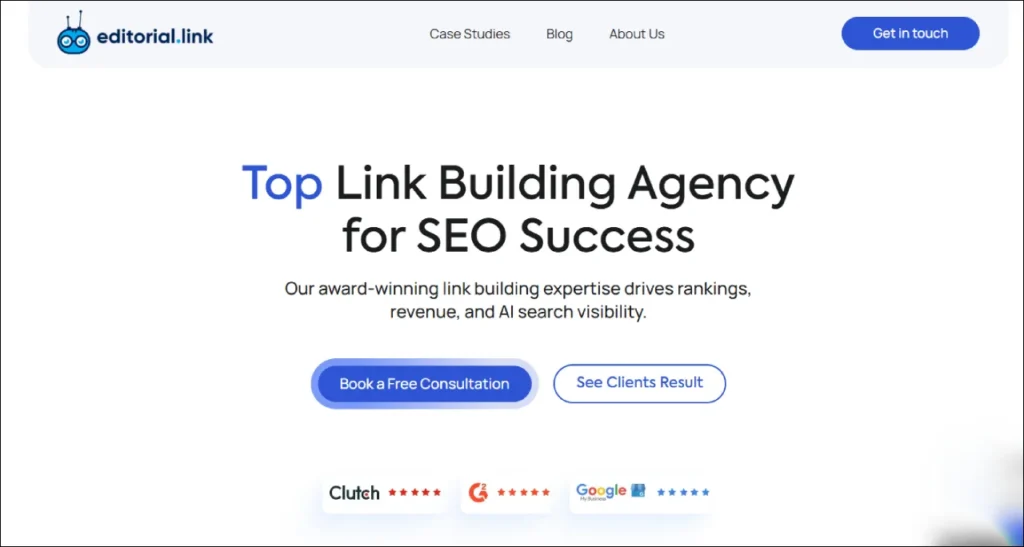
1. Editorial.Link — Best for Premium Editorial Backlinks
- Starting price: From $375 per link. Managed plans from $1,500/month
- Best for: Agencies, established brands, serious SEO professionals
- Rating: 4.8 / 5
Editorial.Link is a managed link building agency, which makes it a different kind of purchase from a marketplace. You brief the team on your target pages, goals and current profile, and they handle outreach, content creation and placement. If you want to buy backlinks without spending your own time browsing publisher catalogs, this is the model that removes most of the work. It suits brands and agencies that would rather pay for a vetted result than manage dozens of orders themselves.
Why Choose Editorial.Link?
The main advantage is process control. Independent roundups describe a manual outreach approach and a pre-approval step, where you see the proposed publisher before any content is written. That step addresses the biggest risk in link buying: discovering after payment that your link sits on a weak or irrelevant site. The service also offers digital PR, which can earn mentions on publications that marketplaces rarely list. Agencies value the consistency, because a repeatable managed process is easier to resell and report on than a pile of one-off marketplace orders. The trade-off is speed and flexibility. Campaigns are built around your goals, so expect weeks rather than days, and expect to invest time in the briefing stage.
Pricing and Backlink Quality
Published pricing starts at roughly $375 per link, with managed monthly plans costing considerably more. Treat that as an entry point rather than a fixed rate, because the final cost depends on the authority of the publisher and the competitiveness of your niche. At this price level you should be getting placements on genuine publications with real organic traffic, not domains with inflated metrics. Before you approve a prospect, check its traffic trend, recent articles and outbound links in your own SEO tool. Ask what the replacement policy is if a link is removed, and get that in writing. Compare the quote with the benchmark averages in the pricing section below so you know whether you are paying for editorial quality or just management margin.
Pros and Cons
Pros
- Pre-approval of publishers before you commit
- Manual outreach rather than bulk publisher lists
- Digital PR available alongside guest posting
- Consistent delivery that suits agency reporting
Cons
- Premium pricing puts it out of reach for small budgets
- Slower than marketplace purchases
- Publisher choice depends on the team unless you set strict criteria
- Not designed for cheap, high-volume orders
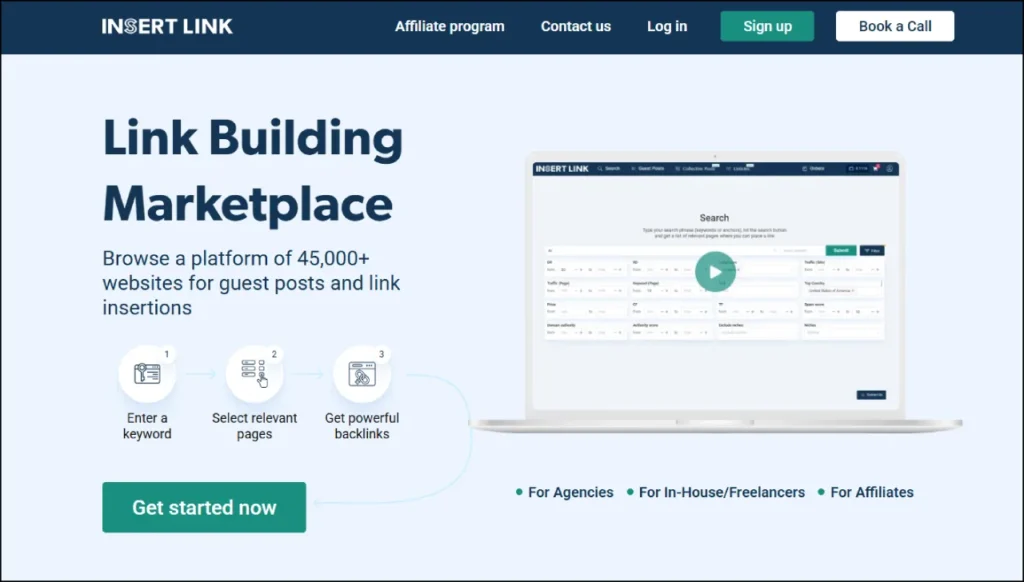
2. INSERT.LINK — Best Backlink Marketplace
- Starting price: From $30–$50 for niche sites. $1,000+ for top-tier media
- Best for: SEO professionals, agencies needing scale, experienced link buyers
- Rating: 4.6 / 5
INSERT.LINK is a self-service backlink marketplace for guest posts and link insertions. You search the catalog, compare publishers, and place the order yourself. For buyers who already know their strategy, it is one of the fastest ways to build a shortlist of relevant pages and turn it into live placements, because you keep control over relevance, anchor text and budget at every step.
Why Choose INSERT.LINK?
Marketplace buyers lose money when they cannot see what they are buying. INSERT.LINK shows metrics and prices up front and lets you filter by DR, traffic, country, language and niche. Independent reviews also highlight topic-based discovery, which surfaces sites by subject instead of simple keyword matching. That helps when you want a link insertion on a page that already discusses your topic. Country and language filters narrow results sharply, so the platform works well for geo-targeted campaigns, including campaigns where you need to buy backlinks in a specific market. There is no retainer, which suits variable budgets, such as a product launch or a short ranking push.
Pricing and Backlink Quality
Each listing carries its own fixed price. Reviews describe a range from roughly $30 for smaller niche sites to $1,000 or more for major media placements, and most useful campaigns sit in the middle. Quality varies because the catalog contains many independent publishers, so the marketplace gives you the data, not a guarantee. Open the actual page where your link would appear and read the surrounding article. Confirm traffic in your own tool rather than relying only on the displayed number. A sensible approach is to place a small first order of two or three links across different price tiers, then compare indexation speed, traffic and visible quality before scaling. Guarantee terms can differ by listing, so confirm them before payment.
Pros and Cons
Pros
- Metrics and prices visible before purchase
- Filters for niche, country, language and traffic
- Guest posts and link insertions in one place
- No retainer; you pay per placement
Cons
- Quality depends on the publishers you pick
- Less hand-holding than a managed service
- Premium media placements cost as much as managed services
- Inventory is thinner in some niches and countries
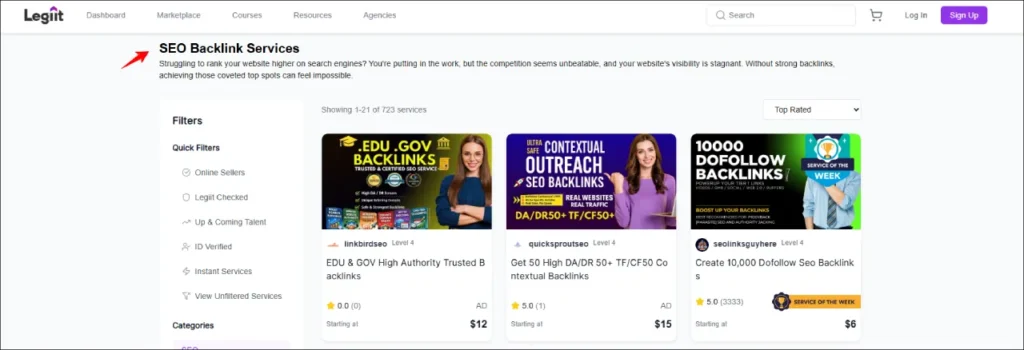
3. Legiit — Best for Affordable Backlinks
- Starting price: From $10. $100–$500 for premium guest posts and niche edits (varies by seller)
- Best for: Small businesses, freelancers, bloggers, agencies needing flexible pricing
- Rating: 4.5 / 5
Legiit is an SEO-focused freelance marketplace where independent sellers list backlink services. It is a practical place to find affordable backlinks and to test several sellers cheaply, but it is a seller marketplace, not a publisher marketplace. That distinction matters, because quality tracks the individual seller rather than the platform.
Finding Quality Backlinks on Legiit
Start with the seller, not the price. Sort by completed orders, review history and how specific the service description is. A strong listing names the type of link, the metrics of the sites involved, the delivery format and what is excluded. A weak listing promises “high DA links” with no examples. Message sellers before ordering and ask for sample live links from recent orders. Then check those samples yourself for organic traffic, topical relevance and unrelated sponsored content. Sellers who answer clearly and show real examples are usually the ones worth testing. Those who refuse to share samples, or dodge questions about where links appear, are not.
Pricing and Link Quality
Prices vary widely, from low-cost citations and supporting links to higher-priced guest posts and niche edits. Cheap listings can work as supporting links, but they rarely suit your most important commercial pages. If you want to buy high quality backlinks cheap here, test with a single order first and verify the result in your backlink tool before scaling up. Compare what you receive with similar placements elsewhere. If a $30 order gives you a link on a site with no traffic, the price was not low, it was wasted. Better value often comes from mid-range listings where the seller documents site metrics and replaces links that fail.
Before you place a larger order, run a simple two-step test. First, buy one low-cost link from three different sellers and compare what each delivers: the page, the traffic, the surrounding content and how quickly the link is indexed. Second, put the best seller on a repeat order and watch whether quality stays consistent. Sellers who deliver well once and decline afterwards are common on any freelance platform. Keep a spreadsheet of seller, price, URL, delivery date and result so you can see which listings actually earn a second order from you.
Pros and Cons
Pros
- Wide price range from small tests to larger orders
- Seller reviews and order history are visible
- SEO-specific categories make sellers easier to compare
- Low commitment for experiments
Cons
- Quality depends entirely on the seller
- Less transparency about publisher sites before purchase
- Top-end placements usually do not match managed editorial services
- Requires your own strategy and vetting
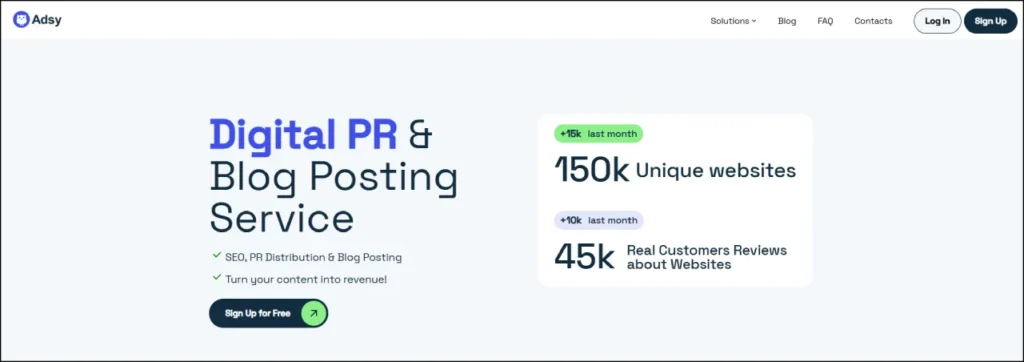
4. Adsy — Best for Publisher Selection
- Starting price: Publisher-set; varies by authority, link type and word count
- Best for: Content marketers and bloggers who want control over publisher, anchor text and placement
- Rating: 4.3 / 5
Adsy is a marketplace where you choose the publisher, the anchor and the content format yourself. It suits buyers who already know which pages they want to promote and which kinds of sites they would accept. If you prefer to control each placement instead of delegating to an agency, Adsy gives you the tools, though the research falls on you.
Publisher Quality and Relevance
Filters let you screen publishers by authority, traffic, category and spam indicators. Use them as a first pass only. A site that passes the filters can still publish unrelated sponsored articles, so open the site and read its recent posts. Completion history on a publisher’s profile is a useful reliability signal, because it shows whether orders actually get published and how often. A practical rule is to prefer publishers with a strong completion record and a low spam score, then confirm topic fit by reading the site. If most of its articles are unrelated guest posts, move on even when the metrics look attractive.
Pricing and Backlink Options
Each publisher sets its own price, so quality sites cost noticeably more than average ones. You can order new guest posts or link insertions into existing articles, and you control the anchor text. This makes Adsy useful for campaigns that follow a clear anchor plan. Refund terms are narrower than on platforms that advertise strong guarantees, so read them before you pay, particularly for orders where you commission the article. Budget for the content as well as the placement, because a poorly written article on a good site wastes the opportunity. Keep records of each order, including the URL, anchor, price and date, so you can follow up if a link changes.
A practical way to use Adsy is to build a shortlist first and buy second. Export or note ten candidate publishers, check each in your own SEO tool, read their recent articles, and drop anything that publishes unrelated sponsored posts. Then order from the best two or three. If you supply the article, make it genuinely useful to the host site’s readers, with the link placed where it adds context. Articles written purely around an anchor tend to read badly, and readers, publishers and search systems can all tell. Quality content on a decent site beats a perfect anchor on a weak one.
Pros and Cons
Pros
- Full control over publisher, anchor and format
- Large catalog with useful filters
- Guest posts and link insertions both available
- Works for international campaigns
Cons
- Prices vary and good sites cost more
- Finding strong placements takes research time
- Narrow refund protection
- No managed option if you want hands-off execution
5. WhitePress — Best for International SEO
- Starting price: Publisher-set; some placements reportedly start around $20, premium media costs far more
- Best for: Agencies and brands running multi-country or multilingual link building
- Rating: 4.4 / 5
WhitePress is a premier international content marketing platform that connects advertisers directly with over 140,000 vetted publisher websites across 30+ global markets. The platform stands out for integrating live Ahrefs, Majestic, and organic traffic metrics directly into its search filters, giving buyers full transparency before placing an order. Alongside direct guest posting and native content placement, it offers in-platform multilingual copywriting and automated 12-month link monitoring. For agencies and SEO teams running multi-language or high-volume campaigns, WhitePress® eliminates manual outreach friction while providing granular control over link selection.
Publisher Network and Website Quality
The platform brings third-party SEO metrics and traffic data into its filters, so you can compare publishers on more than one number. Local relevance matters more internationally than in English-language markets. A high-authority English site linking to a Spanish retail page adds little context, while a mid-sized local publication in the right language often adds more. Choose publishers whose audience matches the market you want to rank in. Check that traffic comes from the country you are targeting, and review recent content for quality, because catalog size says nothing about editorial standards.
Pricing and Link Options
Placement prices are set per publisher, so there is no single starting price to quote with confidence. Reported entry prices are low, while premium media outlets cost far more. The platform offers sponsored articles, link insertions and in-platform content creation, including multilingual writing. Cost differences between countries can be large, so build your budget market by market rather than assuming one rate. If you commission content through the platform, ask who writes it and whether native speakers review it. Poorly translated articles undermine both the link and your brand. Some placements include link monitoring, but confirm the duration and what counts as a failure before ordering.
For multi-country campaigns, plan the work market by market. Assign each country a budget, a list of target pages and a content language, then shortlist publishers locally rather than choosing one global list. Check how each publisher labels sponsored content, since disclosure rules and norms differ between countries. Also consider the target pages themselves: a link to an English page from a Spanish publisher sends mixed signals, so make sure the destination matches the audience. This preparation takes longer than clicking through filters, but it prevents the most common failure in international link buying, which is irrelevant geography.
Pros and Cons
Pros
- Broad coverage across many countries and languages
- Metrics integrated into search filters
- Content creation available in several languages
- Good for multi-market campaigns
Cons
- Pricing is publisher-set and varies widely
- The size of the catalog can overwhelm new buyers
- Quality differs between markets and publishers
- Better suited to experienced buyers than beginners
6. Link Publishers — Best for Scalable Link Building
- Starting price: Marketplace pricing based on publisher authority, traffic and niche; no fixed retainer
- Best for: Agencies, SaaS companies, SEO professionals needing scalable link building
- Rating: 4.8 / 5
Link Publishers is a self-service marketplace that covers guest posts, niche edits and related services across many niches. It is built for agencies and in-house teams that want to place several links a month without running outreach. The platform advertises a very large publisher base, and its dashboard approach suits teams that manage multiple campaigns.
Publisher Selection and Link Quality
You can filter publishers by authority, traffic, niche and geography before ordering. A bigger catalog does not mean better placements, so narrow the list aggressively and check each page. Start by choosing the topics that fit your product, then rank candidates by organic traffic and recent content quality, not just by DR. The platform’s recommendations can speed up discovery, but they should not replace your own checks. Verify traffic in your SEO tool, read recent articles, and count outbound links. If a page links out to many unrelated commercial sites, skip it regardless of how strong the headline metrics look.
Pricing and Scalability
Pricing follows publisher authority, traffic and niche competitiveness, and there are no fixed retainers. That makes it practical to scale gradually. Start with a handful of placements, check indexation and rankings after a few weeks, then increase volume if the results justify it. Faster turnaround on some orders is useful, but do not let speed push you into placing too many links in a short window. A steady monthly pace looks more natural than a burst. Agencies should also check what reporting and white-label options exist, because those affect how easily you can document work for clients. As with any marketplace, the final quality depends on how carefully you choose.
One useful habit with a large marketplace is to set strict rejection rules before browsing. For example, you might reject any site with fewer than a few hundred monthly organic visits, any site publishing in many unrelated categories, and any page carrying more outbound commercial links than you would tolerate on your own site. Written rules stop you from being swayed by attractive metrics or fast delivery. They also make it easier to hand the process to a team member without losing quality. Review the rules every quarter as you learn which placements perform.
Pros and Cons
Pros
- Self-service dashboard with no retainer
- Filters for authority, traffic, niche and country
- Additional services such as digital PR and content writing
- Suitable for agencies managing several clients
Cons
- Quality varies with publisher choice
- A large inventory can overwhelm new buyers
- Premium sites can be expensive
- Requires a clear link strategy to use well
7. PressWhizz — Best for Link Retention
- Starting price: From about $50, publisher-set; third-party reviews report averages of roughly $110–$165 per placement
- Best for: SEO professionals who want fast delivery and replacement cover
- Rating: 4.2 / 5
PressWhizz is a marketplace known for fast delivery and a replacement policy. Third-party reviews describe a catalog of roughly 37,000 curated sites across dozens of countries, with both guest posts and link insertions available. It appeals to buyers who have been burned by links that vanish a few months after purchase.
Link Quality and Placement
Link insertions can go live quickly, with reviewers reporting average turnaround under a day, while guest posts that include content creation take several days. Because insertions go into existing articles, they are often a good fit when you want a link on a page that is already indexed and attracting visits. That does not mean every insertion is a good one. Check how many outbound links the page already has, whether your link fits the paragraph naturally, and whether the article is still receiving organic traffic. A fresh guest post on a well-run site can also be strong when the content genuinely helps the publisher’s readers.
Retention and Replacement Policy
PressWhizz is reported to monitor placed links for 12 months and replace links that are removed or changed to nofollow. That is a meaningful safeguard, because link loss is one of the most common problems after purchase. Read the exact terms before you order. A replacement policy usually covers removal or attribute changes, but not a link that stays live while the site’s traffic collapses or Google devalues the domain. Keep your own record of each placement and check links at 30, 60 and 90 days so you notice problems early. Ask how long a replacement takes and whether the new link will have similar metrics.
If you use PressWhizz for link insertions, think about the page as well as the domain. A strong domain can host a page that gets no traffic, ranks for nothing and carries a dozen outbound links. Ask to see the specific URL, check whether it earns organic visits, and read the paragraph where the link would sit. Ideally the link supports a point the author is already making. When the fit is natural, the link is more likely to survive future edits, because the publisher has no reason to remove something that helps the article.
Pros and Cons
Pros
- Reported replacement policy for removed links
- Fast turnaround on link insertions
- Pay-per-link pricing without subscriptions
- Project tools useful for agencies running several sites
Cons
- Niche categories can be expensive
- Guest posts take longer than insertions
- Premium placements cost close to managed services
- Replacement terms do not cover every kind of loss
8. Collaborator — Best for Link Insurance
- Starting price: Publisher-set; platform fees apply
- Best for: Buyers who want built-in protection on every placed link
- Rating: 4.2 / 5
Collaborator is a marketplace of verified websites, plus Telegram channels, spread across well over a hundred countries. Its main selling point for buyers is link insurance, which makes it attractive for campaigns where a lost link would be expensive to replace.
Publisher Quality and Traffic
The catalog displays traffic data, and many sites are verified through Google Analytics or Search Console connections. That is more reliable than self-reported traffic, though you should still check the trend over time and the country mix. A site with strong visits from the wrong country adds little to a local campaign. The platform also aggregates SEO metrics from several sources, which saves time when comparing candidates. Use that data to shortlist, then open the site and read recent articles. Press-style and informational publishers are well represented, which suits brand and authority campaigns more than hard-selling commercial pages.
Link Guarantees and Buyer Protection
Reviews report a free three-month guarantee on each publication, with an extended one-year option available for a fee. The guarantee covers deletion and non-indexation. Platform fees and withdrawal terms exist, so factor them into your budget rather than looking only at the placement price. Claims and refunds depend on following the platform’s process, so keep your order records, screenshots and dates. If you rely on the guarantee, set a reminder to verify the link before the protection period ends. Insurance is not a substitute for choosing good publishers, because a link that stays live on a weak site still delivers weak value.
Because Collaborator is a broad marketplace, results depend on how well you filter. Use the traffic verification to narrow the list, then add your own relevance test: would a reader of this site plausibly click through to your page? Press-style content works well for brand announcements, studies and expert opinions, while hard commercial pages usually need more careful placement. If you manage several clients or sites, check how projects are organized and whether you can keep campaigns separate. Clear project records make it much easier to claim a guarantee later and to report the work to stakeholders.
Pros and Cons
Pros
- Link insurance on placements
- Traffic data often verified through Google tools
- Large catalog across many countries and languages
- Useful for press-style and informational publishers
Cons
- Platform fees add to the total cost
- Extended protection costs extra
- Publisher quality still varies
- Interface and inventory depth differ by market
9. LinksManagement — Best for Budget Backlinks
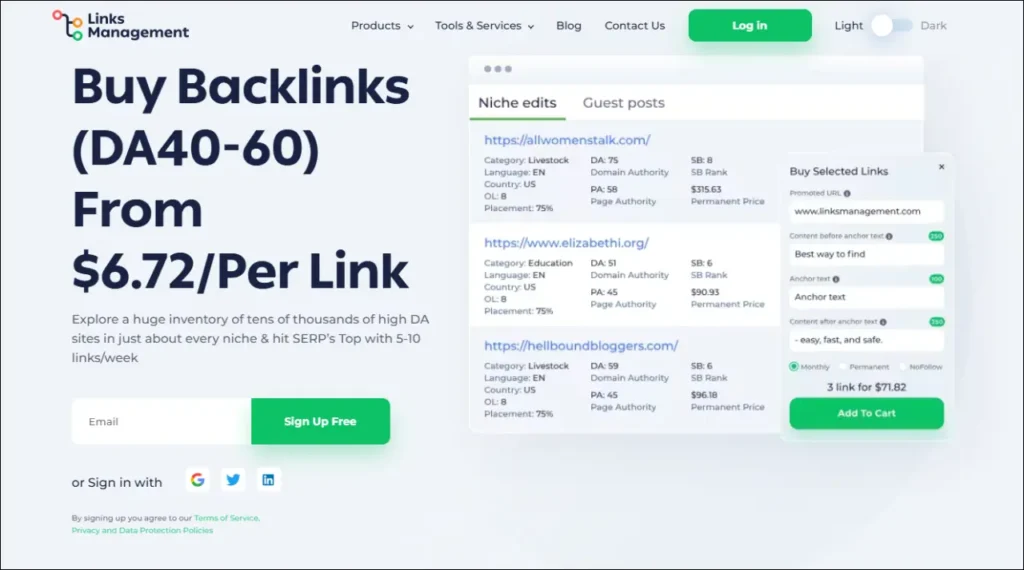
- Starting price: From $0.93/month for entry-level links; higher-authority links cost far more
- Best for: Buyers who want the broadest budget range and a long track record
- Rating: 4.0 / 5
LinksManagement is a long-running link marketplace with both subscription and one-time link options. It is best treated as a place to experiment cheaply and to build supporting links, not as the foundation of your authority strategy. Understanding that limit is what makes the platform useful instead of disappointing.
Pricing and Link Selection
Entry-level links are advertised at under a dollar a month at the low end, while higher-authority links cost far more. Prices rise with site metrics, and you can choose between monthly rental and one-time placement. Rented links disappear when you stop paying, so compare the total cost over a year against a permanent placement before committing. Browse by niche and filter for sites with genuine content, a reasonable number of outbound links per page and signs of real traffic. If a cheap listing looks identical to dozens of others, it probably belongs to a network. Pick a small set, test, and watch how they behave over several months.
Backlink Quality
At budget prices, low quality is the default unless you filter hard. Look for sites with real articles, named authors and a limited number of outbound links per page. Avoid cheap bulk buys for your money pages, and keep them away from pages that generate revenue. Supporting pages and experiments are a safer place to use these links. If you are comparing it with premium services, remember what you are paying for. The cost difference reflects vetting, editorial review and relevance. If you have the time to vet individually, LinksManagement can supply useful filler links. If you do not, the risk of low-quality placements is high.
The sensible way to use LinksManagement is as a controlled experiment. Pick one low-priority page, buy a small group of entry-level links from different sites, and record the starting rankings and traffic. Then watch the page for two or three months while holding everything else steady. If you see no movement, you have learned that cheap links do little for your niche without spending much. If you see gains, repeat carefully and keep checking link status. This approach protects your important pages and gives you evidence instead of guesses.
Pros and Cons
Pros
- One of the widest price ranges available
- Long operating history
- Monitoring and replacement on some plans
- One-time permanent options exist
Cons
- Cheap links tend to be low quality
- Interface feels dated
- Needs strong self-vetting at lower tiers
- Subscription links stop when payments stop
10. LinksThatRank — Best for Quality Guest Post Backlinks
- Starting price: Single links from about $177 (DR 20–34) to $327 (DR 50–80); monthly packages from about $1,497 (last published tiers, verify before ordering)
- Best for: SEOs wanting premium guest post quality with strict blacklist screening
- Rating: 4.4 / 5
LinksThatRank is a managed guest post provider that emphasizes screening. It is aimed at buyers in competitive niches who prefer fewer links of higher quality over volume, and who are willing to pay and wait for that.
Publisher Quality and Relevance
The provider describes a multi-point vetting process and a blocklist of known guest post farms. That focus on exclusion is useful, because most link buying problems come from sites that should never have been listed. One drawback is that publisher names are reportedly revealed after you order, not before. That conflicts with the due diligence advice later in this guide, so ask whether you can approve the site or reject placements that do not meet your criteria. Define your relevance standards in the order, including niche, minimum traffic and prohibited categories.
Guest Post and Link Quality
Articles are written to read like normal editorial content, and reviewers report a one-year replacement guarantee. Turnaround is slower than most marketplaces, with delivery measured in weeks. Tiers are priced by DR, and the most recent figures I found placed single links in the low-to-mid hundreds of dollars. Verify current rates directly. When the placement goes live, check the article for natural writing, relevant supporting links and a sensible link position. Confirm the site is indexed and still carries traffic. A slower, stricter process can be worth it when each link targets a high-value page and a weak placement would be costly to undo.
Because LinksThatRank is a premium service, treat the first order as a quality audit. Define your brief tightly: target page, anchor approach, topic, minimum traffic and categories you refuse. When the placement arrives, compare it against your brief and against placements you could have bought elsewhere at a similar price. If the quality is clearly higher, the premium may be justified for your most valuable pages. If it is similar to cheaper marketplace links, reserve the service for the most competitive terms or use marketplaces for the rest.
Pros and Cons
Pros
- Strict screening and a guest post farm blocklist
- Articles written to look like editorial content
- Replacement guarantee reported
- Suited to competitive niches
Cons
- Publisher visibility before purchase may be limited
- Slower delivery
- Higher per-link cost
- Less choice than a marketplace
11. The HOTH — Best for Managed Link Building
- Starting price: Varies by service tier and authority level; quote-based
- Best for: Businesses that want link building as part of broader SEO management
- Rating: 4.1 / 5
The HOTH is a long-running SEO agency whose link building sits inside a wider service catalog. That is useful if you want one vendor for several tasks and less useful if you only want to buy a few backlinks. Evaluate it as a managed service, not as a marketplace.
Link Building Process
The agency offers outreach-based link building and link insertions. The process is managed: you provide targets and anchor guidance, and the team handles sourcing and placement. That reduces your workload but also reduces visibility into which sites are used, unless you ask for approval rights. Before signing, ask how prospects are chosen, whether you can reject a site, what content standards apply and how reporting works. A managed provider should be able to show examples of past placements and explain how it screens publishers. If answers are vague, treat that as a warning.
Pricing and Campaign Options
Pricing varies by service tier and by the authority level of the placements, so there is no single starting price I can quote reliably. Request a written scope listing the number of links, authority thresholds, content standards and reporting. Compare it against marketplace prices for similar metrics, so you know what you are paying for management. Agencies often package links with other deliverables such as content or technical work, which can be good value if you need those anyway. If you only want links, a bundled package can make the cost per link harder to judge, so insist on itemized pricing.
If you are comparing The HOTH with other options, build a simple scorecard. List what you need: number of links per month, authority range, niches, content standards, reporting and white-label options. Score each provider on how clearly it answers each item in writing. Agencies that are confident in their process answer specifically, and those that rely on vague promises usually fall short later. Also ask what happens when a placement fails, how long a replacement takes and who bears the cost. Clear answers before payment are the best predictor of a smooth campaign.
Pros and Cons
Pros
- Link building alongside other SEO services
- Managed process with reporting
- Suited to white-label and agency use
- Lower workload for your team
Cons
- Less choice over individual publishers
- Pricing is quote-based or tiered
- Management adds cost
- Overkill if you only need a few links
12. Stan Ventures — Best for Link Outreach
- Starting price: From about $150 per link (reported); larger campaigns scoped individually
- Best for: Brands that want human-led outreach and control over messaging
- Rating: 4.0 / 5
Stan Ventures is an agency centered on human-led outreach. It suits buyers who want links earned through pitching and content instead of bought from a catalog, and who accept that this approach is slower and less predictable than a marketplace.
Outreach and Publisher Quality
Outreach-based services depend on the team’s relationships and the strength of your content. Ask what sort of publications they pitch, what share of placements involve a sponsorship arrangement, and whether you can see prospects before content is written. Some reviewers describe the agency as separating publisher fees from the service margin, which helps you see where your money goes. Good outreach starts with a reason for the publisher to care, such as an expert contribution, a data point or a useful resource. If the pitch is only “please add our link,” response rates and quality both suffer.
Pricing and Services
Entry pricing has been reported around $150 per link, with larger campaigns scoped individually. Treat that as indicative. Outreach pricing depends on difficulty, so a link for a SaaS company on a major technology site costs more than a local services link. Ask for an itemized quote that states link count, content, approval process and reporting. Clarify what happens if outreach fails to produce a placement for a target, and whether fees are refundable. For brands with limited content assets, check whether the agency also creates the linkable material, because outreach without something worth linking to rarely works.
Outreach services work best when you give the agency something worth linking to. Before you hire anyone, audit your own assets: original research, tools, templates, expert commentary or case studies. If you have none, the agency will either create them at extra cost or fall back on paid placements. Set expectations on timing as well, since outreach campaigns often take a month or more to produce the first live links. Review the first batch closely, and use it to refine the target list and pitch angle for the next one.
Pros and Cons
Pros
- Human-led outreach
- Potentially more natural placements
- Clear cost separation reported by some buyers
- Suited to brands that want control over messaging
Cons
- Slower than marketplace purchases
- Results depend on your content quality
- Pricing is scoped per campaign
- Not ideal for urgent orders
13. Authority Builders — Best for High-Authority Guest Posts
- Starting price: From about $150; high-authority sites from $400+
- Best for: Established sites wanting authority from vetted, traffic-backed publishers
- Rating: 4.1 / 5
Authority Builders is a curated marketplace focused on higher-authority publishers with visible organic traffic. It is a good fit for buyers who prefer to pick from a smaller, more selective list than from an open catalog with tens of thousands of sites.
Publisher Quality and Organic Traffic
The inventory is filtered by niche, traffic bands and authority, and the emphasis is on sites with real search visibility. That matters because the common failure in high-DR purchases is a site with inflated authority and no audience. Even on a curated list, open the site and review recent content. Look for consistent topics, genuine editorial standards and a reasonable volume of sponsored posts. Compare the displayed traffic with your own tool, and check whether the traffic is stable. A curated marketplace reduces obvious junk, but it cannot remove the need for judgment about relevance.
Pricing and Backlink Quality
Reported starting prices sit around $150, with high-authority placements costing several hundred dollars or more. Higher spend should buy higher relevance and stronger editorial standards, not just a bigger number. Ask what the typical turnaround is, whether you can supply your own content or must use the platform’s writers, and how long links are expected to stay live. For competitive pages, a handful of placements at this level can beat many cheaper ones. Track each link after it goes live, and note changes in rankings and referral traffic so you can judge whether the premium was worth paying.
One of the best uses of a curated marketplace is competitive gap analysis. Check which publications link to your main competitors, then look for similar sites in Authority Builders’ inventory. Placements on sites that already link to rivals in your niche tend to be relevant by definition. Make sure you are not simply copying a competitor’s weakest links, though, since some of those may be spammy. Focus on sites with real audiences and editorial standards. Pair this approach with a clear target page, so each placement supports a specific ranking goal.
Pros and Cons
Pros
- Curated inventory
- Traffic-based filtering
- Good for authority-focused campaigns
- Fewer obviously weak sites than open marketplaces
Cons
- Costs more than budget marketplaces
- Smaller inventory in some niches
- Requires site-by-site checking
- Not built for bulk buying
14. Loganix — Best for Agencies
- Starting price: From about $200 per link placement (reported); varies by product
- Best for: Data-focused SEO agencies and consultants who need detailed reporting
- Rating: 4.0 / 5
Loganix is a long-established provider aimed at agencies, selling link building and local SEO services in packaged form. It is more useful as a fulfillment partner than as a place for a small business to buy a single backlink.
Link Building Services
The service range includes guest posts, niche edits and citation-style work. Independent roundups describe a brokerage-style approach where you choose from vetted sites. Its reporting is built around agency needs, so you can document what you delivered to your own clients. When reviewing the service, ask how sites are vetted, whether you can reject proposed placements and what documentation comes with each order. Agencies should also check turnaround consistency, since missed deadlines affect client relationships as much as link quality does. It is also worth asking how the provider handles restricted niches, since some services decline or reprice categories such as gambling, finance and health, and you want to know that before a client project depends on it.
Pricing and Scalability
Pricing varies by product and authority tier, with reported entry points near $200 per placement. Agencies usually care less about the cheapest option and more about repeatable delivery, clear documentation and white-label compatibility. Ask for sample reports, turnaround times and content standards before moving client work over. Run a pilot with a small number of links across two or three clients and compare results against what you get from marketplaces. If your volume grows, ask whether bulk or ongoing pricing is available, and whether support remains responsive when you scale.
For agencies, the real test of any provider is what happens at scale. Before you move multiple clients to Loganix, run a pilot across two or three accounts and measure turnaround time, communication quality, revision handling and report clarity. Check whether placements match the standards you promised clients, because the weakest link in your supply chain determines your reputation. Also ask about confidentiality and white-label rules, so client relationships stay intact. A provider that performs well on a small pilot and communicates clearly usually scales without surprises.
Pros and Cons
Pros
- Built for agency workflows
- Detailed reporting
- Multiple service types
- Established provider
Cons
- Not the cheapest option
- Pricing varies by product
- Less appealing to individual site owners
- Quality should still be audited per order
15. Backlinks.com — Best for Affordable Link Building
- Starting price: Roughly $0.25 to $30 per month per link, depending on site authority
- Best for: Budget-conscious buyers who want ongoing links with automated monitoring
- Rating: 3.8 / 5
Backlinks.com is one of the older backlink providers and uses a monthly subscription model. It suits buyers who want low-priced, ongoing links with automated monitoring, and who understand that they are renting placements, not owning them.
Publisher Quality and Link Placement
The marketplace lets you filter by authority and relevance, and it monitors links so removed ones can be replaced. The quality ceiling is lower than at curated services, so use it for supporting links and test pages instead of your highest-value URLs. When choosing sites, read the article where your link would appear and check that the page is indexed and has a sensible number of outbound links. Prefer placements inside real content over sidebar or footer slots, which carry less editorial context and look more like paid advertising.
Pricing and Backlink Packages
Fees are charged monthly per link, with the price rising with the site’s authority. A subscription link costs you every month it stays live, so the real cost over a year can exceed a one-time placement. Run the numbers for twelve months before choosing it over a permanent insertion. If you want to buy backlink packages here, review the site list first and avoid concentrating many links on the same few domains. Remember that rented links vanish when you cancel, which can make your profile unstable if you rely on them heavily. Use them selectively, and keep the budget small until you have seen the effect on rankings.
If you decide to use a subscription provider, set a firm budget cap and review it every month. Rented links accumulate quietly, and a handful at a few dollars each can become a meaningful annual cost. Track which links appear to help and cancel the rest. Also avoid pointing rented links at pages you cannot afford to lose rankings on, because cancelling subscriptions removes the support those pages rely on. For permanent authority, a one-time insertion on a good site is often better value than several months of rented links.
Pros and Cons
Pros
- Low monthly entry prices
- Automated monitoring and replacement
- Long track record
- Easy to scale gradually
Cons
- Ongoing cost with no permanent ownership
- Lower quality ceiling
- Not ideal for competitive keywords
- Requires careful filtering
16. Fiverr — Best for Budget Backlink Services
- Starting price: From $5; higher-priced gigs run to several hundred dollars
- Best for: Beginners and very tight budgets who want to experiment with supporting links
- Rating: 3.5 / 5
Fiverr is a general freelance marketplace, so you are buying from individual sellers instead of vetted publishers. It is the lowest-cost route and the easiest to get wrong, which makes it suitable only for low-stakes experiments and supporting links.
How to Find Quality Backlink Sellers
Look for sellers with a long history, many completed orders and detailed descriptions that name the type of link and show live examples. Ask for samples and check them in a backlink tool. Message the seller before ordering and ask where links will be placed, how many outbound links appear on each page, and whether the sites sell links publicly. Filter for strong review volume, then read the reviews for specifics, not just star ratings. Specific comments about indexed links and responsive support are more useful than generic praise. Start with the smallest order available and check the result after a few weeks.
Backlink Services to Avoid
Avoid gigs that promise hundreds of links for a few dollars, guaranteed rankings, “DA 90” links with no traffic evidence, or private network placements. Experienced SEOs, including the team at SEO Sherpa, advise against buying from low-cost gig sites for important pages because links from them are often toxic or worthless. Be especially careful with tiered link pyramids, mass directory submissions and automated blasts. Even if a seller delivers what was promised, the links may sit on pages that Google ignores or that become a liability later.
If you still choose to use Fiverr, treat every order as a test, not as a strategy. Use a fresh, low-priority page for experiments, keep a log of each seller and result, and never give sellers access to your site or ask them to build links in bulk. Review the delivered links in a backlink tool after a few weeks to see whether they are live, indexed and on sites with traffic. If the results are poor, stop. Money saved on a cheap gig is not worth risking a page that earns revenue.
Pros and Cons
Pros
- Very low entry cost
- Easy to order and message sellers
- Useful for supporting or experimental links
- Large number of sellers to compare
Cons
- Quality varies hugely
- Little publisher transparency
- High risk of link spam
- Not suitable for core commercial pages
17. Upwork — Best for Hiring Link Builders
- Starting price: Hourly from about $15 to $100+; project-based pricing varies
- Best for: Businesses that want to hire a specialist for an ongoing link building campaign
- Rating: 3.9 / 5
Upwork is not a backlink marketplace. It is a way to hire a person who runs link building for you, which is a different purchase with different risks. You are buying skill and process, and the quality of the outcome depends on how well you select and manage that person.
Finding a Reliable Link Building Freelancer
Look for a visible track record in outreach, digital PR or content-led link building, and ask for case studies with named sites. Interview candidates about their process, tools and typical publishers. A freelancer who cannot explain how they find and vet sites is likely buying from lists. Ask what proportion of their placements are earned through outreach and what proportion are paid, and how they handle disclosure. Check recent job feedback for evidence of reliable communication, and ask for references from clients with similar goals. A small paid trial project reveals more than any interview.
What to Check Before Hiring
Define deliverables in writing: number of links, minimum traffic, relevance requirements, content standards, and what happens if a link is removed. Clarify who owns the content, who approves the publishers and how progress will be reported. Ask whether they sell links or earn them through outreach, because that affects both cost and risk. Agree a review cadence and a clear stop condition if quality slips. For a broader look at the options, see our guide on outsourcing backlink building. Hourly pricing can be hard to forecast, so consider fixed-scope projects with milestones.
The most reliable way to evaluate a freelancer is a small, paid pilot. Give them a clear brief: one page, a short list of target publications, and a requirement to share prospects before outreach. Review their research, the quality of their pitches and the sites they propose. A good freelancer will push back on weak targets and suggest better ones. If the pilot goes well, expand the scope gradually. If it goes badly, you have lost a little money and learned something valuable about how they work.
Pros and Cons
Pros
- Direct access to a specialist
- Flexible hourly or project pricing
- Good fit for ongoing campaigns
- You can set your own quality standards
Cons
- Quality depends on the individual
- Management time is on you
- No built-in link guarantee
- Hourly work is hard to forecast
18. OutreachZ — Best for Managed Guest Posting
- Starting price: From about $50 (reported; confirm current rates directly)
- Best for: Buyers wanting managed guest posting with coverage in technology, marketing, health and finance niches
- Rating: 4.0 / 5
OutreachZ positions itself as a managed guest posting and editorial placement service, with strengths in technology, marketing, health and finance niches according to third-party reviews. It can serve as a second source when other marketplaces lack inventory in your topic area.
Publisher Quality and Relevance
Managed services are only as good as their publisher filters. Ask which categories the team covers, how it screens for link-selling sites, and whether you can approve placements. Relevance should come first, so compare proposed sites against your niche, not against a DR number. In competitive categories such as finance and health, editorial standards matter more, because these topics attract extra scrutiny and weak sites are common. Request examples of recent placements in your niche and check them for traffic, content quality and unrelated sponsored articles.
Pricing and Guest Post Options
Pricing has been reported from around $50 upward for lower tiers, with higher-authority placements costing more, but I could not verify a current published price list. Ask for a written quote that lists site metrics, content length, delivery time and replacement terms. Compare it with marketplace prices for similar metrics before committing. If the service writes the article, request a draft for approval, and confirm whether revisions are included. A small first order is sensible, since it lets you judge communication, content quality and link placement before you scale.
Because OutreachZ is a managed service, communication quality is part of what you are buying. During the first order, note how quickly the team replies, how clearly they explain choices and whether they provide the placement details you asked for. Compare the result with a similar placement from a self-service marketplace. If the managed version is meaningfully better in relevance and editorial quality, it may justify the higher price for important pages. If not, use it only where inventory is scarce. Document the outcome so you can decide whether to continue.
Pros and Cons
Pros
- Managed process
- Coverage in several competitive niches
- Useful as a second source when other marketplaces lack inventory
- Suited to teams that do not want to browse catalogs
Cons
- Pricing details need confirming
- Less transparent than self-service marketplaces
- Newer than long-established providers
- Quality should be checked per placement
How to Choose the Best Backlinks to Buy
The criteria below work whichever provider you use. They also explain why two links with the same DR can be worth very different amounts.
Check Topical Relevance
Ask whether the linking page would make sense to your customers. A link from a page that discusses your subject, to a page that helps readers with it, is stronger and safer than a link from a generic “business” blog. Relevance also protects you if a provider’s metrics turn out to be inflated.
Check Organic Search Traffic
Real organic traffic shows that Google trusts the site enough to send visitors. Use a backlink or traffic tool to review the traffic trend over the past year. A steady or growing line is good. A sharp drop can indicate a penalty or a site that has lost trust. Traffic from countries unrelated to your market is a weaker signal for local campaigns.
Evaluate Website Authority
DA, DR and similar scores are third-party estimates, not Google metrics. They’re useful for filtering, and they are easy to inflate with weak links. Use them to shortlist, then judge the site on traffic, relevance and quality.
Review Content Quality
Read five or six recent articles. Look for original thinking, named authors, sensible editing and a consistent topic. Pages that are thin, machine-generated at scale or stuffed with sponsored posts suggest a site that exists to sell links.
Check Link Placement and Context
A contextual link inside a useful paragraph carries more weight than a sidebar, footer or author-bio link. The surrounding content should discuss the topic, and the link should be one of only a few outbound links on the page.
Verify Google Indexation
Search for the domain and for a few of its recent URLs. If Google hasn’t indexed the site or the target page, the link can’t contribute much. Deindexed domains are a hard no.
Analyze the Website’s Outbound Links
If every article links out to commercial sites in unrelated niches, the site is probably selling links in bulk. Look at the share of outbound links that point to casinos, loans, pills or other spam categories.
Check Link Retention
Ask how long the link stays live and what happens if the publisher deletes it. A written policy beats a verbal assurance. A site that regularly cleans out old sponsored posts is a weak long-term bet.
Evaluate the Referring Domain’s History
Check whether the domain used to cover a different subject, which can indicate an expired domain rebuilt for links. Expired domains are also used for redirect tactics, which is covered in our guide to 301 redirect backlinks. Old, consistent content is a better sign than a recent redesign with hundreds of unrelated posts.
Don’t Rely on DA or DR Alone
A site with DR 60, almost no traffic and unrelated content is often a worse buy than a DR 35 site with a loyal niche audience. Use DA and DR to sort, then use relevance, traffic and content to decide.
How Much Do Backlinks Cost in 2026?
No fixed market price exists. Cost depends on the publisher’s authority, traffic, niche, link type, content requirements and whether you buy through a marketplace, agency or direct outreach. The benchmarks below come from published 2026 pricing research. BuzzStream’s link building pricing analysis reported an average guest post link of about $461 when bought through vendors, with high-quality posts averaging far more. Its link insertion study put the average insertion at about $179 across a database of more than 420,000 sites.
| Budget band | What it usually buys | Typical risk level |
|---|---|---|
| Under $50 | Supporting links, directories, very small blogs | High |
| $50–$100 | Small niche blogs, basic insertions | Medium to high |
| $100–$300 | Decent niche sites and many standard insertions | Medium |
| $300–$500+ | Higher-authority publishers and managed placements | Lower |
| $1,000+ | Digital PR and major publications | Lowest, but not zero |
Cheap Backlinks: What Should You Expect?
If you want to buy cheap backlinks, expect smaller publishers, weaker traffic and more variation. Cheap links can work as supporting links on pages that matter less, or as controlled experiments. The danger isn’t the price itself but that very low prices usually mean volume selling from sites built for it.
$50–$100 Backlinks
This is where small niche blogs and some link insertions sit. You can find real value here when the site is relevant and has modest traffic. Check every placement individually, since this band mixes good small publishers with link farms.
$100–$300 Backlinks
This band covers many of the best-value placements: established niche sites, decent traffic and usable editorial standards. Marketplaces such as the ones reviewed above supply most of the choices. It’s a sensible target for buyers who want to buy quality backlinks at a manageable cost.
$300–$500+ Premium Backlinks
Premium links cost more because the publisher has real audience trust, an editorial team and limited availability. Managed services also price here because they include outreach and content work. Spend at this level on pages that drive revenue, and ask to approve the publisher first.
What Determines the Price of a Backlink?
Authority, traffic, niche, language, country, turnaround time, content creation, link type, publisher demand and guarantees all affect price. Restricted niches such as gambling, finance and health cost more because fewer publishers accept them.
Are Expensive Backlinks Always Better?
No. A higher price can reflect real editorial value, or it can reflect a reseller’s margin on a weak site. Compare the price to the traffic and relevance of the specific page. If you can’t see why a link costs what it does, treat the price as a warning.
Backlink Packages vs. Individual Links
Backlink packages bundle several placements at a set price. They simplify buying but usually reduce your control over which sites receive your links. Individual placements cost more to manage but let you vet each one. If you consider a package, ask for the full list of sites before payment and check how many come from the same network.
Types of Backlinks You Can Buy
Not every paid link has the same purpose. The category matters because it shapes cost, risk and expected value.
Guest Post Backlinks
When you buy guest post backlinks, you publish a new article on someone else’s site with a link back to yours. Guest posts give you the most control over context, and the quality of the article is part of the value. Many sellers publish thin articles purely for links, so judge the host site, not the offer.
Niche Edit Backlinks
A niche edit, or link insertion, adds your link to an existing article. The page is often already indexed and may already have traffic, which can make the link useful quickly. The risk is that the page may already carry many outbound links or may not truly match your topic.
Editorial Backlinks
Editorial links are links a publisher chooses to include because the content serves readers. Strictly speaking, a paid link is no longer purely editorial, but some managed services arrange placements on real publications with editorial review. These are the closest you can get to the quality bar Google prefers.
Digital PR Backlinks
Digital PR earns coverage through research, expert commentary or newsworthy stories. These links tend to come from high-trust news and industry sites and are the most durable. They cost more, and results aren’t guaranteed. See our guide to PR link building for how the process works.
Dofollow Backlinks
When people ask to buy dofollow backlinks, they mean links with no nofollow or sponsored attribute, so they can pass ranking credit. Those are exactly the links Google’s policy treats as risky when paid for. Cheap dofollow offers deserve extra skepticism.
Permanent Backlinks
Buyers who want to buy permanent backlinks should know that no link is truly permanent. Sites change owners, delete articles and redesign. A written replacement policy is worth more than the word “permanent” in a listing.
High-Authority Backlinks
High-authority backlinks come from sites with strong search visibility and trust in a niche. Authority has to be earned through traffic and relevance, not just a metric. To buy high authority backlinks safely, verify organic traffic and the quality of the surrounding content.
High-DA and High-DR Backlinks
If you want to buy high DA backlinks, treat DA as a sorting tool. Sellers advertise DA 50 or DR 70 links at low prices because the metrics can be manipulated. Ask for traffic and ranking keywords. A genuine DR 60 site will rank for hundreds of terms.
High-PR Backlinks
Searches for high PR or high pagerank backlinks come from an older era. Google removed the public Toolbar PageRank score in 2016, so sellers advertising “PR7” are using outdated or invented labels. PageRank still exists internally at Google, but you can’t see it, and you shouldn’t pay for a number you can’t verify.
Relevant Backlinks
Relevant backlinks come from sites and pages that share your topic or audience. Relevance often outperforms raw authority, particularly in competitive niches. When you buy relevant backlinks, define your target topics before browsing a marketplace.
Tier 2 Backlinks
Tier 2 backlinks point to the pages that link to you, not directly to your site. They’re meant to strengthen a primary link. They’re easy to over-engineer and are often sold as automated bulk packages, which carry high risk. If you do try them, keep them selective and relevant.
PBN Backlinks
Private blog networks are sites built or acquired to pass links. Buyers who search to buy PBN backlinks, buy PBN blog post backlinks or buy PBN backlinks cheap are usually looking for fast gains. The trade-off is risk: PBNs are a core target of Google’s link spam systems, and the cost of recovery can exceed any short-term benefit. For a site that depends on organic revenue, I’d avoid them.
EDU Backlinks
An edu domain is not a ranking shortcut. Genuine links from university pages, such as faculty resources or scholarship pages, are valuable. When sellers offer to let you buy edu backlinks, they are often selling placements on compromised pages, student profile pages or forums, which can be spam. Wikipedia works the same way: its links are nofollow by default, and paid editing without disclosure violates Wikimedia’s rules, so offers to buy Wikipedia backlinks are best ignored.
Sponsored Backlinks
Sponsored links carry rel="sponsored" and follow Google’s guidance. They send referral traffic, build brand exposure and may still help discovery, even if they don’t pass ranking credit as a normal link would. For brands that value compliance, sponsored placements are the lowest-risk way to buy links.
How to Buy Backlinks Safely
No method is free of risk when you pay for links meant to influence rankings. Google says its systems neutralize unnatural links, and it may take action against sites that buy or sell them. What you can do is reduce risk by choosing relevant, real publishers and documenting every step. If you want a shorter walkthrough, see our guide to buying quality backlinks cheaply without risking your site.
Research the Backlink Provider
Check how long the provider has operated, what independent reviewers say and whether its terms are specific. Search for complaints about refunds and about links removed after payment. Be wary of providers with no named team, no clear terms and only glowing testimonials.
Ask to See the Actual Publisher
If a provider won’t show the site before payment, you’re buying blind. Request the domain and the specific page, and decline if they only offer a metric range. Marketplaces usually show sites up front, while managed services should offer pre-approval.
Verify Organic Traffic and Rankings
Run the domain through your own SEO tool, such as one from our roundup of the best SEO tools. Confirm that the site ranks for relevant keywords and that traffic is stable. Don’t rely on screenshots supplied by the seller.
Check Topical Relevance
Match the publisher’s main topics to yours. If the site covers ten unrelated niches, relevance is weak even if the headline metrics look strong.
Review Recent Published Content
Read the last twenty or so articles. Look for repeated guest-post patterns, obvious sponsored content, unrelated categories and low-effort writing. A healthy site publishes useful material for its own readers.
Analyze Outbound Links
Count outbound links on recent articles. Pages that link to many commercial sites suggest bulk link selling. Also look at what those links point to, since a “neighborhood” of spam hurts your link’s value.
Check Page and Site Indexation
Confirm that both the site and the target page are indexed. Use a search for the domain and a few unique phrases. If the page is new and not indexed, ask how soon it will be, and use a link indexing approach only when the content is genuinely worth indexing. Our review of link indexing tools explains the options.
Confirm Link Placement
Agree on the exact placement before publishing: contextual paragraph, anchor text, destination URL, link attribute and number of other outbound links. Get it in writing.
Understand Link Retention and Replacement
Ask how long the link stays live, what counts as a failure and whether the provider replaces it or refunds you. Keep a log of the placement, date and attributes so you can raise a claim.
Start With a Small Test Order
Place one or two links first. Check that they are live, indexed, correctly formatted and on the page you agreed. Scale only if the results match the promise. A small test is cheaper than correcting a large batch.
Backlinks You Should Avoid Buying
These categories repeatedly cause problems, and most offer little benefit even when they don’t trigger penalties.
Cheap Bulk Backlink Packages
Offers of hundreds or thousands of links for a small fee almost always rely on automation or low-quality networks. A real publisher doesn’t place a contextual link for pennies.
Automated Backlinks
Software-generated links violate Google’s link spam rules. They create unnatural patterns and rarely stay live.
Link Farms
Sites that exist mainly to sell links often carry many outbound commercial links and little real audience. Their value is low and their risk is high.
Private Blog Networks With Manipulated Metrics
PBNs often use expired domains with inflated metrics. Even when the numbers look impressive, the sites lack genuine audiences, and Google targets them.
Sitewide Footer and Sidebar Links
Links repeated across every page of a site look like paid placements and carry little editorial context. Google’s policies list widely distributed links in footers and templates as a risk.
Comment and Forum Spam
Mass comment and forum links add noise, not authority. Most carry nofollow or ugc attributes and are often removed.
Low-Quality Directory Links
Directories built purely for SEO have no real users. Reputable local or industry directories are different because they serve actual searchers.
Links From Unrelated Websites
A link from a site with no connection to your topic provides weak context and looks artificial. A pattern of unrelated links is a footprint.
Links From Deindexed Websites
If Google has removed a site from its index, links from it add nothing and signal a bad neighborhood. Always check indexation before buying.
Guaranteed Ranking Backlinks
No provider can guarantee a position in Google. Anyone who does is selling a claim, not a result.
Best Backlinks for Different SEO Goals
The right type of link depends on your goal, budget and risk tolerance. Use this section to match the approach to your situation.
Best Backlinks for Small Businesses
Prioritize local relevance and a few strong placements over volume. Local publications, industry associations and relevant niche blogs often outperform generic high-DR sites. For small budgets, start with a handful of links per month.
Best Backlinks for New Websites
A new site needs trust and discovery, so start slowly with relevant links and focus first on content and technical health. A burst of paid links to a brand-new domain looks unnatural.
Best Backlinks for Established Websites
Established sites can absorb more links and usually benefit from higher-authority placements. Use your existing profile to identify gaps, such as missing industry publications.
Best Backlinks for Agencies
Agencies need repeatable delivery, reporting and white-label options. Managed providers and marketplaces with project management tools serve this need.
Best Cheap Backlinks
Cheap links work best as supporting links on non-critical pages. Choose small niche publishers with real content over bulk packages, and avoid anything that cannot show a live sample.
Best High-Quality Backlinks
Quality means relevant, indexed, traffic-backed and contextual. Managed editorial services and carefully filtered marketplaces are the usual sources.
Best High-Authority Backlinks
High-authority links come from publications with real audiences. Expect higher prices and slower delivery, and verify authority through traffic and keywords, not just a score.
Best Guest Post Backlinks
The best guest posts appear on sites that publish a limited number of articles with real editorial review. If a site accepts every pitch, its guest posts carry less value.
Best Backlinks for SaaS Websites
SaaS companies benefit from technology, marketing and industry-specific publications, plus research-led digital PR. Relevance to your product category matters more than broad DR.
Best Backlinks for E-commerce Websites
E-commerce sites should look for product category blogs, review publications, local features and sponsorships. Link to guides and category pages with useful content, not only product pages.
Best Backlinks for Local SEO
Local relevance beats general authority. Local news, chambers of commerce, sponsorships and community organizations provide the strongest signals.
Best Backlinks for Competitive Niches
In competitive niches, a few high-quality, relevant placements usually beat many mid-quality ones. Study competitors’ referring domains to set a realistic target.
Best Places to Buy Backlinks in India
If you want to buy backlinks in India, filter marketplaces by Indian traffic and language, and favor publishers with local audiences. INSERT.LINK, Adsy, Collaborator and PressWhizz let you filter by country. Budget in your own currency after checking exchange rates, because most providers price in USD or EUR.
Best Places to Buy Backlinks in the USA
To buy backlinks in the USA, look for publishers whose traffic comes mainly from US visitors, since regional relevance affects value. Most marketplaces in this guide offer US inventory. Managed services such as Editorial.Link and LinksThatRank are common choices for competitive US markets.
Best Casino, Gambling, Poker and Slot Backlinks
Gambling is one of the most restricted and expensive link building niches. Many mainstream publishers refuse gambling content, and the sites that accept it often carry heavy spam. The same discipline applies here as elsewhere, with higher stakes for mistakes. Check the laws and advertising rules in the countries you target, because they differ widely. Nothing here is legal advice.
Casino Backlinks
If you plan to buy casino backlinks, relevance and publisher quality are especially important. Look for publishers that already cover entertainment, iGaming news or related topics, and avoid sites that mix casinos with loans, pills and adult content.
Gambling Backlinks
Searchers who want to buy gambling backlinks or find gambling backlinks for sale will see many offers. Most sit on sites with very high outbound link counts. Ask the seller to show recent articles and traffic, and decline anything that looks like a link farm.
Poker Backlinks
Poker is narrower than general gambling, so relevance can be easier to measure. If you want to buy backlinks for poker sites, target poker strategy blogs, gaming communities and sports or card-game publishers where the topic fits.
Slot Website Backlinks
To buy backlinks for slots or slot websites, aim for gaming news, reviews and entertainment publications over generic blogs. Be careful with regional restrictions, since a slot site targeting one country may not suit a publisher that serves another.
Cheap Casino and Gambling Backlinks
When you search for cheap casino backlinks, expect the cheapest options to be the riskiest. Low prices in this niche often mean link networks. If budget is limited, buy fewer links from better sites instead of many from weak ones.
How to Evaluate Backlinks in Competitive Niches
Check traffic quality, topic consistency, outbound link patterns and publisher history. Compare each proposed placement with the sites already linking to your top competitors. If a site would be hard to explain to a reader, it’s probably the wrong choice.
How to Build a Backlink Buying Strategy
Buying individual links without a plan produces scattered results. A strategy ties your budget, target pages and link types together. Start with a backlink audit to understand your current profile.
Set Your Backlink Budget
Decide a monthly budget before browsing. Split it between a few higher-quality placements and, if appropriate, some supporting links. Keep a reserve for replacing lost links.
Choose the Right Pages to Promote
Don’t point every link at your homepage. Promote pages that deserve links: guides, tools, studies and key commercial pages. Pages with weak content gain little from extra links. Internal links decide how that authority flows once it arrives, and link sculpting explains how to direct it toward your priority pages.
Build a Natural Anchor Text Profile
Use a mix of brand names, URLs, partial matches and descriptive phrases. Exact-match anchors should be a small share of the total. There is no official percentage, but repeating the same commercial keyword across many links is a common footprint.
Diversify Your Referring Domains
Spread links across many different sites instead of buying repeatedly from the same few. Diversity makes your profile more natural and reduces dependence on any one publisher.
Prioritize Relevant Websites
When two options cost the same, choose the more relevant site. Relevance supports both rankings and referral traffic.
Balance Different Link Types
Combine guest posts, insertions, editorial mentions and earned links. Our guide to natural link building techniques covers ways to earn links alongside paid ones.
Scale Your Link Building Gradually
Increase volume slowly. Sudden spikes from a small base look unnatural. Review results every month and adjust before spending more.
Monitor Rankings and Organic Traffic
Track rankings, impressions and clicks for the pages you promote in Google Search Console. Compare against pages that received no new links to estimate impact.
Monitor New and Lost Backlinks
Check that each purchased link is live and correctly formatted at 30, 60 and 90 days, then periodically. For a quick manual check, you can find backlinks in Google search with a few operators. Our guide to backlinks management explains ongoing monitoring.
Backlink Marketplace vs. Link Building Agency vs. Direct Outreach
Each purchasing model trades control, cost and effort differently. Pick the model that matches your skills and time.
Backlink Marketplaces
Marketplaces such as INSERT.LINK, PressWhizz, Collaborator and Adsy give you choice and speed. You see metrics and prices and place orders yourself. Quality depends on your vetting, and the work of checking publishers falls on you.
Link Building Agencies
Agencies handle strategy, outreach and placement. They cost more and give you less control over individual sites, unless you require approval. They suit teams with budget and little time.
Direct Publisher Outreach
Contacting publishers yourself gives you the most control and often the best context, but it takes time and negotiation skill. Costs include outreach time, content creation and the link fee itself.
Freelance Link Builders
Freelancers sit between agencies and marketplaces. You gain flexibility and direct communication, and you take on the risk of an individual’s quality and honesty.
Which Link Building Method Is Best for You?
If you have SEO experience and time, a marketplace is usually the most efficient route. If you lack time and have budget, a managed provider reduces effort. If you need links on specific sites, direct outreach is worth the work. For many businesses, a mix works best. If you’d rather hand the whole process to specialists, see our off-page SEO services or our dedicated page on buying backlinks professionally.
Do Backlinks Still Work for SEO in 2026?
Yes, but the bar is higher. Links remain a core part of how Google understands which pages deserve trust, yet Google has improved at discounting manipulative ones. For more background, read our explanation of why backlinks still matter.
Are Backlinks Still a Ranking Signal?
Links remain an important signal in search, which is why people continue to buy backlinks for SEO. No outside tool can tell you exactly how much weight Google gives a particular link, so treat claims of precise impact with caution.
What Makes a Backlink Valuable in 2026?
Relevance, genuine traffic, editorial context, a healthy site history and a natural place within a link profile. A link that sends real visitors is more likely to be valuable than one that exists only for ranking.
Why Link Quality Matters More Than Quantity
A single strong, relevant link can be worth more than many weak ones. Google’s systems can ignore low-quality links, so money spent on volume may produce nothing.
Do Cheap Backlinks Still Work?
Some do, particularly relevant links on small but real sites. Most very cheap offers don’t, because the links come from sites built to sell them, which Google can neutralize.
Do Paid Backlinks Help SEO?
They can help when the placement is on a relevant, trusted site and appears natural, but outcomes aren’t guaranteed. Google’s policies describe paid links for ranking as link spam, so there is always policy risk. Properly qualified sponsored links are within the rules and may still bring traffic and brand exposure.
How Google Evaluates Links
Google says its systems aim to identify and neutralize link spam, and its documentation emphasizes links as editorial endorsements. It recommends rel="sponsored" for paid links and rel="nofollow" where appropriate. Treat anything beyond that, such as specific thresholds, as industry observation, not official guidance.
Do Backlinks Matter for AI Search in 2026?
They matter indirectly. Google’s guidance says the usual SEO fundamentals still apply to AI Overviews and AI Mode, and it says no special files or markup are needed. See Google’s AI features documentation for the details.
How Backlinks Can Support AI Search Visibility
AI answers draw on the search index, so pages that rank well and are trusted are more likely to be used. Backlinks help the page earn that standing, but there is no formula linking a number of links to an AI citation.
Backlinks, Brand Mentions and Citations
Mentions of your brand on respected sites help AI systems and search engines understand who you are. Some industry analyses report that brand mentions correlate more strongly with AI visibility than links alone, though correlation isn’t proof. Google’s guidance warns against seeking inauthentic mentions, so earn them instead of manufacturing them.
Why Topical Authority Matters for AI Search
Consistent coverage of a subject helps both search engines and AI systems judge expertise. Support your main pages with related articles and link between them. Our overview of AI SEO covers this in more detail.
Creating Content Worth Citing
Original data, clear definitions, first-hand observations and well-sourced comparisons are more likely to be cited. A purchased link can’t fix a page that offers nothing unique.
Measuring Visibility in AI Search Results
Use Search Console for Google traffic, check referral traffic from AI tools in your analytics, and test your target questions in several AI tools periodically. Our list of AI SEO tools can help with tracking.
Buying Backlinks vs. Building Backlinks Naturally
Both approaches work, and many sites use both. The difference lies in cost, speed, control and risk.
Buying Backlinks
Buying is faster and more predictable, but it carries policy risk, ongoing costs and vendor risk. It makes sense when you can vet placements carefully and the pages you promote are worth it.
Organic Link Building
Organic link building through outreach, resource pages and content, covered in our guide to link building tactics that actually work, takes longer and produces fewer links, but they’re more durable and carry less risk. Free options include guest posting on genuine sites.
Digital PR and Link Earning
Digital PR earns links by giving journalists and publishers something worth covering, such as research or expert commentary. It costs more and doesn’t guarantee a result, but the links are the most resilient.
Which Approach Is Best for Long-Term SEO?
For long-term SEO, build a base of earned links and use selective paid placements to speed up the process. Avoid dependence on a single method. Our broader link building guide shows how these methods fit together.
Frequently Asked Questions About Buying Backlinks
Is It Safe to Buy Backlinks? It’s never completely safe. Google treats paid links meant to influence ranking as link spam. Risk drops when links are relevant, on real sites and part of a modest, steady campaign.
Is Buying Backlinks Against Google’s Guidelines? Buying links for ranking purposes is listed as link spam. Paid links for advertising are acceptable when qualified with rel="sponsored" or rel="nofollow".
What Is the Best Place to Buy Backlinks? It depends on your goal. Editorial.Link suits premium managed placements, while INSERT.LINK, PressWhizz, Collaborator and Adsy suit buyers who want to choose publishers themselves.
Where Can I Buy Backlinks Online? Online options include link marketplaces, managed agencies and freelance platforms. Marketplaces give the most visibility into the publisher before you pay.
How Do I Buy Backlinks for SEO? Set a budget, choose target pages, shortlist relevant publishers, verify traffic and content, place a small test order and monitor the results before scaling.
How Much Does a Good Backlink Cost? Published 2026 studies put average guest posts and insertions in the hundreds of dollars. Decent niche placements often cost roughly $100–$300, with premium links costing more.
How Many Backlinks Should I Buy? There’s no fixed number. Start with a few per month, measure the effect and compare your referring domain count with the pages that already rank for your target term.
Are Cheap Backlinks Worth Buying? Sometimes, as supporting links on real, relevant sites. Very cheap bulk offers usually aren’t worth it.
Are Paid Backlinks Good for SEO? They can contribute when they’re relevant and natural, but results aren’t guaranteed and policy risk exists.
Are Dofollow Backlinks Worth Buying? Dofollow links pass ranking credit, which is why buyers want them and why Google treats paid ones as risky. Weigh the benefit against that risk.
Should I Buy PBN Backlinks? I wouldn’t for any site that depends on organic traffic. PBNs are a known target of Google’s spam systems.
Are High-DA Backlinks Better? Only if the site also has real traffic and relevance. DA alone is easy to inflate.
Are High-DR Backlinks Better? The same applies. DR is a useful filter, but traffic and relevance are better indicators of value.
Are Permanent Backlinks Really Permanent? No. Publishers can remove pages or change sites. Look for a written replacement policy.
Do Backlinks Still Work in 2026? Yes, they remain an important signal, though low-quality links are increasingly ignored.
Do Backlinks Help AI Search? Indirectly. They support the authority of pages that AI features draw on, but Google says no special optimization is required.
Where Can I Buy Quality Backlinks? Managed services and carefully filtered marketplaces are the usual sources. Quality depends on the publisher you choose.
Where Can I Buy Cheap Backlinks? Legiit, LinksManagement and Backlinks.com offer low entry prices. Vet each placement.
Are Backlink Packages Worth Buying? Rarely for important pages. Packages reduce your control over publishers and often include weak sites.
How Do I Know if a Backlink Provider Is Legit? Check independent reviews, ask for live examples, confirm the publisher before payment, read refund and replacement terms and start with a small test.
Final Verdict: Where Should You Buy Backlinks in 2026?
There isn’t a single winner for every buyer. The right choice depends on budget, niche and how much vetting you’re willing to do. Whichever route you take, remember that Google can neutralize unnatural links, so spend where relevance and real traffic are visible.
Best Overall Backlink Provider: Editorial.Link, for buyers who want pre-approved, managed editorial placements and can afford premium pricing.
Best Provider for Cheap Backlinks: Legiit or LinksManagement, provided you strictly vet the available options and start with a small test order.
Best Provider for High-Quality Backlinks: Editorial.Link, LinksThatRank, or Authority Builders, depending on whether you prefer managed delivery or a more curated publisher selection.
Best Backlink Marketplace: INSERT.LINK for filtering and transparency, with PressWhizz and Collaborator as strong alternatives offering replacement coverage and link insurance.
Best Managed Link Building Service: Editorial.Link for editorial depth, with The HOTH or Loganix for agency-style link-building packages.
How to Choose the Right Backlink Provider: Define the page you want to promote and set your budget. Shortlist providers that let you review publishers before payment, verify organic traffic and recent content yourself, review their replacement and retention policies, and start with a small test order.
If you’d like help planning or running this process, see our SEO services, our SEO packages or contact us.
