

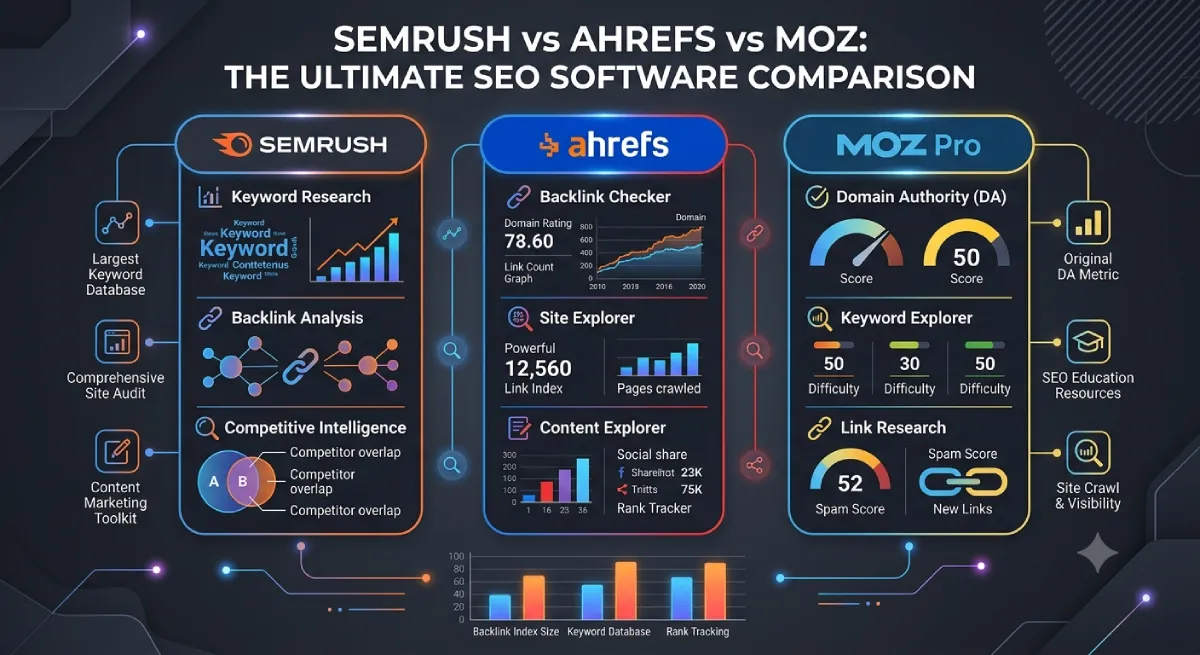
Semrush, Ahrefs, and Moz can all help you find keywords, analyze competitors, track rankings, and understand backlinks. The problem is that choosing between them gets expensive quickly, especially if you subscribe to a platform and later discover that its best features are not the ones you actually need.
Semrush is the strongest all-round option for businesses that want SEO research alongside paid advertising and broader marketing tools. Ahrefs is particularly attractive for backlink analysis and organic competitor research. Moz is worth considering if you rely on Domain Authority, need a focused SEO workflow, or want to start with a smaller subscription.
But none of these tools is automatically the best choice for every website.
Today, we’ll examine Semrush vs Ahrefs vs Moz across pricing, keyword research, backlink analysis, competitor research, technical SEO, rank tracking, and AI search visibility. We’ll also compare their limitations and explain which tool makes sense for different budgets and workloads.
Table of Contents
Semrush vs Ahrefs vs Moz: Quick Comparison
| Feature | Semrush | Ahrefs | Moz |
|---|---|---|---|
| Best for | All-round SEO and digital marketing | Backlink research and organic competitor analysis | Domain Authority and focused SEO workflows |
| Keyword research | Keyword Magic Tool and competitive research | Keywords Explorer and SERP analysis | Keyword Explorer and keyword suggestions |
| Backlink analysis | Backlink Analytics and backlink auditing | Site Explorer and extensive link research | Link Explorer and Domain Authority |
| Competitor research | Organic and paid search research | Organic keywords, pages, and backlinks | Competitor analysis and link research |
| Technical SEO | Site Audit | Site Audit | Site Crawl |
| Rank tracking | Position Tracking with daily updates on eligible plans | Rank Tracker with plan-dependent updates and limits | Campaign-based rank tracking |
| Paid search research | Strongest of these three for integrated PPC research | Not its main focus | Not its main focus |
| Content research | Keyword research and content marketing tools | Content Explorer and competing-page analysis | Keyword research and on-page workflows |
| AI search visibility | Available through eligible SEO and AI search plans | Brand Radar and AI prompt-tracking options | AI visibility features on eligible plans |
| Entry-level paid option | SEO plan from $139/month | Starter from $29/month; full SEO plans from $129/month | Starter from $49/month |
| Main drawback | Broad feature set and potentially higher total costs | Plan limits and additional costs require attention | May not cover every advanced research workflow you need |
Pricing and features are based on the vendors’ published pages checked on October 19, 2026. Product limits, plan availability, and promotional prices can change.
The short answer: Choose Semrush if you need several marketing capabilities in one platform. Choose Ahrefs if backlink and organic competitor research are central to your work. Choose Moz if its authority metrics and SEO workflow fit your requirements.
Let’s look at what those differences mean in practice.
1. Semrush vs Ahrefs vs Moz: Pricing Compared
Price is one of the first things to check because these subscriptions are not interchangeable. A lower-priced plan may have fewer reports, tracked keywords, projects, or historical data. A higher-priced subscription may be worthwhile if it replaces several tools you already use.
The following table shows published starting prices, not a promise that every feature is included in the cheapest plan.
| Tool and plan | Monthly billing | Annual-billing equivalent |
|---|---|---|
| Semrush SEO | $139/month | $117.33/month |
| Ahrefs Starter | $29/month | Check current billing terms |
| Ahrefs Lite | $129/month | Check current billing terms |
| Ahrefs Standard | $249/month | Check current billing terms |
| Ahrefs Advanced | $449/month | Check current billing terms |
| Moz Starter | $49/month | Check current billing terms |
| Moz Standard | $99/month | $79/month |
| Moz Medium | $179/month | $143/month |
| Moz Large | $299/month | $239/month |
Sources: Semrush pricing, Ahrefs pricing, and Moz Pro pricing.
Annual-billing equivalents are not necessarily monthly payment options. Check the amount charged upfront and the renewal terms before subscribing.
Semrush pricing
Semrush’s standalone SEO plan is listed at $139 per month, or $117.33 per month when billed annually.
The platform also offers combined SEO and AI search plans. Its published Starter option costs $199 per month, or $165.17 per month billed annually, while Pro+ costs $299 per month, or $248.17 per month billed annually.
These are different subscriptions, so compare their included features and limits before assuming that the cheapest plan gives you access to everything Semrush offers.
Semrush is most cost-effective when you use several parts of its platform. If you only need an occasional backlink report, paying for a broad marketing suite may not make financial sense.
Ahrefs pricing
Ahrefs offers a $29-per-month Starter product and its main SEO subscriptions: Lite at $129, Standard at $249, and Advanced at $449 per month.
The Starter option is not equivalent to a full SEO subscription. Review the limits on reports, credits, projects, tracked keywords, and other features before choosing it.
Ahrefs can be worth the cost when organic competitor research and backlink analysis are central to your work. However, the total cost depends on how many websites you manage and how frequently you use its tools.
Moz pricing
Moz lists Starter at $49 per month, Standard at $99, Medium at $179, and Large at $299 per month. Its published annual-billing equivalents for Standard, Medium, and Large are $79, $143, and $239 per month, respectively.
The Starter plan may appeal to someone managing one website. Larger campaigns need to account for tracked sites, keyword limits, crawl capacity, and the number of users.
Moz is not automatically the cheapest option just because it offers a smaller entry-level plan. Compare the features you need against the actual subscription limits.
Which tool offers the best value?
- Semrush: Best value when you use SEO, paid search, competitive research, and other included marketing capabilities.
- Ahrefs: Best value when backlink research and organic competitor analysis are essential to your workflow.
- Moz: Best value when its keyword research, link metrics, and campaign features cover your requirements.
Do not compare the prices alone. Calculate the annual subscription cost, identify the features you will use regularly, and consider whether the platform can replace other paid services.
If you are trying to keep your software budget under control, read our guide to affordable SEO tools.
2. Keyword Research: Semrush vs Ahrefs vs Moz
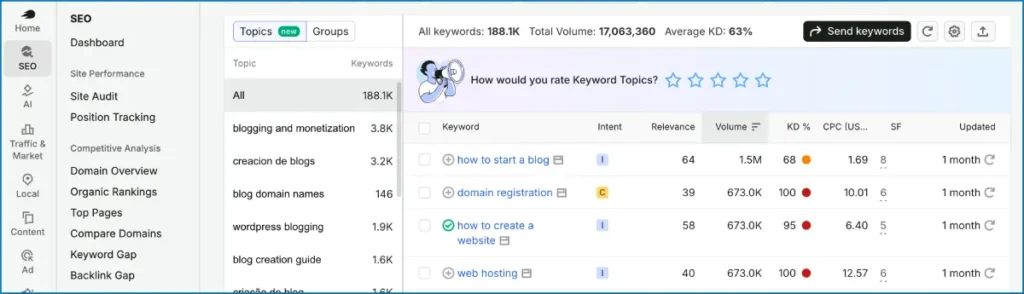
Keyword research is more than finding search terms with high monthly volume. You also need to understand search intent, competition, traffic potential, and whether a query is relevant to your website.
All three platforms provide keyword research tools, but they organize their data and workflows differently.
Semrush Keyword Magic Tool
Semrush is useful when you want to expand a seed keyword into a large collection of related queries and organize them into potential content topics.
For example, a website covering web hosting might start with “WordPress hosting” and investigate variations such as:
- Managed WordPress hosting
- Cheap WordPress hosting
- WordPress hosting for small businesses
- WordPress hosting with free migration
- Best WordPress hosting providers
You can then investigate search intent, estimated volume, keyword difficulty, and competing pages to decide which topics deserve attention.
The advantage is the connection between keyword discovery and broader competitor research. You can investigate the search landscape without treating each keyword as an isolated task.
The limitation is that a large list of suggestions can contain near-duplicates and low-value queries. More keyword suggestions do not automatically mean better keyword research.
Ahrefs Keywords Explorer
Ahrefs Keywords Explorer helps you discover keyword ideas, evaluate difficulty, investigate search results, and examine click-related metrics.
Those click metrics can be useful because search volume does not tell you how much traffic an organic result will receive. A query may have substantial search demand but generate fewer organic clicks because of advertisements, AI-generated answers, featured results, or other SERP features.
Ahrefs also makes it useful to move from keyword research into competitor-page analysis. You can examine pages that already rank and identify related topics that your website could cover more effectively.
Moz Keyword Explorer
Moz Keyword Explorer provides keyword suggestions, search-volume estimates, difficulty metrics, and SERP-related information.
It may be sufficient if your process focuses on identifying relevant keywords and prioritizing manageable opportunities. If you conduct extensive research across many websites, countries, and commercial topics, compare Moz’s available limits with those of Semrush and Ahrefs.
Which tool is best for keyword research?
There is no universal winner for every market or keyword.
| Your priority | Tool to evaluate first |
|---|---|
| Keyword research combined with paid search and broader marketing data | Semrush |
| Organic competitor pages, keyword opportunities, and click-related metrics | Ahrefs |
| Focused keyword research and a simpler SEO workflow | Moz |
For a fair comparison, use the same keywords and target country in each tool. Compare the relevance of the suggestions and the usefulness of the competing pages they identify, rather than choosing the tool that reports the largest number of keywords.
3. Backlink Analysis: Ahrefs vs Semrush vs Moz
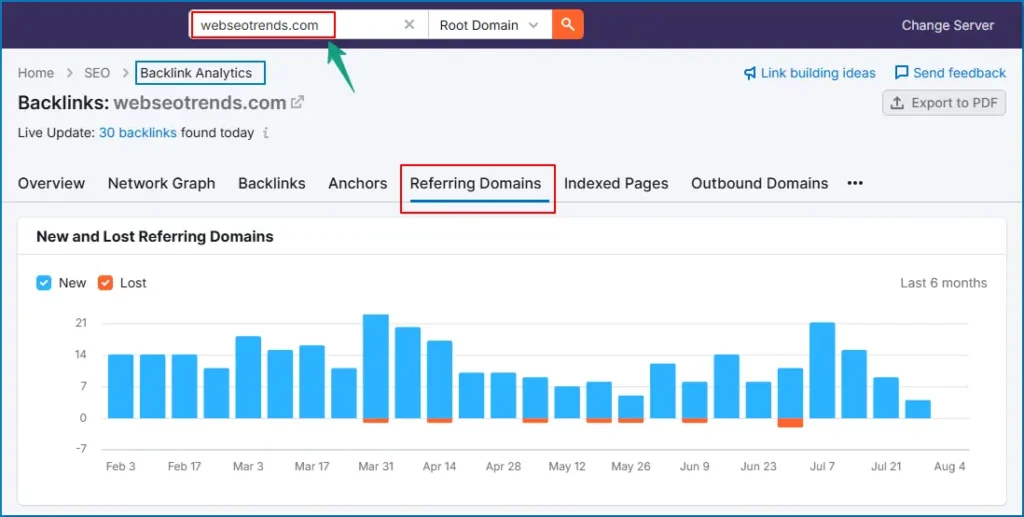
Backlink analysis is one of the most important differences to consider if you manage link building, digital PR, competitor research, or website acquisitions.
These platforms help you investigate referring domains, discover linking pages, monitor new and lost links, and identify potential outreach opportunities. However, none has a complete record of every link on the internet.
Ahrefs for backlink analysis
Ahrefs is a strong option for backlink-focused SEO. Site Explorer lets you examine backlinks, referring domains, linking pages, and competitor link profiles.
You can use this information to investigate why a competitor’s article attracts links and identify publishers that might be interested in your own useful resources.
For example, suppose a competing hosting guide attracts links from technology blogs. Rather than copying its backlink profile, you can inspect the linking pages, determine what made the resource worth citing, and develop something that offers a genuine improvement.
Ahrefs is particularly attractive when this kind of investigation is a regular part of your work.
Semrush for backlink analysis
Semrush offers Backlink Analytics and backlink auditing features. You can research competitors, inspect referring domains, and monitor changes in link profiles.
Its main advantage is integration with the wider platform. If you already use Semrush for keyword research, rank tracking, and paid search analysis, you can keep more of your research in one place.
However, backlink reports still require judgment. A high authority score does not automatically make a link valuable, and a large number of referring domains does not guarantee better rankings.
Moz Link Explorer
Moz Link Explorer provides backlink data alongside metrics such as Domain Authority and Page Authority.
This can be useful when you compare potential outreach targets or need Moz’s metrics for reporting. Its value depends on whether the data and features fit your specific workflow.
Domain Authority vs Domain Rating vs Authority Score
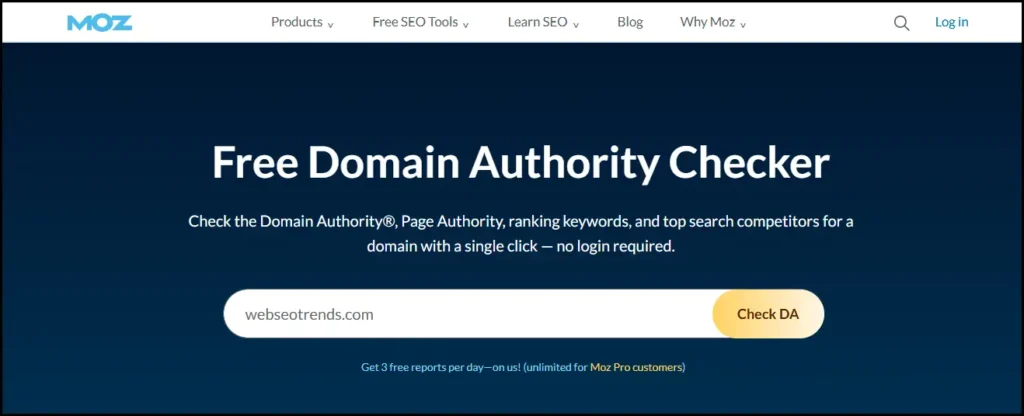
This is an important distinction when comparing these platforms.
- Domain Authority (DA) is Moz’s proprietary metric.
- Domain Rating (DR) is Ahrefs’ proprietary measure of backlink profile strength.
- Authority Score (AS) is Semrush’s proprietary metric that combines backlink-related and other signals.
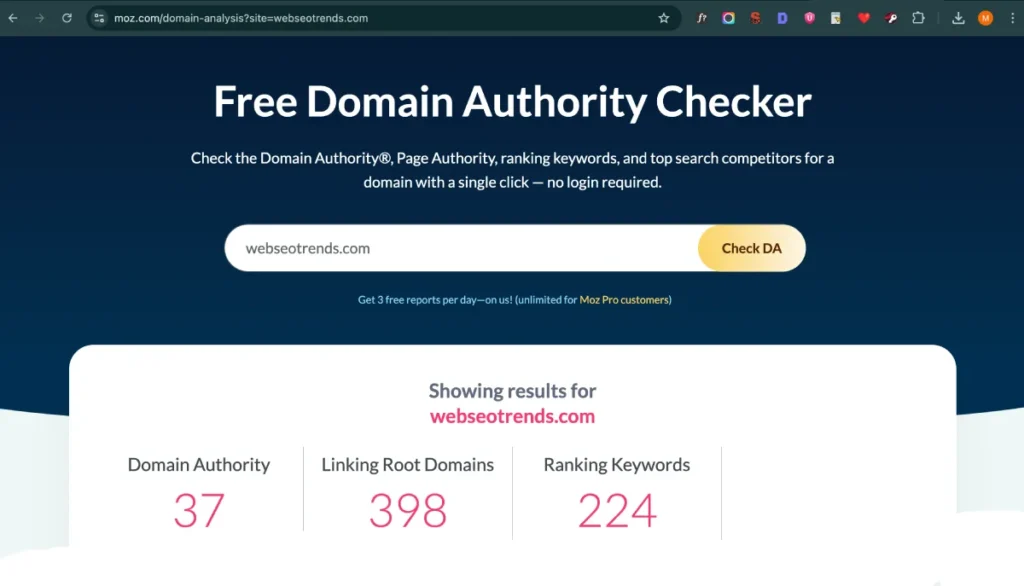
These scores are not interchangeable. A website with a DA of 40, DR of 40, and Authority Score of 40 does not necessarily have equivalent strength according to each provider.
None of these metrics is a Google ranking score, and none should be treated as a direct ranking factor.
For a deeper explanation, read our guide to Ahrefs DR vs Moz DA.
Which tool should you choose for backlinks?
Ahrefs deserves a close look if backlink research is your main priority. Semrush is a strong alternative if you want backlink analysis within a broader marketing suite. Moz makes sense if its link research and authority metrics suit your needs.
For the most useful comparison, test the same domains in each platform. Examine the quality and relevance of discovered links, the freshness of the results, and whether the reports help you make better decisions.
Do not choose a platform based solely on the number of backlinks it claims to have indexed.
4. Competitor Analysis: Which Tool Gives You Better Insights?
Competitor analysis should help you answer practical questions:
- Which pages attract organic traffic?
- Which keywords do competitors rank for?
- What content topics have they covered that your website has missed?
- Which pages attract relevant backlinks?
- Are they gaining visibility through organic search, paid advertising, or both?
- Which opportunities are realistic for your website to pursue?
Semrush
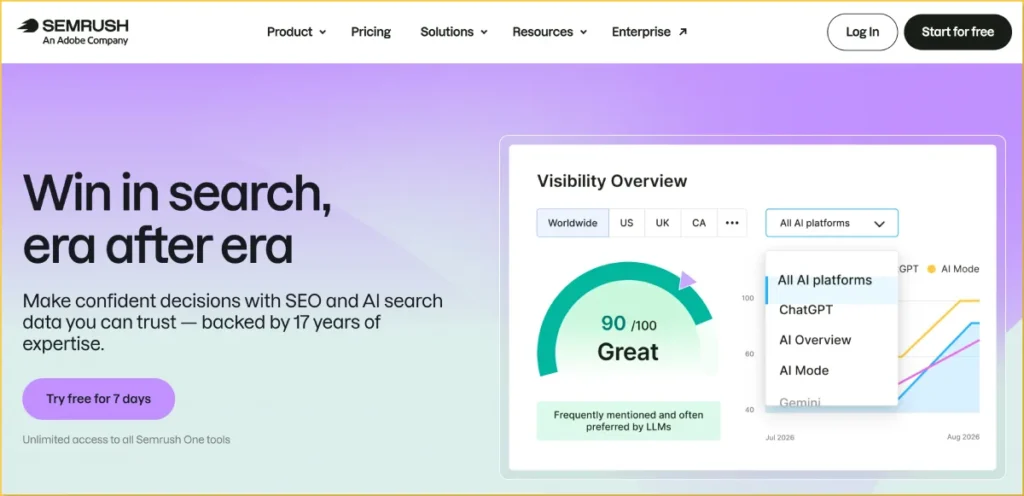
Semrush combines organic competitor research with paid search and broader market intelligence.
That combination is useful if you want to understand how competitors attract visibility through both SEO and advertising. For instance, you can investigate whether a competitor ranks organically for a commercial keyword while also bidding on related search terms.
This does not mean that copying the competitor’s strategy is automatically a good idea. It gives you more information for deciding where to invest your own resources.
Ahrefs
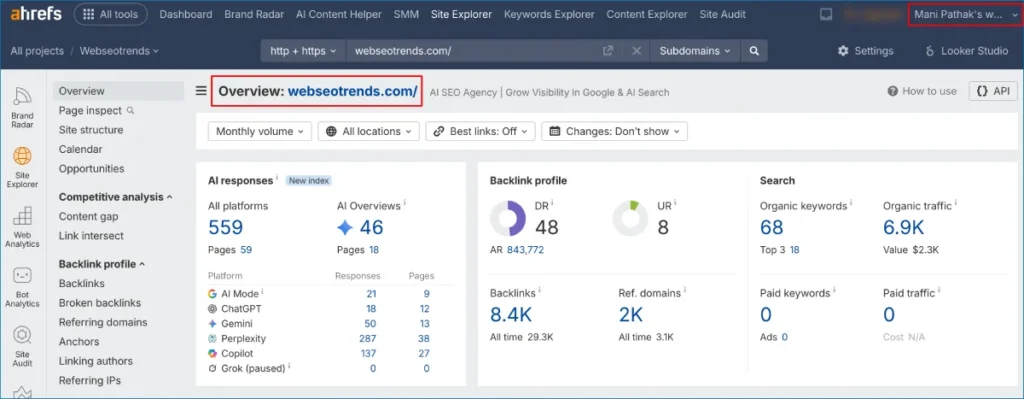
Ahrefs is particularly useful for investigating competitors’ organic keywords, top pages, and backlink profiles.
You can examine pages that attract rankings and links, then use those findings to identify potential content gaps. A competing page may succeed because it contains original research, answers a difficult question, or offers a useful resource that other websites cite.
Understanding why a page performs well is more valuable than simply reproducing its topic.
Moz
Moz provides competitor research and link analysis capabilities that can support domain comparisons and SEO planning.
For smaller campaigns, its features may be sufficient. For extensive research involving many competitors, large keyword sets, and paid advertising, compare its current capabilities and subscription limits against Semrush and Ahrefs.
Which tool is best for competitor research?
Semrush is a strong option when you need organic and paid search insights together. Ahrefs is an excellent candidate for organic page and backlink research. Moz is worth considering when its reporting and authority metrics fit your requirements.
Remember that third-party traffic figures are estimates. For your own website, Google Search Console and analytics data provide the evidence needed to evaluate actual search performance and visitor behavior.
5. Technical SEO: Semrush vs Ahrefs vs Moz
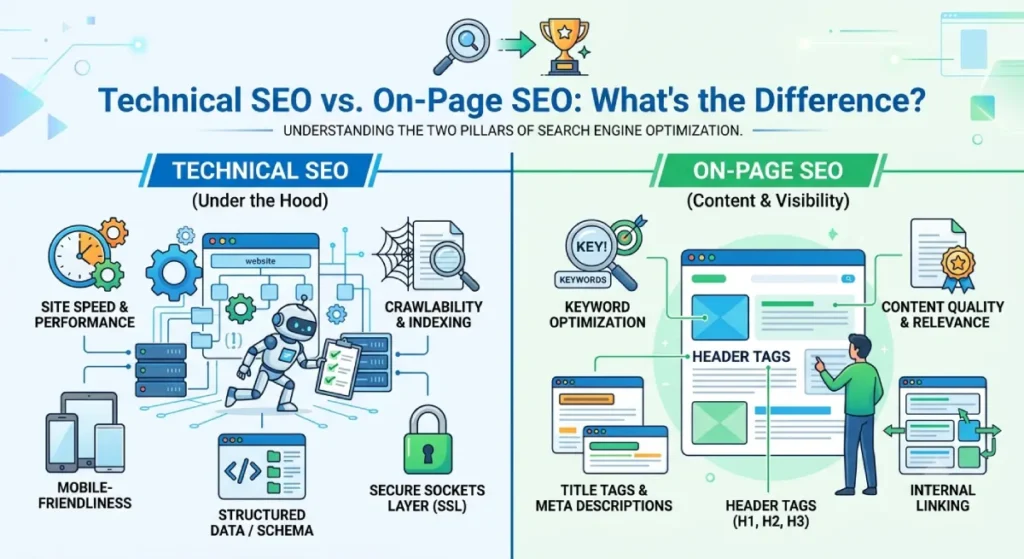
Technical SEO tools help you identify problems that could affect crawling, indexing, page accessibility, or user experience.
All three platforms offer website auditing capabilities. Depending on the plan and configuration, their crawlers can identify issues involving broken links, redirects, missing metadata, duplicate pages, and other technical concerns.
Semrush Site Audit
Semrush Site Audit is useful for finding and prioritizing technical and on-page SEO issues. It can help you monitor changes over time and keep technical findings within the same workflow as your keyword research and reporting.
It is particularly convenient if your team already uses Semrush for other marketing tasks.
Ahrefs Site Audit
Ahrefs Site Audit crawls websites and reports technical problems. It can help investigate broken links, redirect issues, orphan pages, and other potential problems affecting a website.
Its value is greatest when technical auditing is part of a broader organic SEO process involving competitor analysis and backlink research.
Moz Site Crawl
Moz Pro includes site-crawling functionality that helps identify technical and on-page issues. It may be suitable for smaller campaigns and teams that want to manage website health alongside keyword and ranking data.
Before choosing a plan, check the crawl limits against the size of your website and the number of sites you manage.
Which tool is best for technical SEO?
There is no universal winner. The better tool is the one that crawls your website reliably, identifies meaningful issues, and presents findings you can act on.
A report containing hundreds of warnings is not automatically better than one containing fewer issues. Some findings require context, and fixing every warning is not a substitute for prioritizing problems that actually matter.
6. Rank Tracking: Semrush vs Ahrefs vs Moz

Rank tracking helps you monitor the search positions of selected keywords over time.
Semrush Position Tracking supports daily updates on eligible plans. Ahrefs Rank Tracker has its own update schedule and plan-dependent limits. Moz also provides rank tracking through its campaign-based workflow.
Before comparing them, check whether each plan supports the locations, devices, keywords, and update frequency you need.
A fair test should use the same target keywords, country, device, and tracking period wherever possible.
Also remember that rankings fluctuate. A keyword moving from position 8 to position 6 is useful information, but it does not necessarily mean traffic or conversions increased. Search features, location, device, and changes in search intent can all affect the results.
Choose Semrush if daily tracking and wider reporting fit your requirements. Consider Ahrefs for organic SEO workflows and Moz for its campaign-based approach. The best option is the one that provides enough reliable data without forcing you to pay for unnecessary capacity.
7. Content Research and On-Page SEO
A keyword tool can identify opportunities, but it cannot guarantee that your content will deserve to rank.
Semrush offers keyword research and content marketing tools that help connect topic discovery with content planning and optimization. Ahrefs helps you investigate competing pages, identify content opportunities, and analyze the organic performance of existing resources. Moz supports keyword research and on-page SEO workflows.
Suppose you want to publish a guide about WordPress hosting. You can use these tools to identify relevant queries, examine competing pages, and discover questions your article needs to answer.
The final content still needs to be accurate, useful, and aligned with the reader’s intent. Following every optimization suggestion or reaching a particular content score does not guarantee rankings.
If you want to compare more products in this category, see our best SEO tools guide.
8. AI Search Visibility in 2026
AI-generated search experiences have made visibility tracking more complicated. Businesses increasingly want to understand whether their brands appear in AI answers, which competitors are mentioned, and how visibility changes across different platforms.
Semrush offers AI visibility capabilities through eligible plans and products. Ahrefs provides Brand Radar and AI prompt-tracking options. Moz also offers AI visibility features on eligible subscriptions.
However, these features do not necessarily measure the same thing. Some track selected prompts, while others analyze brand mentions across their own datasets or provide visibility reports for particular AI platforms.
Before paying for an AI visibility product, determine what you need to measure:
- Do you want to monitor a set of prompts regularly?
- Do you need to compare brand mentions with competitors?
- Do you want visibility reporting across multiple AI platforms?
- Will the data help you make a specific content or marketing decision?
Choose the product whose coverage, update frequency, and reporting match those needs. An AI visibility score is not a substitute for organic rankings, qualified website traffic, or conversions.
9. Semrush vs Ahrefs vs Moz vs Ubersuggest
Ubersuggest is worth considering if you want to keep your SEO software costs down.
Semrush and Ahrefs offer extensive research workflows. Moz combines keyword and link analysis with its domain metrics. Ubersuggest provides a more budget-conscious option for keyword discovery, competitor research, and basic SEO analysis.
The products differ in their available data, limits, and feature depth, so do not assume that a lower-priced subscription will offer the same capabilities as a more expensive suite.
| Tool | Consider it when |
|---|---|
| Semrush | You need broad SEO and marketing research |
| Ahrefs | Backlink analysis and organic competitor research are central |
| Moz | You value DA and its focused SEO workflow |
| Ubersuggest | You want a more budget-conscious SEO research option |
If you have narrowed your choice to two tools, our Ubersuggest vs Ahrefs comparison explores that decision in more detail.
10. Which SEO Tool Should You Choose?
The easiest way to decide is to start with your main SEO task instead of the feature list.
Choose Semrush if you need SEO and marketing research together
Semrush is a strong choice for agencies, in-house marketers, and businesses that need keyword research, organic competitor analysis, rank tracking, site audits, and paid search insights.
Its broader feature set is useful when you use several of those capabilities regularly. If you only need occasional backlink checks, a full subscription may be unnecessary.
For more details about the platform itself, read our Semrush review.
Choose Ahrefs if backlink research is a major part of your work
Ahrefs is worth evaluating if you spend much of your time examining backlinks, investigating competing pages, finding organic keyword opportunities, and developing content strategies.
Check the subscription limits carefully if you manage many websites or need extensive reports. The right plan should support your workflow without making you pay for unused capacity.
If you are comparing other options, see our guide to the best Ahrefs alternatives.
Choose Moz if its metrics and workflow meet your needs
Moz can be a sensible choice if you regularly use Domain Authority, keyword research, site crawling, and its campaign-based reporting features.
However, do not buy a full subscription solely to obtain a DA number for link prospecting. Consider whether the additional features will help you make better decisions and justify the recurring cost.
Choose Ubersuggest if budget is your main concern
If you are a beginner, blogger, or small business owner, a budget-conscious tool combined with free resources may be enough to start.
Google Search Console provides first-party information about your own site’s Google Search performance. Google Analytics helps you understand visitor behavior. You may still need a paid suite for deeper competitor research, but you do not necessarily need to purchase one immediately.
11. Can You Use Semrush, Ahrefs, and Moz Together?
Yes, but using all three is not automatically a good investment.
An agency might use Ahrefs for backlink research, Semrush for paid search and broader competitive analysis, and Moz for DA reporting. That combination can make sense if each subscription serves a distinct purpose.
For a freelancer or small website owner, however, three overlapping subscriptions can be difficult to justify.
Start with the tool that addresses your most important research need. Use it consistently, identify the gaps that affect your work, and add another subscription only when you can explain what it contributes.
This approach keeps costs manageable and makes it easier to determine whether the additional data actually improves your SEO decisions.
Frequently Asked Questions
Is Semrush better than Ahrefs?
Semrush is often a better fit when you need SEO research and paid advertising insights in one platform. Ahrefs is particularly strong for backlink analysis and organic competitor research. Neither is universally better; the right choice depends on your workflow and plan limits.
Is Ahrefs better than Moz?
Ahrefs is a strong option for backlink-focused research and organic competitor analysis. Moz may be a better fit if you rely on Domain Authority and prefer its workflow. Compare the current features and limits rather than assuming one tool is superior for every task.
Is Moz better than Semrush?
Moz may be sufficient if its keyword research, link metrics, and site auditing features cover your requirements. Semrush is more attractive if you need broader marketing research, including paid search analysis. Your actual use case should determine the choice.
Which tool has the most accurate keyword data?
There is no universal winner for every keyword, country, and search type. Each provider uses its own data sources and estimation methods. Compare the same keywords across platforms and use Google Search Console to evaluate your own website’s actual search performance.
Which tool has the best backlink database?
Ahrefs is a strong candidate for backlink-focused research, while Semrush and Moz also provide backlink analysis. Database size alone does not establish which tool will discover the most useful links for your particular niche. Compare the relevance, freshness, and usefulness of the results.
Is Domain Authority a Google ranking factor?
No. Moz Domain Authority is a third-party metric designed to estimate the relative ranking potential of a domain. Ahrefs DR and Semrush Authority Score are also proprietary metrics, not Google ranking scores. They can help with competitive analysis, but they should not be treated as direct ranking factors.
Can you use Semrush, Ahrefs, or Moz for free?
Each provider offers some form of free access or limited tools, but the available features differ. Check the official websites for current restrictions. Free resources may be sufficient for occasional checks, while regular competitor research may justify a paid subscription.
Which SEO tool is best for beginners?
The best choice is the one that matches your budget and makes your regular tasks manageable. Moz or Ubersuggest may suit users who prefer a more focused or budget-conscious workflow. Semrush and Ahrefs can also be useful for beginners, although their extensive features may take time to learn.
Should I pay for all three tools?
Only if each subscription serves a distinct purpose that justifies its cost. Most small businesses and independent website owners should start with one platform and supplement it with free resources. Add another subscription when you identify a specific need your existing setup cannot address efficiently.
Final Verdict: Semrush vs Ahrefs vs Moz
There is no universal winner in the Semrush vs Ahrefs vs Moz comparison. Each platform serves a different set of priorities.
Semrush is my first recommendation for broad SEO and digital marketing research. Ahrefs is a strong choice for backlink-led SEO and organic competitor analysis. Moz is worth considering when Domain Authority and its SEO workflow meet your needs.
If budget is your biggest concern, compare Ubersuggest and free SEO resources before committing to a premium subscription.
Do not choose a platform because it claims to have the biggest database or because another SEO professional prefers it. Evaluate it against the work you actually need to do: researching keywords, analyzing competitors, finding relevant links, identifying technical problems, and measuring progress.
The best SEO tool is the one that helps you make better decisions consistently—not the one that produces the longest reports.
