


Google, Bing, and ChatGPT are three major platforms people use to find information, research topics, and answer questions online. However, they work differently. Google and Bing are traditional search engines, while ChatGPT is an AI assistant that can generate conversational answers and help users explore information.
Google continues to dominate traditional search engine activity worldwide. Microsoft Bing holds a smaller share but has a stronger position on desktop than on mobile. Meanwhile, ChatGPT has become an important channel for AI-assisted information discovery, creating new opportunities for publishers and businesses.
According to StatCounter, Google accounted for 89.94% of worldwide search engine market share in September 2026, compared with 5.29% for Bing. ChatGPT usage is measured differently, so its audience cannot be compared directly with these percentages.
In this guide, we compare Bing vs. Google vs. ChatGPT using market share, user statistics, regional data, device usage, historical trends, and the implications for websites competing for organic search traffic.
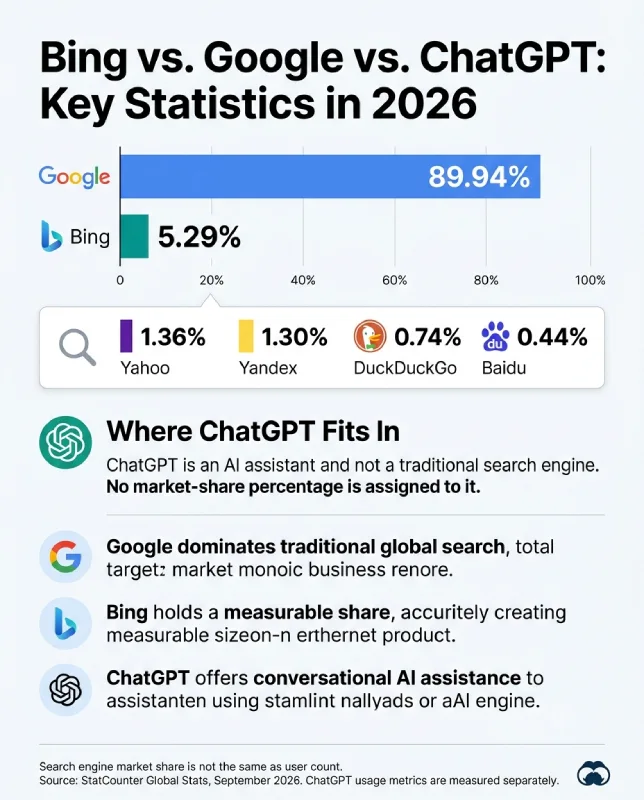
Bing vs. Google vs. ChatGPT: Key Statistics in 2026
The most useful way to compare these platforms is to examine their respective audiences, search activity, and roles in information discovery.
| Statistic | Reported figure | Reporting period |
|---|---|---|
| Google worldwide search market share | 89.94% | September 2026 |
| Bing worldwide search market share | 5.29% | September 2026 |
| Google search market share in Europe | 88.97% | September 2026 |
| Bing search market share in Europe | 5.34% | September 2026 |
| Bing desktop search market share worldwide | 14.62% | September 2026 |
| Bing mobile search market share worldwide | 0.69% | September 2026 |
Source: StatCounter Global Stats. Market share varies by country, device, and reporting period.
These figures demonstrate Google’s dominance in traditional search and Bing’s stronger relative position on desktop computers.
ChatGPT requires a separate measurement. Its audience can be evaluated using monthly active users, weekly active users, website visits, or app usage. These metrics measure different things and should not be added to search engine market-share percentages.
For website owners, the important question is how each platform contributes to visibility, visitors, and conversions. A platform with a smaller overall audience may still be valuable if it reaches the right people.
Bing vs. Google vs. ChatGPT Market Share
Global search engine market share in 2026
According to StatCounter’s September 2026 worldwide data, Google held 89.94% of measured search engine activity, while Bing accounted for 5.29%.
Other search engines, including Yahoo, Yandex, DuckDuckGo, and Baidu, accounted for smaller shares.
| Search engine | Worldwide market share |
|---|---|
| 89.94% | |
| Bing | 5.29% |
| Yahoo | 1.36% |
| Yandex | 1.30% |
| DuckDuckGo | 0.74% |
| Baidu | 0.44% |
Source: StatCounter Global Stats, September 2026.
Market share represents the distribution of measured search activity, not the percentage of internet users who use a particular service. A person may use Google for one query, Bing for another, and ChatGPT for a more complex question.
Google’s position reflects its established search ecosystem, broad device reach, and integration into browsers and mobile experiences. Bing benefits from Microsoft’s products, including Windows and Edge, as well as its integration with Microsoft’s AI offerings.
For additional context, our guide to the most visited websites in 2026 explores how website visits differ from search engine market share. A website can receive billions of visits without those visits representing unique users or search queries.
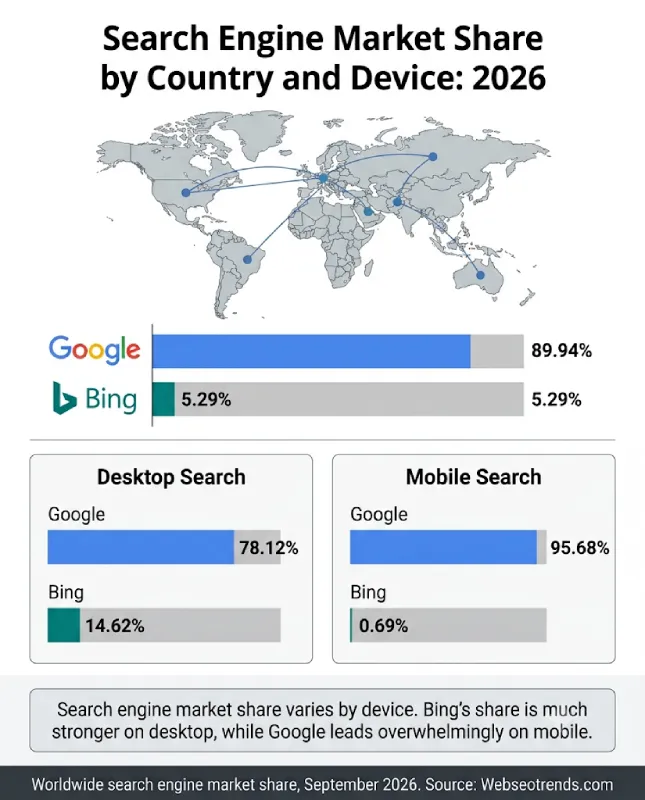
Bing vs. Google market share
Google’s worldwide search market share was approximately 17 times Bing’s in September 2026.
That gap is significant, but it does not mean businesses should ignore Bing. Search engine performance depends on the audience, device mix, industry, competition, and quality of the traffic each platform delivers.
For example, a software company targeting professionals who work on desktop computers may find Bing more valuable than a global market-share comparison suggests. A consumer website whose audience primarily uses mobile devices may experience a different distribution.
Rather than assuming that Google and Bing will contribute traffic in proportion to their worldwide shares, website owners should compare their own impressions, clicks, engagement, and conversions from each platform.
Google vs. ChatGPT usage and market share
Google Search and ChatGPT have overlapping but different purposes.
Google primarily helps users discover information through search results, websites, local listings, images, videos, and other resources. ChatGPT provides conversational answers, explanations, summaries, and assistance with a wide range of tasks.
Google’s search market share can be measured using StatCounter. ChatGPT’s audience is better evaluated through user activity and platform usage statistics.
This distinction matters because a monthly active user is not the same as a search query, website visit, or share of search activity.
ChatGPT may help someone understand a subject without that person visiting an external website. In other cases, a user may follow a source or recommendation to a publisher’s site. These behaviors affect how businesses should measure the value of AI-driven discovery.
Search engines vs. AI chatbots
The main differences are in how people interact with each platform.
| Feature | Bing | ChatGPT | |
|---|---|---|---|
| Primary function | Web search | Web search | Conversational AI assistance |
| Traditional search results | Yes | Yes | Not its primary interface |
| Conversational answers | AI features available | AI features available | Core experience |
| Website discovery | Search results and other features | Search results and other features | Responses may include sources and links |
| Useful measurement | Search impressions and clicks | Search impressions and clicks | Active users, referrals, and usage |
These are broad product distinctions, not a ranking of quality. Features change over time, and the services increasingly overlap.
How Many People Use Bing, Google, and ChatGPT?
User statistics are popular because they help businesses understand the potential reach of each platform. However, there is no single public dataset that measures unique users across all three services using identical definitions.
How many people use Bing?
Microsoft does not provide a continuously updated public count of Bing’s unique monthly users that is directly comparable with every other platform’s monthly active-user figures.
StatCounter provides a useful alternative measure of Bing’s position in traditional search. In September 2026, Bing accounted for 5.29% of worldwide search activity and 14.62% of desktop search activity.
These figures demonstrate that Bing is an established search alternative, particularly on desktop. They do not mean that 5.29% of all internet users use Bing, nor do they reveal the exact number of unique monthly users.
Bing also operates within Microsoft’s wider ecosystem. Some users access it through a browser or an integrated Microsoft experience rather than visiting the Bing homepage directly.
How many people use Google?
Google has the largest share of traditional search activity worldwide. StatCounter reported a worldwide market share of 89.94% in September 2026.
However, this figure should not be described as Google’s percentage of internet users. Market share measures search activity, whereas user counts measure people active during a particular period.
A single person can conduct many searches in a day, use multiple devices, or access Google through different interfaces.
When discussing Google’s audience, always distinguish between unique users, monthly visits, search volume, and search engine market share.
How many people use ChatGPT?
ChatGPT has become a major consumer AI platform, but its audience size depends on the reporting period and measurement method.
OpenAI publishes information about ChatGPT adoption through its research and announcements. Third-party organizations also estimate monthly active users, website visits, and other usage metrics.
When using a ChatGPT user statistic, check whether it measures:
- Monthly active users.
- Weekly active users.
- Website visits or sessions.
- App users or downloads.
- Messages or prompts submitted.
These metrics are not interchangeable. Website visits, for example, can include multiple visits by the same person, while app downloads do not establish how many people actively use the service.
For an accurate comparison, cite the original report, identify its reporting period, and label independent estimates as estimates rather than official user counts.
Bing users vs. Google users
Google has a much larger share of traditional search activity, but Bing’s position becomes more significant when the comparison focuses on desktop computers.
| Device category | Bing | |
|---|---|---|
| Worldwide, all platforms | 89.94% | 5.29% |
| Worldwide desktop | 78.12% | 14.62% |
| Worldwide mobile | 95.68% | 0.69% |
Source: StatCounter Global Stats, September 2026.
The difference is important for businesses with a desktop-heavy audience, including B2B companies, software publishers, and professional service providers.
However, these figures still measure search activity rather than unique users. A proper user-count comparison would require comparable audience data for both platforms.
ChatGPT users and monthly usage statistics
ChatGPT usage is different from traditional search because many conversations are completed without the user clicking through to another website.
People use ChatGPT to research topics, generate ideas, explain complex concepts, draft content, and compare options. Some of those activities lead to website visits, while others do not.
For publishers, this creates a distinction between being used as a source in an AI-generated answer and receiving a referral visit from that answer.
Both may matter, but they should be measured separately. AI visibility and referral traffic are not the same thing, and neither guarantees a conversion.
Bing Market Share by Country in 2026
Bing’s market share differs across countries. Browser usage, device preferences, local search habits, and competition from other search engines all contribute to these differences.
The following examples illustrate the importance of using country-specific data rather than relying on a worldwide average.
| Country or region | Bing | |
|---|---|---|
| Worldwide | 89.94% | 5.29% |
| Europe | 88.97% | 5.34% |
| United States | 85.19% | 9.89% |
| United Kingdom | 91.39% | 6.08% |
| Netherlands | 89.14% | 4.60% |
| India | 96.63% | 1.92% |
Source: StatCounter Global Stats, September 2026. Country-level figures should be rechecked against the relevant dataset before publication.
These differences have practical implications. Bing’s position in the United States is stronger than in India, for example. A business targeting multiple countries should therefore review search performance by location rather than applying one global estimate to every market.
Bing market share in the United States
In September 2026, Bing held 9.89% of the measured US search market, while Google held 85.19%.
This makes Bing a relevant secondary channel for US-focused businesses. Its value depends on whether it reaches the right audience and generates qualified traffic.
Publishers should compare search impressions, clicks, and conversions from both engines to determine how much effort each channel deserves.
Bing market share in the United Kingdom
StatCounter measured Bing’s UK search market share at 6.08% in September 2026, compared with Google’s 91.39%.
For businesses targeting British audiences, Bing can provide additional search visibility alongside Google. The actual contribution will vary by industry, device, and query type.
Bing market share in Canada
Canada should be evaluated using the latest country-specific data rather than assuming its market share matches the United States or the United Kingdom.
When publishing an exact figure, use the same reporting month and device scope for both Bing and Google. This keeps the comparison consistent and makes future updates easier.
Bing market share in Germany and France
Germany and France are important European search markets, but their individual Bing percentages may differ from the European average.
Use the relevant country-level StatCounter datasets to establish the latest figures. Avoid presenting regional data as if it represents every country within that region.
Bing market share in the Netherlands
The Netherlands is an important target for the keyword “Bing market share Netherlands.”
In September 2026, Google held 89.14% of the measured Dutch search market, while Bing held 4.60%, according to the figures used in this comparison.
This is below Bing’s reported worldwide share of 5.29%. The difference illustrates why regional data is useful for publishers and businesses targeting a specific country.
For a more detailed comparison, desktop and mobile figures should be examined separately because the distribution can differ considerably by device.
Bing market share in India
India has a particularly strong Google position. The September 2026 figures used here put Google’s search market share at 96.63%, compared with 1.92% for Bing.
This does not mean Bing has no value for Indian businesses. A smaller channel may still contribute relevant traffic, particularly for specialized audiences or desktop-focused searches.
The appropriate approach is to evaluate Bing’s actual performance rather than dismissing it based on market share alone.
Bing market share in Australia
Australia should be assessed using the latest Australian country dataset. Its percentage should not be inferred from worldwide or European figures.
Businesses targeting Australia should compare Bing and Google by device, landing page, and conversion performance before deciding how much effort to allocate to each platform.
Search Engine Market Share in Europe: Bing vs. Google
Bing’s market share in Europe in 2026
StatCounter’s September 2026 figures show the following distribution of search engine activity in Europe.
| Search engine | European market share |
|---|---|
| 88.97% | |
| Bing | 5.34% |
| Yandex | 2.39% |
| Yahoo | 1.56% |
| DuckDuckGo | 0.78% |
| Ecosia | 0.48% |
Source: StatCounter Global Stats, September 2026.
Google leads the European market by a substantial margin, while Bing holds the second-largest share among the engines listed above.
For website owners, these numbers support a practical strategy: prioritize Google because of its scale, but monitor Bing separately to identify additional opportunities.
Bing market share in the Netherlands in 2026
Bing’s Dutch market share was lower than its European share in the September 2026 comparison.
This matters for country-specific SEO because an overall European figure can conceal differences between individual markets. A business focused on the Netherlands should use Dutch data when making decisions about search traffic and marketing budgets.
Google vs. Bing market share across Europe
Google’s dominant position makes it the primary traditional search channel for many European businesses. Bing remains a useful secondary channel, particularly where its desktop audience overlaps with the business’s target customers.
The right approach is not to distribute SEO effort according to market share alone. Instead, measure how each search engine contributes to organic traffic, engagement, leads, and sales.
Bing Market Share by Device: Desktop vs. Mobile
Device-level statistics reveal one of the clearest differences between Google and Bing.
In September 2026, StatCounter measured Bing’s worldwide desktop search share at 14.62%, compared with 0.69% on mobile.
Bing desktop search market share
Bing held 14.62% of worldwide desktop search activity in September 2026. Its desktop share was substantially higher than its share across all platforms.
This can matter for B2B websites, professional services, software companies, and publishers whose audiences spend considerable time working on desktop computers.
However, desktop share alone does not guarantee traffic. Rankings, keyword demand, content relevance, and competition determine whether a particular website receives visitors.
Bing mobile search market share
Bing’s worldwide mobile search share was 0.69% in September 2026, compared with Google’s 95.68%.
This difference shows why businesses should avoid using overall market share as a direct estimate of their mobile search traffic.
If most visitors to a website use smartphones, Google’s much larger mobile share may be more representative of the available search audience.
Google vs. Bing desktop and mobile market share
The gap between desktop and mobile market share is one reason to segment analytics reports by device.
Compare impressions, clicks, conversions, and engagement for Google and Bing separately on desktop and mobile. This will show whether Bing is contributing meaningful results for your particular audience.
Bing Market Share History: 2018–2026
Historical data helps distinguish long-term changes from short-term fluctuations.
StatCounter maintains historical search engine market-share datasets that can be used to compare Bing and Google across years, countries, and device categories.
Bing market share in 2018
To report Bing’s market share in 2018 accurately, specify whether the figure represents an annual average or a particular month. These two measurements can differ.
Historical comparisons should use a consistent method throughout the series rather than mixing annual averages with individual monthly observations.
Bing market share from 2020 to 2025
Search behavior, device usage, and the search product landscape evolved between 2020 and 2025. However, the direction and scale of Bing’s market-share changes should be established using historical data rather than inferred from product announcements.
A useful historical table should include the year, reporting period, worldwide market share, and device scope.
Bing market share trends in 2026
In September 2026, Bing held 5.29% of worldwide search market share and 14.62% of desktop search market share.
These figures confirm that Bing’s relative position is stronger on desktop. To determine whether it gained or lost market share during 2026, compare the monthly figures across the same dataset.
How Google’s search market share has changed
Google accounted for 89.94% of worldwide search engine market share in September 2026.
Its long-term trend should be evaluated using a consistent historical series. One monthly observation cannot establish whether a search engine is gaining or losing ground over time.
Bing vs. Google vs. ChatGPT: Usage and Search Trends
How often do people use Bing and Google?
Google and Bing operate at different scales, but their market-share percentages do not reveal the number of unique users or exact daily searches.
A person can use both services, and the frequency of searches varies by individual. Market share describes the distribution of measured search activity, not the proportion of people who use a service.
How many Google searches happen each day?
Third-party organizations publish estimates of Google’s daily search volume, but their figures may differ because of their methodology and reporting periods.
Any specific daily search count should be attributed to its original source and clearly labeled as an estimate unless Google has confirmed it.
For SEO work, keyword-level impressions, clicks, and conversions are generally more useful than a broad global search-volume estimate.
How ChatGPT usage compares with traditional search
Traditional search engines help users discover and evaluate external resources. ChatGPT provides a conversational interface that can summarize information, explain topics, and support follow-up questions.
The two behaviors can overlap. Someone might use ChatGPT to understand a topic, Google to find a product, and Bing to search within a desktop workflow.
The growth of AI assistants does not, by itself, establish that traditional search usage is declining.
How AI search is changing search behavior
AI tools are changing how some users research questions and compare options. Users can ask follow-up questions and receive synthesized answers without necessarily opening multiple pages.
For website owners, this creates an additional discovery channel. However, AI visibility does not guarantee clicks or sales.
Our guide to AI SEO and optimizing for AI search explains how crawlability, helpful content, clear structure, and trust contribute to visibility across traditional and AI-powered search experiences.
Bing vs. Google: Which Search Engine Is Better in 2026?
There is no single winner for every use case. Google leads traditional search market share, Bing integrates with Microsoft’s ecosystem, and ChatGPT specializes in conversational assistance.
Search results, features, and user experience
Google offers broad web discovery, including traditional search results, local information, products, images, and videos.
Bing provides traditional search alongside Microsoft ecosystem integrations and AI-powered features.
ChatGPT is useful for drafting, brainstorming, research, and explanations. As with other AI systems, its answers can contain errors, so important claims should be checked against reliable sources.
Bing AI and Microsoft Copilot vs. Google
Bing and Microsoft Copilot are connected through Microsoft’s ecosystem, but they are not identical products. Their features and access may vary by product, region, and account.
Google also offers AI-powered search experiences and separate AI products. Users should evaluate each platform according to the task they need to complete rather than assuming that one service is universally superior.
Is Bing better than Google for everyday searches?
Google is the stronger choice if the main consideration is worldwide traditional search reach.
Bing is a useful alternative, particularly for desktop users and people who work within Microsoft’s ecosystem. ChatGPT complements both services when a user wants conversational explanations or help working through a complex question.
For website owners, the more important question is which platform delivers qualified traffic to their content.
Bing vs. Google vs. ChatGPT Statistics: 2027 Outlook
Bing market share forecast for 2027
A precise 2027 Bing market-share figure should not be presented as fact without a transparent forecasting method.
Bing’s future position will depend on search quality, browser and operating system integration, user preferences, and competition from other search and AI products.
For an evergreen article, retain historical observations and update the latest figures when new data becomes available. Clearly label forecasts rather than presenting them as measured statistics.
Expected trends in Google and ChatGPT usage
Google is likely to remain an important traditional search platform, while AI assistants will continue to play a role in information discovery. However, current figures alone cannot establish the exact scale of future changes.
Businesses should monitor search visibility, clicks, conversions, and AI referral traffic to understand how their own audiences behave.
For broader context on the commercial value of organic visibility, see our guide to why SEO is important for business.
Frequently Asked Questions
What is Bing’s market share in 2026?
Bing held 5.29% of worldwide search engine market share in September 2026, according to StatCounter. Its share was higher on desktop and lower on mobile.
What is Bing’s market share in Europe?
Bing held 5.34% of European search engine market share in September 2026, while Google held 88.97%, according to StatCounter.
What is Bing’s market share in the Netherlands?
The September 2026 figures used in this article put Bing’s Dutch search market share at 4.60%, compared with Google’s 89.14%. Check the latest StatCounter country dataset before republishing these numbers.
How many people use Bing vs. Google?
A direct comparison of unique monthly users is difficult because the platforms do not publish continuously updated figures using identical definitions. StatCounter offers a comparable alternative for traditional search activity: Google held 89.94% and Bing held 5.29% of worldwide search market share in September 2026.
How many times has Google been searched on Bing?
There is no widely available authoritative public count of how many times users have entered the exact query “Google” into Bing. Market-share data does not reveal how often a specific term is searched.
Is Bing owned by Google?
No. Bing is Microsoft’s search engine, while Google Search is operated by Google, which is part of Alphabet.
How many people use ChatGPT in 2026?
The answer depends on the reporting period and definition of a user. Use a dated OpenAI announcement or a clearly documented third-party estimate, and distinguish monthly active users from website visits and app downloads.
Is ChatGPT replacing Google Search?
Current market-share figures do not establish that ChatGPT is replacing Google Search. The services have overlapping but different uses, and people can use both. Google remains dominant in traditional search activity, while ChatGPT provides conversational AI assistance.
Can ChatGPT drive traffic to websites?
Yes. ChatGPT can provide links and references that users may follow to external websites. The amount of traffic depends on the topic, the response, and user behavior.
Website owners can monitor AI referrals separately from traffic coming from Google and Bing.
Final Takeaway
Google remains the dominant traditional search engine, Bing holds a smaller but meaningful share—particularly on desktop—and ChatGPT offers another way for people to discover and work with information.
For businesses and publishers, the most useful strategy is to measure each platform using the appropriate metrics: search market share for traditional search engines, clearly sourced audience estimates for ChatGPT, and actual referral traffic and conversions for website performance.
Keep this article updated using consistent reporting periods and reliable data sources. Original analysis, accurate statistics, useful comparisons, and relevant internal links will make it more valuable to readers than a page that simply repeats market-share numbers.
