


Most people searching for the best domain registrar in India focus on the first-year price. A ₹99 .com or low-cost .in offer may look attractive, but renewal pricing, privacy, transfer fees, DNS management, support, and payment options matter more over the life of your domain.
I’ve worked with websites across India, the USA, and other markets. When comparing a domain provider in India, I look beyond introductory discounts. Whether it’s Hostinger, Namecheap, GoDaddy, BigRock, or Dynadot, I consider long-term costs, WHOIS privacy, DNS management, transfers, UPI payments, and GST invoices.
This guide compares the 10 best domain registrars in India based on pricing, renewal costs, features, security, support, and overall value. You’ll also learn about domain registration services, .com vs .in, and what to check before buying a domain.
Note: Domain prices may be subject to 18% GST and can change. Always verify current registration, renewal, transfer, and privacy costs directly with the registrar before purchasing.
Quick Answer: Best Domain Registrars in India
| Use Case | Recommended Registrar |
|---|---|
| Best for beginners | Hostinger |
| Best for long-term renewal pricing | Porkbun or NameSilo |
| Best for .in domains | BigRock or MilesWeb |
| Best for Indian businesses (INR + GST) | BigRock or MilesWeb |
| Best for UPI payments | Hostinger or BigRock |
| Best for domain privacy | Namecheap or Porkbun |
| Best for advanced DNS management | Cloudflare Registrar |
| Best for bulk domain registration | Dynadot or NameSilo |
| Best for domain + hosting bundle | Hostinger |
| Best for agencies | Namecheap or Dynadot |
| Best for at-cost renewals | Cloudflare Registrar |
The right registrar depends on your budget, how many domains you manage, whether you need INR billing, and what TLDs you need. I’ll explain each option in detail below.
Best Domain Registrars in India at a Glance
| Registrar | Best For | .com Registration | .in Registration | .com Renewal | Free Privacy | UPI / Indian Payment |
|---|---|---|---|---|---|---|
| Hostinger | Beginners, bundles | Promo from ₹1; regular ~₹909/yr | Promo from ₹1; renewal ₹899/yr | ~₹909/yr | Yes | Yes (UPI, cards, net banking) |
| Namecheap | Value, privacy | ~₹570 promo ($6.79); renewal ~₹1,240 ($14.78) | Check current price | ~₹1,240/yr ($14.78) | Yes (WhoisGuard, free) | Cards (no UPI) |
| BigRock | Indian businesses | ~₹749 ($7.86); renewal ~₹1,479 ($15.51) | ₹579/yr; renewal ₹899/yr | ~₹1,479/yr | Paid add-on (~₹499/yr) | Yes (UPI, net banking) |
| GoDaddy | Broad TLD selection | From ₹1 (3-yr plan promo); renewal ~₹1,049–₹1,500 | Promo ~₹199; renewal ₹799–₹999 | ~₹1,049–₹1,500/yr | Paid add-on | Yes (UPI, cards) |
| Cloudflare Registrar | At-cost renewals, DNS | At-cost ~$10.46 (~₹997); renewal same | Limited ccTLD support | Same as registration | Yes | Cards (no UPI) |
| Porkbun | Renewal pricing, new TLDs | ~$10.99 (~₹1,047); renewal same | Check availability | Same as registration | Yes | Cards (no UPI) |
| Spaceship | Modern interface | Check current price | Check current price | Check current price | Yes | Cards |
| MilesWeb | Indian businesses | Check current price | Check current price | Check current price | Check | Yes (UPI, net banking) |
| NameSilo | Bulk, long-term | ~$9.89 (~₹942); renewal same | Limited | Same as registration | Yes | Cards |
| Dynadot | Agencies, bulk | Check current price | Check current price | Check current price | Yes | Cards |
Pricing note: Prices are approximate as of September 2026 and based on publicly available data. USD prices are converted at approximately ₹95/USD. Domain pricing changes frequently. Always verify the current price — especially the renewal price — at checkout before purchasing. All prices exclude 18% GST where applicable.
How We Compared the Best Domain Registrars
When I evaluate a registrar for myself or for a client, I work through a consistent set of criteria. Here is what I look at and why each factor matters.
First-year vs renewal pricing. A cheap first-year price is not the same as a cheap registrar. Many companies offer steep introductory discounts — sometimes 70–90% off — then charge significantly more from year two onward. The renewal price is what you’ll pay every year after the first, and that’s the number that matters.
Total ownership cost. For a domain you intend to keep for five or ten years, the cumulative renewal price matters more than the registration discount. I’ll show you how to calculate this below.
.com and .in pricing. Both TLDs have separate pricing structures. If you need a .in domain, not all registrars offer competitive .in pricing or even support it well.
WHOIS privacy. When you register a domain, your contact details are stored in the WHOIS database. Privacy protection replaces your details with generic ones. Some registrars include this free; others charge extra — typically ₹300–₹500 per year. That adds up.
DNS management. Can you add A, CNAME, MX, TXT records easily? Is the DNS interface clear? Do they support DNSSEC? For clients with custom DNS requirements, this matters a lot more than the registration price.
Domain security. Look for domain locking (prevents unauthorized transfers), two-factor authentication (2FA) on the account, and DNSSEC support.
Indian payment options. If you need to pay in INR, use UPI, net banking, or receive a GST invoice, not all international registrars support this.
Transfer policies. Standard ICANN policy requires a 60-day lock after registration or transfer before you can transfer again. Check whether the registrar makes outgoing transfers straightforward and charges no exit fee.
Expiration and redemption policies. What happens when your domain expires? How long is the grace period before it enters the costly redemption phase?
10 Best Domain Registrars in India
1. Hostinger
What it is: Hostinger started as a web hosting company and has grown into a popular domain registrar for the Indian market, particularly for beginners who want domain and hosting management in one place.
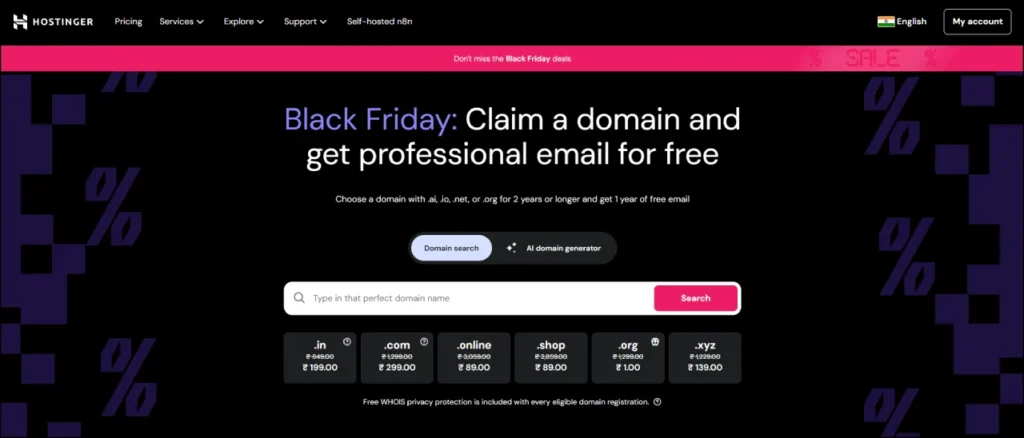
Best for: Beginners, domain + hosting bundles, users who want UPI payments, Indian-market users setting up their first website.
Pricing:
.comregistration: Promotional pricing from ₹1 for the first year with multi-year hosting plans; standalone.comis approximately ₹909/year at regular prices.comrenewal: Approximately ₹909/year.inregistration: Promotional from ₹1 for the first year; renewal ₹899/year- WHOIS privacy: Free — included by default
- Transfer: Standard ICANN process; check current transfer fee at checkout
Pricing verified from Hostinger’s India pricing pages, September 2026. Promotional rates apply to new customers and specific plan combinations. Confirm at checkout.
Key Features:
- hPanel is clean and beginner-friendly
- Free WHOIS privacy included on eligible domains
- UPI, debit/credit cards, and net banking accepted
- INR billing available
- Supports
.com,.in,.net,.org, and popular new TLDs - DNS management is straightforward
- Domain + hosting integration in one dashboard
- 18% GST added at checkout on Indian billing
Pros:
- Most accessible registrar for Indian beginners
- UPI support makes payment friction-free
- Free privacy is included, not sold as an add-on
- Competitive when bundled with hosting plans
- Indian-language support available
Cons:
- Standalone
.comrenewal pricing is higher than pure-play registrars like Porkbun or NameSilo - Checkout upsells can feel aggressive
- Not ideal for managing dozens of domains across multiple clients
.inrenewal at ₹899/yr is higher than some competitors
My Take: For someone registering their first domain in India — especially if they’re also getting hosting — Hostinger is one of the most practical choices. UPI support, INR billing, free privacy, and a clean interface make it genuinely beginner-friendly. Just go in knowing the renewal price before committing, and factor that into your long-term budget.
2. Namecheap
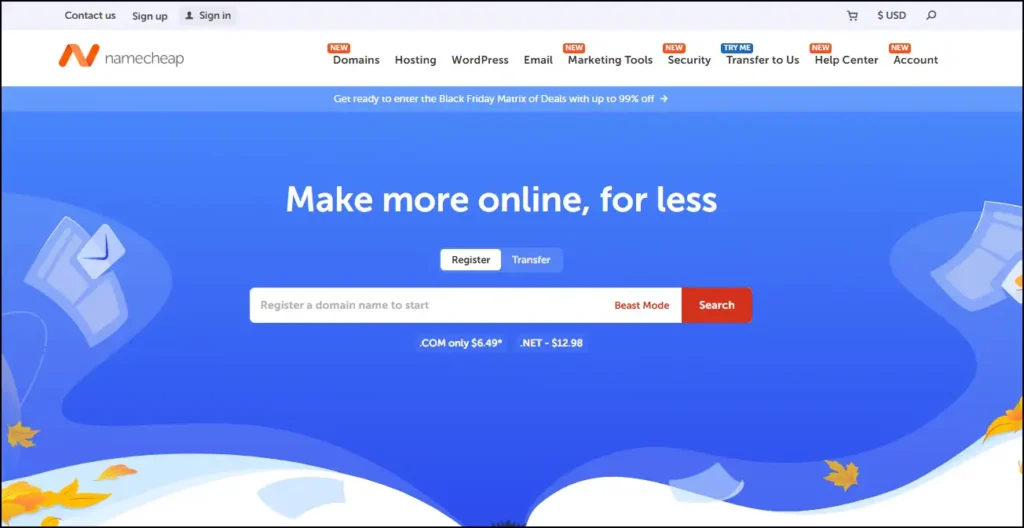
What it is: One of the most widely used domain registrars globally, known for competitive pricing, free WhoisGuard privacy for life, and a solid domain management interface.
Best for: Budget-conscious buyers, domain privacy, agencies managing multiple domains, .com registrations where long-term renewal value matters.
Pricing:
.comregistration: Approximately $6.79 (~₹646) for the first year as of August 2026 (promotional rate for new customers); renewal $14.78/year (~₹1,404/year)- WHOIS privacy: Free for life (WhoisGuard) — a meaningful saving over registrars that charge annually
.comtransfer: $11.18 (~₹1,062), includes one-year renewal extension- Note: Namecheap bills in USD; Indian users pay with international cards. No UPI.
Pricing sourced from public registrar comparison data verified August 2026. Always confirm at Namecheap’s checkout. USD converted at approximately ₹95/USD.
Key Features:
- Free WhoisGuard privacy on eligible TLDs — permanent, not just first year
- Strong DNS management with easy record management
- DNSSEC support
- Two-factor authentication
- Domain transfer process is clean and well-documented
- Large TLD selection including hundreds of newer extensions
- PremiumDNS available as an upgrade for advanced needs
Pros:
- Renewal pricing is significantly lower than GoDaddy
- Free permanent privacy protection is a genuine advantage
- Good DNS control panel with full record type support
- Reliable infrastructure and strong reputation
- Large TLD selection
Cons:
- Does not accept UPI — international card or PayPal required
- No INR billing; forex markup applies
- No GST-compliant invoices for Indian businesses
- Support response times can vary; live chat sometimes slow
.inavailability should be confirmed; not always competitively priced
My Take: For most .com registrations where you’re comfortable with international card payment, Namecheap is one of the registrars I most commonly recommend. The free-for-life privacy protection alone saves you ₹400–₹500 per year compared to registrars that charge for it. The lack of UPI is a real limitation for users who only have Indian payment methods available.
3. BigRock
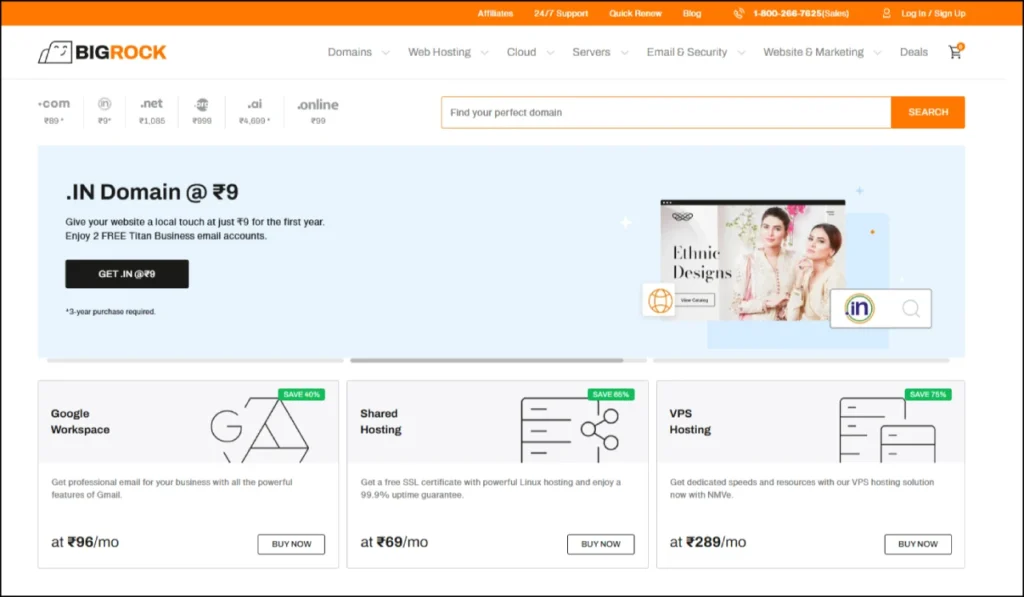
What it is: One of the most established Indian domain registrars, founded in Mumbai in 2010. BigRock is well-suited to the domestic market and supports the full range of Indian payment methods and billing requirements.
Best for: Indian businesses needing INR billing and GST invoices, .in and .co.in domains, UPI payments, users who prefer a domestic provider.
Pricing:
.comregistration: Approximately ₹749 ($7.86); renewal approximately ₹1,479/year ($15.51).inregistration: ₹579/year for one year; promotional pricing from ₹1 on multi-year plans; renewal ₹899/year- WHOIS privacy (Domain Protect+): Paid add-on, added automatically to cart — remove it if you don’t want it; approximately ₹499/year
.comtransfer: Approximately ₹968 ($10.16)- All prices exclude 18% GST
BigRock pricing sourced from tldes.com registrar data (July 2026) and BigRock’s own domain pages. Confirm current pricing at bigrock.in before purchasing.
Key Features:
- Full INR billing — no forex markup or international card required
- GST-compliant invoices issued — important for Indian businesses claiming input tax credit
- UPI, net banking, debit/credit cards accepted
- Supports
.in,.co.in,.net.in,.org.inand other Indian ccTLDs - Indian customer support (phone, live chat, tickets)
- Domain Protect+ privacy add-on available
- API access for bulk operations
Pros:
- Best Indian-market billing experience among major registrars
- GST invoice is a meaningful advantage for registered Indian businesses
- Strong
.inand.co.inTLD support and pricing - Accepts all major Indian payment methods
- Transparent renewal pricing shown on results page
Cons:
- WHOIS privacy is a paid add-on (Domain Protect+) — auto-added to cart
.comrenewal pricing is higher than international alternatives like Porkbun or NameSilo- Dashboard and interface feel dated compared to newer registrars
- Checkout upsell flow is aggressive
My Take: If you’re running an Indian business and need GST-compliant invoices, INR billing, and Indian phone support, BigRock makes practical sense. For personal projects or .com domains aimed at global audiences, the renewal pricing premium is worth evaluating against cheaper alternatives like Porkbun or NameSilo — particularly if you don’t need the local billing features.
4. GoDaddy
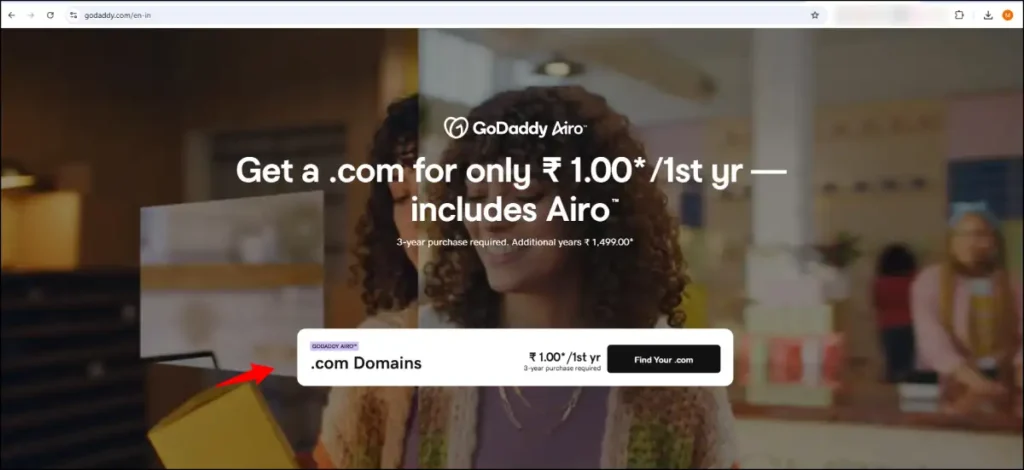
What it is: The world’s largest domain registrar by volume. GoDaddy’s India presence is substantial, with full UPI support, INR billing, and even Hindi-language customer support. It is well-known but has a mixed reputation for renewal pricing.
Best for: Users comfortable with a well-known brand, those who want Hindi-language phone support, large domain marketplaces, and one-stop domain + hosting.
Pricing:
.comregistration: From ₹1 for first year on a 3-year plan; regular introductory pricing around ₹199–₹599; renewal approximately ₹1,049–₹1,500/year.inregistration: Promotional from approximately ₹179–₹199 (new customers); renewal approximately ₹799–₹999/year- Transfer: ₹1,029 for
.com, includes one year of registration - WHOIS privacy: Paid add-on — GoDaddy now includes Domain Privacy + Protection with most plans; confirm at checkout whether this is free or charged
- All prices exclude 18% GST
GoDaddy pricing sourced from GoDaddy India pricing page (September 2026) and third-party verified data. Promotional rates are for new customers on specific term plans. Renewal prices are significantly higher than promotional prices. Always check the renewal column at checkout.
Key Features:
- Very large TLD selection — 700+ extensions
- Accepts UPI, net banking, and Indian debit/credit cards
- INR billing available with GST invoices
- Hindi phone support available 9 am–7 pm daily
- Domain auction marketplace for expired and premium domains
- Domain Discount Club for bulk buyers
- Stevie Award-winning customer support
Pros:
- Largest domain marketplace and auction platform in India
- Accepts UPI and all Indian payment methods
- Hindi support is a genuine advantage for some users
- Widest TLD selection of any registrar in this list
- GST-compliant invoicing
Cons:
- Renewal pricing is among the highest in the industry — a
.comcan renew at ₹1,049–₹1,500+/year - Checkout process is notorious for upsells and confusing pricing layers
- First-year promotional price vs year-two renewal is one of the largest gaps in the market
- Privacy terms and pricing should be confirmed at checkout
My Take: GoDaddy is fine if you already have an account there or specifically need Hindi phone support or the largest domain auction marketplace. I would not recommend it as a long-term home for domains if you’re cost-conscious. The renewal pricing gap compared to alternatives like Porkbun or NameSilo adds up to thousands of rupees over five years on a single domain.
5. Cloudflare Registrar

What it is: Cloudflare Registrar is a domain registration service integrated into the Cloudflare platform, operating on a strict at-cost model — you pay only the wholesale registry price with zero markup.
Best for: Advanced users already using Cloudflare for DNS or CDN management, users who want the absolute lowest possible renewal cost on supported TLDs.
Pricing:
.comregistration and renewal: Approximately $10.46/year (~₹994/year) — this is the exact wholesale cost (registry price + $0.20 ICANN fee), with zero Cloudflare markup.- Renewal price = same as registration price. No bait-and-switch.
- WHOIS privacy: Free
- Note: Cloudflare does not offer first-year promotional discounts — you pay the full at-cost price from day one
Cloudflare at-cost
.compricing sourced from Instant Domain Search and independent registrar comparison data, verified September 2026. At-cost price may change if registry wholesale rates change.
Important limitations:
- Cloudflare Registrar does not support all TLDs.
.inand many Indian ccTLDs are not supported — verify specific TLD support at Cloudflare’s official registrar page before proceeding - Cloudflare does not support standard outbound EPP/Auth code transfers to other registrars for most TLDs at time of writing. Verify current transfer-out policy before moving domains here
- New registrations and management require an active Cloudflare account — this is not a standalone consumer registrar
- Payment via international cards only — no UPI, no INR billing
Key Features:
- At-cost renewal pricing — consistently among the cheapest for
.comand other supported gTLDs - Free WHOIS privacy
- Cloudflare’s DNS infrastructure is among the fastest and most reliable globally
- DNSSEC supported by default
- Strong account security model
- Integrated with Cloudflare’s full platform (CDN, firewall, Workers, etc.)
Pros:
- Genuinely the lowest renewal price on supported TLDs — no markup ever
- Free privacy
- Best-in-class DNS performance
- Strong security posture — domain locking, DNSSEC, 2FA
Cons:
- Limited TLD support — not suitable for
.inor many ccTLDs - No first-year promotional pricing
- Not suitable for users unfamiliar with Cloudflare’s technical interface
- Outbound transfer policy is more restrictive than standard registrars — verify before transferring domains in
- No UPI, no INR billing, no GST invoices
My Take: Cloudflare Registrar is excellent for .com domains you intend to keep long-term if you’re already in the Cloudflare ecosystem. For Indian users needing .in domains, INR billing, or UPI payment, it is not the right fit. If you’re technical and primarily manage .com or popular gTLD domains through Cloudflare, the at-cost renewal pricing is genuinely unbeatable.
6. Porkbun
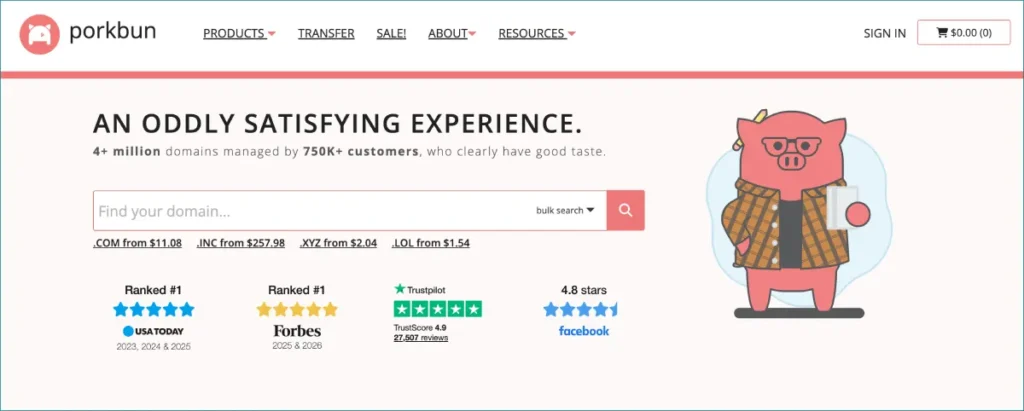
What it is: Porkbun is a US-based domain registrar that has built a strong reputation for transparent, competitive renewal pricing and free domain privacy across most TLDs. Named the #1 domain registrar by USA Today.
Best for: Long-term renewal pricing, .com domains, free privacy, users comfortable with international payment who want the best value without technical complexity.
Pricing:
.comregistration: Approximately $10.99/year (~₹1,044/year) — same price as renewal.comrenewal: Approximately $10.99/year (~₹1,044/year) — no price increase at renewal- WHOIS privacy: Free on most TLDs — included by default
- Transfer: Approximately $10.99, includes one-year extension
- Note: Porkbun bills in USD; Indian users pay with international cards
Pricing sourced from Porkbun’s pricing page and independent comparison data, July 2026. Porkbun’s
.compricing is flat — registration and renewal are the same price. Verify at checkout.
Key Features:
- Free WHOIS privacy on most TLDs — permanent, not just first year
- Clean, modern dashboard
- DNS management is solid with full record type support
- DNSSEC supported
- Free SSL certificates with parking pages
- Email forwarding included
- API available for bulk management and automation
Pros:
- One of the most competitive
.comrenewal prices available - Flat pricing model — registration = renewal, no surprise hikes
- Free privacy standard across most TLDs
- Transparent pricing — no hidden fees, no upsells
- Good interface; friendly for non-technical users
Cons:
- Does not accept UPI or provide INR billing
- No GST-compliant invoices for Indian businesses
- Customer support is primarily ticket-based — no phone support
- Some users find the interface takes a little time to learn
.inTLD support is limited — confirm before purchasing
My Take: Porkbun is one of the registrars I recommend to clients who want to register .com domains and keep long-term costs down. The flat pricing model — where renewal costs the same as registration — is rare and genuinely valuable. If you’re comfortable paying via international card and don’t need GST invoices, Porkbun is among the best long-term value options for Indian users.
7. Spaceship
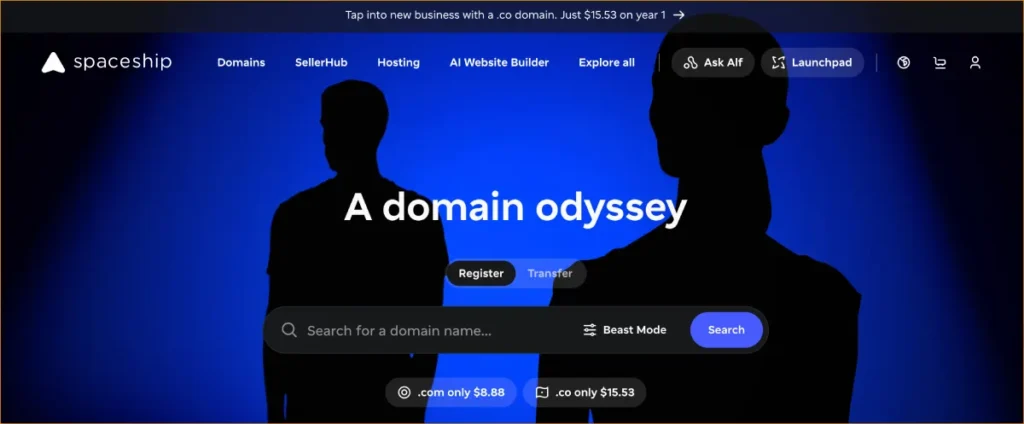
What it is: Spaceship is a newer registrar built by the team behind Namecheap’s parent company, designed with a clean modern interface and competitive pricing aimed at a new generation of domain buyers.
Best for: Users who want a modern, streamlined interface; competitive pricing on popular TLDs; a newer alternative to established registrars.
Pricing:
.comregistration: Competitive — check current pricing at Spaceship’s website directly, as they run frequent promotions- WHOIS privacy: Free
- Note: Spaceship pricing continues to evolve as the platform grows. Verify at checkout.
Key Features:
- Clean, modern dashboard — arguably the best interface in this list for new users
- Free WHOIS privacy
- Competitive pricing on popular TLDs
- DNS management is clear and functional
- DNSSEC supported
- Growing TLD catalogue
Pros:
- Modern interface is genuinely easier to navigate than older registrars like BigRock or GoDaddy
- Competitive pricing structure with no upsell pressure
- Free privacy included
- Backed by established infrastructure
Cons:
- Relatively new — less established track record than Namecheap or BigRock
- Does not accept UPI
- TLD support still expanding; verify
.inand Indian ccTLD availability - Support resources still developing
My Take: Spaceship is worth considering if you want a clean, modern domain management experience at competitive prices. For Indian users specifically, verify current .in support and Indian payment options before committing, as these areas are still developing.
8. MilesWeb
What it is: MilesWeb is an Indian web hosting company with over 13 years of industry experience that also provides domain registration, with a strong focus on the domestic market and INR billing.
Best for: Indian businesses needing local billing and support, .in registrations, users who want domain + hosting from an Indian company.
Pricing:
.comregistration and renewal: Check current pricing at milesweb.in — competitive for the Indian market.inregistration and renewal: Check current pricing at milesweb.in- WHOIS privacy: Check current privacy policy and pricing
- All prices subject to 18% GST
MilesWeb’s specific domain pricing varies and should be confirmed directly at milesweb.in. They position themselves as competitively priced for Indian ccTLDs.
Key Features:
- Full INR billing — no forex markup
- GST invoice provided — important for Indian businesses
- UPI, net banking, Indian debit/credit cards accepted
- Supports
.in,.co.in,.net.inand other Indian ccTLDs - Indian customer support team
- Hosting integration available
Pros:
- Indian company with 13+ years of experience and 80,000+ clients
- GST-compliant invoicing
- Strong support for Indian TLDs
- Accepts all common Indian payment methods including UPI
- Combined domain and hosting management
Cons:
- Interface is functional but not best-in-class
- Domain renewal pricing should be compared with BigRock before deciding
- Less international TLD support than global registrars
My Take: MilesWeb is a solid alternative to BigRock for Indian businesses that want a domestic domain registrar with full GST invoicing and UPI support. Worth comparing pricing directly with BigRock before deciding — both serve the same core need.
9. NameSilo
What it is: NameSilo is a US-based registrar known for consistent, low renewal pricing, free WHOIS privacy, and an API-friendly platform suited to bulk domain management and domain investors.
Best for: Bulk domain registration, agencies managing many domains, long-term cost-conscious buyers, domain investors.
Pricing:
.comregistration: Approximately $9.89/year (~₹940/year) — same as renewal.comrenewal: Approximately $9.89/year — flat, consistent pricing- WHOIS privacy: Free — included on all domains
- Volume discounts available through NameSilo’s Discount Program
- Note: Bills in USD; international card required
NameSilo
.compricing sourced from registrar comparison data, 2026. Known for flat, consistent pricing with no first-year promotional tricks.
Key Features:
- Free WHOIS privacy on all domains
- Flat renewal pricing — no price increases year over year
- API for bulk operations and automation
- Straightforward DNS management
- Auto-renewal management with robust controls
- Domain parking
- No upsells during checkout — refreshingly clean
Pros:
- Consistently low and flat renewal pricing for
.comand many TLDs - Free privacy — no separate fee ever
- Minimal upsell pressure — one of the cleanest checkout experiences
- Good for agencies managing multiple client domains at scale
- Volume discount program for large portfolios
Cons:
- Interface feels dated — functional but not modern
- Does not accept UPI or provide INR billing
- No GST-compliant invoices for Indian businesses
- Customer support is slower than some competitors
.inand Indian ccTLD support is limited — verify before purchasing
My Take: For managing a portfolio of .com domains over the long term, NameSilo is one of the most cost-efficient registrars available. The flat pricing model means no surprises at renewal, and the lack of upsells makes the checkout experience unusually clean. The absence of UPI and INR billing is a real limitation for Indian users, but international cards work fine.
10. Dynadot
What it is: Dynadot is a US-based registrar popular with domain investors and agencies, with competitive pricing, good bulk management tools, a domain marketplace, and a growing TLD catalogue.
Best for: Domain investors, agencies managing large portfolios, developers who want API access, users who want a capable all-round management platform.
Pricing:
.comregistration and renewal: Competitive — check current pricing at dynadot.com- WHOIS privacy: Free on most TLDs
- API access: Available, well-documented
- Note: Bills in USD; international card required
Key Features:
- Free WHOIS privacy on many TLDs
- Bulk management tools — domain portfolio view, bulk actions
- DNS management is solid with full record support
- API access for developers and automation workflows
- Domain marketplace and auction platform for buying and selling
- DNSSEC support
Pros:
- Clean management interface — better than most for bulk management
- Competitive pricing at volume
- Domain marketplace for buying/selling is well-developed
- Good API for automation
- Transparent pricing model
Cons:
- Does not accept UPI or provide INR billing
- Less suited to pure beginners — interface assumes familiarity with domain management
.inand Indian ccTLD support should be confirmed before purchasing- Support ticket response times can vary
My Take: Dynadot suits agencies, developers, and domain investors who want a capable management platform at competitive prices. It’s not the first recommendation for an Indian business needing INR invoices or UPI payment, but it’s excellent for international domain portfolios and development workflows.
Best Domain Registrar in India by Use Case
Best for Beginners
Hostinger is the clearest recommendation for beginners in India. The hPanel interface is clean and well-designed, UPI is accepted, INR billing is available, privacy is included free, and getting domain + hosting in one place removes a lot of complexity. The renewal pricing is higher than pure-play registrars, but the overall experience justifies it for users setting up their first website.
Best for .in Domains
BigRock and MilesWeb are the strongest options for .in, .co.in, and other Indian country-code TLDs. Both support INR billing, GST invoices, and all major Indian payment methods. BigRock has a longer track record; MilesWeb is worth comparing on pricing. Hostinger also supports .in with renewal at ₹899/year and UPI payment.
Best for .com Domains
Porkbun and NameSilo offer the most competitive long-term renewal pricing for .com at approximately $10.99 and $9.89 per year respectively — with no promotional games. Namecheap is also strong, particularly with free WhoisGuard privacy. For existing Cloudflare users, Cloudflare Registrar provides at-cost pricing at approximately $10.46/year.
Best for Long-Term Renewal Pricing
Porkbun, NameSilo, and Cloudflare Registrar (for supported TLDs) consistently offer the lowest renewal pricing for .com. When you keep a domain for five years, the difference between a ₹940/year and ₹1,500/year renewal works out to approximately ₹2,800 more expensive on the higher-priced registrar — for a single domain.
Best for Indian Businesses
BigRock and MilesWeb are the strongest for Indian businesses that need GST-compliant invoices and INR billing. Hostinger is also viable with UPI support and INR billing. For businesses primarily needing international .com domains and comfortable with international billing, Namecheap or Porkbun offer better renewal pricing.
Best for UPI Payments
Hostinger, BigRock, MilesWeb, and GoDaddy all support UPI. Most international registrars — Namecheap, Porkbun, NameSilo, Dynadot, Cloudflare — do not currently support UPI and require payment via international card or PayPal.
Best for Domain Privacy
Namecheap (free WhoisGuard for life), Porkbun, NameSilo, and Cloudflare Registrar all include free WHOIS privacy on most TLDs. Hostinger also includes free privacy. If you’re considering a registrar that charges for privacy separately, factor that annual cost into your five-year ownership calculation.
Best for Bulk Domain Registration
NameSilo and Dynadot are the most practical for bulk registrations. Both offer volume-friendly pricing, API access, and clean bulk management interfaces. NameSilo’s flat pricing makes cost forecasting straightforward at scale.
Best for Agencies
Agencies managing domains across multiple clients benefit most from Namecheap (sub-account management and consistent renewal pricing), Dynadot (API and bulk portfolio tools), or NameSilo (low renewal cost across a large portfolio). Predictable renewal pricing matters more than first-year discounts when you’re managing long-term client relationships.
Best for Domain + Hosting
Hostinger is the strongest domain + hosting combination for Indian users. UPI support, INR billing, free privacy, and a single hPanel dashboard for domain and hosting management make it the most practical all-in-one option. For a full comparison, see our best web hosting in India guide and our cheap web hosting India guide.
Best for Advanced DNS Management
Cloudflare Registrar — if your domain is already on Cloudflare’s DNS, registering there completes the setup. Cloudflare’s anycast DNS infrastructure is among the best globally for performance and reliability. For users who aren’t on Cloudflare but need DNS control, Namecheap, Porkbun, and Dynadot all have solid DNS management panels.
Domain Registration Prices in India
Domain pricing in India varies considerably depending on the TLD, the registrar, and whether you’re in a promotional period.
First-year pricing is almost always discounted. Registrars use low first-year prices to attract new customers. A .com that costs ₹99–₹599 in the first year will typically renew at ₹800–₹1,500 or more from year two.
Renewal pricing is the price you pay from the second year onward. This is the number that actually matters for long-term budgeting. Based on current September 2026 pricing:
| Registrar | ~.com Renewal/Year | Privacy Cost |
|---|---|---|
| NameSilo | ~₹940 ($9.89) | Free |
| Cloudflare Registrar | ~₹994 ($10.46) | Free |
| Porkbun | ~₹1,044 ($10.99) | Free |
| Hostinger | ~₹909 | Free |
| Namecheap | ~₹1,404 ($14.78) | Free |
| BigRock | ~₹1,479 ($15.51) | ~₹499 extra |
| GoDaddy | ~₹1,049–₹1,500 | Check current |
Approximate pricing as of September 2026. USD converted at ~₹95/USD. Prices exclude 18% GST. Verify at checkout.
Transfer pricing for .com is typically one year’s renewal fee, and the transfer adds one year to your registration term — so transferring to a cheaper registrar is usually worthwhile if you’re on a high-renewal registrar.
Privacy fees vary. Registrars including NameSilo, Porkbun, Namecheap, Cloudflare, and Hostinger include WHOIS privacy free. BigRock charges approximately ₹499/year extra. GoDaddy’s current privacy policy should be confirmed at checkout.
GST. In India, domain registration services attract 18% GST at checkout. Registrars who issue proper GST invoices — BigRock, MilesWeb, GoDaddy India, and Hostinger — allow Indian businesses to claim input tax credit.
What Does a Domain Really Cost Over 5 Years?
The 5-year ownership cost formula:
5-year cost = Year 1 registration + (4 × annual renewal) + (5 × privacy if charged separately)
Illustrative comparison using September 2026 approximate pricing (excluding GST):
| Registrar | Year 1 | Renewal/yr | Privacy/yr | 5-Year Total (est.) |
|---|---|---|---|---|
| GoDaddy (promo) | ₹1 | ₹1,300 | ₹0 (if included) | ₹5,201 |
| BigRock | ₹749 | ₹1,479 | ₹499 | ₹9,660 |
| Namecheap | ₹646 | ₹1,404 | ₹0 | ₹6,262 |
| Hostinger | ₹909 | ₹909 | ₹0 | ₹4,545 |
| Porkbun | ₹1,044 | ₹1,044 | ₹0 | ₹5,220 |
| NameSilo | ₹940 | ₹940 | ₹0 | ₹4,700 |
| Cloudflare Registrar | ₹994 | ₹994 | ₹0 | ₹4,970 |
Important: These figures are illustrative estimates based on approximate September 2026 pricing, converted from USD at ~₹95/USD. They exclude 18% GST. Privacy cost for GoDaddy is marked ₹0 assuming it’s included — verify this at checkout. Always calculate from current checkout prices before making a decision.
The registrar with the cheapest first-year promotional price is not necessarily the cheapest over five years. In several cases, it’s the most expensive.
To calculate your actual 5-year cost:
- Note the renewal price at checkout (not the first-year price).
- Confirm whether WHOIS privacy is included or charged separately.
- Calculate: Year 1 + (4 × renewal) + (5 × privacy if separate).
- Add 18% GST.
- Compare that total across registrars.
Cheapest Domain Registration in India
The cheapest domain registration in India depends entirely on what metric you’re using.
Cheapest first year: GoDaddy, BigRock, and Hostinger regularly run promotions making the first year very cheap — sometimes as low as ₹1–₹99. These are one-time rates for new customers.
Cheapest long-term: NameSilo (~₹940/yr renewal), Cloudflare Registrar (~₹994/yr), and Porkbun (~₹1,044/yr) consistently offer lower renewal pricing than the major promotional registrars.
For Indian users specifically: Hostinger at ~₹909/yr renewal is competitive when you factor in the UPI support, INR billing, and free privacy included — making it the cheapest among registrars that support Indian payment methods natively.
One mistake I often see is someone choosing a registrar based on a ₹99 first-year offer, only to face a ₹1,400+ renewal bill 12 months later — and realising the total cost over three years was never cheap at all. For genuinely cheap domain registration in India over the long term, compare renewal prices, not registration prices, and include privacy cost in your calculation.
What Are Domain Registration Services?
Domain registration services are the services provided by an accredited domain registrar that allow you to search for, register, renew, manage, and transfer domain names.
A domain registrar acts as the intermediary between you and the domain registry. When you register a .com, your registrar communicates with VeriSign (the .com registry) on your behalf. When you register a .in, your registrar communicates with NIXI (the National Internet Exchange of India, the .in registry) on your behalf.
Core domain name registration services include:
- Domain search — checking whether a domain name is available
- Registration — purchasing the right to use a domain name for a defined period (1–10 years)
- Renewal — extending your registration before it expires
- DNS management — configuring where your domain points (your website, email, etc.)
- Domain transfer — moving your domain to another registrar
- WHOIS privacy — protecting your personal contact information from public WHOIS lookups
- Domain locking — preventing unauthorized transfers
- Email forwarding — routing email for your domain to another inbox
- Expiration management — auto-renewal and grace period management
A good domain service provider makes all of these functions straightforward, transparent, and accessible — without burying the renewal price in the small print.
Domain Registrar vs Domain Registry vs Reseller
These three terms are often confused. Understanding the difference helps you make better decisions when something goes wrong.
What Is a Domain Registrar?
A domain registrar is a company accredited by ICANN (or the relevant country-level authority) to sell domain registrations directly to the public. When you buy a domain from Namecheap, BigRock, or Hostinger, you’re buying from a registrar.
Registrars are responsible for:
- Selling domain registrations and renewals
- Managing WHOIS records
- Providing DNS management tools
- Processing domain transfers
- Communicating with the registry on your behalf
What Is a Domain Registry?
A domain registry is the organisation that operates a specific TLD. For example:
- VeriSign operates
.comand.net - NIXI (National Internet Exchange of India) operates
.in,.co.in,.net.in,.org.in,.gen.in,.firm.in, and.ind.in - Public Interest Registry operates
.org
Domain registries set the rules for their TLD — who can register, at what wholesale price, and under what conditions. In most cases, registries do not sell directly to the public. They work through accredited registrars. These are your domain name registry services at work behind the scenes.
What Is a Domain Reseller?
A domain reseller purchases domain services wholesale from a registrar and sells them under their own brand — often at a markup or bundled with hosting. Many smaller web hosts in India act as domain resellers without being ICANN-accredited registrars themselves.
When you buy through a reseller, your domain may technically be managed by the underlying registrar rather than the reseller you purchased from. In a dispute, knowing who holds your actual registration matters.
What Is the Best Website to Buy a Domain in India?
The best website to buy a domain in India depends on what you need from the experience. There is no single answer that works for everyone.
| Priority | Best Domain Website |
|---|---|
| UPI + INR billing + GST invoice | BigRock, MilesWeb, Hostinger |
Lowest .com renewal (intl. card) | Porkbun (~$10.99/yr), NameSilo (~$9.89/yr) |
| Best beginner experience | Hostinger |
Best .in / Indian ccTLD support | BigRock, MilesWeb |
| Best agency management tools | Namecheap, Dynadot |
At-cost .com renewals | Cloudflare Registrar (~$10.46/yr) |
The best domain purchase site is the one that offers the right TLD, at a sustainable renewal price, with payment options you can actually use, and a management interface you’re comfortable with. A registrar that accepts UPI and provides GST invoices is worth paying a modest premium over for Indian business owners who need compliant accounting.
.com vs .in: Which Domain Should You Choose?
When to Choose .com
.com is the default TLD for most websites with global audiences or ambitions. It is universally recognised, broadly trusted, and available from nearly every registrar at competitive prices. If you’re building a business you want to grow beyond India, or if your audience is international, .com is the safer choice in most cases.
When to Choose .in
.in signals geographic relevance to India. It can be appropriate for:
- Local Indian businesses serving primarily domestic customers
- Businesses whose brand is explicitly India-focused
- Situations where the
.comequivalent is unavailable or too expensive
.in domains are generally cheaper to register than .com from Indian registrars — BigRock offers .in at ₹579/year with renewal at ₹899/year, for example.
When to Choose .co.in
.co.in is a second-level domain under .in, traditionally used for commercial Indian businesses. It’s a legitimate choice for established Indian companies who want a clearly domestic identity. However, the simpler .in has effectively the same connotations and is more widely adopted.
Does .in Help SEO?
Not automatically. Google has historically treated country-code TLDs like .in as geographic signals that can support India-specific ranking. However, this effect is not guaranteed, not significant enough to override content quality, and does not mean a .in domain automatically ranks better in India than a well-optimised .com.
A .com targeting India with strong SEO can and regularly does outrank a .in domain. Don’t choose .in purely for assumed SEO benefit.
Can an Indian Business Use .com?
Absolutely. Most successful Indian businesses — including those targeting Indian audiences exclusively — use .com domains. The TLD choice should be driven by your brand strategy and the availability of your preferred name, not by assumptions about SEO.
Which Domain Registrars Accept UPI in India?
UPI support is important for Indian users who want to pay in INR without international card fees or currency conversion costs.
| Registrar | UPI | Net Banking | Indian Cards | INR Billing | GST Invoice |
|---|---|---|---|---|---|
| Hostinger | Yes | Yes | Yes | Yes | Check |
| BigRock | Yes | Yes | Yes | Yes | Yes |
| GoDaddy India | Yes | Yes | Yes | Yes | Check |
| MilesWeb | Yes | Yes | Yes | Yes | Yes |
| Namecheap | No | No | International cards only | No | No |
| Porkbun | No | No | International cards only | No | No |
| NameSilo | No | No | International cards only | No | No |
| Cloudflare Registrar | No | No | International cards only | No | No |
| Dynadot | No | No | International cards only | No | No |
Payment method support can change. Always verify directly at the registrar’s checkout page. International card payments at non-Indian registrars typically attract a 3–5% forex markup from your bank, plus GST on the conversion fee.
If UPI is a requirement, the practical options are Hostinger, BigRock, MilesWeb, and GoDaddy India. Of these, BigRock and MilesWeb are strongest for .in domains and GST invoices. Hostinger is best for domain + hosting combined.
What to Check Before Buying a Domain
Before confirming any domain purchase, work through this checklist:
- Renewal price — What will you pay from year two onward? Not just year one.
- WHOIS privacy — Is it included free, or is it a paid add-on?
- 5-year total cost — Have you calculated Year 1 + (4 × renewal) + privacy?
- TLD availability — Does the registrar support the TLD you need at competitive pricing?
- DNS management — Can you manage A, CNAME, MX, TXT, and other records easily?
- DNSSEC — Supported if you need it?
- Domain lock — Enabled by default to prevent unauthorized transfers?
- 2FA — Can you enable two-factor authentication on your account?
- Payment method — UPI, INR billing, or GST invoice required?
- Auto-renewal — Is it manageable? Ensure it’s on a valid payment method.
- Expiration grace period — How many days after expiry before the domain is at risk?
- Redemption cost — What does recovery cost if the domain enters redemption?
- Transfer fees — Does the registrar charge to transfer your domain to another registrar?
- Transfer lock period — 60-day lock after registration (standard ICANN policy)?
- Upsells — Have you declined unnecessary extras at checkout?
- Support — Is there accessible support via chat, email, or phone if something goes wrong?
How to Register a Domain Name in India
- Choose your domain name. Decide on the name and TLD before searching. Check whether the
.comis available alongside.inif brand protection matters to you. - Check availability. Use the domain search tool at your preferred registrar to confirm the name is available.
- Compare registrars. Don’t register at the first registrar you search. Check the renewal price at two or three registrars before deciding.
- Note the renewal price explicitly. Before clicking “buy”, find the renewal price — it is sometimes shown in smaller text below the first-year price. This is what you’ll pay every year after the first.
- Select the registration period. You can register for 1–10 years at most registrars. Multi-year registration locks in current pricing and reduces the risk of forgetting to renew.
- Create an account. Provide accurate registrant contact details. ICANN policy requires accurate WHOIS data regardless of whether you use privacy protection.
- Enable WHOIS privacy. If the registrar offers free privacy, enable it. If it’s a paid add-on, decide whether the cost is worth it for your use case.
- Enable security features. Set up 2FA on your account before adding any payment information. Enable domain lock.
- Pay. Use your preferred payment method — UPI, card, or net banking as applicable.
- Verify your contact email. ICANN requires domain registrants to verify their email address after registration. Check your inbox immediately.
- Configure DNS. Point your domain to your hosting nameservers, or set up DNS records within your registrar’s DNS panel.
- Set auto-renewal on a valid payment method. The most common cause of domain expiration is a lapsed credit card on auto-renewal. Keep it current.
Need hosting after registering your domain? See our best web hosting in India guide, or our best WordPress hosting guide if you’re building a WordPress site.
How to Transfer a Domain to Another Registrar
Transferring to a cheaper or better registrar is a valid and common move. The standard process for .com and most gTLDs:
- Check transfer eligibility. Domains cannot be transferred within 60 days of registration or a previous transfer (ICANN policy). Confirm your domain is past this lock period.
- Unlock the domain. Log into your current registrar and disable the transfer lock (also called “Registrar Lock” or “Domain Lock”).
- Request the EPP/Auth code. Also called the Authorization Code or Transfer Code. Your current registrar must provide this when requested — they cannot refuse unreasonably.
- Initiate the transfer at your new registrar. Enter the domain name and EPP code at the receiving registrar’s transfer page and pay the transfer fee (typically one year’s renewal, which also extends your registration by one year).
- Approve the transfer. You’ll receive a confirmation email to the registrant email address. Confirm the transfer. If you don’t respond, the transfer proceeds automatically after approximately 5 days (standard ICANN timeline).
- Wait for completion. Standard transfers take up to 5 days. Most complete sooner.
- Verify DNS settings. After transfer, confirm DNS settings are correct at the new registrar.
Note for
.intransfers:.indomain transfers follow NIXI policies, which differ from ICANN’s standard gTLD transfer process. Contact your registrar to confirm the specific steps for Indian ccTLDs before initiating a transfer.
For a full comparison of registrars worth transferring to, see our GoDaddy alternatives guide.
What Happens When a Domain Expires?
Domain expiration policies vary by registrar and TLD, but the general sequence for .com:
Expiration date. Your registration period ends. The domain may remain active for a short period depending on the registrar.
Grace period. Typically up to 30 days after expiration for .com. You can usually renew at the standard price during this period.
Redemption period. After the grace period, the domain typically enters a redemption period (usually 30 days for .com). You can still recover the domain, but redemption fees are significantly higher — often ₹5,000–₹15,000 or more, depending on the registrar. This is a costly mistake to make.
Pending deletion. The domain is queued for deletion. Recovery is typically not possible at this stage.
Available again. After deletion, the domain becomes available for general registration.
Domain may go to auction. Some aftermarket services intercept expiring domains and put them to auction before they reach the general deletion queue.
The most important protection against this sequence: keep auto-renewal active on a current payment method.
Domain Privacy and Security
WHOIS privacy replaces your registrant contact details in the public WHOIS database with generic proxy details from the privacy service provider. This reduces spam, unsolicited calls, and the public visibility of your personal address and phone number.
ICANN rules require registrars to collect accurate registrant data, and privacy services fulfil this requirement by keeping your actual data on file while presenting their own to the public WHOIS.
Privacy availability varies by TLD. Privacy is widely available for .com, .net, .org, and most gTLDs. For .in and many Indian ccTLDs, privacy options may be limited by NIXI registry policy. As of September 2026, .in registrant details are protected under India’s data protection framework, but confirm your specific privacy status with your registrar for .in domains.
2FA (Two-Factor Authentication). Enable 2FA on your domain registrar account immediately after creating it. Domain hijacking typically happens by compromising the registrar account, not by directly attacking the domain itself.
Domain lock. Keeps your domain locked against unauthorized transfers. Disable this only when you’re ready to initiate a legitimate transfer.
DNSSEC. Signs your DNS records cryptographically, preventing certain DNS hijacking attacks. If your hosting provider and registrar both support DNSSEC, enabling it adds a meaningful security layer for high-value domains.
Transfer protection. Many registrars require additional account verification before processing outgoing transfers. This friction is intentional — it prevents unauthorized transfers.
FAQs
Which is the best domain registrar in India?
There is no single best registrar for all users. For Indian businesses needing INR billing and GST invoices, BigRock or MilesWeb are strong choices. For the lowest .com renewal pricing with international card payment, Porkbun or NameSilo. For a beginner-friendly experience with UPI support, Hostinger. The right answer depends on your payment method, billing requirements, and which TLD you need.
Which domain registrar is cheapest?
It depends on whether you mean first-year pricing or long-term renewal pricing. For first-year promotions, GoDaddy, BigRock, and Hostinger regularly go as low as ₹1–₹99. For the lowest renewal pricing for .com, NameSilo (~₹940/yr), Cloudflare Registrar (~₹994/yr), and Porkbun (~₹1,044/yr) are consistently most competitive. Among registrars with UPI support, Hostinger (~₹909/yr renewal) is strong value.
What is a domain registrar?
A domain registrar is an ICANN-accredited company that registers domain names on behalf of customers. They act as the intermediary between you and the domain registry — the organisation that operates a specific TLD. When you register a .com through Namecheap or BigRock, the registrar communicates with VeriSign on your behalf.
What is the difference between a registrar and a registry?
A registrar sells domain registrations to the public. A registry operates a specific TLD. VeriSign operates .com; NIXI operates .in. You buy from a registrar; the registrar communicates with the registry. Registries set the wholesale price and rules; registrars add their own pricing and service layer on top.
What is the best website to buy a domain in India?
It depends on your priorities. Hostinger and BigRock are the most suitable for Indian users wanting UPI payments and local billing. Porkbun and NameSilo offer the best renewal pricing for those with international cards. There is no single best domain website for everyone.
Which is better for an Indian business — .com or .in?
Both are viable. .com has universal recognition and is preferred for businesses with global ambitions. .in signals Indian geographic focus and may suit purely domestic businesses. Most successful Indian companies use .com. Don’t choose .in purely for assumed SEO advantage — the effect is not automatic or guaranteed.
How much does a domain cost in India?
A .com domain currently costs approximately ₹700–₹1,500 at standard registration prices from major registrars, with first-year promotions sometimes as low as ₹1–₹599. Renewal prices range from approximately ₹909–₹1,500+ per year depending on the registrar. .in domains typically cost ₹579–₹899 per year including renewal from Indian registrars. All prices exclude 18% GST.
Is domain renewal more expensive than registration?
Almost always, yes — especially at registrars that run promotional first-year pricing. The renewal price is what you should compare between registrars, not the introductory offer. Registrars like Porkbun, NameSilo, and Cloudflare are exceptions — they charge the same price for registration and renewal.
Can I buy a .com domain from India?
Yes. All major registrars covered in this guide support .com registration from India. You don’t need to be in a specific country to register a .com. You can pay in INR at registrars with Indian billing, or in USD at international registrars.
Can I transfer my domain to another registrar?
Yes. You can transfer your domain after 60 days from the date of registration or last transfer (ICANN policy). The process involves unlocking your domain, obtaining an EPP/Auth code from your current registrar, and initiating the transfer at the new registrar. See our full transfer guide above.
Is WHOIS privacy free?
It depends on the registrar. Namecheap (WhoisGuard), Porkbun, NameSilo, Cloudflare Registrar, Hostinger, and Dynadot all include free privacy on most TLDs. BigRock charges approximately ₹499/year for privacy as an add-on. Always confirm before purchasing, and factor the cost into your 5-year ownership calculation if privacy is important to you.
Can I pay for a domain using UPI?
Yes, but only at certain registrars. Hostinger, BigRock, MilesWeb, and GoDaddy India accept UPI. International registrars including Namecheap, Porkbun, NameSilo, Cloudflare, and Dynadot do not currently support UPI — international card or PayPal is required.
Do I need hosting to buy a domain?
No. A domain registration is entirely separate from web hosting. You can register a domain and point it to hosting purchased elsewhere, or simply park the domain and add hosting later. However, bundling both with a registrar like Hostinger can be convenient and cost-effective for beginners.
What happens if my domain expires?
After expiration, there is typically a grace period during which you can renew at standard prices. After that, the domain enters a redemption period with significantly higher recovery fees (often ₹5,000–₹15,000+). After redemption, the domain is deleted and available for anyone to register. Enable auto-renewal to avoid this sequence.
How long should I register a domain for?
At minimum, one year. For a business domain, two to five years is sensible — it locks in current pricing and reduces the risk of accidental expiration. ICANN caps domain registration at 10 years maximum.
Also Read
- Best Web Hosting in India (2026) — Compare top web hosting providers for speed, reliability, and pricing
- Best WordPress Hosting in India (2026) — Best managed and shared WordPress hosting options
- Best Web Hosting for Small Business (2026) — Hosting recommendations tailored to small businesses
- Cheap Web Hosting India (2026) — Affordable hosting plans without compromising on performance
- 10 Best GoDaddy Alternatives (2026) — Better options if you’re looking to move away from GoDaddy
- Web Hosting Deals & Coupon Codes (2026) — Active discount codes and hosting offers
Conclusion
Choosing the best domain registrar in India is not a one-size-fits-all decision. The right registrar depends on the TLD you need, how long you plan to keep the domain, whether you need UPI or GST invoices, how many domains you’re managing, and what features matter most to you.
My consistent advice: calculate the five-year ownership cost before purchasing, not just the first-year promotional price. Factor in privacy costs if they’re not included. Check that the registrar accepts your preferred payment method. Confirm that you can transfer away without friction if you want to switch later.
For Indian businesses who need local billing: BigRock or MilesWeb are the most practical options.
For the best long-term renewal pricing on .com with international card: Porkbun or NameSilo.
For an all-round beginner experience with UPI support: Hostinger.
For at-cost renewals if you’re in the Cloudflare ecosystem: Cloudflare Registrar.
There is no universally best domain registrar in India. But there is a best registrar for your specific situation — and now you have the information to identify it.
Article updated September 2026 by Mani Pathak — SEO expert, web designer, and website consultant at Webseotrends.
Disclosure: Webseotrends may earn a commission through affiliate links to some registrars listed above. This does not influence our recommendations. All assessments are based on publicly available pricing data and professional evaluation.
