

Quick Navigation: What Is Orchly? | Features | My Experience | Pros and Cons | Pricing | vs. Competitors | Best For | Use Cases | Limitations | Verdict | FAQ
Quick Summary: Orchly AI at a Glance
| Detail | Summary |
|---|---|
| What it is | An all-in-one AI SEO platform combining Google rank tracking, AI search visibility monitoring across ChatGPT, Claude, Perplexity, Gemini, Grok, and Microsoft Copilot, AI-powered content creation, and ongoing website auditing |
| Best for | SEO professionals, content teams, digital agencies, SaaS companies, and ecommerce brands that want to dominate both Google and AI search results in 2026 |
| Starting price | $37/mo (annual) or $49/mo (monthly). 14-day free trial, no credit card required |
| Biggest strength | Replaces eight different tools — Ahrefs, Semrush, Jasper, Surfer SEO, Screaming Frog, Brand24, AgencyAnalytics, and CoSchedule — in one dashboard at a fraction of the combined cost |
| Biggest limitation | The Essential plan is limited to one website and 25 AI prompts per day, which can feel restrictive for competitive niches or multi-site operators |
| Copilot tracking | One of the few platforms with dedicated Microsoft Copilot rank tracking built directly into the core dashboard alongside all other AI search engines |
| Overall verdict | 4.5 out of 5 stars — Highly recommended for any team investing seriously in GEO (Generative Engine Optimization) in 2026 |
Orchly AI Review 2026: The Future of SEO Has Arrived — And It Tracks AI Search Too
Let me be direct with you: if you are still running your SEO strategy using only Google rankings as your north star, you are already falling behind.
In 2026, over 800 million people ask ChatGPT questions every week. Perplexity processes 780 million searches monthly. Gemini serves 400 million users.
And Microsoft Copilot — now deeply embedded across Windows 11, Office 365, and Bing — has become one of the fastest-growing AI search surfaces on the planet. Copilot’s weekly active users grew more than 90 percent during 2025 alone, and that growth shows no signs of slowing. Virtually none of these interactions show up in your Google Search Console data.
That is a massive, invisible traffic gap. I learned this the hard way. For three months in late 2025, I was optimizing for Google while Microsoft Copilot was quietly answering my target audience’s buying questions and citing my competitors instead of me — without any Copilot rank tracking or AI search visibility monitoring in place. That was a wake-up call I would not wish on anyone in this industry.
Most SEO tools built before 2025 are completely blind to this gap. They were designed for a world where Google was the only search engine that mattered. That world no longer exists.
When I first heard about Orchly AI, I was skeptical. Another AI SEO tool claiming to solve everything? We have seen plenty of those. But after spending several weeks inside the platform — testing every feature from the AI Search Monitoring to the Copilot rank tracking capabilities to the Article Writer Agent — I can say with confidence that Orchly is genuinely different, and it addresses a real problem that no other affordable tool adequately solves.
In this in-depth Orchly AI review, I will walk you through everything — what it is, how it works, who it is for, detailed feature breakdowns, honest pros and cons, a transparent pricing analysis, and my personal verdict on whether it is worth your investment in 2026. I will also compare it against direct competitors, show you where it wins and where it falls short, and give you a clear answer on whether the free trial is worth your time.
If you are serious about AI search visibility, Copilot rank tracking, and GEO optimization in 2026, read this before you make any tool decisions.
What Is Orchly AI?
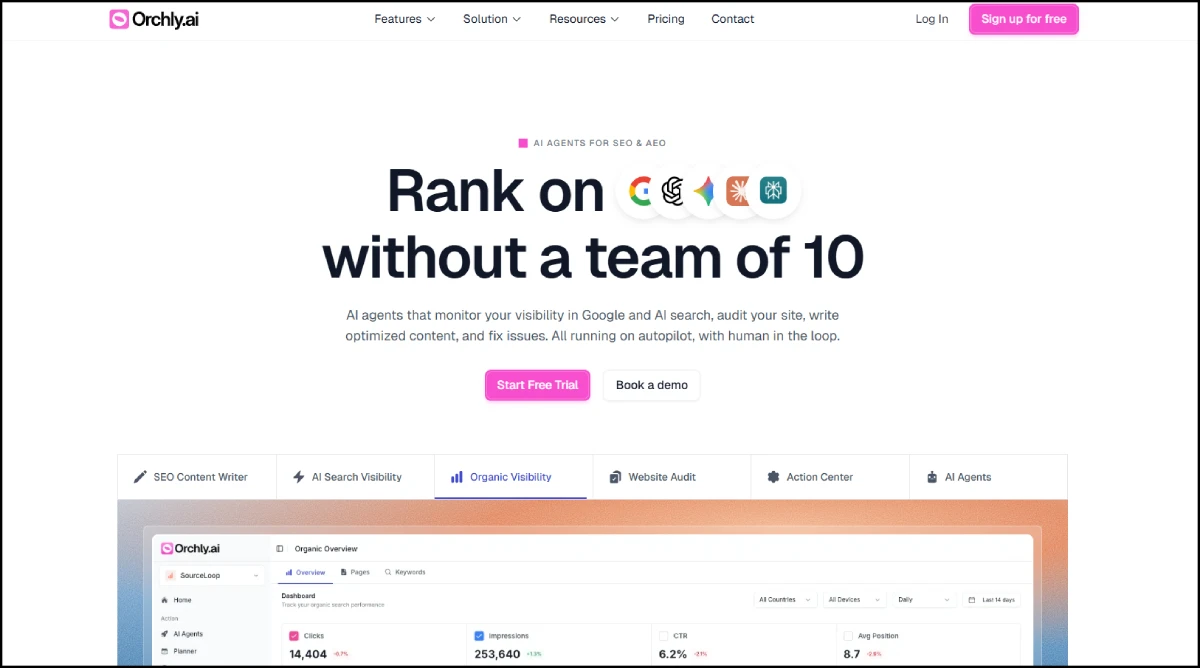
Orchly AI is an AI-powered SEO and GEO (Generative Engine Optimization) platform that helps businesses track, optimize, and improve their visibility across both traditional search engines like Google and AI-powered search platforms like ChatGPT, Claude, Perplexity, Gemini, Grok, and Microsoft Copilot — all from a single unified dashboard.
Here is the simplest way to think about it. Traditional SEO tools tell you where you rank on Google. Orchly tells you where you rank everywhere — including inside the AI-generated answers that hundreds of millions of people are receiving instead of clicking through search results at all. When a prospect asks Copilot which project management tool to buy, or asks ChatGPT which accounting software is best for a small business, they get a direct answer with source citations. Orchly tracks whether your brand is in those answers or invisible to them entirely.
The platform is built around three core operational pillars.
SEO Visibility covers traditional Google keyword rank tracking, Google Search Console integration, daily position updates, and comprehensive site auditing. This is the foundation that makes Orchly suitable as a primary SEO platform rather than just an add-on monitoring tool.
GEO Visibility is where Orchly separates itself from every competitor in the traditional SEO category. It monitors whether your brand is cited in AI-generated answers across ChatGPT, Claude, Perplexity, Gemini, Grok, and Microsoft Copilot. It also tracks Reddit brand mentions, source attribution data showing which web pages are influencing AI citations, brand sentiment scoring, and competitive citation share analysis. As one of the most capable Copilot rank tracking tools available in 2026, this pillar alone justifies the subscription for many brands.
Content Operations rounds out the platform with an AI Article Writer Agent, an SEO and GEO Optimizer that scores existing pages against both Google and AI citation criteria, a Brand Kit that maintains voice and style consistency across all AI-generated content, an editorial calendar, and a publishing integration layer that connects to your CMS.
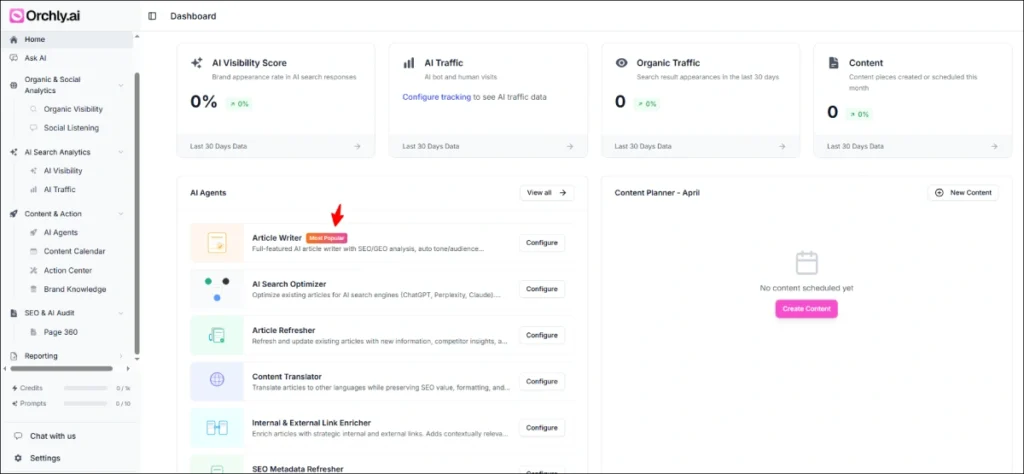
The platform also includes an Action Center that functions as a permanently active AI SEO consultant. It scans your site, your AI citation data across all platforms, and your competitors around the clock, then surfaces prioritized recommendations and dispatches AI agents to implement approved fixes — writing articles, updating metadata, adding schema, and strengthening internal links — with human oversight at each approval stage.
For context on how AI search is fundamentally reshaping content strategy and why GEO is becoming as important as traditional SEO, the Webseotrends blog has a dedicated article on the best Copilot rank tracking tools in 2026 that provides broader industry context around this shift and where Orchly fits in the competitive landscape.
Orchly AI Features: Deep-Dive Breakdown
Every feature in Orchly exists to solve a specific, measurable problem. Here is a detailed look at what each one does and why it matters for your business in 2026.
1. AI Search Monitoring Including Microsoft Copilot Rank Tracking
This is Orchly’s most distinctive capability and the feature that makes it genuinely unique in the current market.
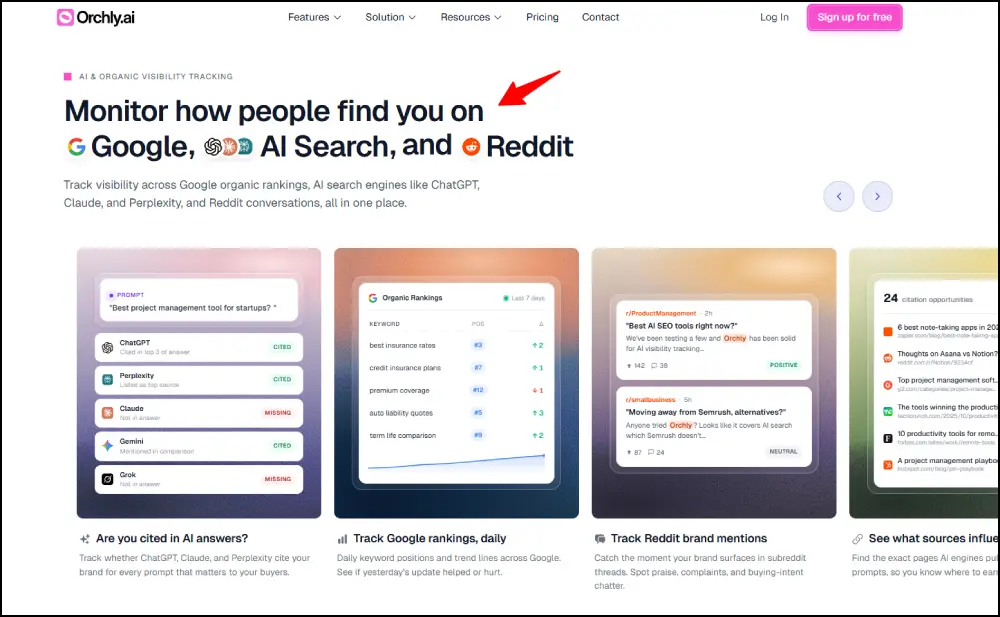
AI Search Monitoring tracks whether your brand is cited in AI-generated answers for the prompts that matter to your actual buyers — and it does this across every major platform: ChatGPT, Perplexity, Claude, Gemini, Grok, and Microsoft Copilot.
Understanding why Copilot tracking specifically matters in 2026 requires a brief look at where Copilot sits in the market. Microsoft Copilot is no longer just a Bing feature.
It is embedded into Windows 11 as a system-level assistant, integrated across the entire Microsoft 365 suite including Word, Excel, Outlook, and Teams, and accessible through Edge as a default browsing companion. This means hundreds of millions of enterprise users are getting AI-generated answers through Copilot as part of their normal daily workflow — answers that cite sources, recommend software, suggest vendors, and influence procurement decisions — all without those users ever visiting a search results page.
For any B2B brand or enterprise-facing product, Copilot SEO rank tracking is no longer optional. It is a core visibility metric.
Orchly’s Copilot rank tracking tool works by checking your configured buyer-intent prompts against Microsoft Copilot’s live responses on a daily basis.
The system shows you the citation status for each prompt — whether you are cited or missing — your position within Copilot’s answer relative to competitors, the sentiment of how your brand is characterized in those responses, which source pages are influencing your Copilot search rank, and trend data showing whether your Copilot online rank tracking performance is improving or declining week over week.
This same monitoring logic applies across all other tracked platforms. You get a unified dashboard showing your citation status across every major AI search engine simultaneously, making it genuinely possible to manage your brand’s AI visibility as a single operational discipline rather than a series of disconnected manual checks.
The monitoring also surfaces competitive intelligence. You can see which competitors are being cited in the same prompts where your brand is absent, and Orchly identifies which source pages are driving those competitor citations — telling you precisely what content you need to create or strengthen to compete for those citations.
For teams evaluating the best Copilot rank tracker options available today, Orchly’s AI Search Monitoring is consistently one of the most capable solutions in the market, particularly because it combines Copilot SEO tracking with monitoring across five other major AI platforms in a single subscription rather than requiring separate tools for each platform.
2. Google Keyword Rank Tracking
Orchly’s Google keyword rank tracking gives you daily position updates for your target keywords, complete with trend lines, position change indicators showing whether you moved up or down, and competitor comparison data alongside your own rankings.
The Essential plan supports 25 tracked keywords and the Pro plan supports 50. For agencies and enterprise teams, the unlimited keyword tracking on the Enterprise plan removes all practical limits.
Google Search Console connects directly within the dashboard, pulling in clicks, impressions, click-through rates, and average position data from your verified properties. This means you have both your rank tracking data and your actual Google performance data in one view rather than switching between tools.
If you are currently paying for a standalone rank tracking tool, this feature alone may justify a significant portion of Orchly’s cost before you even factor in the AI search monitoring capabilities. For context on evaluating rank tracking tools and what metrics matter most, the Webseotrends guide on the best SEO tools tested and ranked covers the evaluation framework in detail.
3. AI Article Writer Agent
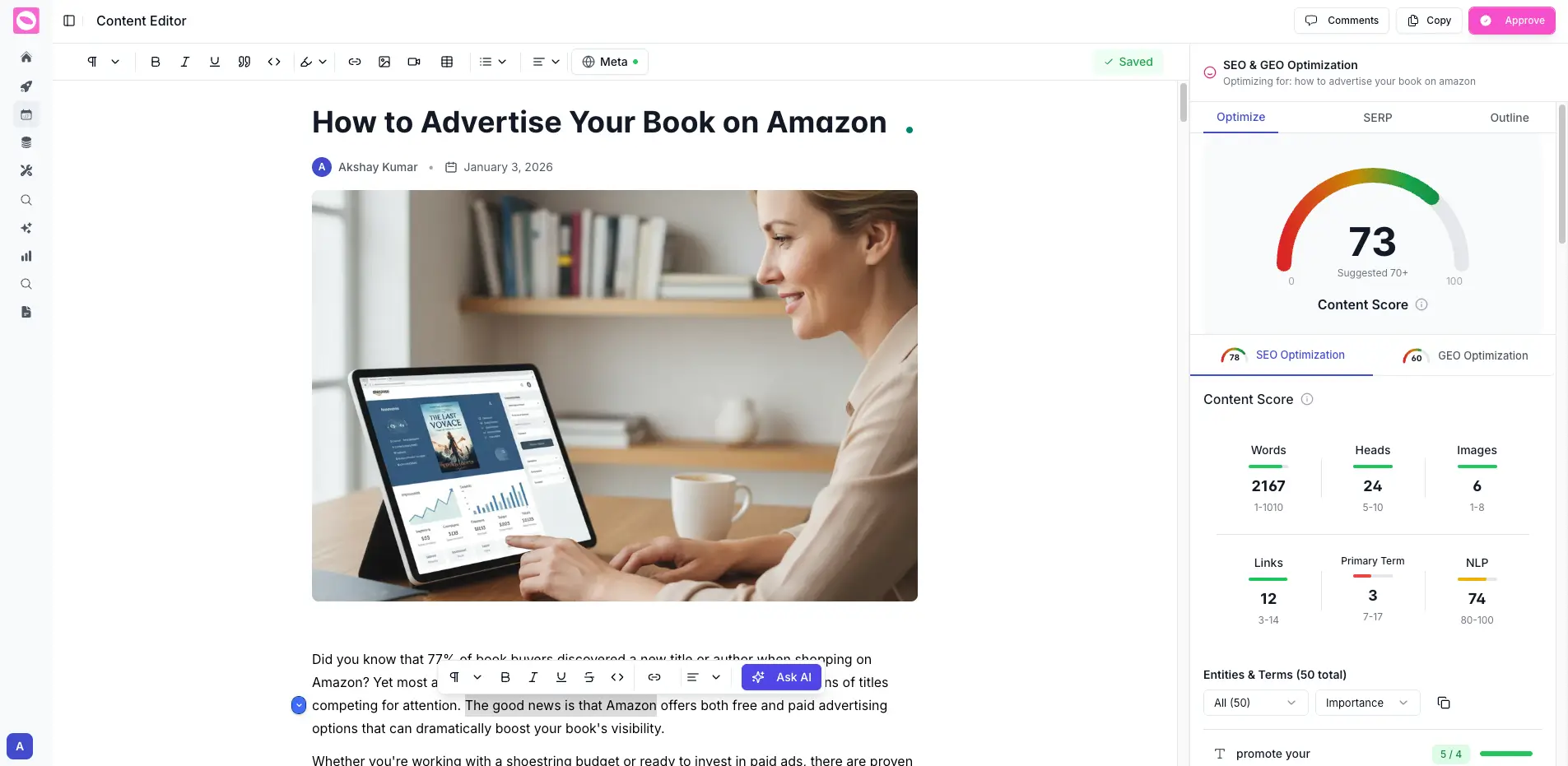
Orchly’s Article Writer Agent is a multi-step AI content production system, not a generic AI writer that produces undifferentiated text. The distinction matters significantly for content quality and search performance.
The Agent begins by analyzing top-ranking competitor content for your target keyword and buying-intent context. It pulls in your Brand Kit — voice guidelines, tone preferences, style rules, any existing content examples you have uploaded — to ensure consistency with your established content. It writes fully structured articles with proper H1, H2, and H3 hierarchy, natural keyword integration, and internal linking based on your existing content architecture.
Critically, it also applies GEO optimization signals as part of the writing process. These include structured data formatting, clear factual claim presentation, FAQ schema integration, and source authority signals — the specific content characteristics that make pages more likely to be cited by AI models including Microsoft Copilot, ChatGPT, and Perplexity when they generate answers to related buyer-intent queries.
The Essential plan allows you to create or refresh 20 articles per month. The Pro plan raises this to 50. The Agent can also schedule and publish content directly to your CMS through available integrations, removing the manual step of moving approved content from the tool to your site.
The output quality I observed in testing was consistently above what I have seen from general-purpose AI writing tools. The difference is attributable to the fact that the Agent is optimizing specifically for search intent and GEO citation potential rather than simply filling a word count target with readable text.
4. SEO and GEO Optimizer
The Optimizer takes your existing published pages and scores them against two distinct sets of criteria: Google’s ranking signals and the citation criteria that AI models use when selecting sources to reference in their answers.
Most optimization tools only address Google’s algorithm. The Orchly Optimizer addresses both simultaneously, which reflects the fundamental shift in how content now needs to be evaluated. A page that ranks well on Google but lacks the structured data, factual clarity, and E-E-A-T signals that AI models look for will still underperform in Copilot, ChatGPT, and Perplexity citations regardless of its Google position.
The Optimizer identifies specific improvement opportunities — missing schema markup, semantic gaps in topic coverage, thin content sections, technical performance issues, weak heading structures — and ranks them by estimated impact. This gives content teams and SEO professionals a clear priority order rather than an undifferentiated list of issues to work through.
For teams running content operations at scale, the Optimizer’s ability to score large batches of existing pages is particularly valuable. Identifying which older published content can be refreshed for improved AI citation performance is one of the highest-ROI content strategies available in 2026, and the Optimizer makes that identification systematic rather than manual.
5. Website SEO and GEO Audit
Orchly’s site audit crawls up to 100 pages on the Essential plan and up to 300 pages on the Pro plan, surfacing technical SEO issues, content gaps, crawlability problems, and AI-specific accessibility issues in a unified report. The audit runs continuously rather than on demand, so you have a live, always-current view of your site’s health rather than a snapshot that goes stale between manual audit runs.
One capability that stands out from traditional audit tools is the AI Crawlability Checker. This evaluates whether AI bots — including Microsoft Copilot’s crawler — can properly read, parse, and index your content. Conventional audit tools like Screaming Frog were not designed with AI crawler behavior in mind. If your site has technical characteristics that prevent AI bots from accessing your content, no amount of content optimization will improve your Copilot search rank or ChatGPT citation frequency. Orchly identifies and prioritizes these issues specifically.
For teams looking to understand the full scope of a professional technical SEO audit and what issues to prioritize, the Webseotrends service page on WordPress SEO services provides a useful benchmark for what comprehensive technical auditing should cover across a modern site.
6. AI Traffic Analytics (Pro and Enterprise Plans)
AI Traffic Analytics connects to your hosting provider — supported integrations include WordPress, Cloudflare, Vercel, and others — and gives you real-time visibility into when AI bots crawl your site and when human visitors arrive from AI search platforms as referral sources.
This is a measurement layer that most analytics setups currently lack entirely. Google Analytics tracks user sessions but does not disaggregate AI search referral traffic from other organic sources. Orchly’s AI Traffic Analytics fills this gap, showing you which AI platforms are sending traffic, how that traffic is trending over time, and how AI-sourced visitors behave on your site compared to other traffic sources.
For teams investing in Copilot SEO tracking software or broader GEO optimization strategies, this feature provides the attribution data needed to measure ROI. Without it, you cannot prove that improvements in your AI citation metrics are translating into actual site traffic and business results.
7. Query Fan-Out Analysis
When an AI search engine processes a user’s query, it does not interpret the question narrowly. It explores a cluster of related topics, subtopics, and semantic angles to build a comprehensive answer. This exploration pattern is called query fan-out, and understanding it is essential for creating content that AI models will find authoritative enough to cite.
Orchly’s Query Fan-Out Analysis maps this pattern for the prompts you are tracking. It shows you which related topics and subtopics AI engines are considering when answering questions in your category, which gives you a content architecture blueprint for building the topic depth and breadth that drives consistent AI citation performance.
This feature is particularly valuable for brands operating in complex or nuanced categories where a single piece of content cannot address the full scope of what AI engines are evaluating. Understanding the fan-out pattern lets you build content clusters that satisfy the complete set of AI evaluation criteria rather than optimizing individual pages in isolation.
8. Action Center
The Action Center is the operational core of Orchly’s platform and the feature that most differentiates it from passive analytics tools. It functions as a continuously running AI SEO monitoring system that ingests data from your site audit, your AI citation tracking across all platforms, your competitor monitoring, and your Google rank tracking, then surfaces prioritized, actionable recommendations on a regular basis.
Recommendations are specific and tied to measurable opportunity. For example: you have a content gap — eight competitors cover a high-value topic and you do not have a page targeting it — with an estimated citation opportunity of 180 additional monthly AI citations across ChatGPT and Copilot. Or: three of your core product pages are missing structured data that is present on all competing pages currently being cited in Copilot responses.
Once you approve a recommendation, the appropriate AI agent is dispatched to implement the fix. The Article Writer Agent produces the identified content piece. The SEO Optimizer updates the flagged pages. The Metadata Refresher improves titles and descriptions across a batch of pages. The Link Enricher adds internal links to pages identified as under-linked. All of this happens with human approval at each stage — you are not handing over full automation without oversight.
For agency teams managing multiple client accounts, the Action Center effectively scales the analytical work that would otherwise require a dedicated analyst per account. For in-house SEO teams, it provides the kind of continuous monitoring and prioritization that is difficult to maintain manually across a large site.
9. White-Label Reports (Pro and Enterprise Plans)
Orchly generates client-facing reports as live, branded, shareable dashboards that update automatically as new data comes in. A single link gives clients real-time access to their Google ranking performance, AI citation status across all platforms including Copilot, site audit results, and content performance metrics — all presented under your agency’s branding with your logo, colors, and domain.
The practical value for agencies is significant. There are no monthly PDF exports to prepare, no slide decks to update, and no manual data aggregation across multiple tools. The report is always current, always branded, and always comprehensive. For agencies that currently spend several hours per client per month on reporting, this feature alone often justifies a meaningful portion of the Pro plan cost.
10. ChatGPT Shopping Visibility Tracker
This feature is specifically designed for ecommerce brands operating in a market where AI-powered shopping recommendations are increasingly influencing purchase decisions. The ChatGPT Shopping Visibility Tracker monitors where your products appear in ChatGPT’s responses to buyer-intent shopping queries — for example, “best wireless headphones under $200” or “top-rated project management software for small teams.”
As ChatGPT’s shopping integrations have matured through 2025 and into 2026, appearing in these AI-generated product recommendations has become a meaningful traffic and revenue driver for ecommerce brands that have optimized for it. Orchly is currently one of the few platforms that tracks this channel specifically, giving ecommerce teams visibility into a revenue stream that most analytics tools cannot measure.
My Personal Experience Using Orchly AI
I have been using Orchly for several weeks, and what follows is an honest account of the day-to-day experience rather than a summary of the marketing materials.
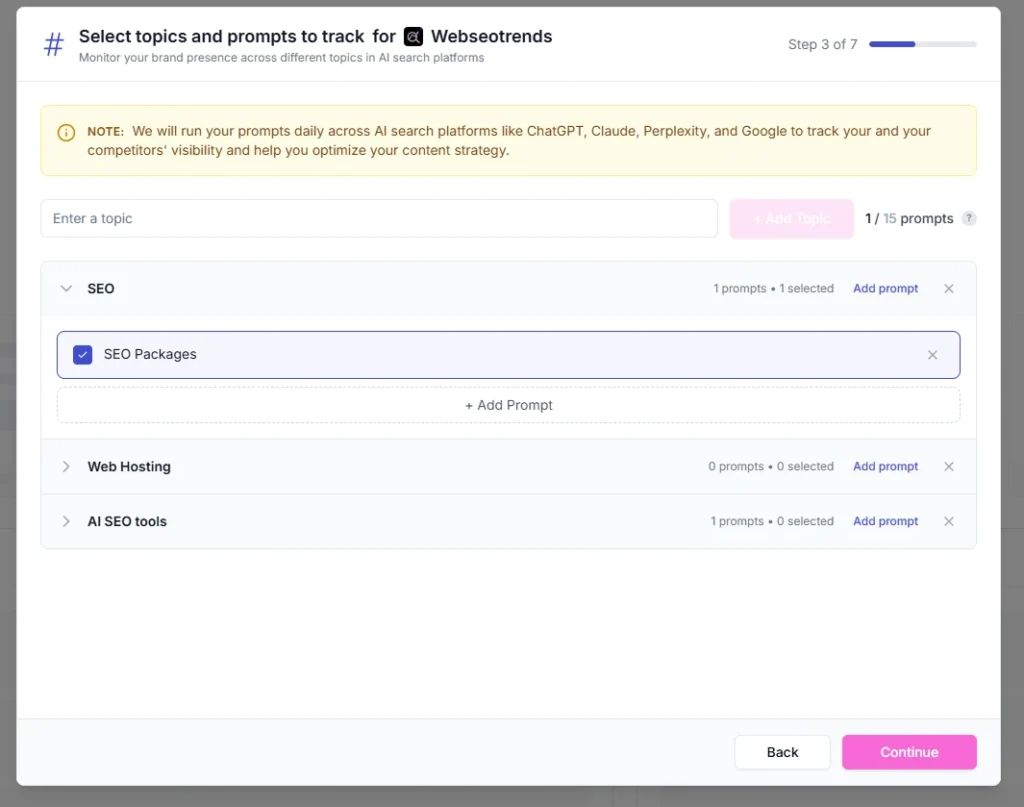
Onboarding was faster than I expected for a platform of this scope. After signing up — no credit card required — I connected my domain, completed the Brand Kit setup with tone preferences, style notes, and competitor domains, and added my first batch of tracking prompts across Google, ChatGPT, and Microsoft Copilot. The complete setup process took approximately 25 minutes, and the interface was clear enough that I did not need to consult any documentation to get started.
The AI Search Monitoring dashboard was where I spent the most time first, and the data it surfaced immediately was more actionable than I anticipated. I had configured 20 buyer-intent prompts relevant to my niche and assumed I had reasonable visibility across AI platforms based on my Google rankings.
The Copilot rank tracking data told a different story. For seven of those 20 prompts, I was completely absent from Copilot’s responses. For three more, I was present but not among the top cited sources. The competitor who was consistently appearing had published content I would not have identified as a threat through traditional SEO analysis alone. That is precisely the kind of intelligence that justifies the platform.
The Copilot rank tracking tool specifically delivered data I had no way to access before. Seeing which competitor pages Microsoft Copilot was pulling as source references for my target prompts gave me an exact content improvement roadmap — not a general recommendation to create more content, but specific topic angles, content formats, and structural approaches that were visibly driving the citations I was missing.
The Article Writer Agent produced output that required less editing than I expected. I tested a 1,600-word piece on a competitive topic that I have written about manually before, and the structure, keyword integration, internal linking, and GEO optimization signals were all solid on the first pass. The human review pass was still necessary — there were factual details I needed to verify and brand-specific nuances to add — but the baseline quality was well above what I have seen from general-purpose AI writers.
The Action Center delivered useful recommendations consistently across the weeks I was testing. The Copilot citation gap findings were the most valuable category of recommendation for my specific situation. The technical SEO recommendations were accurate but relatively standard — the kind of issues any good audit tool would surface. Where the Action Center showed its specific value was in connecting technical and content issues to specific AI citation outcomes, which is a level of analytical synthesis that would take a skilled SEO analyst significant time to replicate manually.
What I would change: The 25-prompt-per-day limit on the Essential plan is a real constraint for competitive niches. If you are tracking 15 to 20 buyer-intent queries across six AI platforms, you will feel that limit. The Pro plan’s 100 prompts per day resolves this, and at $93 per month on the annual plan it represents genuinely strong value for the capability provided.
I would also note that the Article Writer produces content that benefits from a human editorial pass before publication — this applies to all AI content generation tools, not specifically to Orchly, but it is worth factoring into your workflow planning.
Orchly AI Pros and Cons
Understanding what Orchly does well and where it falls short is essential for making the right decision for your specific situation.
What Orchly does well:
Orchly covers Google SEO and AI search — including full Copilot rank tracking — in a single platform, eliminating the need to maintain separate subscriptions for different aspects of your visibility monitoring. The combination replaces eight separate tools at a fraction of their combined cost, which is the most compelling economic argument for the platform.
Daily AI citation monitoring across six platforms including Microsoft Copilot gives you data that simply does not exist anywhere else at this price point.
The 14-day free trial with no credit card required gives you meaningful time to evaluate the platform with real data before committing. The AI agents actively implement approved recommendations rather than just generating reports, which distinguishes Orchly from passive analytics tools.
White-label reports for agencies remove one of the most time-consuming client management tasks. ChatGPT Shopping Visibility tracking gives ecommerce brands a measurement capability that most analytics setups cannot provide.
The connection to hosting providers for AI traffic attribution closes a measurement gap that affects virtually every analytics setup. Free tools including a Copilot rank tracker, ChatGPT rank tracker, Perplexity rank tracker, and AI crawlability checker give teams a no-cost starting point for AI visibility assessment.
Where Orchly falls short:
The Essential plan’s limits — one website, one user, 25 AI prompts per day — make it unsuitable for multi-site operators or teams tracking competitive niches with large prompt sets. Claude and Grok monitoring are restricted to Pro and Enterprise plans, which means Essential plan users are tracking a subset of the AI search landscape.
AI-generated content requires a human review pass before publication, which needs to be factored into content production workflows. There is currently no monitoring for LinkedIn, X (formerly Twitter), or other social platforms beyond Reddit.
The platform is feature-dense enough that new users should budget time for onboarding and setup. Enterprise pricing is not publicly listed, which requires a sales conversation to evaluate. Several GEO features introduced in late 2025 are still labeled as beta.
Orchly AI Pricing: Is It Good Value?
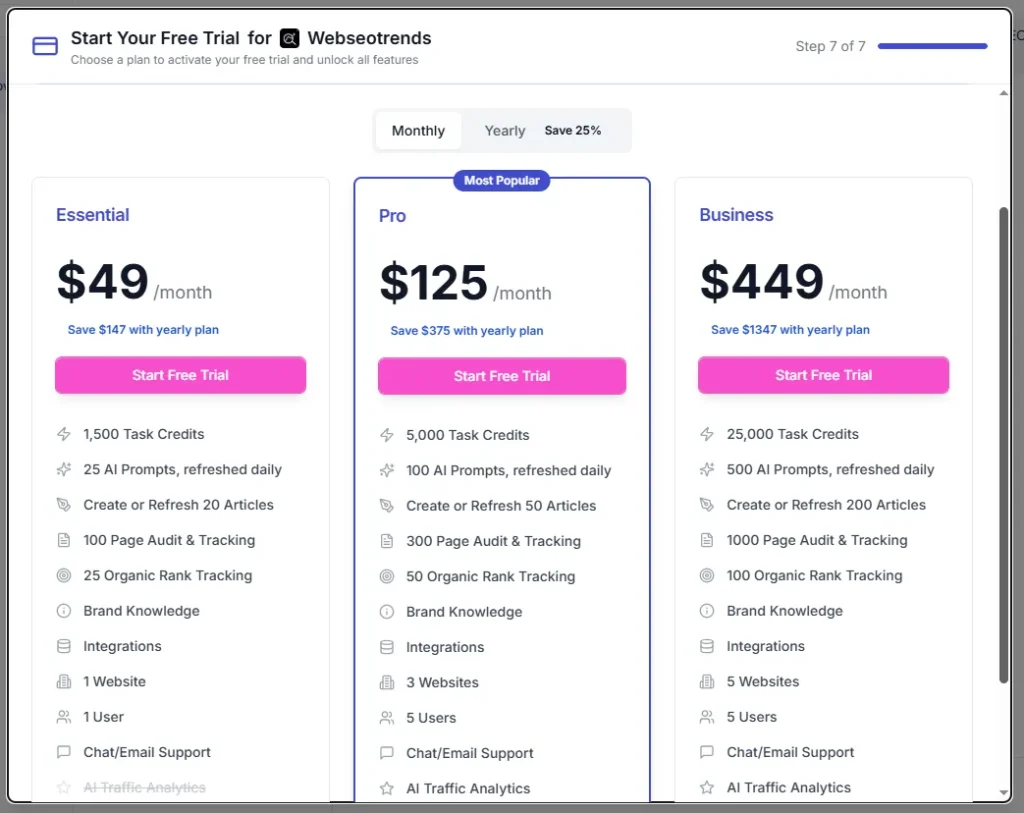
Orchly offers three pricing tiers, all of which include a 14-day free trial with no credit card required. Here is a complete breakdown of what each tier includes and how to evaluate which one is appropriate for your situation.
Pricing Table (2026)
| Feature | Essential | Pro (Most Popular) | Enterprise |
|---|---|---|---|
| Monthly Price | $49/mo | $125/mo | Custom |
| Annual Price | $37/mo (save $144/yr) | $93/mo (save $384/yr) | Custom |
| Websites | 1 | 3 | Unlimited |
| Users | 1 | 5 | Unlimited |
| AI Prompts per Day | 25 | 100 | Unlimited |
| Articles per Month | 20 | 50 | Custom |
| Page Audit Coverage | 100 pages | 300 pages | Unlimited |
| Keyword Tracking | 25 keywords | 50 keywords | Unlimited |
| Copilot Tracking | Basic | Full | Full |
| Claude and Grok Monitoring | Not included | Included | Included |
| AI Traffic Analytics | Not included | Included | Included |
| White-Label Reports | Not included | 5 reports | Unlimited |
| Custom AI Agents | Not included | Not included | Included |
| API Access | Not included | Not included | Included |
| Dedicated Account Manager | Not included | Not included | Included |
Understanding the Value
To put the pricing in context: the tools that Orchly consolidates would collectively cost over $1,192 per month if purchased and maintained as separate subscriptions. Ahrefs or Semrush for keyword tracking and backlinks runs $117 to $199 per month. A dedicated Copilot rank tracking software or AI visibility monitoring platform runs $79 to $299 per month. An AI content writing tool runs $99 per month.
A content optimization tool like Surfer SEO runs $99 to $199 per month. A site crawling and audit tool runs $99 per month. A brand monitoring platform runs $149 per month.
A white-label reporting platform runs $99 per month. A content calendar and planning tool runs $49 per month. Even the $125 per month Pro plan represents a 90 percent cost reduction versus maintaining the equivalent separate tool stack.
For teams specifically evaluating standalone Copilot SEO rank tracking software, dedicated Copilot tracking tools alone can run $79 to $299 per month for that single capability. Orchly’s Essential plan includes Copilot rank tracking alongside Google SEO, AI content creation, site auditing, and Google Search Console integration for $37 per month on the annual plan.
The question of whether to choose Essential or Pro comes down primarily to prompt volume and multi-site needs. Solo operators managing a single competitive site will likely hit the 25-prompt-per-day limit if they are tracking seriously across multiple AI platforms. Teams managing multiple clients or websites need the Pro plan’s three-site allowance and 100 daily prompts.
If you are evaluating this as part of a broader budget assessment, the Webseotrends guide on affordable SEO tools that actually deliver results provides a useful framework for deciding what to pay for versus what free tools can cover, and the affordable SEO services guide for small businesses covers how to allocate an SEO budget across tools and professional services realistically.
Orchly AI vs. Competitors: How Does It Stack Up?
The competitive landscape for AI visibility and SEO platforms has shifted significantly in 2026. Here is an honest comparison of how Orchly stacks up against the tools it most directly competes with.
| Feature | Orchly | Semrush | Ahrefs | Profound AI | Otterly AI |
|---|---|---|---|---|---|
| Starting Price | $37/mo | $117/mo | $129/mo | $79/mo | $99/mo |
| Google Rank Tracking | Yes | Yes | Yes | No | No |
| ChatGPT Monitoring | Yes | No | No | Yes | Yes |
| Microsoft Copilot Rank Tracking | Yes | No | No | Partial | No |
| Claude Monitoring | Yes (Pro and above) | No | No | Yes | Yes |
| Perplexity Monitoring | Yes | No | No | Yes | Yes |
| Grok Monitoring | Yes (Pro and above) | No | No | Partial | No |
| AI Content Writing | Yes | Limited | No | No | No |
| GEO Content Optimization | Yes | No | No | No | No |
| Site Audit | Yes | Yes | Yes | No | No |
| AI Traffic Analytics | Yes (Pro and above) | No | No | No | No |
| White-Label Reports | Yes (Pro and above) | Yes, extra cost | No | No | No |
| ChatGPT Shopping Tracking | Yes | No | No | No | No |
| Reddit Brand Monitoring | Yes | No | No | No | No |
| AI Action Agents | Yes | No | No | No | No |
| Free Trial | 14 days | 7 days | 7 days | 14 days | 7 days |
The Copilot Tracking Gap in 2026
The most important competitive distinction in 2026 is the Copilot tracking gap. Microsoft Copilot has grown too large and too commercially influential — particularly for B2B and enterprise audiences — to ignore in any serious AI visibility strategy. Brands that are not monitoring their Copilot search rank, identifying Copilot SEO analysis gaps, and optimizing for Copilot citation criteria are operating with a significant blind spot that their competitors may already be exploiting.
Among the tools in this comparison, Orchly is currently the strongest all-in-one solution that combines Copilot rank tracking with full-spectrum Google SEO, AI content creation, and site auditing. Profound AI offers capable AI monitoring including some Copilot SEO analysis but lacks Google SEO tracking and content creation. Otterly AI covers AI brand monitoring but has no Copilot support and no traditional SEO capabilities. Semrush and Ahrefs remain powerful for Google-focused SEO but have not meaningfully addressed AI search monitoring, Copilot rank tracking software, or GEO optimization.
For teams that have already read the best Copilot rank tracking tools comparison on Webseotrends and are specifically evaluating Orchly against dedicated Copilot tracking tools, the key consideration is whether you need just the Copilot monitoring layer or the full integrated platform including content and Google SEO.
Who Is Orchly AI Best For?
Orchly is not the right tool for every use case. Here is a clear breakdown of who benefits most and who would be better served by a different solution or a different combination of tools.
Orchly is the strongest fit for:
SEO professionals and in-house SEO teams who need to manage both Google rank tracking and AI search visibility — including Copilot online rank tracking — from a single platform without maintaining separate subscriptions. Digital marketing agencies managing multiple client sites who need white-label Copilot SEO rank tracking software, multi-site management, and client-ready reporting that updates automatically. SaaS companies with B2B or enterprise audiences who need to ensure their brand appears in Copilot, ChatGPT, and other AI search responses for the buying-intent queries their prospects are using. Ecommerce brands who want ChatGPT Shopping visibility alongside broader AI search monitoring. Content marketing teams who need AI-assisted article production optimized for both Google and AI search citation at scale. Solo bloggers and niche site owners who are serious about GEO optimization and want an affordable starting point — the Essential plan at $37 per month annual provides significant capability for a single site. Enterprise brands running competitive intelligence on AI citation share across multiple competitor domains.
Orchly is not the best fit for:
Teams whose primary need is deep backlink analysis and link prospecting — for that use case, Ahrefs or a specialized link building tool remains the better choice, used alongside Orchly rather than instead of it. The Webseotrends guide on link building strategies and best practices covers this area in depth for teams that need to maintain a strong backlink strategy alongside their GEO work. Businesses managing more than three websites on a budget, since the Essential plan’s single-site limit and the Pro plan’s three-site limit mean scaling to larger site portfolios requires the Enterprise plan. Pure PPC and paid advertising teams with no content marketing focus — there is no paid search functionality in Orchly. Users who need extensive social media brand monitoring beyond Reddit, since Orchly does not currently track LinkedIn, X, Instagram, or other social platforms. Developers needing raw API access to build custom integrations or internal tools — API access is Enterprise only.
Real-World Use Cases: How Different Teams Use Orchly
Abstract feature lists become much clearer when you see them applied to specific operational scenarios. Here are five representative use cases based on the types of teams that benefit most from Orchly.
Use Case 1: Digital Agency Managing Multiple Clients
A digital agency uses Orchly Pro to track Google rankings and AI citation status — including Copilot rank tracking — across three client websites simultaneously. The weekly workflow begins with reviewing each account’s Action Center for new recommendations, approving content pieces for the Article Writer Agent to produce, and checking AI citation performance trends across ChatGPT, Copilot, and Perplexity for each client.
Client reporting that previously required manual data collection and slide deck preparation is replaced entirely by Orchly’s live white-label dashboards. Each client receives a branded link to their real-time performance dashboard showing Google ranking trends, Copilot SEO rank tracking data, site audit status, and content performance — all under the agency’s branding, always current, requiring zero manual preparation.
For agencies already reviewing Webseotrends’ guide on SEO packages and what monthly plans should include, Orchly’s white-label reporting and multi-site management capabilities address several of the most time-intensive components of client service delivery.
Use Case 2: B2B SaaS Company Competing for AI Citations
A B2B SaaS company selling project management software sets up 80 buyer-intent prompts covering the questions their target buyers ask AI search engines — queries like “best project management tool for remote teams,” “Asana alternatives for small businesses,” and “how to manage cross-functional projects.” They track citation performance across ChatGPT, Copilot, Perplexity, and Gemini.
The initial data reveals that for 35 of those 80 prompts, competitors are being cited in Microsoft Copilot responses while the SaaS brand is entirely absent. Orchly’s competitive source attribution data shows which competitor pages Copilot is pulling as references, revealing that comparison-style content and detailed how-to guides are driving the majority of competitor citations.
The Action Center translates this analysis into a prioritized content production plan. The Article Writer Agent produces the identified content pieces, each optimized for both Google ranking and AI citation criteria. Within 60 days, Copilot citation frequency for the brand’s target prompts improves measurably.
Use Case 3: Ecommerce Brand Optimizing for AI Shopping
An ecommerce brand selling consumer electronics uses the ChatGPT Shopping Visibility Tracker alongside the broader AI Search Monitoring to understand where their products appear in AI-generated shopping recommendations. For their flagship wireless headphone line, they find that ChatGPT consistently recommends three competitor products while omitting theirs entirely.
Orchly’s GEO Optimizer identifies the specific content and structured data gaps on their product pages that are preventing AI citation. Structured data for product specifications is incomplete. Review aggregate schema is missing. Product comparison content that AI models use as source material does not exist on the brand’s site. The Action Center produces a prioritized implementation plan, and the Optimizer scores each page update as it is published to track improvement in AI citation readiness.
Use Case 4: Solo Blogger Building Niche Authority
An individual blogger running a single-topic niche site in a competitive vertical uses the Essential plan at $37 per month on the annual billing. They track 25 Google keywords alongside 25 buyer-intent prompts across ChatGPT, Perplexity, Gemini, and Copilot.
The Article Writer Agent produces 20 SEO and GEO-optimized posts per month, covering identified content gaps from both the Google keyword opportunity analysis and the AI citation monitoring data. The site audit runs continuously, surfacing technical issues as they arise rather than requiring manual audit scheduling.
Within 90 days of consistent content production aligned with both Google and AI citation signals, the blogger sees measurable improvements in AI citation frequency across tracked platforms. This drives referral traffic from AI search sources that does not appear in Google Analytics organic traffic reports but is clearly visible in revenue-attributed sessions from readers who arrived via AI-generated recommendations. For bloggers looking for more context on building a content-driven site from scratch, the Webseotrends guide on how to start a blog and build income from content covers the foundational approach and what tools matter at each growth stage.
Use Case 5: Enterprise Brand Running Competitive Intelligence
A large consumer brand uses Orchly Enterprise to run continuous Copilot SEO rank tracking against five competitor domains. Custom AI agents generate weekly competitive intelligence reports showing which competitors are gaining citation share in which AI platforms, which content types are driving the strongest Copilot and ChatGPT citation performance, and where the brand’s own citation share is growing or declining relative to the competitive set.
The full API access on the Enterprise plan allows the brand’s internal data team to pipe Orchly’s AI visibility metrics into their broader marketing intelligence dashboards alongside paid media, social, and traditional organic search data — creating a unified view of total search visibility across all channels.
Orchly AI Limitations: What to Know Before You Buy
Being genuinely useful as a review means being honest about where a tool falls short, not just where it excels. Here is a candid assessment of Orchly’s current limitations.
The Essential plan’s prompt and page limits are real constraints for competitive use.
Twenty-five AI prompts per day sounds sufficient in the abstract, but if you are tracking 20 buyer-intent queries across six AI platforms with daily refresh cycles, you will find this limit restrictive. Similarly, the single-website limitation makes the Essential plan inappropriate for agencies or operators managing multiple sites. The Pro plan at $93 per month annual resolves both constraints, but it is worth understanding that the entry-level plan is genuinely limited in ways that matter for competitive SEO work.
Backlink analysis is not included at any tier.
Orchly is not attempting to compete with Ahrefs or Semrush in the backlink intelligence space, and that is a reasonable strategic decision given the platform’s focus on AI visibility and content operations. But it means that if link building is a central component of your SEO strategy — and for most sites it should be — you will need a separate tool for backlink analysis and link prospecting. The Webseotrends detailed guide on link building strategies and best practices covers this area, and the cheap SEO tools guide identifies affordable options for backlink monitoring that can complement Orchly without significant additional cost.
AI-generated content requires a human editorial pass.
The Article Writer Agent produces strong baseline content, but publishing AI-generated content without human review is not advisable for quality, accuracy, or brand voice consistency reasons. This applies to every AI writing tool on the market, not specifically to Orchly, but it is a workflow consideration that affects how you calculate the true time cost of the content production feature.
Several GEO features introduced in late 2025 are still in beta.
Some aspects of the Copilot SEO tracking and query fan-out analysis capabilities were added relatively recently and carry beta labels reflecting ongoing refinement. In practical testing, these features worked reliably, but data refresh timing occasionally varied from the stated daily cadence.
The learning curve is real for non-technical users.
Orchly is a feature-dense platform, and users who are not already familiar with SEO fundamentals, content strategy concepts, and analytics terminology will face a steeper onboarding experience than the marketing materials suggest. The available demo call with the Orchly team is a worthwhile investment of time for anyone evaluating the platform at the agency or enterprise level.
Enterprise pricing requires a sales conversation.
The lack of published Enterprise pricing makes it difficult to evaluate the platform’s cost at scale without initiating contact with the sales team. This is common for enterprise software but worth noting for teams that prefer transparent pricing across all tiers before initiating any vendor conversation.
Final Verdict: Is Orchly AI Worth It in 2026?
The short answer is yes, with a qualification that depends on your current situation and priorities.
The longer answer is this: the question in 2026 is not whether AI search visibility matters. Microsoft Copilot’s user base grew by more than 90 percent in 2025. ChatGPT processes over 800 million queries per week. Perplexity, Gemini, Claude, and Grok are collectively serving hundreds of millions more. AI-generated answers now influence a significant and growing share of commercial and informational queries across virtually every industry and audience segment. If your brand is not being cited in those answers, you are losing visibility and revenue to competitors who are — and you likely do not know the full extent of what you are missing.
Orchly is one of very few platforms that treats AI search visibility as a first-class operational discipline rather than a secondary feature bolted onto an existing Google SEO tool. The combination of Copilot rank tracking, multi-platform AI citation monitoring, AI-powered content creation optimized for GEO signals, continuous site auditing, and an action center that implements recommendations rather than just generating them — all at a price point that undercuts the equivalent separate tool stack by 90 percent — represents genuinely strong value for teams that are ready to invest in this area.
The qualification is that Orchly is not the right primary tool for teams whose work is primarily focused on backlink analysis, technical crawling at enterprise scale, or paid search. It is also not an appropriate solution for the Essential plan if you are managing multiple client sites or properties. Know what you actually need before you sign up for any tier.
Recommendation by role and situation:
Solo bloggers and niche site operators who are serious about GEO and AI visibility should start with the Essential plan at $37 per month on the annual plan. The ROI potential for a competitive single site is high, and the 14-day free trial provides enough time to evaluate whether the AI citation data changes your content strategy in a meaningful way.
Growing brands and content marketing teams should go directly to the Pro plan at $93 per month annual. The additional AI platforms, higher prompt volume, AI Traffic Analytics, and white-label reporting provide capabilities that are meaningful for serious content operations, and the step up from Essential to Pro is justified by the feature expansion.
Digital agencies should evaluate Pro or Enterprise based on the number of client sites managed. The white-label reporting, multi-site management, and Copilot SEO rank tracking capabilities are directly billable value-adds for client engagements, and the time savings on reporting alone typically justifies a meaningful portion of the subscription cost.
Enterprise brands with complex AI visibility requirements, competitive intelligence needs, and integration requirements should contact the Enterprise sales team directly. The unlimited tracking, custom AI agents, and full API access provide the flexibility that large organizations typically require.
The 14-day free trial with no credit card required means there is no meaningful downside to testing Orchly with your real data. Start the trial with your ten most important buyer-intent prompts, configure Copilot rank tracking alongside two or three other AI platforms, and spend the first week reviewing the citation data before making any subscription decision. The data you see in that first week typically makes the decision straightforward.
If you want a professional evaluation of your current AI search visibility gaps before committing to any tool, the free SEO consultation at Webseotrends covers both traditional search and AI search visibility as part of the initial diagnostic process.
Free Copilot Rank Tracking: What Orchly Offers Without a Paid Account
For budget-conscious teams or those in the early stages of evaluating AI search visibility as a strategic priority, Orchly offers a meaningful set of free tools that do not require a paid subscription.
The free Copilot rank tracker lets you check your brand’s citation status in Microsoft Copilot for specific queries without creating a paid account. This provides an initial benchmark for your Copilot search rank visibility before committing to ongoing tracking.
The free ChatGPT rank tracker performs the same function for ChatGPT, showing whether your brand appears in ChatGPT’s responses to specific prompts.
The free Perplexity rank tracker, free Gemini rank tracker, and free Grok rank tracker extend this spot-check capability across the other major AI platforms.
The free AI crawlability checker evaluates whether AI bots can properly access and parse your site’s content — a foundational technical check that should precede any AI visibility optimization effort, since content that AI bots cannot read will never be cited regardless of its quality.
The free keyword research tool provides standard keyword discovery functionality for teams that need this without committing to a paid tool.
These free Copilot rank tracking tools provide useful one-time benchmarks for teams evaluating their starting position. They do not provide the daily tracking, historical trend data, competitor analysis, or source attribution that the paid platform delivers, but they are a credible starting point for teams that have not yet invested in AI search visibility monitoring.
For teams comparing all available free Copilot rank tracking options alongside paid alternatives, the detailed best Copilot rank tracking tools guide at Webseotrends covers the full landscape including where free tools are adequate and where paid tracking becomes necessary.
FAQ: Orchly AI Common Questions Answered
What is Orchly AI used for?
Orchly AI is used for tracking brand visibility across Google search and AI-powered search engines — including ChatGPT, Perplexity, Claude, Gemini, Grok, and Microsoft Copilot — creating SEO and GEO-optimized content with AI agents, auditing websites for technical and content issues, monitoring brand sentiment and Reddit mentions, and generating white-label reports for client-facing agencies. It is designed to replace the combination of separate rank tracking, AI monitoring, content production, site audit, and reporting tools that most SEO teams currently maintain.
How much does Orchly AI cost in 2026?
Orchly AI pricing starts at $37 per month on the annual plan (Essential tier) or $49 per month billed monthly. The Pro plan is $93 per month billed annually or $125 per month billed monthly. Enterprise pricing is custom and requires a conversation with the sales team. All plans include a 14-day free trial with no credit card required.
Is Orchly the best Copilot rank tracker available in 2026?
Among all-in-one SEO platforms, Orchly is currently the strongest solution that combines Copilot rank tracking with Google SEO, GEO optimization, and content operations in a single subscription. If your organization needs only a dedicated standalone Copilot rank tracking tool and nothing else, specialized monitoring platforms may offer deeper prompt-level analytics for that specific function. The Webseotrends best Copilot rank tracking tools comparison covers this distinction in detail, including where Orchly fits relative to specialist monitoring platforms and which use cases favor one approach over the other.
Does Orchly track Microsoft Copilot citations?
Yes. Orchly’s AI Search Monitoring includes Copilot rank tracking that checks your configured prompts against Microsoft Copilot’s live responses on a daily basis. You receive citation status data, sentiment analysis, source attribution showing which pages are influencing Copilot’s answers for your tracked prompts, competitive citation data, and trend analysis showing how your Copilot SEO tracking performance changes over time.
What makes Orchly different from Semrush or Ahrefs?
Semrush and Ahrefs are primarily Google-focused SEO platforms with extensive backlink databases and keyword research capabilities. Neither platform offers meaningful AI search monitoring, Copilot rank tracking, GEO optimization, or AI content creation designed for AI citation performance. Orchly addresses the AI search visibility gap that traditional SEO tools do not cover. The appropriate framing is that Orchly and tools like Ahrefs or Semrush address different problems — for teams with budget for both, they are complementary rather than competitive. For teams choosing one primary platform, the decision comes down to whether Google-focused backlink and keyword intelligence or AI search visibility and content operations is the higher priority for your current situation.
Is there a free Copilot rank tracking option from Orchly?
Yes. Orchly offers a free Copilot rank tracking tool that lets you check your brand’s citation status in Microsoft Copilot for specific queries without a paid account. This provides a starting benchmark for your Copilot search rank visibility. For daily Copilot rank tracking online with historical trends, competitor data, and source attribution, the paid Essential plan is required.
Can Orchly AI write content automatically?
Yes. Orchly includes an Article Writer Agent that produces SEO and GEO-optimized articles based on your Brand Kit, target keywords, competitor analysis, and AI citation optimization signals. The process includes human approval at key stages — you are not running fully automated publishing without oversight. The Essential plan supports creating or refreshing 20 articles per month and the Pro plan supports 50.
What are the best alternatives to Orchly AI?
The closest alternatives are Profound AI, which offers capable AI search monitoring including some Copilot SEO analysis but lacks Google SEO tracking, content creation, and site auditing; Otterly AI, which covers AI brand monitoring but has no Copilot support and no traditional SEO capabilities; and a combination of Semrush or Ahrefs plus a dedicated AI monitoring tool, which covers both Google SEO and AI visibility but at significantly higher combined cost and without the content production or action agent capabilities. The best Copilot rank tracking tools guide at Webseotrends provides a detailed comparison of all major options in this category.
How does Orchly collect AI search data?
Orchly scrapes responses directly from ChatGPT, Perplexity, Microsoft Copilot, and other AI platform interfaces using proxies configured to your preferred location, ensuring the data reflects what real users in your target market see when they ask those queries. For AI bot and human visit analytics, the platform connects with your hosting provider to monitor actual crawl patterns and traffic attribution from AI sources.
Is Orchly AI worth it for small businesses?
Yes, particularly for small businesses whose growth depends on content marketing and organic search visibility across both Google and AI platforms. The Essential plan at $37 per month on the annual billing includes daily AI citation tracking across major platforms including Microsoft Copilot, 20 articles per month from the Article Writer Agent, a 100-page site audit, and 25 Google keyword tracking positions — a meaningful capability set for a single site at a price that competes with standalone rank tracking tools that offer none of the AI visibility features. For small businesses evaluating broader SEO service options alongside tools, the affordable SEO services guide and SEO packages comparison at Webseotrends provide context on how to allocate budget across tools and professional services effectively.
Ready to See Where Your Brand Stands in AI Search?
Orchly’s 14-day free trial is genuinely risk-free. No credit card. No commitment. The trial gives you enough time to configure real tracking prompts, see actual Copilot rank tracking data for your brand, identify the AI citation gaps you are currently missing, and evaluate whether the platform’s content and optimization tools fit your workflow.
Start with your ten most important buyer-intent prompts and configure Copilot rank tracking alongside ChatGPT and Perplexity monitoring in your first session. The data you see in the first week is typically enough to make the subscription decision clear.
Try Orchly AI Free for 14 Days at orchly.ai
For additional context before making your decision, the following Webseotrends resources cover the broader landscape of AI search visibility and tool evaluation:
- Best Copilot Rank Tracking Tools in 2026: Tested and Ranked
- Best SEO Tools I Use to Rank Higher and Drive Traffic
- Affordable SEO Tools That Actually Work
- Affordable SEO Services for Small Businesses
- Cheap SEO Tools That Deliver Real Results
- Link Building: How to Build High-Quality SEO Backlinks
- Free SEO Consultation — Get Your AI and Organic Visibility Assessed
- SEO Packages: Monthly Plans for Startups and Small Businesses
- WordPress SEO Services: Technical Optimization and Auditing
Disclosure: This article may contain affiliate links. If you make a purchase through our links, we may earn a commission at no extra cost to you. All reviews and opinions are based on independent testing and genuine use. Affiliate relationships do not influence our assessments or scores.
