

Editor’s Pick: The best AI visibility tool for most teams in 2026 is Semrush One (with the AI Visibility Toolkit) — it combines a database of 317+ million prompts, real-time brand monitoring across major AI platforms, and a full SEO suite under one login. For pure-play AI tracking on a budget, OtterlyAI starts at $29/month. For enterprise-grade depth, Profound remains the category leader. Keep reading for the full breakdown.
You probably checked your Google rankings today. But there’s another search landscape you may not be monitoring yet: search through LLMs, AI chatbots, and platforms like ChatGPT, Microsoft Copilot, Gemini, and Google AI Overviews.
When someone asks ChatGPT which software to use in your category, does it mention your brand? When they turn to Perplexity, does your company appear—or do your competitors get the recommendation instead?
Traditional SEO shows you where your website ranks in Google. AI search visibility shows whether your brand appears in the answers people increasingly rely on. That difference is becoming a critical blind spot for businesses competing for attention online.
As AI search grows, being visible in these answers matters. When ChatGPT, Perplexity, Google AI Overviews, or other AI systems respond to questions in your category, the brands they mention can gain valuable exposure, trust, and potential customers.
That’s where AI visibility tools come in. These platforms, also called AI visibility trackers, AI visibility tracking tools, AI brand visibility tools, and LLM visibility tools, help you monitor brand mentions, citations, competitors, and changes in your presence across AI search.
They can also reveal where your brand is missing and provide insights for AI visibility optimization.
This guide compares the best AI visibility tools for 2026, covering what they track, their key features, and which types of businesses they’re designed for.
The tools that help you track, analyze, and improve that presence are called AI visibility tools (also called LLM visibility trackers, AI brand monitoring tools, or GEO tools). This guide cuts through the noise to show you exactly which ones are worth your time and budget in 2026 — and who each one is actually built for.
Disclosure: Some links in this article are affiliate links. If you purchase through them, Webseotrends may earn a commission at no extra cost to you. We only recommend tools we’ve genuinely evaluated. See our editorial standards for details.
What Are AI Visibility Tools — and Why Do They Matter Now?
AI visibility tools are platforms that monitor how your brand, products, and content appear inside AI-generated answers across systems like ChatGPT, Google AI Overviews, Perplexity, Gemini, Microsoft Copilot, Claude, and others.
Traditional rank tracking tells you where your page lands in Google’s blue links. AI visibility tracking tells you something fundamentally different: whether an AI system mentions your brand when someone asks a relevant question, how that mention is framed, which competitors it recommends instead, and which sources it cites to justify those answers.
This discipline is sometimes called Generative Engine Optimization (GEO) or Answer Engine Optimization (AEO) — the practice of optimizing content so that large language models (LLMs) surface your brand favorably. Without a dedicated tool, you’re flying blind in a channel that’s growing faster than any other in search.
What Makes the Best AI Visibility Platform?
Not all AI tracking tools are built the same. Before you evaluate any platform, these are the criteria that actually determine whether a tool earns its subscription cost:
Multi-Engine Coverage
LLMs don’t produce identical outputs. ChatGPT might mention you while Gemini recommends a competitor. Any tool that only tracks one or two platforms gives you an incomplete — and potentially misleading — picture. Look for tools that cover ChatGPT, Google AI Overviews, Google AI Mode, Perplexity, Gemini, Claude, Copilot, and ideally Grok and Meta AI.
Prompt-Level Tracking vs. Keyword-Level Tracking
Some platforms (notably Semrush) approach AI visibility from a keyword-first perspective — mapping your keyword universe onto AI responses. Others let you define custom prompts that mimic real user questions (“What’s the best project management software for small teams?”). The best tools offer both, because keyword data tells you your coverage footprint, while custom prompts reveal exactly what AI systems say when your customers are making decisions.
Citation Source Identification
When an LLM cites a source, that citation carries enormous authority. Knowing which domains AI systems trust — and whether your site is among them — is often more actionable than any visibility score. Top-tier platforms surface not just that you were mentioned, but which pages drove those mentions and which competitor pages are getting cited instead.
Sentiment and Brand Safety Analysis
Appearing in AI answers is table stakes. Being portrayed accurately and positively is the goal. The best AI brand visibility tools analyze the sentiment and framing of AI mentions — flagging when a model portrays your brand negatively, associates it with incorrect information, or positions you as a second-tier option.
Competitor Benchmarking and Share of Voice
LLM monitoring tools become strategic assets when they show you how you compare against 3–5 named competitors on any given prompt or topic cluster. Share of voice in AI search — the percentage of relevant AI responses that include your brand — is becoming one of the most important metrics in modern marketing.
Actionable Recommendations, Not Just Data
The most common complaint about AI tracking tools is that they produce impressive-looking dashboards without telling you what to actually do. The best platforms link monitoring data directly to content optimization, technical GEO recommendations, and competitive gap analysis.
Trend Tracking Over Time
AI models are updated constantly, and their outputs shift with each model version. A tool that only shows you a snapshot is less useful than one that shows you a trend line — so you can see when your visibility improved, when a competitor gained ground, and what changed.
How We Evaluated These AI visibility tools (LLM monitoring tools)
The tools on this list were evaluated across the following dimensions: range of AI engines covered, quality and depth of citation tracking, prompt customization flexibility, competitor benchmarking capabilities, actionability of insights, pricing transparency, and how well AI visibility data connects to traditional SEO workflows.
Where hands-on testing was possible, we evaluated account setup, dashboard experience, and report quality. Pricing and features in this category change frequently — always verify current information on each vendor’s website before making a decision.
The 10 Best AI Visibility Tools at a Glance
| Tool | Best For | Starting Price | Free Trial |
|---|---|---|---|
| Semrush One (AI Visibility Toolkit) | All-in-one SEO + AI visibility | $165.17/mo (annual) | 14-day free trial |
| Profound | Enterprise-grade AI monitoring | $99/mo (ChatGPT only); $399/mo (3 engines) | Demo only |
| Ahrefs Brand Radar | Existing Ahrefs users + deep backlink context | $199/mo add-on | No |
| OtterlyAI | Budget-friendly entry-level tracking | From $29/mo | Free tier available |
| Peec AI | Agency reporting + smart prompt suggestions | From $95/mo | Free trial |
| SE Ranking | Affordable all-in-one with AI + classic SEO | ~$103/mo (annual) | 14-day free trial |
| ZipTie | Granular URL-level analysis and reporting | From $35.63/mo | No |
| Similarweb AI Brand Visibility | SEO + GEO data side by side | Custom pricing | Free demo |
| Clearscope | Content creators optimizing for GEO | From $129/mo | No |
| Yext Scout | Multi-location enterprise brands | Custom pricing | No |
Pricing verified as of September 2026. This market moves fast — confirm current rates with each vendor.
1. Semrush One (AI Visibility Toolkit) — Best Overall AI Visibility Platform
Best for: Marketing teams, SEO professionals, and agencies who want AI visibility integrated with a full-stack SEO platform — without managing multiple tool subscriptions.
If you’re serious about both traditional SEO and AI visibility, Semrush One is the single most strategically coherent platform available in 2026. It doesn’t force you to choose between tracking your Google rankings and monitoring your AI search presence — it does both, inside one unified dashboard, with shared data infrastructure.
What Sets It Apart
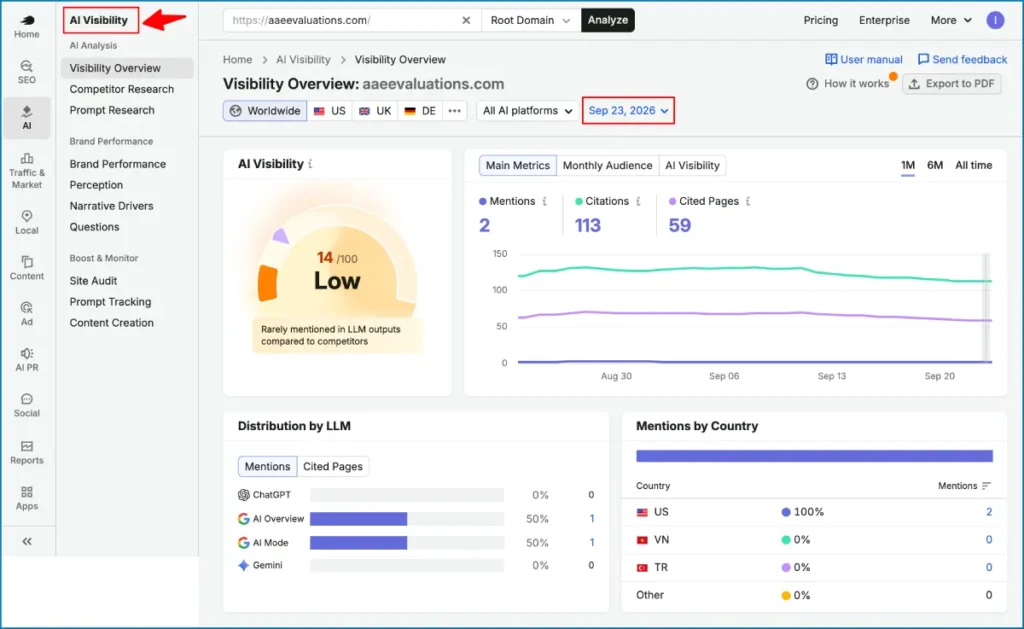
The AI Visibility Toolkit within Semrush One operates against one of the largest proprietary datasets in this category: over 317 million prompts across 36 million brands and 32 regional databases. That scale matters because it means your visibility scores reflect statistically significant prompt sampling — not a handful of manually entered queries.
The toolkit tracks brand mentions, citations, sentiment, and competitor visibility across ChatGPT, Google AI Overviews, Google AI Mode, Gemini, and Perplexity. When your brand appears in an AI response, Semrush surfaces the cited source, the positioning context, and how your visibility compares against competitors you’ve added to your tracking list.
Where Semrush genuinely outperforms dedicated AI-only trackers is in the bridge between AI visibility and action. If Semrush’s AI data shows competitors out-ranking you in AI responses for a cluster of commercial queries, you can move directly into keyword gap analysis, backlink research, content optimization, and technical site auditing — all within the same tool. That workflow continuity is worth real money.
The Domain Overview report now displays AI-specific metrics — visibility score, brand mention count, and cited pages — alongside traditional authority metrics. For teams that report on overall digital presence, this integrated view simplifies stakeholder communication considerably.
Semrush One vs. Standalone AI Visibility Add-On
Semrush offers two paths. The AI Visibility Toolkit ($99/month per domain, requires a Semrush subscription) is available as a standalone add-on for existing Semrush users. Semrush One bundles the AI toolkit with the full Semrush SEO platform and starts at $165.17/month (billed annually). For teams that need both SEO and AI visibility — which is nearly every modern marketing team — Semrush One is the more cost-effective choice over time.
The main legitimate criticism is pricing per user: Semrush charges additional fees per sub-user, which can add up quickly for larger teams. And if you only need lightweight AI monitoring with no traditional SEO requirements, a dedicated tool like OtterlyAI or Peec AI will be cheaper and simpler.
Who It’s For
Semrush One makes the most sense for in-house SEO teams, content marketing agencies, and mid-market brands that are already running a full digital marketing operation and need their AI visibility data to live alongside — not separate from — their keyword tracking, technical audits, and competitive research.
Semrush One Pricing:
- Starter: $199/mo (or $165.17/mo billed annually)
- Pro+: $299/mo (or $248.17/mo billed annually)
- Advanced: $549/mo (or $455.67/mo billed annually)
- Standalone AI Visibility Toolkit add-on: $99/mo per domain
Try Semrush One free for 14 days → Start your free trial.
Pros:
- Largest proprietary AI prompt database in a mainstream SEO tool
- Seamless bridge from AI visibility data to SEO action (keywords, backlinks, site audit)
- Tracks ChatGPT, Google AI Overviews, AI Mode, Gemini, and Perplexity
- Integrated competitor benchmarking at the AI and traditional search level
- Domain Overview integrates AI and SEO metrics in one view
Cons:
- Per-user pricing adds cost for larger teams
- Deeper prompt-level analysis available in dedicated AI-only platforms
- Full value requires using the broader Semrush ecosystem
2. Profound — Best Enterprise AI Visibility Platform
Best for: Fortune 500 marketing teams, enterprise brand managers, and organizations that need the widest AI engine coverage, autonomous optimization agents, and board-level AI ROI reporting.
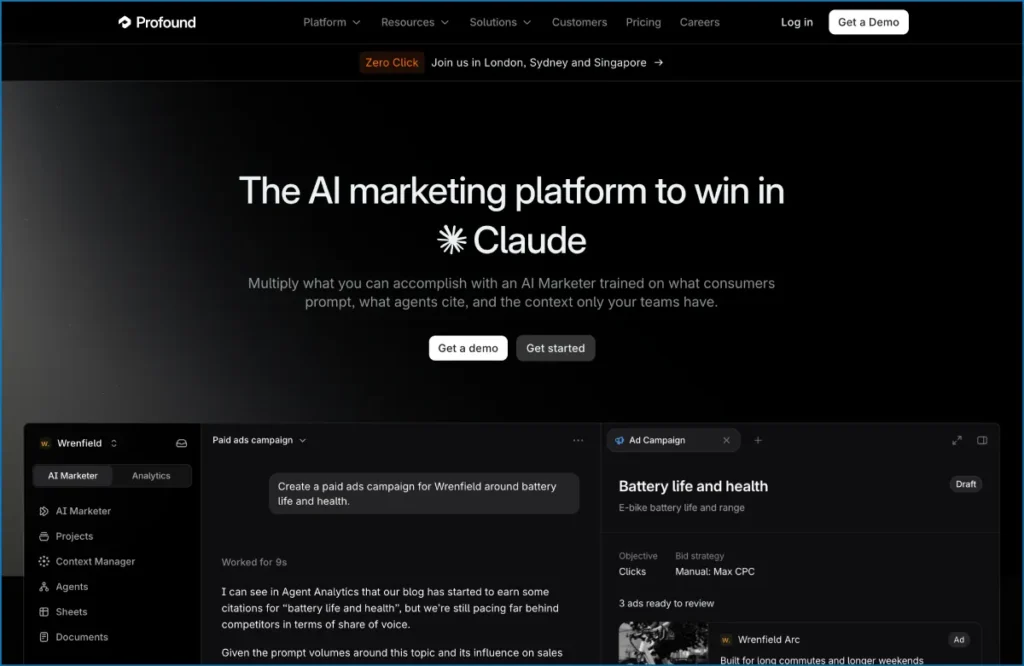
Profound is the most funded and arguably the most feature-complete AI visibility platform on the market. It raised a $96 million Series C at a $1 billion valuation in early 2026, and its customer roster includes major enterprise brands. If you need the deepest possible monitoring across the most AI engines — and can justify the price tag — Profound is the category benchmark.
Engine Coverage: The Widest in the Market
Where most tools track four to six AI systems, Profound monitors ChatGPT, Claude, Perplexity, Gemini, Grok, Microsoft Copilot, Meta AI, DeepSeek, Google AI Overviews, and Google AI Mode — ten platforms in total. For enterprise brands where your customers might use any of these channels, that breadth is genuinely strategic rather than just impressive-sounding.
Beyond brand mentions, Profound tracks AI crawler behavior — when AI bots like ChatGPT’s crawler, Gemini’s crawler, or Claude’s crawler visit your site, Profound captures that activity. This tells you which pages AI systems are actively indexing, not just which pages get cited in responses. It’s the kind of upstream visibility data that has no equivalent in traditional SEO.
Prompt Volumes is another standout feature: Profound surfaces real-world consumer demand by revealing which questions users are actually asking these AI systems related to your category. That data is gold for editorial planning and content strategy, because it shows you where your audience’s AI-native curiosity actually lives.
The platform also includes autonomous AEO agents — automated workflows that can create AI-optimized content, generate demand-driven FAQs, and support PR outreach based on the visibility data. For enterprise teams that want the platform to drive execution, not just reporting, this is a meaningful differentiator.
The Honest Assessment on Pricing
Profound’s pricing structure has been a persistent concern in the community. The $99/month Starter tier tracks ChatGPT only — one engine. The $399/month Growth tier adds two more. Full multi-engine coverage across all ten platforms requires an Enterprise contract, which third-party reports place anywhere from $2,000 to $5,000+ per month. For teams that need everything Profound offers, that spend is justifiable. For teams that just need solid multi-engine tracking at a reasonable price, better alternatives exist.
The platform’s depth also creates a learning curve. Reviewers consistently note that Profound’s data is rich but requires dedicated analytical bandwidth to convert into action. If you don’t have a GEO strategist on staff, you may find yourself with excellent data and unclear next steps.
Profound Pricing:
- Starter: $99/mo (ChatGPT only, 50 prompts)
- Growth: $399/mo (3 engines, 100 prompts)
- Enterprise: Custom pricing (all engines, dedicated support, API access)
Pros:
- Widest AI engine coverage in the category (10+ platforms)
- AI crawler analytics — see which pages AI bots are indexing
- Prompt Volume data reveals real consumer AI search demand
- Autonomous AEO/content agents for teams that want execution support
- SOC2 compliance and enterprise-grade security for regulated industries
Cons:
- Entry tier tracks ChatGPT only; multi-engine requires $399+/mo
- Enterprise-level full coverage requires a custom contract
- Significant learning curve without dedicated technical resources
- Complex ROI to justify for SMBs and mid-market teams
3. Ahrefs Brand Radar — Best for Existing Ahrefs Users
Best for: SEO professionals already using Ahrefs who want to extend their existing workflow into AI visibility tracking — with access to the largest keyword-backed AI dataset available.
Ahrefs has long been the tool of choice for technical SEO professionals, particularly those who prioritize backlink analysis and keyword dataset breadth. With Brand Radar, Ahrefs brings that same data-first rigor to AI visibility — and the scale of the underlying dataset is genuinely impressive.
What the Data Looks Like
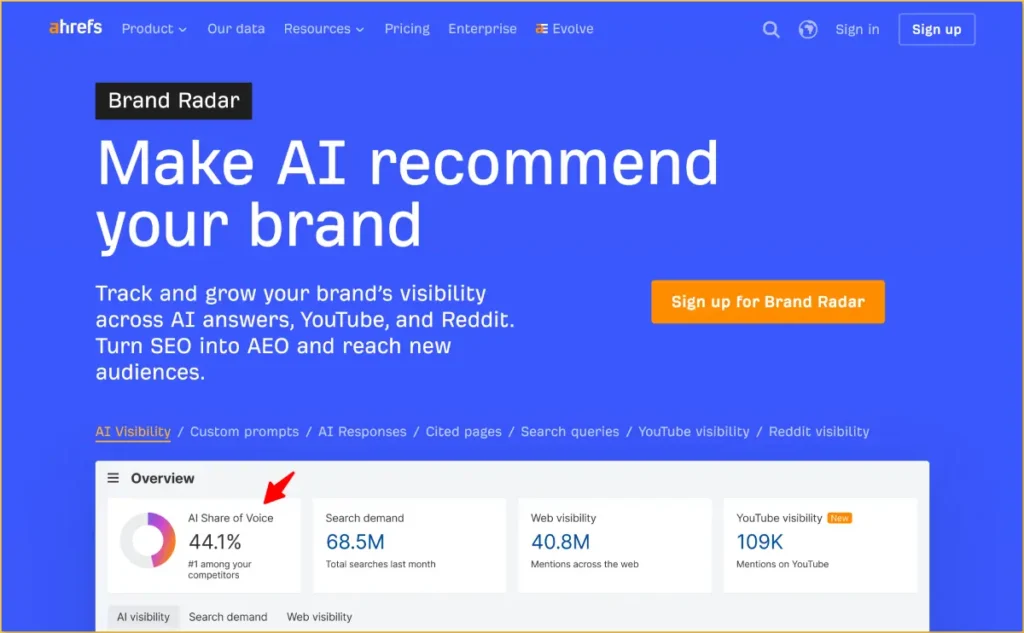
Brand Radar draws on a prompt database of 371 million+ monthly search-backed prompts — making it the largest AI visibility dataset currently published by any major SEO platform, edging out Semrush’s 317 million. The system monitors brand presence across Google AI Overviews, Google AI Mode, ChatGPT, Perplexity, Microsoft Copilot, and Gemini.
The competitive benchmarking is clean and intuitive. For any tracked brand, you can see visibility scores, mention frequencies, and citation sources plotted against direct competitors — and the interface carries over Ahrefs’ signature simplicity. If you’re already familiar with the Rank Tracker and Domain Overview inside Ahrefs, Brand Radar feels like a natural extension rather than a new product to learn.
The SEO-to-AI Connection
Where Brand Radar earns its place in a serious practitioner’s toolkit is the diagnostic capability it unlocks when used alongside the broader Ahrefs suite. If your AI visibility drops in a specific topic cluster, you can immediately cross-reference that against your backlink profile, keyword rankings, and technical site health — and in many cases, find a causal explanation that a pure AI tracking tool would never surface.
Ahrefs has also noted integration with its MCP (Model Context Protocol) tools, meaning teams using AI assistants internally can pull Brand Radar data directly into those workflows. That’s a small but telling signal about where Ahrefs is taking the product.
Limitations to Know
Brand Radar is an add-on product, not bundled into Ahrefs’ core plans. The $199/month price tag adds to what is already a premium subscription. And while the interface is clean, the depth of AI-specific features — prompt customization, content recommendations, sentiment analysis — is less developed than dedicated AI visibility platforms. Brand Radar is excellent at measuring AI presence; it’s less specialized at improving it.
For users who don’t already have Ahrefs in their stack, starting with Brand Radar isn’t the most efficient entry point to AI visibility. The standalone value doesn’t justify the combined cost for most smaller teams.
Ahrefs Brand Radar Pricing:
- $199/month add-on (available to free and paid Ahrefs subscribers)
- Covers Google AI Overviews, AI Mode, ChatGPT, Perplexity, Gemini, and Copilot
Pros:
- 371M+ prompt database — largest in a mainstream SEO platform
- Native integration with Ahrefs’ backlink, keyword, and traffic data
- Clean, intuitive interface with minimal learning curve for Ahrefs users
- Strong competitor benchmarking and brand visibility scoring
Cons:
- Meaningful only for existing Ahrefs users; expensive as a standalone purchase
- Less depth on prompt customization vs. dedicated AI tracking tools
- No autonomous content or GEO optimization recommendations
- Feature set still maturing compared to AI-native platforms
4. OtterlyAI — Best Budget AI Visibility Tool
Best for: Freelancers, small business owners, and early-stage teams that want to start tracking AI visibility without a four-figure monthly budget.
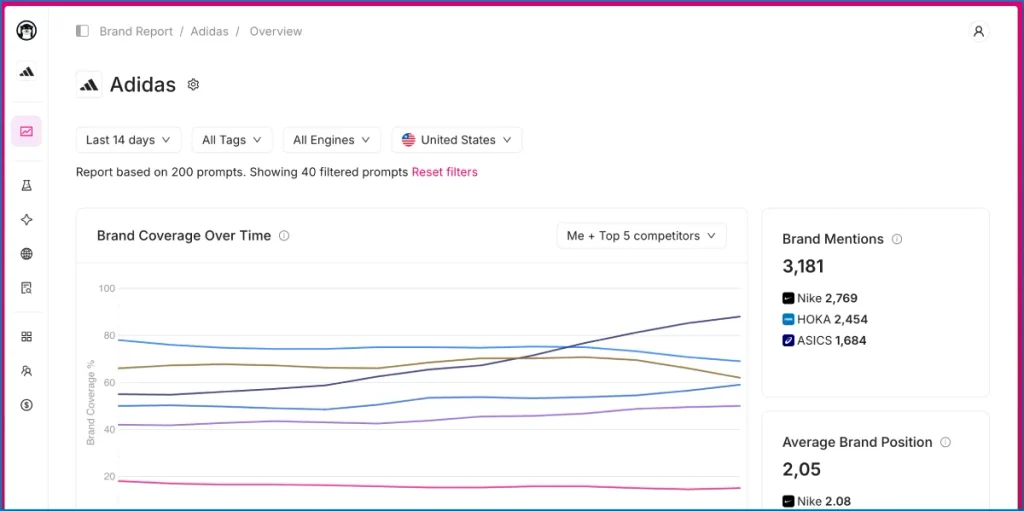
In a category where entry-level pricing often starts at $99–$199 per month, OtterlyAI stands out by making AI visibility accessible at $29/month. That price point represents more than a bargain — it represents a genuinely lower barrier to entry for practitioners who are exploring GEO for the first time and need real data before committing to a more expensive platform.
What You Actually Get
The Lite plan ($29/month) tracks 15 prompts daily across Google AI Overviews, ChatGPT, Perplexity, and Microsoft Copilot. That’s a limited but functional starting point for a single brand or small website. A notable feature is OtterlyAI’s ability to convert your existing SEO target keywords into related LLM prompts automatically — a small but genuinely useful shortcut that saves research time when you’re new to the GEO space.
The GEO Audit feature deserves particular mention: it analyzes your existing content against AI system requirements and suggests specific improvements for better LLM discoverability. For content teams that have been SEO-focused and are now adding GEO to their workflow, this audit is a practical first step.
Where the Budget Shows
OtterlyAI’s limitations are real. Claude, Google AI Mode, and Gemini are only accessible as paid add-ons on top of the base plan, which can quietly raise your effective cost. Advanced features like crawler traffic analysis and unlimited optimization recommendations require the Standard plan at $189/month — at which point, you’re within range of more capable alternatives.
The platform also tracks fewer AI engines in its baseline configuration than competitors like SE Ranking or Semrush at similar or overlapping price points. That engine coverage gap becomes material as AI search continues to fragment across more platforms.
Still, for a solo practitioner or a startup making its first serious move into AI visibility tracking, OtterlyAI is one of the most honest entry points on the market. You can get real data, learn the mechanics of AI monitoring, and upgrade once you understand what you actually need.
OtterlyAI Pricing:
- Lite: $29/mo (15 prompts/day, 4 AI engines)
- Standard: $189/mo (expanded engines, crawler analysis, unlimited recommendations)
- Premium: $489/mo
Pros:
- Most affordable paid entry point in the category
- Converts SEO keywords into LLM prompts automatically
- GEO content audit feature helps beginners take action
- Straightforward onboarding with minimal setup friction
Cons:
- Prompt count and engine coverage limited at base tier
- Claude, Gemini, and AI Mode require add-on purchases
- Less robust than mid-tier competitors once you scale
- Standard plan at $189/mo offers better value-per-feature than Lite
5. Peec AI — Best for Agencies and Smart Prompt Suggestions
Best for: Marketing agencies and enterprise teams that need AI visibility reporting they can share with clients, with intelligent prompt suggestions built in.
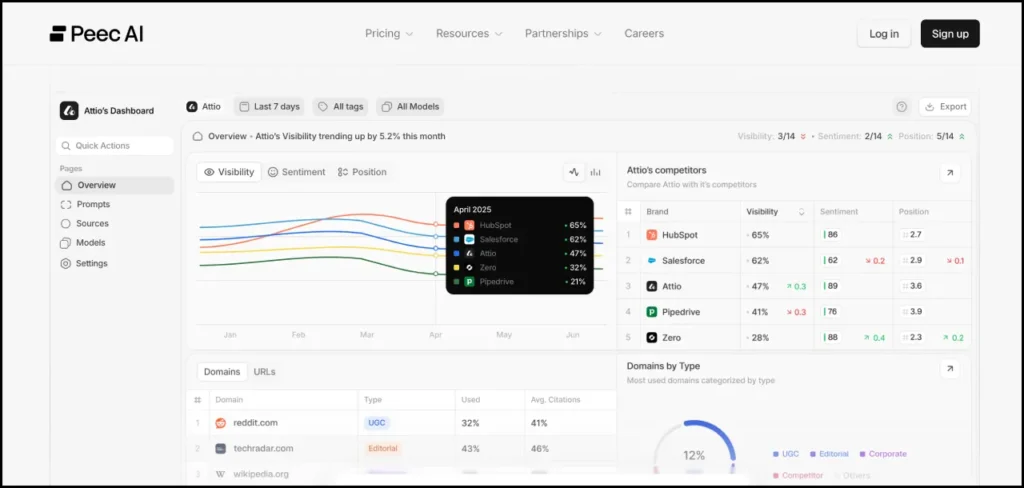
Peec AI occupies an interesting position in the market: it’s priced above the budget tools but below the enterprise platforms, and it’s specifically designed for the kind of reporting that wins client relationships. The Pitch Projects feature — which packages AI visibility data into shareable reports showing brand performance relative to competitors — is genuinely differentiated. No other tool in this category makes client-facing AI visibility reporting this turnkey.
Prompt Intelligence Done Differently
Most AI tracking tools require you to manually define every prompt you want to track, which can be time-consuming and requires GEO expertise to do well. Peec AI supplements this with built-in intelligent suggestions — recommending prompts based on your brand, competitors, and industry context. For agencies onboarding new clients to GEO services, this acceleration matters.
The data included per tracked prompt is generous: daily tracking, unlimited countries, and all models included within your chosen plan. A Google Data Studio connector allows teams to pull live visibility and citation data into existing dashboard environments — a detail that enterprise marketing teams will appreciate.
Peec AI currently tracks six AI models, but the Starter, Pro, and Advanced plans allow you to choose only three of those options. Claude and DeepSeek are reserved for Enterprise plans. The absence of trend data is a real gap — understanding how visibility changes over time is fundamental to GEO strategy, and Peec AI’s current reporting is more snapshot-oriented than trend-oriented.
Peec AI Pricing:
- Free trial available
- Starter: from $95/mo (50 prompts, 3 AI engines of your choice)
- Pro, Advanced, and Enterprise tiers available
Pros:
- Pitch Projects feature built for agency client reporting
- Intelligent prompt suggestions accelerate GEO setup
- Generous data depth per prompt (daily tracking, unlimited countries)
- Google Data Studio connector for custom dashboards
Cons:
- No trend data in current feature set
- Only 3 AI engines accessible in baseline plans
- Claude and DeepSeek locked to Enterprise tier
- Not the deepest tool for in-house teams focused on technical GEO
6. SE Ranking — Best Value All-in-One for SMBs and Agencies
Best for: Small-to-medium businesses and agencies that want best AI overviews trackers and AI visibility tracking integrated with traditional SEO tools, without paying enterprise-level prices.
SE Ranking has spent years building a reputation as the best-value all-in-one SEO platform for teams that can’t justify Semrush or Ahrefs pricing. In 2026, that reputation extends to AI visibility: SE Ranking’s AI tracking module covers AI Overviews, AI Mode, ChatGPT, Gemini, and Perplexity — all integrated into a unified dashboard alongside rank tracking, site auditing, backlink analysis, keyword research, and competitive intelligence.
The SEO-AI Integration Advantage
What makes SE Ranking particularly practical is how AI visibility data connects to the rest of the platform’s diagnostic tools. When your AI visibility drops for a topic cluster, SE Ranking’s unified view helps you correlate that shift with changes in keyword rankings, site health scores, or backlink patterns. That kind of integrated context is genuinely useful for teams that operate across the full SEO stack — not just those focused exclusively on GEO.
The platform’s keyword clustering and intent analysis tools feed directly into GEO content strategy: identify the semantic territories where you’re underperforming in AI search, then use SE Ranking’s content tools to build topical depth. For agencies, white-label reporting and the Agency Pack make AI visibility deliverables scalable across client accounts.
SE Ranking also supports API access and MCP integration, meaning live AI visibility data can flow directly into AI assistants and BI environments at scale — a feature that matters increasingly as marketing operations teams build AI-native workflows.
Where to Set Expectations
SE Ranking’s AI tracking module is solid but doesn’t have the prompt volume depth of Profound, the raw dataset scale of Semrush or Ahrefs, or the specialized GEO content recommendations of tools like Clearscope. It’s a strong generalist — exceptionally capable for teams running a full-service SEO and AI visibility operation, but not the right choice if AI visibility is your only concern and you want the deepest possible monitoring.
For agencies managing 10+ client accounts with diverse SEO and GEO needs, SE Ranking’s combination of breadth, affordability, and white-label infrastructure is difficult to beat.
SE Ranking Pricing:
- Starts at approximately $103.20/month (billed annually; pricing scales with keyword volume and feature tier)
- 14-day free trial available
Pros:
- AI tracking integrated with full SEO platform (rank tracking, audits, backlinks, keywords)
- Covers ChatGPT, Gemini, Perplexity, AI Overviews, and AI Mode
- White-label reporting and Agency Pack for multi-client management
- API and MCP support for BI and AI workflow integration
- Strong historical trend modeling for AI and traditional visibility
Cons:
- AI visibility features are modular add-ons with separate pricing
- Smaller AI prompt database than Semrush or Ahrefs
- Advanced reporting benefits from prior analytics experience
- Not optimized for teams focused solely on GEO without SEO context
7. ZipTie — Best for Granular AI Visibility Analysis
Best for: Data-driven SEO teams and in-house analysts who need deep, URL-level filtering and custom AI visibility scoring — not just summary dashboards.
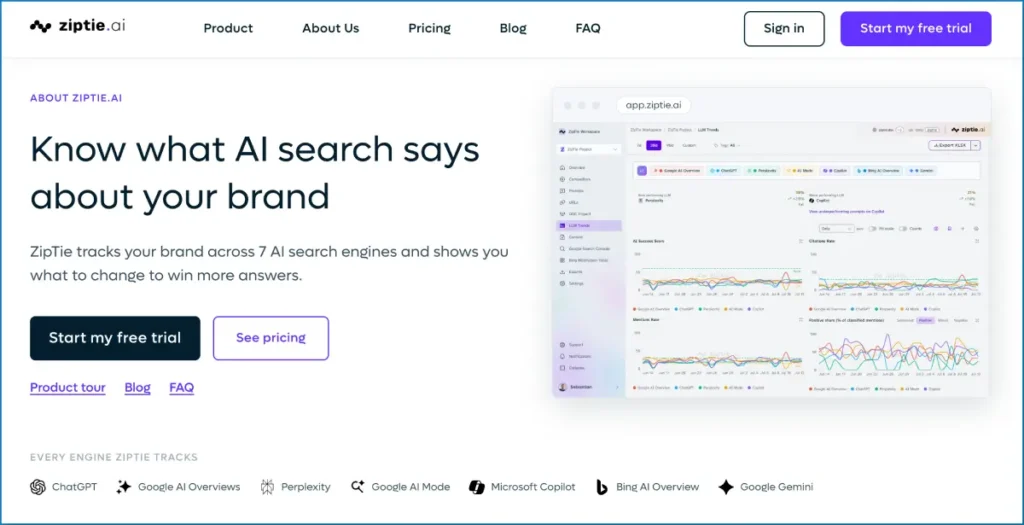
ZipTie is built for the type of practitioner who looks at a summary dashboard and immediately wants to drill down. Its filtering capabilities are unusually granular for this category: you can segment visibility data by URL (not just domain), specific query, AI platform, and time period — a level of analytical precision that many platforms don’t yet offer.
The AI Success Score and Technical Auditing
ZipTie’s proprietary AI Success Score combines tracked mention frequency, sentiment analysis, and citation inclusion into a single composite metric that serves as an executive-level performance indicator. That translation from complex multi-variable data to a single interpretable number is genuinely useful for reporting upward.
The Indexation Audit feature is another meaningful differentiator: it analyzes your URLs specifically for issues that prevent AI bot crawling and indexation — not just traditional search engine crawlability. As AI systems increasingly rely on their own web crawling infrastructure, auditing for LLM bot accessibility is becoming as important as auditing for Googlebot.
ZipTie also includes a content optimization module that identifies specific questions your existing content could answer more completely — linking AI visibility gaps directly to on-page improvement opportunities.
Key Limitations
ZipTie’s per-engine pricing model means that tracking multiple AI platforms can get expensive quickly. The lack of conversation data — understanding the multi-turn context in which your brand is mentioned — is also a gap compared to platforms like Profound that offer this depth. And unlike Semrush or SE Ranking, ZipTie is a pure AI visibility tool; there’s no traditional SEO integration to connect the dots between your AI and organic performance.
ZipTie Pricing:
- Starter from $35.63/month (customizable plans)
- Additional charges per AI engine tracked
Pros:
- URL-level filtering for granular content performance analysis
- Proprietary AI Success Score for executive reporting
- Indexation Audit specifically designed for LLM crawlability
- Built-in content optimization linked to AI visibility gaps
Cons:
- Per-engine pricing escalates costs for multi-platform tracking
- No conversation or multi-turn interaction data
- No traditional SEO tools or integration
- Smaller community and support infrastructure than category leaders
8. Similarweb AI Brand Visibility — Best for Connecting AI Traffic to Web Analytics
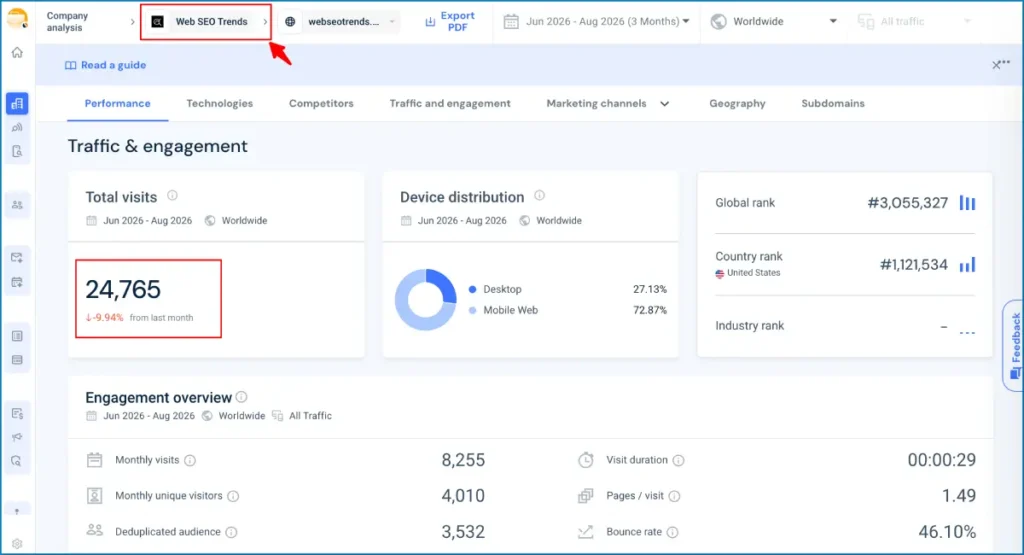
Best for: Enterprise and mid-market marketing teams that want to understand the traffic and behavioral impact of AI visibility — not just the mentions.
Similarweb has spent years building one of the most trusted web traffic intelligence platforms on the market. Its expansion into AI brand visibility brings a distinctive angle to the category: rather than focusing purely on where and how your brand is mentioned in AI outputs, Similarweb connects AI visibility data to actual referral traffic behavior.
The Referral Traffic Intelligence Advantage
Similarweb’s platform tracks traffic from AI chatbots and generates GA4-style reports that identify which AI channels are driving the most users to your site, which topic clusters are generating that traffic, and how that traffic converts compared to other channels. This closes a loop that most AI visibility tools leave open: you can see that you’re mentioned in Perplexity, but Similarweb helps you understand whether those mentions are actually driving visits, engagement, and commercial outcomes.
The inclusion of AI ads tracking is also notable — as AI platforms begin integrating advertising models, understanding your competitive landscape in paid AI placements alongside organic mentions will become increasingly important.
Considerations
Similarweb’s strength is in mid-market and enterprise contexts. Some users report lower accuracy in traffic estimates for smaller websites, which can make its data less reliable for SMBs. Pricing is custom and requires a sales conversation, which limits accessibility. And while Similarweb’s AI visibility features are compelling, the platform is not primarily a GEO tool — teams that need deep prompt-level tracking and content optimization recommendations will want a dedicated tool alongside it.
Similarweb AI Brand Visibility Pricing:
- Custom pricing, by request; free demo available
Pros:
- Connects AI visibility to actual referral traffic behavior
- GA4-style reports for AI channel performance
- AI ads tracking for competitive intelligence across paid AI placements
- Strong brand within the web analytics category
Cons:
- No public pricing; requires sales conversation
- Traffic accuracy concerns for smaller websites
- Not optimized for prompt-level or content-level GEO analysis
- Better suited to enterprises with mature analytics operations
9. Clearscope — Best AI Visibility Tool for Content Teams
Best for: Content strategists, SEO writers, and editorial teams who want AI visibility to inform and improve the content they’re actively creating — not just monitor it.
Most AI visibility tools are built for analysts and strategists. Clearscope is built for writers and content teams — and that audience-specific focus makes it distinctly useful for organizations where content production is the primary lever for AI search performance.
The Content-First Approach to GEO
Clearscope’s existing content optimization platform (long respected in SEO circles for its NLP-based content grading) has been extended to address GEO requirements. The AI Cited Pages view connects the pages you’ve created with Clearscope to the specific AI system citations those pages are generating — closing the loop between content creation investment and AI search outcomes.
The Topic Exploration feature applies a topic clustering methodology to AI search demand: rather than tracking individual keywords in isolation, Clearscope maps the semantic territory around your primary topics to identify content gaps that, when filled, improve AI visibility across the entire cluster. This is a more structurally sound approach to GEO content strategy than prompt-by-prompt tracking.
Clearscope’s AI Draft tool is among the most capable content creation features in this category — flexible enough to accommodate different brand voices, content formats, and structural requirements while building in the GEO optimization logic that drives AI citations.
Limitations
Clearscope’s LLM tracking currently covers ChatGPT, Gemini, and Perplexity — fewer platforms than most competitors. Custom prompt tracking is metered, which can become a constraint for teams running large content operations. And Clearscope is a content-optimization tool first; you’ll need additional tools for competitor benchmarking, citation source analysis, and technical GEO auditing.
Clearscope Pricing:
- Essentials: from $129/month
Pros:
- Natural extension from content SEO to GEO in one workflow
- Topic clustering approach to AI visibility gap analysis
- AI Cited Pages connects content creation to citation outcomes
- Excellent AI-assisted content drafting with GEO optimization built in
Cons:
- Tracks only 3 AI platforms (ChatGPT, Gemini, Perplexity)
- Metered custom prompt tracking limits scale
- Requires additional tools for competitive benchmarking and technical GEO
- Higher per-feature cost without the broader monitoring suite
10. Yext Scout — Best AI Visibility Tool for Multi-Location Brands
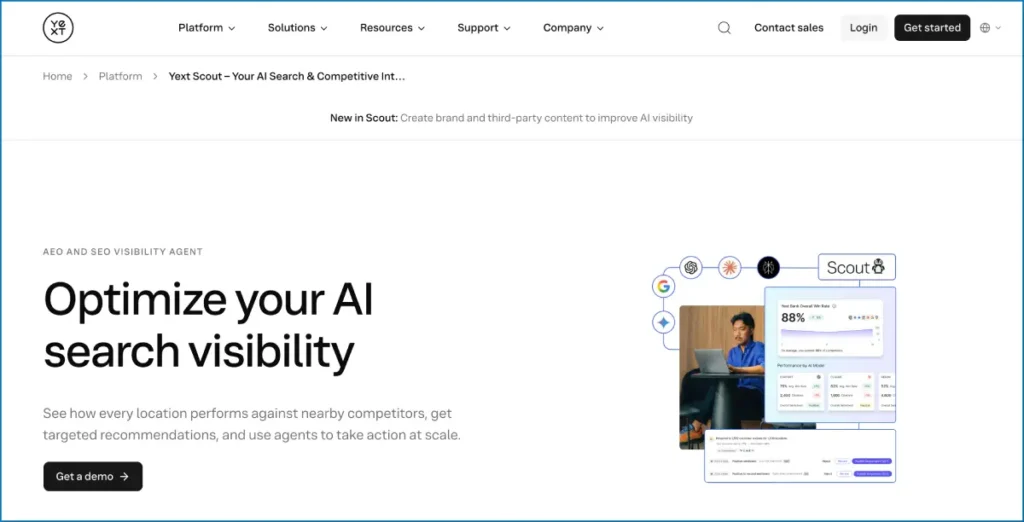
Best for: Enterprise brands with hundreds or thousands of physical locations that need AI visibility broken down by geography and individual location performance.
Most AI visibility tools measure your brand’s presence at the national or global level. For a restaurant chain, a healthcare system, or a retail network, that top-line number is nearly meaningless. What you actually need to know is: when someone in Chicago asks ChatGPT for a recommendation in your category, does your nearest location appear? Yext Scout answers that question.
Location-Level AI Visibility Intelligence
Scout’s most distinctive feature is its geographic heat map showing AI visibility by individual location — visualizing which branches, stores, or offices are being recommended in AI responses based on high-intent queries in their specific area. That granularity is not available in any other mainstream tool.
Based on location-level visibility data, Scout generates specific action recommendations and can deploy Yext’s AI-powered agents to execute improvements across Yext’s marketing platform — updating local listings, optimizing location-specific content, and managing citation signals that influence local AI recommendations.
Competitor benchmarking in Scout is local by default: you’re compared against the 20 nearest competitors per scan, based on actual geographic proximity. For local search strategy, this is far more relevant than national share-of-voice comparisons.
Who It’s Actually For
Yext Scout is enterprise software designed for enterprises. If you operate fewer than twenty or thirty locations, the platform’s complexity and cost are difficult to justify. And Scout works best as part of the broader Yext platform — the agent-driven execution features require Yext’s full marketing infrastructure to deliver on their promise.
For large multi-location enterprises — think national retail, healthcare systems, hospitality brands, financial services — Yext Scout offers capabilities that genuinely don’t exist elsewhere. For everyone else, it’s more platform than you need.
Yext Scout Pricing:
- Custom pricing; third-party sources suggest from ~$199/month at entry
- Free demo available
Pros:
- Location-level AI visibility mapping — unique in the category
- Geographic competitor benchmarking (nearest 20 competitors per scan)
- Agent-driven action recommendations across Yext’s full platform
- Connects to the most comprehensive local listing management infrastructure available
Cons:
- Designed exclusively for enterprise-scale multi-location businesses
- Full value requires investment in the broader Yext platform
- Not suitable for SMBs or single-location businesses
- Custom pricing with no published rates
Key Concepts: GEO, AEO, and LLM Visibility Explained
If you’re new to this space, a few terms come up constantly and are worth defining clearly before you dive into any tool:
Generative Engine Optimization (GEO) is the practice of optimizing your content so that AI systems — ChatGPT, Gemini, Perplexity, Google AI Overviews — surface your brand, products, or content in their generated responses. It’s an evolution of SEO adapted for the architecture of large language models.
Answer Engine Optimization (AEO) is often used interchangeably with GEO. Both refer to optimizing for AI-generated answer surfaces, though AEO sometimes carries a more specific focus on direct-answer queries (as opposed to recommendation or comparison queries).
Share of Voice in AI Search is the percentage of AI responses to relevant queries in your category that include your brand, compared to the total responses tracked. It’s the AI-native equivalent of organic search share of voice.
AI Visibility Score is a composite metric used by various platforms to quantify overall AI search presence. Different tools calculate this differently — it’s important to understand each platform’s methodology before comparing scores across tools.
LLM Crawlers are bots deployed by AI companies (such as GPTBot for OpenAI, Google-Extended for Google) to index web content for training and real-time retrieval. Monitoring which of your pages these crawlers visit — and ensuring those pages are structured for LLM comprehension — is a technical component of GEO strategy.
How to Choose the Right AI Visibility Tool for Your Situation
You’re an individual SEO practitioner or small business:
Start with OtterlyAI at $29/month or SE Ranking if you want AI visibility alongside traditional SEO. Both give you enough data to understand your baseline and start making improvements without a significant budget commitment.
You’re an agency managing multiple client accounts:
Peec AI is worth evaluating for its client-reporting infrastructure. SE Ranking is a strong choice if you need a full SEO platform alongside AI tracking. Both offer white-label or shareable reporting designed for client relationships.
You’re an in-house SEO or marketing team at a mid-market company:
Semrush One is the most strategically coherent choice — it keeps your AI visibility data inside the same platform as your keyword research, site audits, and competitive intelligence. The 14-day free trial makes evaluation low-risk.
You’re a content team focused on GEO optimization:
Clearscope is purpose-built for your workflow. If you also need broader competitive monitoring, pair it with SE Ranking or Semrush One.
You’re an enterprise brand with complex needs:
Profound offers the deepest engine coverage, autonomous optimization agents, and enterprise-grade compliance. Yext Scout is the only serious option if multi-location AI visibility is your primary requirement.
You’re already committed to Ahrefs:
Ahrefs Brand Radar at $199/month is the most seamless extension of your existing workflow. The 371M+ prompt database makes it genuinely capable — not just a checkbox feature.
What to Look for When Setting Up Any AI Visibility Tool
Getting accurate and useful data from an AI tracking platform depends more on how you configure it than which tool you choose. Here are the setup principles that experienced GEO practitioners recommend:
Start with commercial intent prompts. The highest-value AI visibility signals come from prompts that mimic buyer behavior: “best [category] software for [use case],” “alternatives to [competitor],” “which [product type] should I buy.” These prompts reveal whether your brand appears when purchase intent is highest.
Track 20–50 prompts before scaling. Starting broad dilutes your data. Begin with the 20–50 prompts most directly tied to your commercial categories, establish baselines, and expand once you understand which prompt types produce the most actionable insights.
Set up competitor tracking from day one. AI visibility tools generate their highest ROI when used comparatively. Monitoring your visibility without competitor context leaves you guessing about whether your numbers are strong or weak for your category.
Monitor citation sources weekly. The sources AI systems cite in your category are your competitors for AI authority — not just your Google competitors. Understanding which domains are consistently cited alongside or instead of your brand is essential input for digital PR and link acquisition strategy.
Review sentiment, not just mention counts. A high mention rate with negative or inaccurate framing is worse than no mention. Most platforms above include sentiment analysis — use it.
Frequently Asked Questions About LLM monitoring tools
What is an AI visibility tool?
An AI visibility tool tracks how your brand, products, or content appear inside AI-generated responses across platforms like ChatGPT, Google AI Overviews, Perplexity, Gemini, and Microsoft Copilot. These tools monitor brand mentions, citation sources, competitor visibility, and sentiment — helping marketers understand and improve their presence in AI search.
How is AI visibility different from traditional SEO rankings?
Traditional SEO rank tracking measures where your page appears in a list of blue links. AI visibility tracking measures whether an AI system mentions your brand, recommends your product, or cites your content when generating a response to a relevant query. The two often correlate but can diverge significantly — a page that ranks well on Google may not be cited by AI systems, and vice versa.
Do I need both an SEO tool and an AI visibility tool?
For most teams, yes — or you need a platform that does both. Tools like Semrush One and SE Ranking combine traditional SEO (keyword tracking, site auditing, backlink analysis) with AI visibility monitoring in one platform. This integration is valuable because AI visibility and organic search performance are interconnected: improving your backlink profile and content depth often improves both simultaneously.
Which AI platforms should I track?
At minimum: ChatGPT, Google AI Overviews, Google AI Mode, and Perplexity. These four cover the vast majority of AI search activity for most brands. Add Gemini, Microsoft Copilot, and Claude based on your audience’s likely usage patterns. Enterprise brands in global markets should additionally consider Meta AI, Grok, and DeepSeek.
How accurate are AI visibility tools?
AI visibility data is inherently probabilistic because LLMs are non-deterministic — the same prompt can produce different responses on the same day. Reputable tools account for this through prompt sampling methodology (running each prompt multiple times and averaging responses). Use visibility scores as directional trend indicators rather than precise measurements. The trend over time — improving, declining, stable — is more meaningful than any single data point.
What’s a realistic budget for AI visibility tracking?
Entry-level monitoring starts at $29/month (OtterlyAI Lite). Serious multi-platform tracking for a single brand runs $99–$199/month. Agency-scale or mid-market platforms range from $100–$400/month. Enterprise platforms with full engine coverage and autonomous optimization agents start at $399/month and scale into custom enterprise contracts. Most teams find the mid-range ($100–$200/month) sufficient for a strong starting point.
How long does it take to see results from GEO optimization?
Unlike PPC, there’s no immediate feedback loop. Most practitioners see measurable AI visibility improvements within 8–16 weeks of targeted content and authority-building efforts. The timeline depends on the competitiveness of your category, your current domain authority, and the quality of your GEO content investments. AI visibility tracking tools help you see directional movement earlier in this cycle.
Is AI visibility tracking worth it for small businesses?
Yes, if you operate in a category where buyer decisions are frequently research-led. For service businesses, SaaS companies, professional services, e-commerce in research-intensive categories, and any B2B brand, AI search is increasingly part of the discovery funnel. Starting with an affordable tool like OtterlyAI or the AI tracking module within SE Ranking allows small teams to build a baseline and compete effectively without enterprise-level investment.
The Bottom Line: Which AI Visibility Tool Is Right for You?
The AI visibility tool category has matured considerably in the past 18 months. The gap between entry-level and enterprise products has widened — but so has the quality of mid-tier options that give serious practitioners real capability at sensible prices.
Semrush One remains the best overall choice for teams that want AI visibility as part of a complete digital marketing intelligence platform. Its 317M+ prompt database, multi-engine tracking, and seamless bridge to traditional SEO workflows make it the most strategically coherent option for in-house teams and agencies alike.
Profound is the right choice if you’re at the enterprise level, need the widest possible engine coverage, and have the analytical resources to act on deep data.
Ahrefs Brand Radar earns its place for existing Ahrefs users who want a native extension of their current workflow.
OtterlyAI and SE Ranking are the strongest budget-to-value options — the former for entry-level AI monitoring, the latter for teams that need traditional SEO alongside AI tracking without paying Semrush prices.
Whichever tool you choose, start soon. The brands building AI visibility intelligence now will have a compounding advantage over those who wait — both in data history and in established citation authority with the AI systems that are increasingly shaping how your customers find you.
Ready to start tracking your brand’s AI visibility? Try Semrush One free for 14 days and see how your brand shows up across ChatGPT, Google AI, Gemini, and Perplexity — before your competitors do. (affiliate link)
Related Reading on Webseotrends
- What Is Generative Engine Optimization (GEO)? The Complete Guide
- How to Optimize Content for Google AI Overviews
- Answer Engine Optimization (AEO): Strategies That Actually Work
- The Best SEO Tools in 2026: Our Independent Rankings
- How to Track Keyword Rankings in 2026 (AI-Era Edition)
- LLMs.txt: What It Is and Whether Your Site Needs One
Last updated: September 2026. Pricing and features in this category change frequently. Always verify current information on each vendor’s website before making a purchasing decision.
Disclosure: This article contains affiliate links. Webseotrends may receive a commission if you purchase a product through one of these links. This does not affect our editorial independence or the tools we recommend — we only include products we have genuinely evaluated. For full details, see our affiliate disclosure policy.
