

Local SEO looks simple from the outside. A business creates a Google Business Profile, adds its address to a few directories, collects reviews and waits for customers to find it.
The best local SEO tools help businesses track Google Maps rankings, optimize Google Business Profiles, manage citations, monitor reviews, and research local competitors. Popular options include BrightLocal, Local Falcon, Whitespark, Semrush Local, Moz Local, Localo, Nightwatch, and Grid My Business.
Local SEO becomes harder to manage when you have multiple locations, competitors, or service areas. A business can rank well in one part of a city and much lower just a few miles away. Inconsistent listings, missing citations, weak reviews, and an under-optimized Google Business Profile can also affect local visibility.
That’s where local SEO software helps. Local Falcon and Grid My Business focus on geographic rank tracking, while BrightLocal and Whitespark offer local rankings and citation tools. Semrush Local, Moz Local, and Localo provide additional tools for listings and Google Business Profile management.
You don’t need every tool. The right choice depends on whether you need local rank tracking, Google Maps monitoring, citation management, review tracking, competitor research, or multi-location reporting.
This guide focuses specifically on local SEO tools rather than general SEO software. For keyword research, technical SEO, content optimization, backlinks, and more, see our guide to the best SEO tools.
Best Local SEO Tools at a Glance
| Tool | Best for | Main strength | Best suited to |
|---|---|---|---|
| BrightLocal | Local SEO management | Rankings, citations, reviews and reporting | Businesses and agencies |
| Local Falcon | Google Maps rank tracking | Geo-grid visibility | Local businesses and agencies |
| Whitespark | Citation research | Citation opportunities and local rankings | Local SEO specialists |
| Semrush Local | Multi-location SEO | Listings, reviews and local visibility | Existing Semrush users |
| Moz Local | Listing management | Business data distribution | Small businesses |
| Nightwatch | Local rank tracking | Location-level tracking | Agencies and multi-location brands |
| Localo | Google Business Profile workflows | GBP optimization and local tracking | Small businesses |
| Yext | Enterprise listings | Large-scale location management | Enterprise brands |
| Grid My Business | Geo-grid analysis | Google Maps ranking visualization | Local SEO professionals |
| Google Search Console | Local organic search data | First-party search data | Every website |
| Google Business Profile | Business profile management | Google’s own local listing platform | Every local business |
What Are Local SEO Tools?
Local SEO tools are software platforms designed to help businesses monitor and improve visibility in geographically relevant search results.
Depending on the tool, that can include:
- Google Maps rankings
- Local Pack rankings
- Google Business Profile performance
- Local organic rankings
- Citation consistency
- Business listings
- Online reviews
- Competitor locations
- Local keyword tracking
- Geo-grid rankings
- Local SEO reporting
- Multi-location management
The important distinction is that local SEO software isn’t simply regular SEO software with a city filter.
Local search has its own problems.
A business might rank first when someone searches from its storefront but appear fifth when the same person searches two miles away. A competitor may have fewer backlinks but a much stronger Google Business Profile. A business can also have correct information on its website while outdated information remains on third-party directories.
Local SEO tools help make those differences visible.
What Should a Local SEO Tool Help You Do?
Before paying for any platform, identify the task you need it to solve.
A useful local SEO tool should help with at least one of these areas.
Track local rankings
You should be able to monitor where your business appears for important local searches.
For serious local campaigns, look for location-level or geo-grid tracking rather than a single ranking for an entire city.
Monitor Google Maps visibility
Google Maps is one of the most important parts of local search for businesses that depend on physical locations or local service areas.
A good local rank tracker should show how visibility changes across different points around your target area.
Manage citations
Citations are mentions of your business information on directories and other websites.
Tools can help identify missing listings, inconsistent information and duplicate profiles.
Monitor reviews
Reviews influence how customers evaluate businesses, and local SEO platforms can make monitoring multiple review sources easier.
Analyze competitors
A useful platform should help you understand which competitors appear in the same local searches and where their visibility is stronger.
Manage multiple locations
A single-location restaurant and a company with 200 offices have completely different requirements.
For multi-location businesses, location management, reporting, permissions and bulk changes become much more important.
1. BrightLocal
Best for: All-around local SEO management
BrightLocal is built specifically around local search rather than trying to be an all-purpose SEO platform.
It brings together local rank tracking, citation management, Google Business Profile-related workflows, review monitoring and reporting.
That makes it particularly useful for agencies managing several local clients.
What BrightLocal can help with
- Local keyword rankings
- Google Maps visibility
- Local Search Grid tracking
- Citation management
- Google Business Profile audits
- Review monitoring
- Competitor tracking
- Client reporting
- Multi-location SEO
The Local Search Grid is particularly useful because it shows how rankings vary across different locations instead of giving you one city-wide number.
That matters because local rankings aren’t uniform.
A business might dominate searches around its address while losing visibility farther away.
BrightLocal also makes sense when reporting is a major part of your workflow. Agencies can bring rankings, citations and other local data into client-facing reports rather than building everything manually.
Best for: Local SEO agencies, small businesses with several locations and marketers who need reporting.
2. Local Falcon
Best for: Google Maps geo-grid rank tracking
Local Falcon focuses heavily on one of the most important local SEO questions:
Where does my business actually rank across the area I serve?
Instead of checking Google Maps from one location and assuming the result represents the whole city, Local Falcon lets you analyze rankings across a geographic grid.
This can reveal patterns that a traditional rank tracker misses.
For example, your business might rank very well around its physical address but gradually disappear as the search location moves farther away.
You can also compare local visibility against competitors.
That makes Local Falcon particularly useful when the objective is to understand Google Maps ranking distribution, rather than manage citations or reviews.
Best for: Local rank tracking, agencies and businesses focused heavily on Google Maps.
3. Whitespark
Best for: Local citations and local search research
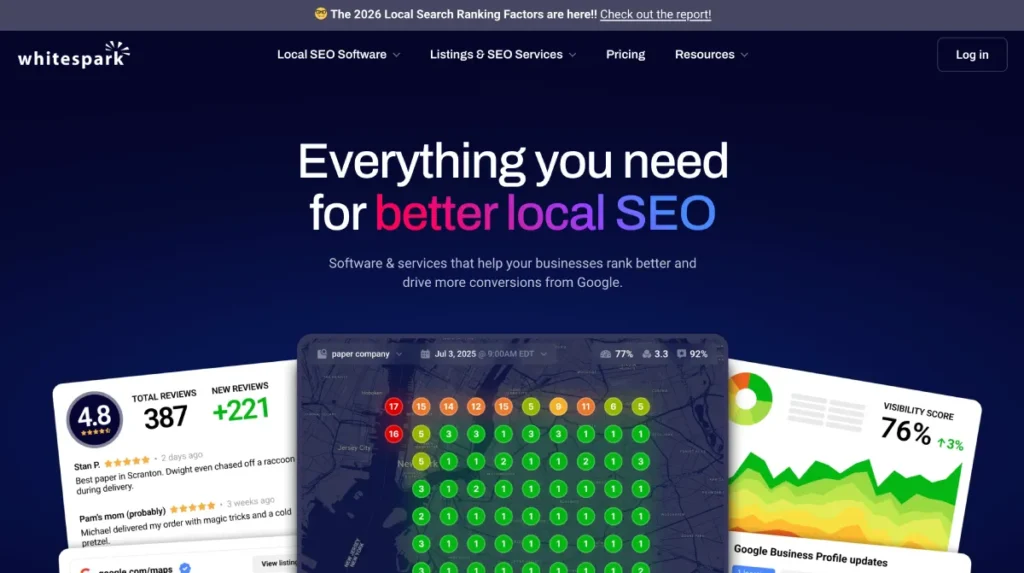
Whitespark is one of the more specialized local SEO platforms.
Its tools focus on areas such as:
- Citation research
- Local rank tracking
- Google Maps visibility
- Local search results
- Google Business Profile management
- Competitor research
The Citation Finder is particularly useful when you’re trying to discover directories and websites where competitors have listings that your business doesn’t.
That’s more useful than blindly submitting a business to hundreds of directories.
Not every directory is relevant to every company.
A local plumber, medical practice, law firm and ecommerce business should not build the same citation profile.
Whitespark’s local focus makes it useful when citation research is a major part of the campaign.
Best for: Local SEO specialists, agencies and businesses working on citation gaps.
4. Semrush Local
Best for: Businesses already using Semrush
Semrush Local brings local search functionality into the broader Semrush ecosystem.
That can be convenient if you’re already using Semrush for keyword research, competitor analysis, technical SEO and other work.
Local features can help with:
- Business listings
- Local rankings
- Review management
- Google Business Profile information
- Location management
- Local reporting
The main advantage isn’t necessarily that Semrush Local does every local task better than a dedicated specialist tool.
It’s that you can connect local SEO work with the rest of your SEO workflow.
For example, you can research a local keyword in Semrush, investigate competitors and then manage local visibility without moving between several unrelated platforms.
Best for: Existing Semrush users, agencies and businesses managing multiple locations.
5. Moz Local
Best for: Business listing management
Moz Local is focused heavily on maintaining accurate business information across online directories.
That makes it different from tools primarily designed for geo-grid ranking analysis.
It can help businesses manage important information such as:
- Business name
- Address
- Phone number
- Website
- Business categories
- Opening hours
- Listings
This can be useful when inaccurate or outdated information is spread across multiple directories.
The appeal is simplicity.
A small business that doesn’t need a sophisticated local SEO dashboard may prefer a tool focused on keeping its listings organized rather than paying for a large platform full of features it won’t use.
Best for: Small businesses and companies that mainly need listing management.
6. Nightwatch
Best for: Local and multi-location rank tracking
Nightwatch is primarily a rank-tracking platform, but its location-level tracking makes it relevant for local SEO campaigns.
You can monitor rankings across specific locations and compare changes over time.
This becomes particularly useful when a business operates across several cities or when an agency needs to track different client locations.
The advantage of specialist rank tracking is control.
You can choose the keywords, locations and search environments that matter instead of relying on a generic city-level ranking.
Nightwatch can also fit into broader reporting workflows, making it worth considering for agencies that care more about rank tracking than citation management.
Best for: Agencies, multi-location businesses and SEO teams that need granular ranking data.
7. Localo
Best for: Small businesses managing local SEO themselves
Localo takes a more guided approach to local SEO.
It’s designed for businesses that want help managing and improving their Google Business Profile and local search presence without needing a full enterprise SEO platform.
Typical workflows include:
- Google Business Profile optimization
- Local rank tracking
- Competitor monitoring
- Local SEO tasks
- Review-related workflows
- Visibility tracking
This type of tool can be useful for a business owner who wants actionable tasks rather than a dashboard filled with SEO metrics.
If you’re doing local SEO yourself, simplicity can matter more than having dozens of advanced reports.
Best for: Local business owners, freelancers and smaller agencies.
8. Yext
Best for: Large multi-location businesses
Yext is designed for businesses with a large number of locations and listings.
Managing five locations manually is one thing.
Managing 500 is completely different.
Enterprise businesses need centralized control over business information, location data and listings.
Yext is built around that problem.
It’s more relevant to organizations such as:
- Retail chains
- Restaurant groups
- Healthcare networks
- Financial institutions
- Franchises
- Large service businesses
For a single-location business, this level of infrastructure can be unnecessary.
But when hundreds or thousands of locations need consistent information, centralized management becomes much more important.
Best for: Enterprise and large multi-location organizations.
9. Grid My Business
Best for: Visualizing local rankings on a map
Grid My Business focuses on geographic rank tracking.
Instead of looking at one ranking position, you can visualize how a business performs across a geographic area.
This helps answer questions such as:
- Where does my business rank strongest?
- Where does visibility fall?
- Which competitor dominates a particular area?
- Has visibility improved after an optimization?
- Are rankings concentrated around the business location?
This type of analysis is particularly useful for service-area businesses because their customers may search from many different parts of a city.
Best for: Google Maps analysis, local SEO consultants and service-area businesses.
10. Google Search Console
Best for: First-party organic search data
Google Search Console isn’t a dedicated local SEO platform, but it belongs in almost every local SEO toolkit.
The reason is simple: the data comes directly from Google for your verified website.
You can use it to understand:
- Search queries
- Impressions
- Clicks
- Average position
- Pages receiving organic traffic
- Indexing issues
- Mobile usability and other search-related reports
- Search performance trends
The important limitation is that Search Console doesn’t replace a local rank tracker.
It won’t give you the same geographic grid view as Local Falcon or BrightLocal.
Instead, it tells you what is happening with your website’s organic search performance.
For businesses doing their own SEO, pairing Search Console with a dedicated local rank tracker can provide a much more complete picture.
You can also combine it with the broader workflow in our SEO cheat sheet when you’re working through technical and search optimization tasks.
Best for: Every local business with a website.
11. Google Business Profile
Best for: Managing your business’s presence in Google local search
Google Business Profile isn’t technically a paid SEO tool, but it is the foundation of local search visibility for many businesses.
It lets eligible businesses manage information that can appear in Google Search and Maps, including:
- Business name
- Address
- Phone number
- Website
- Hours
- Categories
- Services
- Photos
- Reviews
- Updates
Because the profile lives within Google’s ecosystem, it should be part of your local SEO workflow even if you use third-party software for tracking and reporting.
The important point is that a local SEO tool doesn’t replace the profile itself.
Third-party software helps you monitor, analyze and manage local SEO work.
Google Business Profile is where much of the actual business information is presented to searchers.
For a broader explanation of why local visibility matters to businesses, our guide on why SEO is important for business covers the relationship between search visibility, customers and business growth.
Best for: Every eligible local business.
Local SEO Tools Pricing and Ratings Comparison
Local SEO software can cost anywhere from free to hundreds of dollars per month, depending on the number of locations, keywords, scans, users, and features included. Some platforms use a straightforward monthly subscription, while others charge based on locations or usage credits.
The table below compares the approximate starting price with current third-party review ratings, giving you a quick way to evaluate both cost and user feedback.
| Local SEO Tool | Starting Price* | Review Rating | Reviews | Pricing Model | Best For |
|---|---|---|---|---|---|
| BrightLocal | From $39/month | 4.8/5 | 283 | Monthly plans | Local SEO campaigns and agencies |
| Local Falcon | From ~$24.99/month | 4.7/5 | 155 | Scan credits | Google Maps geo-grid tracking |
| Whitespark | From ~$20/month | 4.6/5 | 22 | Tool-specific plans | Citations and local rank tracking |
| Semrush Local | From ~$20/month per location | 4.6/5** | 2,329** | Subscription/add-ons | Multi-location SEO |
| Moz Local | From ~$14/month | 4.4/5 | 33 | Per-location plans | Listings and citation management |
| Nightwatch | Varies | 4.8/5 | 39 | Subscription plans | Local and organic rank tracking |
| Localo | From ~$39/month | 4.8/5 | 147 | Monthly plans | Google Business Profile optimization |
| Yext | Custom pricing | 4.4/5 | 1,125 | Enterprise/location-based | Large multi-location businesses |
| Grid My Business | From $29/month | 4.7/5 | 45 | Credit-based plans | Geo-grid tracking and local audits |
| Google Search Console | Free | — | — | Free | Organic search performance |
| Google Business Profile | Free | — | — | Free | Google Maps and business profile management |
* Starting prices are approximate and can change based on billing frequency, location count, credits, usage limits, features, and region.
** The Semrush rating shown is for the broader Semrush platform rather than only its Local add-on, so it should not be treated as a rating of Semrush Local alone.
What Do Local SEO Tools Cost?
For a small business with one location, you can start with free tools such as Google Business Profile and Google Search Console and add a paid platform when you need more detailed local rank tracking, competitor research, citation management, or reporting.
Paid local SEO software generally starts in the $20–$40 per month range, although pricing can increase considerably when you add more locations, users, keywords, scans, or reporting features. Grid My Business, for example, lists plans starting at $29 per month, while its higher plans increase based on usage and workspace requirements.
The pricing model matters just as much as the starting price. A tool that looks inexpensive at first can cost more as your number of locations or monthly scans grows. Before subscribing, check exactly how many locations, keywords, searches, credits, reports, and users are included.
How Reliable Are the Ratings?
Review scores are useful for understanding customer experience, but they should not be treated as a measure of SEO performance. Ratings can also differ between review platforms and change as new reviews are submitted.
For example, current G2 data shows strong user ratings for several local SEO platforms, including Localo at 4.8/5 from 147 reviews, Local Falcon at 4.7/5 from 155 reviews, and Grid My Business at 4.7/5 from 45 reviews. BrightLocal has a 4.8/5 rating from 283 Capterra reviews, while Nightwatch has 4.8/5 from 39 reviews on the same platform.
Use these ratings alongside pricing, features, location limits, reporting options, and the specific local SEO tasks you need to perform rather than choosing a tool based on its star rating alone.
Which Local SEO Tool Should You Choose?
Start with the task you need to solve rather than the number of features a platform offers. If you mainly need Google Maps rank tracking, look for a tool with detailed geo-grid reporting. If citation management is the priority, focus on listing coverage and citation workflows. Agencies should also consider client reporting, white-label options, multi-location support, and the cost of adding additional campaigns.
For many businesses, a combination of Google’s free tools and one specialized paid platform is enough. You can then add another tool when you have a specific need that your existing setup cannot handle.
Local SEO Tools Compared
| Tool | Local rankings | Geo-grid | Citations | Reviews | GBP | Multi-location | Reporting |
|---|---|---|---|---|---|---|---|
| BrightLocal | ✓ | ✓ | ✓ | ✓ | ✓ | ✓ | ✓ |
| Local Falcon | ✓ | ✓ | — | — | ✓ | ✓ | ✓ |
| Whitespark | ✓ | ✓ | ✓ | — | ✓ | ✓ | ✓ |
| Semrush Local | ✓ | ✓ | ✓ | ✓ | ✓ | ✓ | ✓ |
| Moz Local | — | — | ✓ | — | ✓ | ✓ | ✓ |
| Nightwatch | ✓ | ✓ | — | — | — | ✓ | ✓ |
| Localo | ✓ | ✓ | — | ✓ | ✓ | Limited | ✓ |
| Yext | — | — | ✓ | ✓ | ✓ | ✓ | ✓ |
| Grid My Business | ✓ | ✓ | — | — | ✓ | Limited | ✓ |
| Google Search Console | Organic | — | — | — | — | — | ✓ |
| Google Business Profile | — | — | — | ✓ | ✓ | ✓ | Limited |
The table is intentionally broad. Features and plan limits can change, so check the current product documentation before choosing a subscription.
What Is a Local Rank Tracker?
A local rank tracker measures where your business appears for searches associated with a particular geographic location.
That’s more complicated than normal rank tracking.
Imagine a dentist in Chicago.
The business might rank:
- #1 near its office
- #4 several miles away
- #9 on the other side of the city
- Outside the visible Map Pack in another area
A single city-level ranking could hide that entire pattern.
That’s why geo-grid tracking has become so useful for local SEO.
Tools such as Local Falcon, BrightLocal, Whitespark and Grid My Business can show ranking changes across multiple points.
This lets you identify areas where visibility is weak instead of assuming one ranking represents the whole market.
What Are Citation Tools?
Citation tools help businesses manage mentions of their business information across directories and other websites.
The most important information usually includes:
- Name
- Address
- Phone number
- Website
- Category
- Business hours
You may hear this referred to as NAP consistency.
The practical goal isn’t to create as many directory listings as possible.
It’s to make sure important business information is accurate and consistent on relevant platforms.
Citation tools are particularly useful when:
- A business has changed address.
- A phone number has changed.
- Multiple duplicate listings exist.
- A business has opened several locations.
- Competitors have relevant citations that you don’t.
- An agency manages many local clients.
Whitespark and BrightLocal are particularly relevant here.
Local SEO Tools for Google Maps Rankings
If Google Maps is your primary concern, prioritize tools with geographic rank tracking.
The most useful features include:
- Geo-grid scans
- Competitor comparisons
- Map Pack tracking
- Historical rankings
- Location-level keyword tracking
- Ranking heatmaps
Local Falcon is heavily focused on this type of analysis, while BrightLocal, Whitespark and Grid My Business also provide geographic ranking workflows.
The key advantage is that you stop thinking of local ranking as one number.
Your visibility can change significantly from one neighborhood to another.
Local SEO Tools for Google Business Profile
If your priority is Google Business Profile optimization, look for software that can help monitor:
- Categories
- Business information
- Reviews
- Photos
- Profile completeness
- Competitor profiles
- Local rankings
- Performance changes
However, don’t assume a third-party “optimization score” tells you how well your profile will rank.
A score is useful for finding potential issues. It isn’t a Google ranking score.
For the actual profile, always verify important business information directly in Google Business Profile.
Local SEO Tools for Citations
Citation management is most useful when you’re dealing with a large number of listings or locations.
For example, imagine a company has 30 locations.
Checking every directory manually could take an enormous amount of time.
A local SEO platform can make it easier to identify:
- Missing listings
- Duplicate listings
- Incorrect addresses
- Incorrect phone numbers
- Old business names
- Missing categories
- Competitor citation opportunities
Whitespark, BrightLocal, Moz Local and Yext are particularly relevant for this type of work, although their approaches and pricing models differ.
Local SEO Tools for Reviews
Reviews are important to local businesses because they influence both customer decision-making and the overall reputation of the business.
A review management tool can help you monitor reviews across supported platforms and organize the workflow around responding to customers.
Look for:
- Review monitoring
- Multiple-location support
- Response workflows
- Review alerts
- Reporting
- Customer feedback management
Don’t use software as a substitute for genuine customer service.
Automating review requests is one thing. Manufacturing reviews or posting misleading responses is another.
The goal should be to make it easier for real customers to leave honest feedback.
Local SEO Tools for Agencies
Agencies have different requirements from individual businesses.
A local business might need to track five keywords around one location.
An agency could need to manage:
- 30 clients
- 100+ locations
- Hundreds of keywords
- Multiple Google Business Profiles
- Monthly reports
- Competitor tracking
- Citation campaigns
- Review monitoring
For agencies, I would pay particular attention to:
Multi-client management
Can you separate clients and locations without creating unnecessary manual work?
White-label reporting
Can you produce client reports with your own branding?
Location limits
Does pricing increase dramatically when you add locations?
User permissions
Can team members access the accounts and projects they need?
Historical data
Can you compare local visibility over several months?
Exports and integrations
Can you move data into your existing reporting workflow?
BrightLocal, Semrush Local, Whitespark and Nightwatch are worth comparing for agency workflows because they approach these requirements differently.
If you’re looking beyond software and need someone to manage the strategy itself, WebSEOTrends also provides local SEO services as part of its broader SEO work.
Local SEO Tools for Small Businesses
A small business usually doesn’t need an enterprise local SEO platform.
If you operate one location, start with the fundamentals:
- Google Business Profile
- Google Search Console
- A local rank tracker
- A citation checker if needed
- A review monitoring solution if review volume justifies it
You can then add more software when a specific problem appears.
For example:
Can’t see where you rank across the city? Add a geo-grid tool.
Business information is inconsistent online? Add citation management.
Managing several locations? Move to a platform designed for multi-location businesses.
Need better organic content and technical SEO? Add general SEO software rather than expecting local SEO software to handle everything.
For small businesses working with a limited budget, our guide to affordable SEO services for small businesses explains how local SEO fits into a broader SEO strategy.
Do Local SEO Tools Improve Rankings?
Not directly.
A tool doesn’t make a business rank simply because you subscribe to it.
What it can do is make local SEO work easier to measure and manage.
For example, a tool may show that:
- Your business has weak visibility in part of the service area.
- A competitor has more relevant citations.
- Several listings contain outdated information.
- Your Google Maps visibility improved after an optimization.
- Reviews are growing more slowly than competitors.
- A location performs differently from the rest of the business.
Those findings can lead to actions that may improve local visibility.
The software provides the information.
The actual SEO work still has to be done.
Do You Need a Local SEO Tool?
Not every business does.
If you have one location and only a handful of important keywords, you can do a lot manually with Google Business Profile and Google Search Console.
A dedicated tool becomes more useful when:
- You need regular local rank tracking.
- You want geographic ranking data.
- You manage several locations.
- You work with multiple clients.
- Citation problems are difficult to track manually.
- You need recurring reports.
- You want competitor monitoring.
The more locations and keywords you manage, the more valuable automation becomes.
How to Choose the Right Local SEO Tool
Don’t start by asking which platform has the most features.
Start with the problem.
Need Google Maps tracking?
Look at Local Falcon, BrightLocal, Whitespark or Grid My Business.
Need citation management?
Compare BrightLocal, Whitespark, Moz Local and Yext.
Need an all-around local SEO workflow?
BrightLocal or Semrush Local can make sense depending on your existing SEO stack and workflow.
Need enterprise location management?
Look at Yext and other platforms built around large location sets.
Need simple local SEO management?
A smaller platform such as Localo may be easier to manage than an enterprise suite.
Need only organic search data?
Start with Google Search Console before paying for anything.
A Practical Local SEO Tool Stack
You don’t need six subscriptions to manage local SEO effectively.
For a single-location business, a simple setup could be:
Google Business Profile + Google Search Console + one local rank tracker
For a small agency:
Google Business Profile + BrightLocal or Whitespark + Search Console + your general SEO platform
For a multi-location company:
Local rank tracking + listings management + review monitoring + general SEO platform + reporting
The exact stack should follow the workflow rather than the other way around.
Local SEO Tools vs. General SEO Tools
This distinction is important.
General SEO platforms such as Semrush and Ahrefs are useful for:
- Keyword research
- Competitor analysis
- Backlinks
- Technical SEO
- Content research
- Organic rankings
Local SEO tools go deeper into:
- Google Maps
- Map Pack rankings
- Geo-grid visibility
- Citations
- Business listings
- Reviews
- Location management
You may need both.
For example, a local dentist could use a general SEO platform to research “emergency dentist” content opportunities while using a local SEO platform to monitor Google Maps visibility around the city.
Neither tool needs to replace the other.
Local SEO Tools and AI Search
Local search is also becoming more connected with AI-powered search.
People increasingly ask conversational systems questions such as:
- “What’s the best dentist near me?”
- “Find a highly rated plumber in my area.”
- “Which restaurants near me have good reviews?”
- “Where can I get an emergency appointment today?”
That doesn’t mean traditional local SEO has disappeared.
It makes accurate business information even more important.
Your website, business listings, reviews, location information and other publicly available signals all contribute to the information ecosystem surrounding a local business.
For a broader look at how AI is changing search optimization, see our guide to AI SEO.
If you’re specifically interested in measuring visibility in AI-generated results, our guide to AI visibility tools covers that separate category rather than mixing it into local rank tracking.
Final Takeaway
The right local SEO tool depends on what you need to measure.
BrightLocal is useful when you want a broad local SEO workflow covering rankings, citations, reviews and reporting.
Local Falcon is focused heavily on geographic Google Maps visibility.
Whitespark is particularly relevant for citation research and local search.
Semrush Local makes sense when local SEO needs to sit alongside a wider Semrush workflow.
Moz Local focuses more heavily on business listings.
Nightwatch is useful when granular rank tracking is the priority.
Yext is built for organizations managing large numbers of locations.
And for every local business, Google Business Profile and Google Search Console remain useful foundations.
The biggest mistake is buying a local SEO platform because it has the longest feature list.
Choose the tool based on the question you need answered:
Where do I rank? Where am I losing visibility? Are my business details accurate? How do competitors compare? And what changed after I optimized the business?
Once you know those answers, the right local SEO software becomes much easier to choose.
