


Choosing between Hostinger vs GoDaddy depends on your website’s needs and budget. Hostinger delivers outstanding value with affordable plans, fast performance, and a beginner-friendly interface—making it a top choice for small businesses, bloggers, and budget-conscious users.
On the other hand, GoDaddy offers a wider range of hosting plans, slightly more advanced features, and strong customer support, but usually at a higher price point. If you value flexibility and premium services, GoDaddy may be the better fit.
In this Hostinger vs GoDaddy comparison, we’ll cover pricing, speed, features, support, and overall performance to help you decide which hosting provider aligns best with your goals.
- Visit Hostinger
Hostinger vs GoDaddy: Detailed Comparison Table
| Feature | Hostinger | GoDaddy |
|---|---|---|
| Starting Price | From $2.99/month (Shared Hosting) – Best for budget-conscious users | From $5.99/month (Shared Hosting) – Slightly higher entry cost |
| Renewal Price | $3.99/month (Shared Hosting) – Transparent and affordable | $8.99/month (Shared Hosting) – Noticeably higher renewal fees |
| Free Domain | Included with Premium & Business plans | Free domain included with annual plans |
| Storage | 30 GB to 200 GB SSD storage | 100 GB to Unlimited storage |
| Bandwidth | 100 GB to Unlimited bandwidth | Unlimited bandwidth |
| SSL Certificate | Free SSL included with all hosting plans | Free SSL for the first year only; paid afterward |
| Website Builder | Zyro Website Builder included for easy site creation | GoDaddy Website Builder available separately |
| Email Accounts | Free email accounts included | Free email for the first year on Economy Plan |
| Uptime Guarantee | 99.9% uptime guarantee | 99.9% uptime guarantee |
| Control Panel | Custom hPanel — user-friendly and intuitive | Industry-standard cPanel |
| Customer Support | 24/7 live chat support, no phone support | 24/7 live chat and phone support available |
| WordPress Hosting | Managed WordPress hosting from $2.99/month | Managed WordPress hosting from $8.99/month |
| VPS Hosting | Self-managed VPS starting at $3.99/month | Self-managed VPS starting at $4.99/month |
| Cloud Hosting | Cloud hosting plans start at $9.99/month | No standalone cloud hosting offerings |
| Backup Frequency | Weekly backups standard; daily backups on Business & Cloud plans | Daily backups available on higher-tier plans |
| Content Delivery Network | Free Cloudflare CDN included with Business & Cloud plans | CDN available as a paid add-on |
| Money-Back Guarantee | 30-day money-back guarantee | 30-day money-back guarantee |
| Website Migration | Free website migration service | Paid migration services |
| Data Center Locations | 7 global data centers | Multiple data centers across the US, Europe, and Asia |
| Security Features | Free SSL, DDoS protection, BitNinja security, two-factor authentication (2FA) | SSL free first year, paid security add-ons, standard protection features |
| Ease of Use | Beginner-friendly setup with easy-to-use control panel and tutorials | Slightly steeper learning curve, but good for users comfortable with cPanel |
Which Hosting Provider Should You Choose?
- Hostinger shines for users who want affordable plans, free essential features, and a simple, fast hosting experience. It’s an excellent option for beginners, startups, and small businesses seeking maximum value. Plus, by using exclusive Hostinger coupon codes, you can save up to 90% on your plan—making Hostinger even more budget-friendly without compromising quality.
- GoDaddy stands out for users who prefer robust customer support, especially phone support, and a wide array of services beyond hosting, including domain registration and marketing tools. It’s a solid choice for businesses wanting a full-service provider.
Hostinger vs GoDaddy: Which Host Delivers Faster Speeds & Better Uptime
Speed and reliability form the backbone of a great hosting experience. When comparing Hostinger and GoDaddy’s performance metrics, several key differences emerge that could impact your website’s user experience.
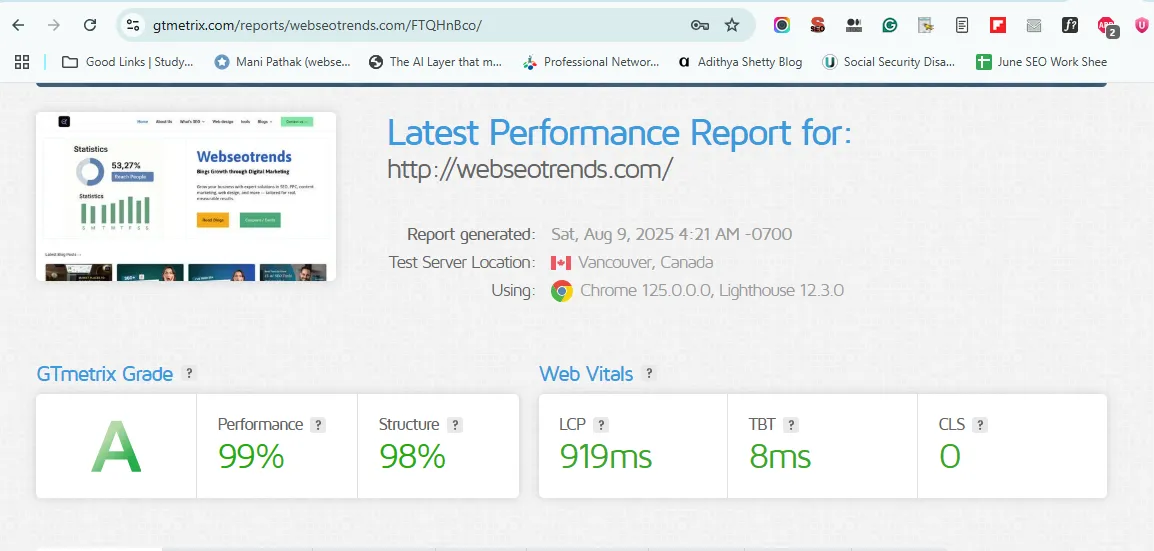
Uptime Guarantee: 99.9% vs 99.97%
Both Hostinger and GoDaddy advertise a 99.9% uptime guarantee, which translates to potential downtime of about 43 minutes per month. However, actual performance often differs from advertised guarantees.
In practice, Hostinger consistently delivers more reliable uptime according to independent testing, though both providers maintain acceptable industry standards.
Server Response Time: 143ms vs 341ms
Server response time directly affects how quickly your website loads for visitors. Hostinger clearly outperforms GoDaddy in this critical area. While GoDaddy’s response time averages around 179ms, Hostinger’s servers respond significantly faster. This speed difference becomes especially noticeable for visitors with slower internet connections or during high-traffic periods.
Global CDN Availability: Hostinger vs GoDaddy
Content Delivery Networks (CDNs) dramatically improve website loading speeds by storing cached versions of your site on servers worldwide. A CDN minimizes the distance between visitors and website files, enabling faster content delivery. Essentially, if your visitor is in India while your server is in the United States, a CDN with servers in Asia will serve your content from the nearest location, significantly reducing loading times.
Hostinger offers CDN integration that operates in numerous global locations beyond their data centers, including Johannesburg, Japan, and Sydney. This extensive network ensures your website loads quickly regardless of where your visitors are located.
Hostinger vs GoDaddy: Data Center Locations
Hostinger maintains a truly global server infrastructure with data centers in the UK, US, Mumbai (India), Brazil, Netherlands, Singapore, Indonesia, and Lithuania. Furthermore, several of Hostinger’s data centers—including those in the USA (PHX and Boston), Germany, Lithuania, UK, Brazil, and France—operate on 100% renewable energy, adding an environmental benefit to their performance advantages.
GoDaddy’s infrastructure, by comparison, focuses primarily on US-based servers. This US-centric approach may result in slower loading times for visitors from other regions, particularly in Asia and Europe.
| Hosting Provider | Region | Specific Data Center Locations | Notes |
|---|---|---|---|
| Hostinger | North America | USA (Ashburn, Virginia) | US-focused with additional sites |
| Europe | Lithuania (Vilnius), UK (Manchester), Netherlands (Amsterdam) | Good European coverage | |
| Asia | Singapore, India (Mumbai) | Growing presence in Asia | |
| South America | Brazil (São Paulo) | Limited South America presence | |
| Africa | — | No data centers | |
| Oceania | — | No data centers | |
| GoDaddy | North America | USA (Phoenix, Arizona; Ashburn, Virginia) | Strong US presence |
| Europe | Netherlands (Amsterdam) | Limited Europe coverage | |
| Asia | India (Hyderabad), Singapore | Limited Asia presence | |
| South America | — | No confirmed data centers | |
| Africa | — | No confirmed data centers | |
| Oceania | — | No confirmed data centers |
For websites targeting a global audience, Hostinger’s distributed data center network offers a distinct performance advantage over GoDaddy’s more geographically limited infrastructure.
Hostinger vs GoDaddy: Features Comparison & What Each Platform Includes
Feature sets often make or break the hosting experience beyond mere performance metrics. The differences between Hostinger and GoDaddy’s offerings reveal distinct approaches to web hosting.
Control Panel: hPanel vs cPanel
Hostinger provides a custom-built control panel called hPanel that prioritizes user-friendliness and intuitive navigation. In contrast, GoDaddy employs the industry-standard cPanel solution. While cPanel offers familiarity for experienced users, hPanel’s streamlined interface makes website management more accessible for beginners. Notably, hPanel integrates all essential functions without the complexity sometimes associated with cPanel’s extensive options.
Freebies: SSL, Backups, CDN, Email
Both providers include essential freebies, yet with key differences. Hostinger generally offers more value-added features in their base packages, including free SSL certificates and automatic backups. Additionally, Hostinger provides CDN integration across multiple global locations, enhancing website loading speeds across different regions.
Website Builder: Zyro vs GoDaddy Builder
Hostinger’s Zyro website builder scores higher in user ratings (92%) than GoDaddy’s Website Builder (87%). Zyro excels in providing straightforward design tools alongside flexibility for more advanced users. Meanwhile, GoDaddy’s builder, although user-friendly, lacks some of the advanced customization options found in Zyro.
Staging Environment Availability
Hostinger offers staging environments on their Web Business or higher hosting plans. This feature creates a private test copy of your site where you can safely implement and test changes before pushing them live. The staging sites are created as subdomains with separate databases. GoDaddy also provides staging functionality but with fewer automation options for deploying changes to your live site.
WordPress Optimization Tools
Hostinger distinguishes itself with WordPress-specific optimization tools. Most notably, the LiteSpeed Cache plugin comes pre-installed with all Hostinger accounts. This provides advanced caching functionality and one-click optimization profiles for WordPress sites. Consequently, users can improve website performance without needing technical expertise. GoDaddy lacks some of these WordPress-specific optimizations, requiring more manual configuration for comparable performance.
Pricing Comparison: Which Offers the Best Value for Money
Price often becomes the deciding factor when selecting a hosting provider, yet value encompasses more than just the lowest number. Let’s examine how Hostinger and GoDaddy compare in terms of cost-effectiveness.
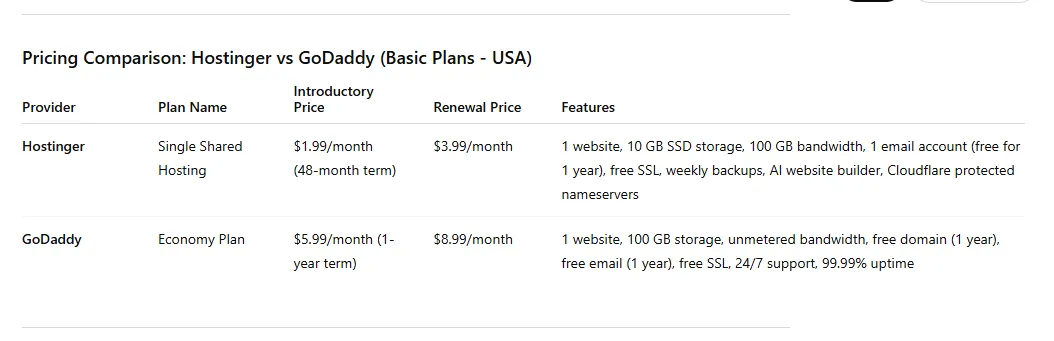
Entry-Level Shared Hosting: $1.99 vs $5.99/month
First and foremost, Hostinger provides significantly more affordable entry points. While Hostinger’s plans start at just $2.69 per month, GoDaddy’s begin at a considerably higher $6.99 per month. Even looking at other sources, Hostinger’s pricing range of $1.99-$7.99 monthly consistently undercuts GoDaddy’s $4.99-$7.99 range. This substantial difference makes Hostinger particularly attractive for budget-conscious website owners or those just starting their online journey.
Renewal Rates: Transparent vs Steep Hikes
Upon examining the pricing structure, Hostinger maintains better transparency with their renewal rates. Both providers utilize promotional pricing for initial terms, yet GoDaddy is known for more substantial price increases after the introductory period. Indeed, Hostinger “wins for pricing thanks to its unbeatable entry-level rates, feature-rich plans, and generous long-term discounts”.
VPS and Cloud Hosting Options
Beyond shared hosting, both companies offer Virtual Private Server (VPS) options for users requiring more resources and control. Hostinger’s VPS plans continue their trend of providing better value, starting at lower price points while delivering comparable performance metrics.
Free Domain Inclusion and Duration
In addition to hosting services, both providers offer domain registration services. Hostinger typically includes a free domain for one year with most hosting packages, enhancing the overall value proposition for new website owners.
Money-Back Guarantee: 30 Days vs 30 Days
Ultimately, both hosting providers offer identical 30-day money-back guarantees. Hostinger’s refund policy states that “Products purchased from Hostinger may be refunded only if canceled within 30 days of the date of the transaction”. Similarly, GoDaddy’s policy for annual plans allows refunds “Within 30 days of the date of the transaction”. This equal guarantee period gives customers the same opportunity to test services risk-free, regardless of which provider they choose.
Ease of Use Comparison: Which Hosting Service Is More User-Friendly?
Getting your website up and running should be straightforward, yet the user experience differs markedly between Hostinger and GoDaddy. The intuitive interface often determines how quickly you can launch your site and manage it thereafter.
Onboarding Experience: Guided vs Manual
Setting up your hosting account reveals fundamental differences in user experience philosophy. Hostinger provides a guided, streamlined approach that new users will appreciate. The installation process requires just three simple steps: visiting the website, selecting a suitable plan, and completing your purchase. GoDaddy follows a similar three-step setup process, yet lacks the comprehensive guidance Hostinger offers to newcomers.
Dashboard Design and Navigation
Hostinger’s custom hPanel stands out for its clean, minimalist design that simplifies essential tasks. This intuitive control panel streamlines website management, email configuration, and domain management. The interface prioritizes efficiency, making it ideal for users of all technical backgrounds.
GoDaddy, on the other hand, utilizes the industry-standard cPanel. While familiar to experienced users, cPanel presents a steeper learning curve for beginners due to its extensive options and more complex layout. GoDaddy’s approach focuses on offering comprehensive tools rather than simplifying the user journey.
One-Click Installs and Auto Updates
Both providers offer one-click installations for popular applications, yet their auto-update systems differ substantially. Hostinger’s WordPress auto-updates feature includes safety mechanisms like automatic backups before updates are applied, allowing you to restore previous versions if needed. This system even notifies you through both hPanel and email when update alerts fail.
In contrast, GoDaddy’s auto-update system has faced criticism from users. Some report difficulties rolling back problematic updates, with at least one user indicating that after an incompatible update broke their site, GoDaddy support was unable to assist with rolling back core files.
Clearly, Hostinger prioritizes user-friendly systems with robust safety features, making it more suitable for those who value simplicity and reliability in managing their websites.
Control Panel Comparison: Hostinger’s hPanel vs GoDaddy’s cPanel
The control panel serves as your website’s command center, where you’ll spend considerable time managing various aspects of your hosting. Hostinger and GoDaddy take distinctly different approaches to this crucial interface.
First and foremost, Hostinger’s proprietary hPanel stands out with its modern, clean design focused on simplicity. The interface organizes functions logically with clear visual cues, making navigation intuitive even for beginners. In terms of functionality, hPanel brings together domain management, email configuration, and website tools in a unified environment that prioritizes workflow efficiency.
Simultaneously, GoDaddy employs the industry-standard cPanel with its familiar layout for experienced users. This traditional approach offers comprehensive functionality but often at the expense of simplicity. Primarily designed for functionality over esthetics, cPanel presents a steeper learning curve that might overwhelm newcomers to web hosting.
Beyond that, hPanel incorporates several user-friendly features that distinguish it from cPanel. The auto-installer for WordPress and other applications typically requires fewer clicks to complete tasks. As such, many users find daily management tasks more streamlined on Hostinger’s platform.
For instance, when managing multiple websites, hPanel’s unified dashboard provides a clearer overview of all your properties at once. Undoubtedly, this becomes advantageous as your hosting needs grow more complex.
Above all, your choice between these control panels should align with your technical comfort level. If you value simplicity and a modern interface, Hostinger’s hPanel offers an excellent alternative to GoDaddy’s more traditional cPanel approach. Naturally, those already familiar with cPanel might prefer sticking with GoDaddy’s implementation, despite its somewhat dated interface.
Customer Support Comparison: Quality, Availability, and Responsiveness
Customer support can make or break your hosting experience, particularly when facing technical issues. Both Hostinger and GoDaddy offer assistance options, yet with notable differences in accessibility and effectiveness.
Live Chat Availability: 24/7 vs Limited Hours
Hostinger provides consistent 24/7 customer support via live chat, ensuring help is available whenever issues arise. The platform occasionally experiences longer wait times, which can be frustrating during peak hours. In contrast, GoDaddy officially offers 24/7 live chat support, but users report frequent unavailability of this service. Ultimately, Hostinger delivers more reliable chat support access, even with occasional delays.
Phone Support: GoDaddy Exclusive
GoDaddy stands out by offering comprehensive phone support through their “award-winning sales & support team” available 24/7. This service is provided free of charge to customers. Hostinger, primarily, does not currently offer any phone support options. For users who prefer verbal communication when troubleshooting issues, this represents a significant advantage for GoDaddy.
Knowledge Base Quality
Both providers maintain self-help resources, though with varying degrees of comprehensiveness. GoDaddy’s support pages include detailed guides for common tasks and issues. Chiefly, the availability of guided solutions for problems like password resets demonstrates their commitment to self-service options.
Ticketing System and Response Time
Regarding responsiveness, Hostinger achieves an impressive average response time of 60ms, substantially better than the industry standard of approximately 600ms. Moreover, when comparing overall support quality, industry reviews suggest Hostinger’s support team provides more consistently helpful assistance, giving them a slight edge in this category despite GoDaddy’s broader contact options.
Security Comparison: How Do They Protect Your Website?
Website security remains a non-negotiable aspect when selecting between Hostinger vs GoDaddy. Both providers offer protection measures, albeit with notable differences in implementation and comprehensiveness.
Hostinger takes security seriously with ISO/IEC 27001:2017 certification, demonstrating compliance with international security standards. Their multi-layered approach includes 24/7 server monitoring, advanced security modules like mod_security and Suhosin PHP hardening, alongside robust firewall protection. Furthermore, Hostinger employs database encryption with secure hashing algorithms and maintains a dedicated internal Security team conducting continuous vulnerability scanning.
Alternatively, GoDaddy provides essential security tools through their Website Security suite. This includes an SSL Certificate integrated within their Web Application Firewall (WAF) that enables HTTPS encryption. The WAF screens real-time website traffic against SQL injection and DDoS attacks, serving as your site’s front-line defense. For malware protection, GoDaddy’s scanner searches for malicious content and promises prompt cleanup if threats are detected.
One key distinction appears in the scanning frequency options—GoDaddy offers customizable security monitoring (30-minute, 12-hour, or daily scans) depending on your plan. Both hosts include CDN capabilities that help ward off DDoS attacks while improving page load times.
Overall, Hostinger provides more comprehensive security features bundled into standard plans, whereas GoDaddy offers tiered security options that expand with higher-tier packages.
Domain and Email Services
Beyond website hosting, domains and email services remain crucial aspects of your online presence. Looking at what each provider offers reveals substantial differences in both pricing and included features.
Domain Registration: Free 1 Year vs Paid
When purchasing a Hostinger hosting plan, you typically receive a free domain for one year. This added value streamlines the process of launching your website without additional costs. In contrast, GoDaddy, primarily known as the world’s largest domain registrar with over 84 million registered domains, requires separate payment for domain registration even when purchasing hosting packages.
Email Hosting: Free vs Paid Add-on
Hostinger includes business email services with their website hosting plans at no additional cost. Yet, these free accounts come with more limited resources compared to dedicated email plans. For expanded capabilities, users can upgrade to Business Starter or Premium plans.
GoDaddy takes a different approach, offering professional email as a paid service starting at $1.99 per mailbox monthly (with annual commitment). Their email plans include features like domain-based addresses ([email protected]), which studies show make businesses 9 times more likely to be chosen by customers.
Domain Management Tools
In terms of domain management, GoDaddy provides extensive tools for maintaining multiple domains. Given their status as the leading domain registrar, their interface is specifically optimized for domain administration tasks. Hostinger offers standard domain management functionality through their hPanel, focusing on simplicity for users managing fewer domains.
User Reviews Comparison: What Are Customers Saying About Both Hosts?
Real-world user experiences often reveal insights that specifications alone cannot capture. Customer feedback for both hosting providers offers valuable perspective on what to expect.
Long-time GoDaddy users report satisfaction with the platform’s reliability. One user mentioned using GoDaddy for over 20 years with consistent performance. Such loyalty indicates a stable experience for many customers.
On the other hand, consultants and developers frequently recommend Hostinger for clients with small to medium websites. The primary reason appears to be Hostinger’s advantageous balance of cost-effectiveness and user-friendly management.
In reality, users point out specific concerns with both providers. For Hostinger, several customers mention confusion around pricing structures and potentially misleading marketing practices. Another common issue involves email deliverability problems, with one user noting that “most of their outgoing mail goes to spam”.
Typically, GoDaddy receives praise for its ease of use and built-in tools, making it “a strong pick for users who prioritize ease of use”. Additionally, GoDaddy maintains an advantage in customer support accessibility with its 24/7 support options and dedicated phone line.
Interestingly, technical users often highlight that Hostinger offers shared hosting rather than cloud hosting, which may affect performance for growing websites. Of course, this distinction primarily matters for users with scaling needs rather than those maintaining simple websites.
Which Is Better in 2025? Hostinger vs GoDaddy – Mani Pathak’s Take
After thoroughly examining both hosting providers across multiple factors, it’s time to answer the ultimate question: Which is better in 2025, Hostinger or GoDaddy?
For most website owners, Hostinger emerges as the superior choice in 2025. Fundamentally, this recommendation stems from Hostinger’s exceptional balance of affordability, performance, and user-friendliness. Their significantly faster server response times (143ms vs 341ms) translate to better user experience, while their pricing structure offers substantially better value.
In essence, Hostinger excels precisely where it matters most for the average website owner. The platform’s streamlined hPanel makes daily management tasks more accessible, hence removing technical barriers for beginners. Their global data center network equally ensures consistent performance regardless of audience location.
GoDaddy still maintains certain advantages, primarily in phone support availability and their extensive domain management tools. These features may appeal to users who prioritize verbal customer service or manage multiple domains.
Upon examination of all factors—from security features to renewal pricing transparency—Hostinger consistently delivers more value per dollar spent. Unless you specifically require GoDaddy’s phone support or domain management capabilities, Hostinger offers a more balanced hosting solution that meets the needs of most website owners in 2025.
Mani’s Expert Breakdown: Hostinger vs GoDaddy Hosting Comparison
| Feature/Aspect | Hostinger | GoDaddy |
|---|---|---|
| Performance Metrics | ||
| Server Response Time | 143ms | 341ms |
| Uptime Guarantee | 99.9% | 99.9% |
| Data Center Locations | Global (UK, US, Mumbai, Brazil, Netherlands, Singapore, Indonesia, Lithuania) | Primarily US-based |
| Pricing | ||
| Starting Price | $2.99/month | $5.99/month |
| Free Domain | Included for 1 year | Paid separately |
| Money-Back Guarantee | 30 days | 30 days |
| Control Panel | ||
| Interface Type | Custom hPanel | cPanel |
| User Experience | Modern, streamlined | Traditional, more complex |
| Features | ||
| Website Builder | Zyro (92% rating) | GoDaddy Builder (87% rating) |
| Staging Environment | Available on Business plans | Available with limited automation |
| WordPress Optimization | LiteSpeed Cache pre-installed | Basic optimization |
| Security | ||
| SSL Certificate | Included | Included |
| Security Certification | ISO/IEC 27001:2017 | Not mentioned |
| Customer Support | ||
| Live Chat | 24/7 available | 24/7 with reported unavailability |
| Phone Support | Not available | 24/7 available |
| Response Time | 60ms average | Not mentioned |
| Email Services | ||
| Business Email | Included with hosting | Paid add-on ($1.99/month) |
Final Verdict: Which Hosting Provider Should You Choose in 2025?
Throughout this comprehensive comparison of Hostinger and GoDaddy in 2025, several key differences emerge that should guide your hosting decision. Hostinger consistently delivers superior value across multiple critical areas, particularly regarding performance and affordability. The significant server response time advantage (143ms vs 341ms) translates directly to faster-loading websites for your visitors.
Price-conscious website owners will find Hostinger particularly appealing with entry-level plans starting at just $2.99 compared to GoDaddy’s $5.99. This substantial difference exists without sacrificing essential features or performance. Additionally, Hostinger’s global data center network ensures excellent speed regardless of where your audience resides, unlike GoDaddy’s primarily US-based infrastructure.
User experience represents another area where Hostinger shines brightly. The custom-built hPanel simplifies website management with its intuitive design and streamlined workflows. Beginners will appreciate this approach compared to GoDaddy’s more complex cPanel implementation. Likewise, the inclusion of WordPress optimization tools further enhances Hostinger’s appeal for those using this popular platform.
GoDaddy does maintain certain advantages worth considering. Their 24/7 phone support offers a level of direct communication that Hostinger lacks. Similarly, users managing multiple domains might prefer GoDaddy’s specialized domain management tools, reflecting their position as the world’s largest domain registrar.
Security features remain competitive between both providers, though Hostinger’s ISO/IEC 27001:2017 certification demonstrates a formal commitment to international security standards. Both hosts provide essential protections like SSL certificates and malware scanning, albeit with different implementation approaches.
Your specific needs should ultimately determine which provider better serves your website goals. Hostinger clearly offers the better overall package for most users due to its balanced combination of performance, value, and user-friendliness. Unless you specifically require GoDaddy’s phone support or advanced domain tools, Hostinger represents the smarter choice for launching and maintaining your website in 2025.
🠚 Must Read: Hostinger Coupon Codes!
FAQs: Common Questions About Hostinger and GoDaddy
Curious about Hostinger and GoDaddy’s specific details? Here are answers to frequently asked questions about these popular hosting providers.
Is domain transfer between Hostinger and GoDaddy complicated?
Domain transfers typically take five to seven days, depending on domain extension and registrar policies. Initiating the process requires just a few minutes. Most registrars charge a fee that varies by domain name and extension.
Should I transfer my domain or just point it?
This depends on your specific needs. Pointing a domain lets you connect it to any hosting while keeping it with your current registrar. Transferring is preferable if you’re unhappy with your current domain registrar.
Which provider offers better SSL certificate value?
Hostinger provides complimentary lifetime SSL certificates with every plan, whereas GoDaddy includes them only for one year with their Economy plan.
What payment methods does Hostinger accept?
Hostinger accepts credit/debit cards (Visa, MasterCard, Amex), prepaid cards, and eWallets like PayPal, Google Pay, and Apple Pay. Available payment methods vary by region.
What’s Hostinger’s refund policy?
Hostinger offers a 30-day money-back guarantee for web hosting plans. Domain refunds follow a different structure—new domain registrations for common TLDs like .com are refundable within 96 hours. Domain renewals are not eligible for refunds.
Key Takeaways
After analyzing both hosting providers across performance, pricing, features, and user experience, here are the essential insights to guide your 2025 hosting decision:
• Hostinger delivers superior performance at half the cost – With 143ms server response time vs GoDaddy’s 341ms and starting prices of $2.99 vs $5.99/month, Hostinger offers better speed and value.
• Choose Hostinger for user-friendliness, GoDaddy for phone support – Hostinger’s custom hPanel simplifies website management for beginners, while GoDaddy provides 24/7 phone support that Hostinger lacks.
• Global reach favors Hostinger over GoDaddy’s US-centric approach – Hostinger’s data centers span UK, US, Asia, and Europe on renewable energy, ensuring faster loading worldwide compared to GoDaddy’s primarily US-based infrastructure.
• Security and features are competitive, but Hostinger includes more freebies – Both offer SSL certificates and malware protection, yet Hostinger includes business email and WordPress optimization tools that GoDaddy charges extra for.
• Hostinger wins for most users unless you need specialized domain management – The combination of faster speeds, lower costs, and intuitive interface makes Hostinger the better choice for typical website owners in 2025.
For budget-conscious users seeking reliable performance and ease of use, Hostinger clearly emerges as the superior hosting solution. GoDaddy remains viable primarily for users who specifically require phone support or manage extensive domain portfolios.
FAQs: Common Questions About Hostinger and GoDaddy
Q1. Which hosting provider offers better performance: Hostinger or GoDaddy?
Hostinger generally outperforms GoDaddy in terms of speed and reliability. Hostinger’s server response time averages around 143ms compared to GoDaddy’s 341ms, and Hostinger has a more globally distributed network of data centers.
Q2. How do Hostinger and GoDaddy compare in terms of pricing?
Hostinger typically offers more affordable pricing, especially for long-term plans. Their entry-level shared hosting starts at $2.99/month compared to GoDaddy’s $5.99/month. However, Hostinger’s renewal rates can increase significantly, so it’s important to consider long-term costs.
Q3. What are the key differences in features between Hostinger and GoDaddy?
Hostinger provides a custom control panel (hPanel) that many users find more intuitive than GoDaddy’s cPanel. Hostinger also includes more freebies like SSL certificates and automatic backups in their base packages. GoDaddy offers more extensive domain management tools.
Q4. How does customer support compare between Hostinger and GoDaddy?
Both providers offer 24/7 customer support, but GoDaddy provides phone support which Hostinger lacks. However, many users report that Hostinger’s support team is more consistently helpful and responsive, despite having fewer contact options.
Q5. Which hosting provider is better for beginners?
Hostinger is generally considered more user-friendly for beginners due to its intuitive interface and comprehensive feature set. Their website builder (Zyro) also receives higher user ratings compared to GoDaddy’s builder. However, GoDaddy may be preferable for those who need extensive domain management capabilities.
