

Quick Answer: The best freelance websites in 2026 are Upwork (best for long-term client relationships), Fiverr (best for package-based services), Toptal (best for elite developers and designers), PeoplePerHour (best for beginners), and 99designs (best for creative professionals). But the right platform depends entirely on your skill set, experience level, income goals, and the type of work you want to do. This guide covers 25+ platforms with honest breakdowns, a complete fee comparison table, skill-specific recommendations, and the strategies that separate top earners from everyone else.
About the author: I’m Mani Pathak — SEO strategist, Content Writer, and digital marketing consultant with 8+ years of active freelancing experience. I kicked off my career as a web developer and freelancer, helping over 500 clients globally build websites, improve search rankings, and grow their digital presence. I’ve worked across platforms including Freelancer.com, direct client acquisition, and consulting through Clarity.fm. Everything in this guide is grounded in real freelancing experience — not theory. I’ll share specific lessons and honest observations throughout.
- The 25 Best Freelance Websites in 2026: Platform-by-Platform Breakdown
- Tier 1: General Freelance Platforms (Largest Audience, Highest Competition)
- Tier 2: Elite & Curated Platforms (Higher Barrier, Higher Rates)
- Tier 3: Niche and Specialist Platforms (Lower Competition, Higher Relevance)
- 8. Contena — Best Curated Platform for Serious Freelance Writers
- 9. Toptal Finance & Expert360 — Best for High-Earning Business and Finance Consultants
- 10. Gun.io — Best for Mid-to-Senior Software Engineers Who Want Less Competition
- 11. Designhill — Best for Designers and Digital Products
- 12. Bark.com — Best for Local and Professional Services
- 13. Working Nomads — Best Remote Job Board for Digital Nomads
- 14. We Work Remotely (WWR) — Best for Remote Tech and Design Contracts
- 15. LinkedIn ProFinder (via LinkedIn Services) — Best for Professional Services Freelancers
- Tier 4: Emerging and Zero-Commission Platforms
- 16. Contra — Best Zero-Commission Platform for Creatives
- 17. Jobbers.io — Best Zero-Commission Platform for Maximum Earnings
- 18. Legiit — Best Platform for SEO and Digital Marketing Freelancers
- 19. Textbroker — Best for Volume Content Writers
- 20. SimplyHired / Indeed / Glassdoor — Best Traditional Job Boards with Freelance Listings
- 21. Behance (Adobe) — Best Portfolio + Client Discovery Platform for Designers
- 22. GitHub (for Developers) — Best Technical Portfolio + Project Discovery Platform
- 23. Codeable — Best Platform for WordPress Developers
- 24. Kolabtree — Best for Scientific and Academic Freelancers
- 25. Hubstaff Talent — Best Zero-Fee Platform for Remote Teams
- The Freelance Economy in 2026: Why This Moment Is Different
- How to Choose the Right Freelance Platform: A Decision Framework
- Best Freelance Websites Comparison: What You Actually Take Home
- Skill-Specific Platform Recommendations
- The Platform Stacking Strategy: Using Multiple Platforms Simultaneously
- How to Build a Winning Freelance Profile: The 8 Non-Negotiables
- Freelance Pricing Guide: From Entry Level to Expert
- AI and the Future of Freelance Platforms: What’s Changing in 2026
- Red Flags to Avoid on Freelance Platforms: Protect Your Time and Income
- Building Your Freelance Brand Beyond Platforms: The Long Game
- For Businesses: How to Hire the Best Freelancers Without Overpaying
- Frequently Asked Questions (FAQs For Top Freelance Websites)
- Which freelance website is best for beginners in 2026?
- How much do freelancers actually make on these platforms?
- Is it better to focus on one platform or multiple?
- What are the best freelance websites for SEO and digital marketing work?
- What’s the best zero-commission freelance platform?
- How do I find freelance work in SEO and AI search?
- Should I build my own website as a freelancer?
- Are freelance platforms safe for payments?
- The Bottom Line
The numbers no longer lie: 76.4 million Americans now freelance — representing 38% of the entire U.S. workforce. Globally, 1.57 billion people work as independent professionals, collectively contributing over $3.5 trillion to the world economy. The freelance platform market alone is estimated at $8.9 billion in 2026 and is projected to double by 2030.
But here’s what most “best freelance websites” articles won’t tell you: most freelancers who fail don’t fail because they lack skill. They fail because they chose the wrong platform for their skill set, priced themselves incorrectly, or built their entire career on a marketplace they never actually owned.
I learned this the hard way in my own freelancing journey. In my early years working on Freelancer.com and other platforms, I watched talented people with real skills get stuck at $10–$15/hour not because their work wasn’t good — but because they were bidding on the wrong platform, writing generic proposals, and pricing in a way that attracted the worst clients instead of the best ones. Choosing the right platform for your specific skills is the first strategic decision in freelancing — and most people get it wrong by defaulting to the most recognizable name.
This guide is different. We won’t just list platforms. We’ll give you a decision framework for picking the right one, a complete fee breakdown so you know what you actually take home, skill-specific recommendations so you stop wasting connects on the wrong platform, and the growth strategies that turn occasional gig income into a full-time career — or a thriving client pipeline if you’re hiring.
Whether you’re just starting out, scaling up, or a business looking to hire the best talent without overpaying platform fees, this is the only freelance platform guide you need in 2026.
The 25 Best Freelance Websites in 2026: Platform-by-Platform Breakdown
Tier 1: General Freelance Platforms (Largest Audience, Highest Competition)
1. Upwork — Best Overall for Ongoing Client Relationships
Monthly visitors: ~3.1M | Registered freelancers: 18M+ | Annual revenue: $718M | Fee: 20% → 10% → 5% tiered | Founded: 2015 (merger of Elance + oDesk)
Upwork is the largest and most financially mature freelance marketplace in the world, and for serious freelancers building a long-term independent career, it remains the single most important platform to master. It serves Fortune 500 companies, funded startups, and SMBs across virtually every professional skill category — software development, design, writing, marketing, accounting, legal, customer service, and more. With $718M in annual revenue and over 18 million registered freelancers, the sheer scale creates opportunity and competition in equal measure.
What Truly Differentiates Upwork
Unlike every other platform on this list, Upwork is engineered for sustained professional relationships. Its time-tracking tool (with screenshot capture), long-term contract structures, milestone-based fixed-price projects, Teams features, and dedicated Enterprise tier make it the only freelance marketplace that genuinely mirrors how a company manages full-time employees — minus the benefits and with complete flexibility. This infrastructure is why businesses spend more per engagement on Upwork than on any other freelance marketplace. When a company is committing $50,000+ to a six-month software project, they want payment protection, time logs, contractual terms, and dispute mechanisms — and Upwork provides all of it.
The Upwork Reputation System: What Actually Matters
The Job Success Score (JSS) is Upwork’s proprietary client satisfaction metric, calculated from reviews, contract outcomes, and client feedback — including private feedback buyers leave that freelancers never see. A JSS of 90% or above is the baseline for serious credibility on the platform. Below 90%, your profile visibility drops and proposal conversion declines sharply. Above 90%, you unlock Rising Talent status. Top Rated badge (95%+ JSS + $1,000+ earned) grants profile boosts, premium badge visibility, and access to clients who filter by reputation tier.
Top Rated Plus (earned at $10,000+ in a 12-month period with sustained JSS) represents Upwork’s highest public credibility tier — only a small percentage of active freelancers reach it, and the differentiation in client quality and rate tolerance at this tier is substantial.
Realistic Earning Potential by Skill Level
| Experience Level | Typical Hourly Rate | Time to Consistent Income |
|---|---|---|
| Entry (0–10 jobs) | $15–$35/hr | 2–4 months |
| Developing (10–50 jobs, Rising Talent) | $35–$75/hr | 6–12 months |
| Established (50+ jobs, Top Rated) | $75–$150/hr | 12–24 months |
| Expert (Top Rated Plus, niche specialist) | $150–$300+/hr | 24+ months |
The Upwork Proposal: Where Most Freelancers Lose
One thing I learned while working with international clients and studying what separates high-performing freelancers from average ones is that the proposal quality gap on Upwork is enormous — most freelancers submit three-sentence generic bids while serious competitors write personalized, insight-rich proposals that demonstrate they actually read the brief. After handling hundreds of freelance projects in SEO and digital marketing, I can tell you that a 200-word proposal that references the client’s specific pain point closes at 4–5x the rate of a generic “I have 5 years of experience and can help you” message.
The strongest Upwork proposals follow this structure:
- Open with their problem, not your credentials
- Show you understand the nuance — reference something specific from the brief
- Propose a concrete first step — what would you do in the first 48 hours?
- One relevant proof point — a specific result from a similar project
- A clear, confident ask — what you’d charge and why it’s worth it
Watch Out For: Scope creep on fixed-price contracts, clients who mark contracts as ended before leaving feedback (to avoid JSS impact from a dispute), and the “test task” request before a paid contract — if a client wants free sample work before hiring, that’s a negotiating tactic, not a professional evaluation.
Fee reality: 20% on the first $500 with each client, 10% from $500–$10,000, and 5% on lifetime earnings above $10,000 per client. The more you invest in long-term relationships, the more fee-efficient Upwork becomes.
Best skills on Upwork: Software development, UX/UI design, data science, SEO and content strategy, copywriting, video production, bookkeeping, legal research, executive virtual assistance, and any specialized B2B consulting.
Mani’s verdict: Upwork is the hardest platform to break into and the most rewarding to master. If you’re willing to put in 90 days of deliberate profile-building, strategic proposals, and underpriced early work to accumulate reviews, the compound returns are unlike anything else in freelancing. The freelancers who quit Upwork after three weeks of rejection are the ones who never discovered what it can become with six months of consistent effort.
2. Fiverr — Best for Packaged, Productized Services
Monthly visitors: ~7.5M | Annual revenue: $388M | Fee: 20% flat (all tiers) | Founded: 2010 | Active buyers: 4M+
Fiverr pioneered the “gig economy” model and remains the most recognizable freelance brand globally. Its core mechanic — pre-priced service packages called “Gigs” — makes it uniquely suited to freelancers who can standardize and productize their services. Where Upwork favors the proposal-and-bid dynamic, Fiverr inverts the process entirely: you publish what you offer, clients browse and buy, you deliver. This inversion is what makes Fiverr so powerful once a profile is established — passive inbound orders while you sleep — and so frustrating in the early months when your Gigs haven’t yet earned the algorithmic visibility to generate them.
Understanding the Fiverr Algorithm
Fiverr’s search algorithm determines which Gigs appear at the top of category searches. It rewards a specific set of performance signals, and understanding them is the difference between a profile that earns $500/month and one that earns $5,000/month at identical quality levels:
- Order completion rate — Cancellations hurt algorithm rank significantly. Never accept a project you can’t complete as scoped.
- On-time delivery rate — Late deliveries are penalized harshly. Build buffer time into every delivery deadline.
- Response rate and speed — Responding to messages within one hour dramatically improves algorithm placement.
- Review velocity — New positive reviews (especially in a short window) signal a high-performing Gig and push it up in rankings.
- Click-through rate on your Gig thumbnail — Your main image is your ad. A professional, benefit-forward thumbnail outperforms a generic one every time.
The Fiverr Pro Tier: The Most Underutilized Opportunity on the Platform
The Fiverr Pro tier represents a vetted category for top-performing freelancers with verified credentials and a demonstrable track record. Fiverr Pro sellers command 3–10x the rates of standard sellers, work with a fundamentally different quality of client (businesses with real budgets, not price shoppers), and face dramatically less competition. Applying for Fiverr Pro requires submitting proof of professional work, credentials, and portfolio — the vetting is real — but the income difference between a top standard seller and a Fiverr Pro in the same category is often $30,000–$80,000/year.
Gig SEO: The Skill That Separates Top Earners
In my freelancing experience working across digital marketing niches, I’ve seen SEO freelancers completely transform their Fiverr performance by treating Gig titles the same way they’d treat a page title tag — targeting the exact phrase buyers type into Fiverr’s search bar, front-loading the key benefit, and eliminating vague language. The freelancers who understand on-page SEO almost always outperform equally talented freelancers who don’t on Fiverr — because the platform’s search algorithm rewards exactly the same signals Google does.
Your Gig title should be a search query, not a label:
- ❌ “I Will Design a Logo” → too generic, too competitive
- ✅ “I Will Design a Modern Minimalist Logo for Your Tech Startup in 24 Hours” → specific, differentiated, buyer-intent matched
Realistic Earning Potential
| Seller Level | Criteria | Avg. Monthly Earnings |
|---|---|---|
| New Seller | 0–10 reviews | $0–$500 |
| Level 1 | 10+ orders, 60-day active | $500–$2,000 |
| Level 2 | 50+ orders, 120-day active | $2,000–$6,000 |
| Top Rated Seller | 100+ orders, exceptional metrics | $6,000–$20,000+ |
| Fiverr Pro | Vetted credentials | $10,000–$50,000+ |
The Honest Trade-Off: The 20% commission never decreases regardless of earnings volume or platform tenure. A top seller earning $150,000/year on Fiverr pays $30,000 in platform fees — every year, without reduction. This is the structural reason experienced Fiverr earners eventually migrate high-value repeat clients to direct relationships or zero-commission platforms.
Best skills on Fiverr: Graphic and logo design, video editing, voice acting, social media content, writing and copywriting, digital marketing packages, WordPress development, SEO audits, and music production.
Mani’s verdict: Fiverr is the best platform for freelancers who can think like product designers — scoping a service tightly, packaging it compellingly, and delivering it consistently. The freelancers who struggle on Fiverr are those who try to offer custom consulting on a platform built for product delivery. Get that distinction right and Fiverr becomes a reliable passive-income engine.
3. Freelancer.com — Best for Competitive Bid Projects Globally
Monthly visitors: ~4.5M | Registered users: 70M+ | Projects posted: 22M+ lifetime | Fee: 10% or $5 (whichever is greater) | Founded: 2009
Freelancer.com is the most globally diverse of the major freelance platforms, with strong user bases in South and Southeast Asia, Eastern Europe, Latin America, and Africa. This creates both opportunity and challenge simultaneously: access to a 70M+ user client base spanning every category, but intense price competition from lower-cost markets that can make it difficult to command premium rates without a strong track record.
How the Platform Works
Freelancer.com operates on two primary models:
Project Bidding: Clients post a project with a budget range, freelancers submit bids, and the client selects based on price, profile strength, reviews, and proposal quality. The bidding window is time-limited, which creates a real-time competitive dynamic — being among the first credible bids received often improves your chances significantly.
Contests: Clients post a creative brief (most commonly for design, writing, or coding tasks) with a prize pool. Freelancers submit completed work — logos, website designs, article drafts — and the client selects a winner. Contests are the fastest path to positive feedback on Freelancer.com for creative professionals, because winning a single high-visibility contest can jump-start a profile’s reputation in ways that winning individual bids can’t.
The Membership Tiers
Freelancer.com’s free tier limits the number of active bids per month. Paid memberships (Intro, Basic, Plus, Professional, Premier) unlock more bids, lower fees, better proposal visibility, and access to premium features. For serious freelancers, the platform’s membership investment typically pays for itself within the first month of active bidding — the unlock in bid capacity alone is worth more than the membership cost at any moderate activity level.
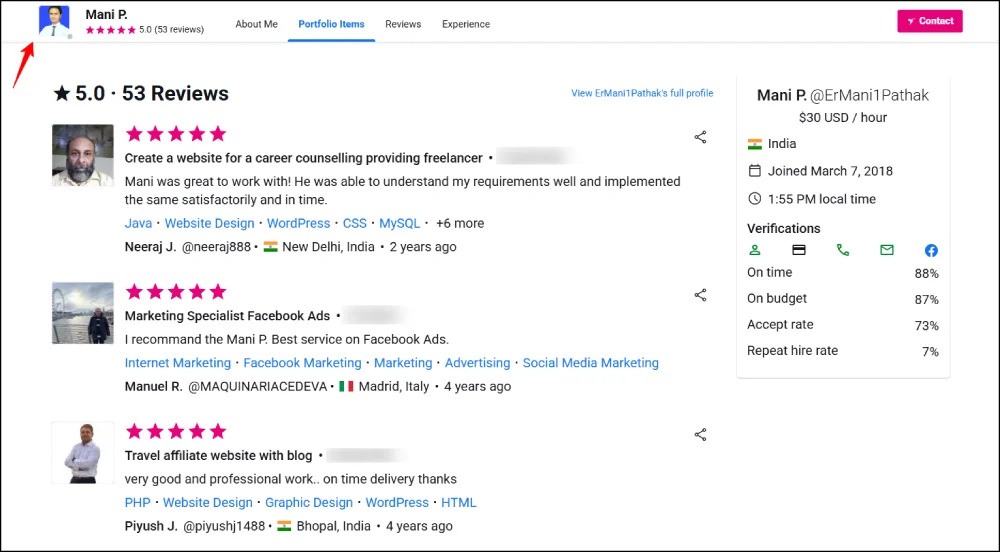
I started my freelancing journey on Freelancer.com — you can see my profile at freelancer.com/u/ermani1pathak — and while it wasn’t where I did my highest-value client work, it was the platform where I sharpened every fundamental skill that made everything else possible: writing clear proposals under time pressure, managing client expectations from the very first message, and learning that how you communicate in the first 24 hours of a new client relationship determines more about the project outcome than your technical skills do. The discipline of writing dozens of proposals on Freelancer.com built the proposal instincts I use across every platform and every direct client relationship to this day.
What Separates Winning Bids from Losing Ones
- Bid early — Projects that receive quality bids in the first hour have higher award rates for early bidders
- Reference the brief specifically — Clients receive dozens of “I can do this, I have 5 years experience” bids; one that says “I noticed you mentioned [specific requirement] — here’s how I’d approach it” stands out immediately
- Suggest a small first milestone — Offering to complete a small paid scoping task before committing to the full project reduces client anxiety about risk
- Use your verified skills badges — Freelancer.com’s skills tests (optional, but visible on profile) give credibility on a platform where anyone can claim any skill
Watch Out For: “Award scams” — clients who award a project, request unpaid sample work as part of “onboarding,” then disappear or create disputes. Always require a funded milestone before starting any deliverable work, no matter how small.
Who wins on Freelancer.com: Freelancers who are disciplined about proposal quality and volume, comfortable operating in a price-competitive global market, and skilled in niches where volume compensates for per-project margin — especially data entry, transcription, translation, entry-level development, graphic design, and virtual assistance.
Mani’s verdict: Freelancer.com is where I’d send any ambitious new freelancer to cut their teeth. It’s imperfect, it’s price-competitive, and the spam bids are genuinely annoying — but there’s no better training ground for the proposal writing, client communication, and expectation management skills that every successful freelancer needs. Use it to learn, earn your first 15 reviews, then take those skills to higher-margin platforms.
4. PeoplePerHour — Best Beginner-Friendly Platform with Intelligent Fee Structure
Monthly visitors: ~3.4M | Users: 1M+ businesses and freelancers | Founded: 2007 | Headquarters: London, UK | Fee: 20% (under $700) → 7.5% ($700–$7,000) → 3.5% (above $7,000)
PeoplePerHour is consistently underrated as a starting point for new freelancers, and it’s one of the most misunderstood platforms in the category. While Upwork and Fiverr dominate mindshare, PeoplePerHour has quietly built a significant, loyal user base — particularly in the UK and European markets — and its fee structure is genuinely one of the most freelancer-friendly of any major platform.
Why Beginners Win Here Faster
The competitive intensity on PeoplePerHour is measurably lower than Upwork for the same skill categories. A new freelancer submitting a thoughtful, well-written proposal on PeoplePerHour is competing against dozens of bids — not hundreds. This matters enormously in the early review-building phase, when every won project is a credibility stepping stone. The platform’s algorithm also gives newer profiles reasonable visibility if they’re active, which Upwork’s algorithm does not.
The Two Ways to Get Work on PeoplePerHour
Method 1 — Project Proposals (WorkStream): Clients post projects, freelancers submit proposals. Standard bidding model, but with lower competition density than Upwork and a more conversational proposal interface that makes it easier to stand out.
Method 2 — Hourlies: PeoplePerHour’s most distinctive feature. Hourlies are pre-packaged service listings — similar in concept to Fiverr Gigs — where you define a fixed deliverable at a fixed price. Hourlies let you generate inbound orders without active bidding, building passive order flow as your listing accumulates reviews. For freelancers who want the best of both Fiverr’s passive model and Upwork’s relationship-driven bidding, PeoplePerHour’s hybrid approach is genuinely the best of both worlds.
The Fee Structure: Why It Gets Better With Every Milestone
| Earnings Per Client | Fee Rate | Real Impact |
|---|---|---|
| First $700 | 20% | Same as Fiverr |
| $700 – $7,000 | 7.5% | Significantly better than Upwork’s 10% |
| Above $7,000 | 3.5% | Better than any major platform |
For a freelancer with a single $5,000 client relationship, PeoplePerHour’s effective fee is approximately 9% — compared to Upwork’s 16–18% at similar earnings levels. This math compounds significantly over a full year of client work.
AI Tools Integration
PeoplePerHour has rolled out VORKI — an AI matching tool that surfaces freelancers to relevant projects based on profile signals and past work. Freelancers who keep their profiles updated with accurate skills, recent portfolio work, and complete project history get better VORKI matches — which means more relevant project notifications without active bidding.
Best skills on PeoplePerHour: Web and WordPress development, graphic design, digital marketing strategy, writing and content creation, SEO services, social media management, virtual assistance, translation, and video editing.
Who Struggles Here: Highly specialized technical roles (where Toptal or Upwork’s larger client volume wins out) and US-market-only services (where the UK-heavy client base may be a mismatch).
Mani’s verdict: If I were starting fresh in freelancing today with zero reviews, PeoplePerHour would be my first platform. The combination of lower competition, the Hourlies passive-income model, and the fee structure that rewards long-term client relationships makes it the most beginner-friendly major platform for the first 6–12 months of building credibility. Win your first 10 reviews here, then expand to Upwork with proof of work in hand.
Tier 2: Elite & Curated Platforms (Higher Barrier, Higher Rates)
5. Toptal — Best for Elite Developers, Designers, and Finance Experts
Acceptance rate: ~3% | Typical freelancer hourly rate: $60–$250+ | Enterprise clients: 10,000+ | Fee to freelancer: 0% | Founded: 2010
Toptal is the most selective freelance platform in the world, and that selectivity is precisely its value proposition — for both the freelancers who clear the bar and the clients who pay to access them. Toptal’s entire model is built around one premise: companies will pay a significant premium to access talent they can trust immediately, without the risk-and-vetting overhead of an open marketplace.
The Five-Stage Vetting Process
Toptal’s screening is rigorous, multi-stage, and genuinely demanding. Only approximately 3 in every 100 applicants are accepted, which is why membership carries the credibility signal it does.
Stage 1 — Language and Communication Screening A structured interview assessing English fluency, communication clarity, and professional presentation. Non-native speakers are evaluated on professional working proficiency, not accent.
Stage 2 — Technical or Portfolio Review For developers: algorithmic problem solving, system design, and language-specific coding challenges evaluated against a strict rubric. For designers: portfolio review against criteria including craft quality, UX reasoning, and professional presentation. For finance experts: financial modeling, case study analysis, and domain knowledge testing.
Stage 3 — Live Problem-Solving Session A live, video-conducted technical evaluation with a Toptal expert in your domain. This is the stage most applicants fail — it requires not just knowing the answer but demonstrating clear, structured thinking while explaining your reasoning aloud in real time.
Stage 4 — Test Engagement A paid, real-world project with an actual Toptal client. You’re evaluated on deliverable quality, communication, deadline adherence, and client feedback. Passing this stage confirms you can perform under real conditions, not just interview conditions.
Stage 5 — Continuous Quality Review Acceptance isn’t permanent. Toptal monitors client feedback on an ongoing basis, and sustained poor performance can lead to removal from the network.
What You Gain If You Get Through
- Direct access to Fortune 500, funded startup, and enterprise clients without proposal bidding
- Rates set by you, with no commission taken from your agreed hourly or project fee
- A globally recognized “Toptal Expert” designation that carries credibility beyond the platform
- Project matching by a dedicated Toptal matcher who understands your skills and connects you to relevant opportunities
Realistic Income at the Toptal Level
| Role | Typical Hourly Rate | Monthly Earnings (40hr/wk) |
|---|---|---|
| React / Full-stack Developer | $80–$180/hr | $13,800–$31,200 |
| UX/UI Designer | $70–$150/hr | $12,000–$26,000 |
| iOS / Android Engineer | $90–$200/hr | $15,600–$34,600 |
| Financial Modeler | $100–$200/hr | $17,000–$34,600 |
| Management Consultant | $150–$400+/hr | $26,000–$69,000+ |
Should You Apply?
If you’re a mid-to-senior software engineer, UX designer, or finance professional with 4+ years of demonstrable results in your domain — yes, apply immediately. The rejection rate is high, but the application is free, and even a partial run through the process tells you precisely where your skills are strong and where gaps exist.
Best skills on Toptal: React, Node.js, Python, full-stack development, iOS/Android engineering, UX research and design, financial modeling, interim CFO/CMO/CTO services, and management consulting.
Mani’s verdict: Toptal is the only freelance platform that functions more like a talent agency than a marketplace. If you’re senior, specialized, and tired of competing against commodity bids on Upwork, the Toptal acceptance process is the most high-value career investment you can make — the credential alone opens doors that no marketplace profile can.
6. 99designs by Vista — Best Dedicated Design Platform
Focus: Graphic design exclusively | Designers: 500K+ registered | Projects completed: 1M+ | Fee: 15% on first project per client, tiered by designer level | Founded: 2008
99designs built the most sophisticated design-specific marketplace in the industry, and for graphic designers at any experience level, it offers a fundamentally different path to income than general platforms. Its defining feature — the design contest model — gives clients variety and market testing while giving designers a legitimate path to significant project fees without any prior platform relationship.
The Two Ways to Work on 99designs
Design Contests: A client posts a creative brief with a prize budget ($299–$1,299+ depending on design category and package). Designers submit original concepts. The client provides feedback throughout, narrows down entries, and picks a winner. For designers, this means you can potentially win $500–$1,000 per logo, $800–$2,500 per brand identity package, or $1,500–$5,000+ for a full web design — all without any prior relationship with the client.
1-to-1 Projects: Clients who’ve found a designer they trust (through their contest work or direct portfolio browsing) can book directly. This is the relationship-building model — less competitive, more predictable, and where experienced designers earn the bulk of their 99designs income over time.
The Designer Level System: How It Unlocks Earning Potential
99designs assigns every designer a level that affects which contests they can enter and the prize tiers available:
| Level | Criteria | Contest Prize Range |
|---|---|---|
| Entry | New to 99designs | $299–$499 |
| Mid | Consistent quality, client feedback | $499–$799 |
| Top | Proven track record | $799–$1,299 |
| Elite | Top 1% — invitation only | $1,299–$5,000+ |
Winning Your First Contests: The Real Strategy
The early win rate for new designers on 99designs is low — typically 5–15% per contest — and most beginners give up before reaching the point where the skill and platform understanding needed to win consistently kicks in. The designers who break through treat initial contests as three things simultaneously: portfolio building, client feedback collection, and platform reputation development.
Practical tactics that improve contest win rates:
- Enter contests in the brief-clarification phase — submit early questions that demonstrate you’ve read the brief carefully. Clients notice who engages thoughtfully.
- Differentiate on concept, not execution — clients often pick designs that interpret the brief in a surprising or distinctive way over technically superior but predictable work.
- Show your thinking — adding a short note explaining your design decisions (typeface choice rationale, color psychology) converts undecided clients at a measurably higher rate.
- Narrow your category focus early — designers who specialize in one category (logos, packaging, T-shirts) accumulate wins faster than those who spread across categories.
The Honest Trade-Off: The spec work model (submitting complete designs without payment guarantee) is the fundamental tension of the contest model. You invest real creative time with no guaranteed compensation. The mitigation: treat it as paid skill development until your win rate reaches 20%+, at which point the math turns decisively positive.
Best for: Logo design, brand identity, product packaging, web and app design, book covers, illustrations, poster design, and stationery.
Mani’s verdict: 99designs rewards patience and volume far more than raw design talent alone. Designers who enter 5 contests per month for 6 months consistently with quality work almost always reach a win rate that makes the platform financially compelling — and the 1-to-1 project pipeline they build from those wins becomes a compounding return on that early effort.
7. Dribbble — Best for Creative Professionals Attracting Premium Inbound Clients
Focus: Design portfolio, community, and job board | Community: 10M+ designers | Founded: 2009 | Reach: Global, premium creative industry
Dribbble occupies a genuinely unique position in the freelance ecosystem: it’s simultaneously a portfolio platform, a job board, a peer community, and a client acquisition engine — and it operates on an inbound model that fundamentally changes the power dynamic between freelancer and client. While most platforms require you to bid, apply, and compete, Dribbble is the platform where the best clients come looking for you — if your portfolio is strong enough to earn their attention.
Why the Inbound Model Matters
On Upwork, you propose to clients. On Fiverr, clients find your Gig through keyword search. On Dribbble, design directors, product leads, brand managers, and agency creative directors browse portfolios and reach out directly to designers whose style they want for their next project. This is a categorically different client quality — someone who reached out after falling in love with your work has already sold themselves on hiring you before the first conversation begins.
Clients who find freelancers through Dribbble are almost universally higher-budget, more design-literate, and more respectful of the creative process than marketplace buyers. Unlike Upwork or Fiverr, Dribbble leads with portfolio first — your work does the selling before any conversation begins. The implication is direct: your portfolio quality is your primary marketing investment, not your proposal writing skill.
How to Build a Dribbble Presence That Generates Inbound
Dribbble’s algorithm surfaces shots (portfolio pieces) based on several factors:
- Engagement signals — likes, saves, and comments on your shots improve visibility
- Consistency — regular posting keeps your profile active in the feed and community sections
- Shot quality over quantity — one exceptional shot with strong visual hierarchy outperforms ten mediocre ones
- Project context — shots presented with a brief case study (“the problem, the solution, the outcome”) attract clients who are actively evaluating your thinking, not just your aesthetics
- Tags and categories — accurate tagging improves search discoverability within Dribbble’s own search function
Dribbble Pro Membership ($0–$92/year)
The free tier limits shots and removes some discovery features. Dribbble Pro unlocks unlimited shots, access to the Dribbble job board, client search functionality, portfolio customization, and pro badge visibility. For a designer serious about using Dribbble as a client acquisition channel, the Pro membership cost is recovered from a single inbound inquiry that converts to a project — the ROI calculus is straightforward.
The Dribbble Jobs Board
Separate from the inbound discovery model, Dribbble maintains a job board where companies post design contracts, remote freelance projects, and full-time remote roles. Companies listing here are typically design-forward brands, product companies, and agencies who specifically seek creative professionals with demonstrated visual taste — a meaningfully different buyer pool than general job boards.
Who Thrives Here: Mid-to-senior designers in UI/UX, branding, illustration, and motion design with a portfolio that demonstrates both craft and thinking. Designers who post case studies — not just finished work — consistently generate more inbound inquiries than those who post only final deliverables.
Who Struggles: Designers with limited portfolio depth, beginners without professional-quality work to showcase, and those in non-visual service categories.
Mani’s verdict: Dribbble is a long-game investment. The first 6–12 months of posting consistently build almost no client inquiries. Then, once the platform’s algorithm and the community’s attention compound, inbound starts arriving — and the quality of those inbound inquiries is consistently superior to anything available through bidding platforms.
Tier 3: Niche and Specialist Platforms (Lower Competition, Higher Relevance)
8. Contena — Best Curated Platform for Serious Freelance Writers
Focus: Content writing and copywriting exclusively | Fee model: Subscription ($99–$197/month) | Job quality: Premium-only ($0.10–$1.00+/word) | Founded: 2016
Contena is the most deliberately curated job board for freelance writers in existence, built on a simple but powerful insight: the highest-paying writing clients don’t post on Upwork or Fiverr — they post in places where they’re more likely to find professional writers rather than commodity content producers. Contena aggregates those high-quality opportunities into a single, searchable interface and filters out the low-rate noise that makes general job boards exhausting.
What You Actually Get in the Subscription
Unlike marketplace platforms where you pay through commissions, Contena charges a flat subscription fee ($99/month for basic, $197/month for Contena Scale with advanced features). In exchange, you get access to a curated database of writing opportunities from:
- Editorial publications paying $0.25–$2.00/word for feature articles and reported pieces
- Content marketing agencies hiring for long-term retainer relationships ($2,000–$8,000/month)
- SaaS and tech companies hiring content strategists and specialist writers ($75–$200/hour)
- Direct brands with ongoing content needs (blog series, email newsletters, whitepapers)
- B2B publications paying premium rates for industry-specific expertise
The critical difference from general job boards: Contena pre-vets every listing for rate quality and legitimacy. You won’t find “$5 per 500-word article” postings here — the floor for listed opportunities is meaningfully above what general platforms surface.
How to Calculate If the Subscription Is Worth It
The math is straightforward: at a $0.25/word rate, one 2,000-word article ($500) more than covers the monthly subscription. For a writer who converts even a single application per month from Contena’s listings, the ROI is immediate and substantial. The subscription is essentially a productivity investment — you’re paying for the time savings of not manually hunting for quality opportunities across dozens of websites and job boards.
Who Thrives on Contena
- Writers with a defined niche (SaaS, fintech, healthcare, marketing tech, cybersecurity) who can target industry-specific opportunities
- Writers transitioning from low-rate content mills toward professional rates
- Established writers who want a consolidated discovery tool rather than manual prospecting
Who Struggles on Contena
- Generalist writers without a clear niche focus (niche-specific opportunities dominate the high-pay listings)
- Writers expecting volume — Contena surfaces quality, not quantity. It typically lists 30–80 curated opportunities per month, not hundreds.
Practical Application Strategy
The writers who get the most from Contena treat it as a job board and a research tool — studying listed opportunities to understand what publications and companies in their target niche are buying, then using that intelligence to pitch those same clients directly alongside the formal application process.
Mani’s verdict: Contena is the right tool for writers who’ve already decided they’re building a professional career, not just earning side income. The subscription cost signals serious intent and filters out the low-rate buyers that make general platforms exhausting. If you’re a writer earning $0.03–$0.08/word anywhere else right now, Contena’s listed opportunities represent a 3–15x rate upgrade on the work you’re already capable of producing.
9. Toptal Finance & Expert360 — Best for High-Earning Business and Finance Consultants
Focus: Finance, management consulting, interim executive roles | Typical rate: $100–$500+/hour | Client profile: Venture-backed startups, PE-backed companies, Fortune 500
Expert360 (dominant in Australia, Southeast Asia, and growing in the US) and Toptal’s Finance & Management division both serve the fastest-growing segment of the freelance market: the demand for fractional executive and senior business talent.
This is the highest-earning segment in all of freelancing, and it’s growing because of a structural economic shift: companies at the Series A–C stage need CFO-level financial modeling, go-to-market strategy, and operational expertise — but can’t yet justify or afford a full-time executive salary plus equity. The solution is a fractional or interim engagement with a senior professional who provides 10–20 hours per week of high-level work at rates that reflect their seniority without the full-time overhead cost.
What These Platforms Specifically Connect
| Role Type | Typical Weekly Hours | Typical Monthly Earnings |
|---|---|---|
| Fractional CFO | 10–20 hrs | $8,000–$25,000 |
| Interim CMO | 15–25 hrs | $10,000–$30,000 |
| Strategy Consultant | Project-based | $15,000–$60,000/project |
| Financial Modeler | 20–40 hrs | $8,000–$20,000 |
| M&A Advisor | Project-based | $20,000–$100,000+ |
| Growth Consultant | Retainer-based | $6,000–$18,000/month |
Expert360 vs. Toptal Finance: Key Differences
- Toptal Finance follows the same rigorous vetting model as Toptal’s tech division — 3% acceptance rate, multi-stage interview, live case study, test engagement. Premium vetting = premium access to premium clients.
- Expert360 operates with a matching model — you apply, submit credentials, and Expert360’s team matches you to relevant engagements. Strong in APAC markets, growing in North America and Europe.
What Makes Business Consultants Valuable on These Platforms
The most-placed consultants on Expert360 and Toptal Finance share a consistent profile: a specific, demonstrable track record in a vertical rather than broad general business expertise.
High-demand specializations include:
- SaaS unit economics and ARR/NRR modeling
- Series A/B fundraising preparation and investor materials
- Post-acquisition integration planning
- E-commerce profitability and contribution margin optimization
- Healthcare and MedTech regulatory and commercialization strategy
- Supply chain resilience and vendor management
The Certification and Credential Signal
Unlike most freelance platforms, credentials matter significantly on business consulting platforms. CFA, CPA, MBA from a recognized program, industry-specific certifications, and published thought leadership are all active trust accelerators. A consultant with a CFA and documented Series B fundraising experience is matched to better clients at higher rates than an equally capable consultant without those credentials visible on their profile.
Mani’s verdict: If you’re a seasoned business professional who’s realized that your corporate expertise translates directly to freelance consulting income — this tier of platforms represents the most direct path to $10,000–$30,000/month that exists in the freelance economy. The barrier to entry is real, but it’s a credential barrier, not a technical one. Your domain experience is the asset.
10. Gun.io — Best for Mid-to-Senior Software Engineers Who Want Less Competition
Focus: Curated software development exclusively | Vetting: Multi-stage technical screening | Typical rate: $75–$200+/hour | Client profile: Funded startups, growth-stage tech companies, product companies | Founded: 2011
Gun.io occupies the most strategically valuable tier in the developer freelance market: rigorous enough to filter out low-quality competition, accessible enough that skilled mid-to-senior developers can actually get in. While Toptal’s 3% acceptance rate makes it genuinely out of reach for most engineers, Gun.io’s vetting creates a meaningful quality filter without requiring elite-tier credentials.
How Gun.io Works
Gun.io focuses exclusively on software engineers and follows a talent network model rather than an open marketplace:
- Application and screening — Technical interview and skills evaluation (typically 2–3 hours total)
- Profile approval — Accepted engineers are added to the Gun.io talent network
- Project matching — Gun.io’s internal team matches network members to client projects based on skills, availability, and fit — no open bidding, no proposal writing
- Engagement — Projects run as contracts, typically 20–40 hours/week for 3–12 months
The No-Proposal Advantage
The most significant practical benefit of Gun.io over Upwork for engineers is the elimination of the proposal-writing burden. On Upwork, a senior developer might spend 5–10 hours per week writing proposals that convert at 5–15%. Gun.io’s matching model removes that friction entirely — once you’re in the network, matches come to you based on profile fit. For developers who find the proposal grind demoralizing, Gun.io’s matching model is a meaningful quality-of-life improvement.
Client Profile and Engagement Quality
Gun.io clients are predominantly:
- Series A–C funded tech startups that need senior engineering capacity without the full-time hire commitment
- Product companies building greenfield features and needing specialized stack expertise
- Scale-ups expanding engineering teams for specific technical initiatives
These clients have real budgets, technical sophistication, and clear project briefs. The average engagement through Gun.io is meaningfully longer and higher-value than the typical Upwork contract — because clients using a curated talent network are making a deliberate, considered hire rather than testing the cheapest available option.
Realistic Earnings on Gun.io
| Specialization | Typical Rate | Monthly Earnings (40hr/wk) |
|---|---|---|
| React / Frontend | $85–$150/hr | $14,700–$26,000 |
| Node / Backend | $90–$160/hr | $15,600–$27,700 |
| Full-Stack (React + Node) | $100–$180/hr | $17,300–$31,200 |
| DevOps / Cloud (AWS, GCP) | $110–$200/hr | $19,000–$34,600 |
| Mobile (iOS/Android) | $95–$175/hr | $16,400–$30,300 |
Who Thrives Here
Mid-to-senior engineers with 3+ years of professional experience, a clean GitHub profile with active repositories, and documented delivery on at least 2–3 completed projects of meaningful scope. Engineers who can articulate their architectural decisions — not just write code, but explain why they made the choices they made — pass Gun.io’s screening at higher rates.
Who Struggles Here
Junior developers, career changers without professional portfolio projects, and specialists in legacy or niche stacks that don’t match Gun.io’s client demand profile (which leans heavily toward modern JS frameworks, Python/Django, mobile development, and cloud infrastructure).
Mani’s verdict: Gun.io is the most underrated platform for developers who’ve outgrown Upwork’s proposal-bidding dynamic but aren’t quite at Toptal’s level. If you’re a solid mid-level engineer earning $50–$70/hour on Upwork and spending significant time on proposals, Gun.io’s matching model could let you earn $100–$150/hour on fewer, longer, higher-quality engagements — and recover 5–10 hours a week you’re currently spending on proposals that don’t convert.
11. Designhill — Best for Designers and Digital Products
Focus: Design marketplace + print-on-demand | Features: Contests, direct work, design store
Designhill stands out by combining traditional design services with a merchandise and digital product store. Designers can sell brand assets, templates, and merchandise alongside taking client work — creating multiple revenue streams from a single platform presence. For designers building toward passive income alongside active client work, this dual model is genuinely valuable.
12. Bark.com — Best for Local and Professional Services
Focus: Service professional matching | Coverage: UK, US, Australia, and more
Bark.com bridges the gap between freelance platforms and local service directories. Rather than competing in a global marketplace, you’re matched with local or regional clients searching for specific services — web design, photography, coaching, legal advice, tutoring, and dozens more professional categories.
The Bark model inverts the typical freelance dynamic: clients describe what they need, Bark matches and alerts relevant freelancers, and you pay credits to respond. For service professionals whose work is location-dependent or relationship-intensive, Bark delivers more relevant, geographically targeted leads than global platforms.
13. Working Nomads — Best Remote Job Board for Digital Nomads
Focus: Remote jobs and contracts | Fee model: Free to browse
Working Nomads aggregates fully remote job listings from companies worldwide, filtered for location independence. Unlike active marketplaces, it’s a discovery tool — you apply directly to employers, negotiate independently, and set your own terms. This makes it ideal for freelancers transitioning from marketplace dependency toward direct, longer-term client engagements.
14. We Work Remotely (WWR) — Best for Remote Tech and Design Contracts
Focus: Remote tech, design, marketing positions | Monthly visitors: 3M+
We Work Remotely is one of the most trusted remote job boards for developers and designers seeking either full freelance contracts or semi-employed remote positions. Its listings often straddle the line between “freelance engagement” and “remote employment” — ideal for professionals who want stability without giving up location flexibility.
15. LinkedIn ProFinder (via LinkedIn Services) — Best for Professional Services Freelancers
Focus: Consulting, coaching, financial services, legal, and more | Integration: LinkedIn ecosystem
LinkedIn’s freelance matching functionality has matured significantly, and for professional services freelancers with strong LinkedIn profiles, the platform’s existing social graph turns every connection into a potential referral. Clients searching for freelancers on LinkedIn are typically higher-budget and more committed than platform browsers, because they’re actively leveraging professional networks rather than price-shopping a marketplace.
Tier 4: Emerging and Zero-Commission Platforms
16. Contra — Best Zero-Commission Platform for Creatives
Contra is one of the most interesting new entrants in the freelance platform space. It charges 0% commission on both sides — no platform fee for freelancers, no service fee for clients. Instead, it monetizes through premium subscriptions and recruiter tools.
For creatives — designers, developers, marketers, writers — who are tired of the Fiverr/Upwork commission drain, Contra offers a genuinely compelling alternative. Its portfolio and profile tools are modern and well-designed, and its community orientation helps newer freelancers build visibility.
The trade-off: smaller client base than established platforms. Best used as a supplementary channel while building on larger platforms, or as a direct-booking tool for repeat clients.
17. Jobbers.io — Best Zero-Commission Platform for Maximum Earnings
Jobbers.io is a newer commission-free freelance marketplace designed specifically for freelancers who’ve calculated how much platform fees cost them at scale. A freelancer earning $80,000/year on Fiverr would keep an additional $16,000 annually by using a zero-commission alternative for the same work.
The platform covers a broad range of categories, offers full payment protection, and has positioned itself as a direct Upwork/Fiverr alternative for freelancers optimizing for take-home earnings.
18. Legiit — Best Platform for SEO and Digital Marketing Freelancers
Legiit is the most specialized marketplace for SEO professionals, content writers, and digital marketers, with 25,000+ active freelancers concentrated in these verticals. The platform’s client base understands SEO-specific services in a way that general platform clients often don’t — reducing the education overhead that SEO freelancers frequently encounter on Fiverr or Upwork.
For freelancers offering SEO services, link building, technical audits, content strategy, or keyword research, Legiit’s niche buyer audience justifies the platform-specific effort. Clients on Legiit aren’t asking “what is SEO?” — they’re asking “what’s your process and what results can I expect?”
From my experience working with businesses on SEO and WordPress optimization, the single biggest friction point on general platforms like Fiverr and Upwork is client education — you spend 30–40% of every project conversation explaining what SEO is and why results take time. On niche platforms, that education gap largely disappears. Working with clients who already understand the value of what you do lets you spend that energy on delivering results instead of justifying your existence.
19. Textbroker — Best for Volume Content Writers
Focus: Content writing, article production | Fee model: Per-word pay based on quality rating
Textbroker is a volume-based content production platform where clients post writing assignments and writers claim them. Pay is determined by a star rating (2–5 stars) assigned through quality assessments, ranging from a fraction of a cent per word at the low end to several cents per word at the top.
It’s not for experienced writers seeking premium rates — but for writers building speed, accumulating samples, and developing niche expertise while earning consistent income, it’s a reliable workflow supplement.
20. SimplyHired / Indeed / Glassdoor — Best Traditional Job Boards with Freelance Listings
These mainstream job platforms have increasingly incorporated freelance, contract, and project-based positions alongside traditional employment. For freelancers in finance, HR, data, and administrative functions, traditional job boards often surface better-paying contract opportunities than specialist freelance marketplaces — because the companies posting there have larger HR budgets and less price sensitivity than the typical Fiverr or Upwork buyer.
21. Behance (Adobe) — Best Portfolio + Client Discovery Platform for Designers
Behance is the most-visited creative portfolio platform in the world, with 50M+ projects and a direct integration with Adobe’s creative tools. While it’s primarily a portfolio showcase, its Behance Jobs board connects top portfolio holders with companies actively seeking creative talent.
The critical insight about Behance: A strong portfolio here generates inbound inquiry — you don’t apply to jobs, jobs come to you. For designers serious about command premium rates, Behance portfolio investment pays dividends across every other platform you’re on.
22. GitHub (for Developers) — Best Technical Portfolio + Project Discovery Platform
GitHub’s 100M+ developer community is both a portfolio showcase and a talent discovery network. Companies and technical recruiters actively search GitHub for open-source contributors with relevant expertise. A developer with a strong GitHub presence — active repositories, quality commits, documented projects — receives more and better-quality inbound freelance inquiries than one who relies solely on marketplace profiles.
23. Codeable — Best Platform for WordPress Developers
Codeable is the most specialized and vetted WordPress development marketplace, with approximately 700 thoroughly screened WordPress experts. Clients pay a premium — average project costs run higher than Upwork for comparable work — but receive curated expert matching rather than a proposal inbox full of unqualified bidders.
For WordPress developers with strong skills, Codeable’s client quality and rate premiums make it a compelling alternative to competing on general platforms. The acceptance rate is strict, but the network effect of being a verified Codeable expert compounds over time.
24. Kolabtree — Best for Scientific and Academic Freelancers
Kolabtree is a niche marketplace for PhD scientists, researchers, statisticians, and academic consultants, connecting them with businesses and research institutions needing specialized scientific expertise. It’s one of the only freelance platforms where domain credentials — publications, degrees, research history — directly translate into earning premium rates.
25. Hubstaff Talent — Best Zero-Fee Platform for Remote Teams
Hubstaff Talent is completely free for both freelancers and clients — no commissions, no posting fees, no subscription required. It’s primarily used by businesses already using Hubstaff’s time-tracking software to find remote workers for longer-term contracts.
For freelancers open to stable, semi-ongoing remote contracts rather than one-off projects, Hubstaff Talent is an underutilized channel that bypasses the competition of major marketplaces entirely.
The Freelance Economy in 2026: Why This Moment Is Different
Before diving into platforms, context matters. The freelance market in 2026 is operating in fundamentally different conditions than it was five years ago.
The pandemic normalization is permanent.
What began as a remote-work experiment in 2020 has calcified into a structural shift. Companies that proved they could work with distributed talent have systematically reduced headcount and increased contractor relationships. According to Upwork’s research, by 2027, 86.5 million Americans are projected to be freelancing — that’s 50.9% of the total U.S. workforce.
AI has bifurcated the market.
Freelancers who’ve integrated AI tools into their workflows are commanding 15–20% higher rates than those who haven’t, and AI-specialized roles (prompt engineering, AI content editing, machine learning development) are fetching 25–60% premiums over comparable non-AI roles. The bottom end of the freelance market — bulk content writing, simple data entry, basic graphic design — is being compressed by AI automation. The high end is thriving. Understanding which end your skills belong to is the most important career decision a freelancer makes in 2026.
Platform fees are becoming a defining competitive factor.
As top earners accumulate track records and direct client relationships, many are migrating away from high-commission platforms toward zero-commission alternatives or direct client acquisition. Fiverr charges 20% across all transactions. Upwork charges 10–20% depending on relationship history. The math becomes significant at scale: a freelancer earning $100,000/year on Fiverr nets approximately $80,000 before taxes. The same earnings on a zero-commission platform retain the full amount.
A portfolio website still matters more than most freelancers realize.
Data consistently shows that freelancers who maintain a strong portfolio website earn 35% more than those who rely solely on marketplace profiles. This isn’t a coincidence — a personal website signals permanence, professionalism, and the kind of brand credibility that attracts better clients at higher rates.
I built Webseotrends as my own platform precisely because of this. Over the years as a freelancer, I found that every serious, long-term client relationship I cultivated eventually moved off-platform and into a direct engagement rooted in my own brand — not a marketplace algorithm. The freelancers who earn the most over a 5–10 year horizon are the ones who treat platforms as stepping stones, not destinations.
With all of that as backdrop, let’s get into the platforms.
How to Choose the Right Freelance Platform: A Decision Framework
Most freelancers pick platforms based on name recognition — Upwork and Fiverr because everyone’s heard of them. That’s a mistake. The right platform depends on five variables: your skill set, your experience level, the type of engagement you want, your pricing model, and your target client type.
From my experience working with freelance clients across SEO, WordPress optimization, and digital marketing, the mismatch between platform and skill set is the single most common reason talented freelancers plateau early. A technical SEO specialist who starts on Fiverr competing on price will struggle — not because they’re not good, but because Fiverr’s buyer base isn’t looking for technical SEO strategy; they’re looking for fast, cheap deliverables. Understanding this distinction before you build your profile saves months of frustration and lost income.
Ask yourself these five questions before committing time to any platform:
1. Are you looking for ongoing relationships or one-time projects? Upwork is built for ongoing engagement — its contract structure, time-tracking tools, and client-return rates favor recurring work. Fiverr is architected for transactional, one-time gig delivery. Knowing which dynamic suits your working style saves months of frustration.
2. Are you selling a packaged service or a custom solution? Packaged services (“I will design your logo in 3 days for $299”) perform exceptionally on Fiverr and 99designs. Custom, consultative solutions (“I’ll develop a technical roadmap for your infrastructure”) are better suited to Upwork, Toptal, or direct client acquisition.
3. How competitive is your skill set on this specific platform? Software development is intensely competitive on Upwork but has better margins on Toptal (due to its elite vetting). Content writing is saturated on most general platforms but commands premium rates on platforms like Contena or specialized industry communities.
4. What’s your fee tolerance at your current income level? For a freelancer earning $500/month, a 20% platform fee is annoying but manageable. For a freelancer earning $10,000/month, that same 20% represents $24,000/year walking out the door. Fee strategy needs to evolve with your income.
5. Are you building a long-term career on platforms or using them as a launchpad? The best freelancers treat top freelance marketplaces as acquisition channels, not permanent homes. They build reviews and credibility on platforms, then gradually migrate high-value clients to direct relationships where no commission applies.
Use this framework as your filter. The platforms below are organized by category and use case — match them to your answers above.
Best Freelance Websites Comparison: What You Actually Take Home
This is the table every freelance guide should include but rarely does. Fee structures dramatically change your effective hourly rate. Here’s the honest picture across the top platforms:
| Platform | Freelancer Fee | Client Fee | Fee Structure | Payment Protection | Best for Fee-Efficiency |
|---|---|---|---|---|---|
| Upwork | 10% (>$10k lifetime with client), 20% (first $500) | 5% | Tiered by relationship | Escrow + time tracking | Long-term repeat clients |
| Fiverr | 20% flat on every order | 5.5% + processing | Flat always | Order-based | Beginners building volume |
| Freelancer.com | 10% or $5 (whichever is higher) | 3% | Flat + project fees | Milestone-based | Competitive bid projects |
| Toptal | 0% to freelancer | Absorbed into rates | Agency margin model | Full protection | Elite developers/designers |
| PeoplePerHour | 3–20% (tiered by earnings) | 10% buyer fee | Tiered | Escrow | Beginners + UK market |
| 99designs | 15% on first project | 5-15% | Tiered by designer level | Full protection | Designers at all levels |
| Guru | 5–9% (tiered by plan) | 2.5% | Tiered by membership | SafePay | Cost-conscious freelancers |
| Contra | 0% | 0% | Zero commission | Payment guarantee | Creatives going independent |
| Jobbers.io | 0% | 0% | Zero commission | Full protection | High-earners keeping margins |
| Workana | 5–15% | Variable | Tiered | Escrow | Latin America focus |
Key insight: At $5,000/month in freelance income, the difference between Fiverr’s 20% and Guru’s 5% represents $9,000/year in take-home pay. As your income scales, fee structure becomes your highest-leverage financial decision.
Skill-Specific Platform Recommendations
One of the most persistent mistakes freelancers make is choosing platforms by popularity rather than skill fit. Here’s the definitive match-up:
If You’re a Software Developer
- First choice: Upwork (volume + ongoing relationships), Toptal (elite tier)
- Second: Gun.io (curated mid-to-senior), We Work Remotely (remote contracts)
- Avoid starting here: Freelancer.com (too price-competitive at entry level)
- Pro tip: A strong GitHub profile supplements every platform you’re on. Developers with documented open-source work receive 2–3x more inbound client interest.
If You’re a Designer
- First choice: 99designs (contests + direct), Dribbble (premium clients), Behance (portfolio + inbound)
- Second: Toptal (elite tier), Upwork (ongoing client relationships), Designhill (multiple revenue streams)
- Portfolio non-negotiable: A professional web design portfolio consistently outperforms marketplace profiles for attracting high-budget clients.
If You’re a Writer or Content Creator
- First choice: Contena (curated high-pay jobs), Upwork (long-term content relationships)
- Second: Fiverr (packaged content services), Textbroker (volume and speed)
- Platform insight: Writers who specialize in a niche — SaaS, fintech, healthcare, B2B — command 40–80% rate premiums over generalists on every platform.
If You’re a Marketer or SEO Specialist
- First choice: Legiit (SEO-specific audience), Upwork (digital marketing generalist)
- Second: Fiverr (packaged audits and consulting), LinkedIn ProFinder (professional services)
- From my experience: After working with 500+ clients globally as an SEO strategist and digital marketing consultant, the most consistent finding is that SEO freelancers who combine technical SEO expertise with content strategy knowledge earn 2–3x more than pure technical specialists on the same platforms. Clients don’t just want rankings — they want to understand what’s driving them. SEO freelancers offering link building services, technical audits, and content strategy as a connected package typically find more qualified, higher-paying clients through niche platforms and direct outreach than through general marketplaces.
If You’re a Finance or Business Consultant
- First choice: Toptal Finance, Expert360, LinkedIn ProFinder
- Second: Upwork (business consulting), Bark.com (local professional services)
- Rate reality: Business and finance consultants who position as specialists in a vertical — SaaS financial modeling, Series A fundraising prep, e-commerce unit economics — earn 3–5x the rates of generalist business consultants on the same platforms.
If You’re a Developer / Tech Specialist Building AI Skills
- Immediate action: Add AI-related skills to every profile. Prompt engineering, AI content editing, LLM fine-tuning, and automation using tools like AI SEO tools and AI document generators are among the fastest-growing request categories on every major platform. AI-specialized freelancers command 25–60% rate premiums in 2026.
The Platform Stacking Strategy: Using Multiple Platforms Simultaneously
The single most underused strategy in freelancing is platform stacking — deliberately operating on multiple platforms simultaneously, each serving a different function in your overall business model.
Data from Colorlib’s 2026 research confirms that most successful freelancers maintain profiles on 2–3 platforms at once, using each for its specific strengths. This mirrors exactly what I did in my own freelancing journey. I started on Freelancer.com to sharpen proposal writing and client communication, moved into longer-term digital marketing and SEO engagements on relationship-oriented platforms, and gradually shifted toward inbound work through Webseotrends — where clients came to me already knowing what they needed. That progression from volume platform to relationship platform to inbound brand took about two years, and every step of it compounded.
Here’s a proven three-platform stack for the majority of skill sets:
Layer 1 — Volume Platform: Fiverr or PeoplePerHour. The goal here is not maximum revenue per project — it’s review accumulation, cash flow maintenance, and market feedback on your service packaging. Set competitive prices, deliver exceptionally, build your review base.
Layer 2 — Relationship Platform: Upwork. Once you have testimonials and proof of work from Layer 1, bring that social proof to Upwork where you’ll pursue longer-term, higher-value client relationships. The JSS and repeat client rate you build here compounds over years.
Layer 3 — Inbound Platform: A portfolio website, Behance, Dribbble, LinkedIn, or GitHub depending on your skill. This is where you plant a flag, showcase your best work, and let qualified clients find you — bypassing platform fees entirely on the clients who convert here.
The goal of the stack is to gradually shift revenue from Layer 1 to Layer 3. As your direct client base grows, your dependence on high-commission platforms decreases. Within 18–24 months of deliberate platform stacking, most experienced freelancers can source 30–50% of their income through direct or near-zero-fee channels.
How to Build a Winning Freelance Profile: The 8 Non-Negotiables
The difference between a profile that converts and one that languishes often comes down to eight specific elements. Get all eight right and your profile works as a sales tool even when you’re sleeping.
1. Headline with a specific deliverable, not a job title. Bad: “Experienced Web Developer” Good: “I build React apps that load in under 1 second — for SaaS companies that can’t afford slow”
2. Professional profile photo that projects credibility. Multiple studies show that profiles with professional headshots receive significantly more responses than those without. This is not the place to use a casual selfie. A clean, well-lit headshot against a neutral background increases perceived professionalism immediately.
3. A portfolio with results, not just samples. Don’t just show what you made — show what it achieved. “Designed a landing page” is weak. “Designed a landing page that increased conversion rate from 2.1% to 5.7% for a B2B SaaS client” is compelling. Results-framed portfolio work converts at higher rates because it speaks the client’s language.
After handling hundreds of freelance projects in SEO and website optimization, I’ve found that the single strongest portfolio entry is a before-and-after — where you show a client’s organic traffic, ranking position, or website performance before your work and after. For example, in one project I grew a client’s website from DA 4 to 28 and generated 180+ monthly leads within six months through technical SEO and strategic content. That kind of specific, outcome-framed case study does more selling than a dozen generic “I’m an SEO expert” bullet points.
4. Niche specificity in your description. The generalist’s profile gets skipped. The specialist’s profile gets bookmarked. Every word of your description should signal expertise in a specific domain, not broad competence across many.
5. Social proof above the fold. On platforms that display reviews, your star rating and review count are the first things experienced buyers look at. On new profiles without reviews, substitute with credentials, certifications, client logos, or published work.
6. Competitive-but-not-desperate pricing. The lowest-priced profile is not the most hired profile — it’s the most suspicious one. Clients spending real money on freelance work are risk-averse, and very low rates signal risk. Price to signal quality, not desperation.
In my freelancing experience working with startups and international clients, the clients who pushed hardest for the lowest possible rate were consistently the ones who required the most revisions, communicated the most poorly, and left the most qualified freelancers frustrated and underearning. Over years of freelance client work, I found that raising my rates by 30–40% actually attracted better clients — because it filtered out the price-first buyers and surfaced the outcome-focused ones. The fear of losing work by raising prices is usually far larger than the reality.
7. Clear process description. Anxiety is the #1 reason clients don’t hire. Alleviate it by describing exactly what working with you looks like: “Here’s how we work together,” followed by a simple 3–4 step process. Predictability is a premium feature.
8. A portfolio website linked in your profile. Freelancers who link a professional portfolio website in their profiles consistently earn more and attract higher-quality clients. Your website signals permanence in a way no marketplace profile can. If you don’t have one, professional web design packages can turn this gap into your biggest competitive differentiator faster than you might expect.
Freelance Pricing Guide: From Entry Level to Expert
One of the most common and costly mistakes in freelancing is chronic underpricing. Here’s an honest earnings framework by experience tier:
Entry Level (0–1 year, building reviews)
| Skill Category | Realistic Hourly Rate | Platform Recommendation |
|---|---|---|
| Content writing | $15–$30/hr | Fiverr, Textbroker, PeoplePerHour |
| Basic graphic design | $20–$40/hr | Fiverr, 99designs contests |
| Data entry / VA | $10–$20/hr | Upwork, Freelancer.com |
| Web development (junior) | $25–$50/hr | Upwork, PeoplePerHour |
| Social media management | $20–$40/hr | Fiverr, PeoplePerHour |
Mid-Level (1–3 years, strong review base)
| Skill Category | Realistic Hourly Rate | Platform Recommendation |
|---|---|---|
| Content strategy | $50–$90/hr | Upwork, Contena |
| Brand design | $60–$100/hr | 99designs, Dribbble, Upwork |
| Full-stack development | $75–$150/hr | Upwork, Gun.io |
| SEO / digital marketing | $60–$120/hr | Legiit, Upwork |
| UX/UI design | $70–$130/hr | Toptal, Upwork, Dribbble |
Expert / Senior (3+ years, specialized or niche)
| Skill Category | Realistic Hourly Rate | Platform Recommendation |
|---|---|---|
| AI/ML development | $100–$250+/hr | Toptal, Upwork Enterprise |
| Senior software architecture | $120–$250+/hr | Toptal, Gun.io |
| Business/strategy consulting | $150–$400+/hr | Toptal Finance, Expert360 |
| Specialized copywriting (finance, legal, SaaS) | $100–$300/hr | Direct clients, Upwork |
| Creative direction | $100–$200/hr | Dribbble, Behance, direct |
The accelerator across all tiers: AI tool integration. Freelancers at every level who can demonstrably show clients they deliver 30–50% faster using AI tools — without sacrificing quality — have a compelling rate justification that’s unique to this moment in the market. Explore the best AI SEO tools if you’re in content or marketing, and the best AI document generators for broader workflow acceleration.
Stat worth internalizing: 70% of freelancers report earning more than their previous full-time salary. The ceiling in freelancing is set by specialization, not tenure.
AI and the Future of Freelance Platforms: What’s Changing in 2026
The freelance economy is in active transformation. Understanding these shifts now positions you ahead of the majority of freelancers who will react to them six months too late.
AI Is Compressing the Low End and Expanding the High End
Routine tasks that once paid entry-level freelancers are being absorbed by AI tools. Bulk article spinning, basic logo generation, simple data formatting, and rote transcription are genuinely under pricing pressure from AI-generated alternatives. If you’re operating at this tier, the strategic response isn’t to compete on price — it’s to move up the value chain toward judgment, strategy, quality control, and customization that AI can’t replace.
Simultaneously, demand for AI-adjacent skills has exploded. Prompt engineering, AI workflow automation, AI content editing, LLM fine-tuning, and digital marketing strategy informed by AI tools are all experiencing significant demand growth. AI-specialized freelancers earn 25–60% more than non-AI counterparts performing equivalent underlying tasks.
Platforms Are Building AI into Their Matching Algorithms
Upwork, Fiverr, and Freelancer.com have all deployed AI-powered matching systems that analyze project requirements and recommend freelancers based on skill fit, past project similarity, and success probability. This makes profile keyword optimization more important than ever — the AI matching algorithm looks for specific skill signals in your profile text, portfolio metadata, and historical project categories.
Treat your freelance platform profile the way you’d treat an SEO-optimized webpage: include exact-match terms for the skills clients search for, use natural synonyms for adjacent capabilities, and keep your skill list precise rather than exhaustive.
The “Freelance-to-Agency” Transition Is Accelerating
One of the most significant structural trends in 2026 is experienced freelancers scaling into micro-agency models — subcontracting work to junior freelancers or AI tools while maintaining client relationships at premium rates. For freelancers who’ve built strong client pipelines and delivery processes, this transition multiplies income without multiplying personal hours. The top marketing consulting firms increasingly operate this way — a single strategist with a lean team of specialists delivering at scale.
Red Flags to Avoid on Freelance Platforms: Protect Your Time and Income
The most avoidable losses in freelancing aren’t from underearning — they’re from bad actors and poor client relationships. Here’s what to watch for:
🚩 Requests to move off-platform immediately. Any client who wants to move the conversation to WhatsApp, email, or another payment method before a contract is signed is bypassing platform protections — and those protections exist for your benefit. Legitimate clients understand and respect platform communication policies.
One thing I learned while working with international clients early in my freelancing career is that the clients who push hardest to move communication off-platform in the first conversation are almost never doing it for innocent reasons. In every case I saw this play out across dozens of projects, the off-platform request was either a precursor to a payment dispute or a scope manipulation. Stay within the platform’s communication tools until the contract is signed and the first milestone is funded.
🚩 Payments contingent on “we’ll pay after we review everything.” On milestone-based platforms, this is workable within the platform’s escrow system. Off-platform, it’s a fast path to unpaid work. Never deliver final, usable work without payment security in place.
🚩 Scope that grows after contract signing without a change order. “While you’re at it, can you also…” is the most expensive phrase in freelancing. Every addition to scope should produce a written change order before work begins. Scope creep without change orders is the most common cause of hourly rate erosion for experienced freelancers.
After handling hundreds of SEO and WordPress projects for startups and small businesses globally, I can tell you that scope creep almost always starts with a small, seemingly reasonable ask — “just one more page” or “can you also check the speed while you’re in there.” The freelancers who handle this best aren’t the ones who refuse these requests — they’re the ones who say “absolutely, let me add that to the project scope” and send a change order before touching it.
🚩 Clients with no reviews, no history, and urgency pressure. Legitimate clients don’t pressure you with artificial deadlines before a relationship is established. New accounts with no history and urgent timelines warrant extra verification before committing significant work.
🚩 Rates dramatically below market. This is as much a practical problem as an ethical one — clients who’ve conditioned themselves to pay below-market rates are almost universally the highest-maintenance, most difficult client relationships you’ll encounter.
Building Your Freelance Brand Beyond Platforms: The Long Game
The most financially resilient freelancers aren’t those with the most Upwork reviews — they’re the ones who’ve built businesses that don’t depend on any single platform’s algorithm, policy change, or fee structure.
A personal website is the foundation of platform independence. As noted, freelancers with portfolio websites earn 35% more than those who don’t — but the more important number is what they earn from direct clients: typically higher rates, better relationships, and zero platform commissions.
Beyond a portfolio website, a deliberate content strategy turns your expertise into a lead generation engine. Freelancers who publish expert-level content about their niche — case studies, process breakdowns, data-backed insights — attract inbound inquiries from clients who’ve already decided they want to work with you before the first conversation.
This is the same principle behind high-ticket affiliate marketing and professional authority building: when clients come to you rather than you bidding for them, the pricing dynamic shifts entirely in your favor.
For freelancers in SEO, content, and digital marketing specifically, building your own site’s authority using proven link building tactics is both a skill demonstration and a client acquisition engine simultaneously — your rankings become live proof of your capabilities.
The compounding power of a personal brand beats any platform algorithm. Platform algorithms change; your expertise, reputation, and published body of work do not. Invest in both simultaneously, with the explicit long-term goal of shifting client acquisition from platform-dependent to brand-dependent.
In my freelancing journey, the moment everything changed was when I stopped relying on platforms to find me clients and started creating the kind of published, expert-level content that made clients find me. Webseotrends started as a vehicle for demonstrating SEO expertise publicly — and over time it became the primary source of client inquiries rather than a supplementary one. The direct referrals and inbound inquiries I receive through my own brand consistently involve better-quality clients, higher budgets, and stronger long-term relationships than anything I ever found through open marketplace bidding.
If you’re at the point where you want strategic advice on growing your freelance business — selecting the right niches, pricing your services, building your content-to-client pipeline — you can book a direct consulting call at clarity.fm/manipathak. I work with freelancers and small businesses navigating exactly this transition: from platform dependency toward a sustainable, brand-driven client acquisition model.
If you’re building toward making your freelance presence more visible in Google and AI search — where an increasing share of buyer discovery now happens — a free SEO consultation with Webseotrends can map exactly what it would take to rank your portfolio and service pages for the specific searches your ideal clients are making.
For Businesses: How to Hire the Best Freelancers Without Overpaying
Freelance platforms aren’t only for freelancers. If you’re on the hiring side, the same principles apply — and the same mistakes cost real money.
Match platform to engagement type. Fiverr is appropriate for one-time deliverables with clear scope. Upwork is appropriate for ongoing work with evolving requirements. Toptal is appropriate when the cost of a bad hire is higher than the platform premium.
Write briefs that attract quality candidates. Vague project descriptions attract generic proposals. A specific brief — scope, timeline, expected outcomes, required experience, communication expectations — filters out low-effort bidders and surfaces the serious ones. The quality of your proposal pool is a direct reflection of the quality of your brief.
Don’t anchor on hourly rate as the primary selection criterion. A $150/hour expert who completes a project in 10 hours costs the same as a $50/hour junior who takes 30 hours — with less risk and more expertise built into the output. Total project cost and risk-adjusted outcome matter more than hourly rate.
Use SEO SEO packages or digital marketing services from specialized agencies when the work is specialized enough that a generalist freelancer — regardless of platform — is unlikely to have the depth of expertise you need for measurable results. For certain scope, working with a focused agency that eats, sleeps, and breathes a specific discipline beats the platform-hiring approach entirely.
Frequently Asked Questions (FAQs For Top Freelance Websites)
Which freelance website is best for beginners in 2026?
PeoplePerHour and Fiverr are the two most beginner-friendly platforms for different reasons. PeoplePerHour has lower competition than Upwork and Fiverr’s open marketplace, making it easier to win early projects and build initial reviews. Fiverr’s Gig model lets you set up a clear service offering without the pressure of competing in a live bidding process. Start with one platform, build five solid reviews, then add a second.
From my experience helping dozens of early-stage freelancers navigate platform choices over the years, I’d add one nuance: the best platform for a beginner is whichever one they’ll commit to long enough to build their first 10 reviews. The platforms don’t matter as much as the consistency. One platform worked well for three months beats three platforms started and abandoned is no contest.
How much do freelancers actually make on these platforms?
Earnings vary enormously by skill, experience, platform, and niche. According to recent data, 70% of freelancers report earning more than their previous full-time salary, and the U.S. freelance workforce contributes $1.5 trillion annually to the economy. Entry-level freelancers on general platforms typically earn $15–$50/hour; specialists with in-demand niches regularly reach $100–$250+/hour. AI-specialized freelancers earn 25–60% more than non-AI counterparts across all skill categories.
Is it better to focus on one platform or multiple?
Experienced freelancers consistently outperform single-platform freelancers, but the sequencing matters. Master one platform first — build reviews, refine your service offering, develop your process — then add a second. The “platform stacking” strategy described in this guide (Volume → Relationship → Inbound) represents the optimal multi-platform approach for sustainable income growth.
What are the best freelance websites for SEO and digital marketing work?
Legiit is the most specialized platform for SEO freelancers, with a buyer audience that specifically understands SEO services. Upwork is best for longer-term digital marketing relationships and content strategy retainers. Fiverr works well for packaged SEO services like audits and keyword research. For high-value clients, direct outreach combined with a strong portfolio that demonstrates SEO results — backed by AI SEO services — consistently outperforms marketplace bidding.
In my experience as an SEO strategist working with 500+ clients globally, the highest-value SEO engagements I’ve worked on have come through direct client relationships — not platform bidding. Businesses with serious SEO needs and proper budgets do their research before hiring; they search Google, read case studies, and reach out to experts whose published work demonstrates real expertise. If you’re an SEO freelancer who hasn’t invested in building your own search visibility, you’re using your skills for everyone else’s growth while neglecting your most important lead generation channel. If you want to discuss strategy, you can book a consulting call at clarity.fm/manipathak.
What’s the best zero-commission freelance platform?
Contra and Jobbers.io are the strongest zero-commission freelance platforms in 2026. Contra has a well-designed product and growing creative community; Jobbers.io covers broader skill categories. Hubstaff Talent is also completely free for both sides and is underutilized. Zero-commission platforms are best used as supplementary channels alongside established-marketplace profiles, at least until they build the client volume to support full reliance.
How do I find freelance work in SEO and AI search?
SEO freelancers in 2026 have a unique advantage: the brands most eager to hire SEO expertise are the same brands trying to understand and improve their AI search visibility. Demonstrating knowledge of AI Overviews, GEO, and AI brand monitoring — beyond traditional keyword rankings — differentiates you from SEO freelancers still working with a 2022 methodology. Resources like Webseotrends’ guides on best AI monitoring tools and Copilot rank tracking tools are the type of content that demonstrates you’re operating at the current frontier.
Should I build my own website as a freelancer?
Yes — unequivocally. Data shows freelancers with professional portfolio websites earn 35% more than those relying solely on marketplace profiles. A website signals permanence, brand confidence, and enables direct client acquisition without platform fees. For freelancers in SEO, it also doubles as a live demonstration of your capabilities. If your current site isn’t performing as a client acquisition tool, a free SEO consultation can identify exactly where the gaps are.
Are freelance platforms safe for payments?
Major platforms with established escrow systems — Upwork, Fiverr, 99designs, PeoplePerHour, Topline and Guru — provide reliable payment protection when you stay within their terms of service. The key rule: never deliver final work without confirmed payment security, and never agree to move off-platform for payment before project completion. Smaller or emerging platforms warrant additional scrutiny; research their dispute resolution processes before committing significant work.
The Bottom Line
The freelance economy in 2026 offers more genuine opportunity than at any point in history — 76.4 million Americans can’t all be wrong, and a market contributing $1.5 trillion to the economy isn’t a trend. It’s a structural shift.
But opportunity and success are different things. The freelancers who thrive aren’t the ones on the most platforms — they’re the ones on the right platforms, with compelling profiles, strategic pricing, AI-augmented workflows, and a long-term plan to shift from platform-dependent to brand-dependent client acquisition.
Use this guide as a decision framework, not a checklist. Pick two platforms that match your skill set and experience level. Build deliberately. Stack strategically. And invest in your own brand as aggressively as you invest in platform performance — because the compounding returns on personal brand ownership outlast any algorithm change any platform can make.
If you’re a freelancer in SEO, content, or digital marketing looking to build visibility beyond the platforms — in Google, in AI search, and in the minds of the clients who find you there — the Webseotrends team specializes in exactly this. Start with a free SEO audit and find out what it would take to make your freelance brand findable by the clients worth finding.
Keep reading on the Webseotrends blog for expert-level guides on digital marketing, AI search visibility, SEO strategy, and the tools that make freelancers and agencies more competitive in 2026.

