
Every website owner eventually asks the same question: how long does SEO take to work? After investing time, effort, or money into search engine optimization, it’s natural to expect results—but SEO doesn’t work overnight.
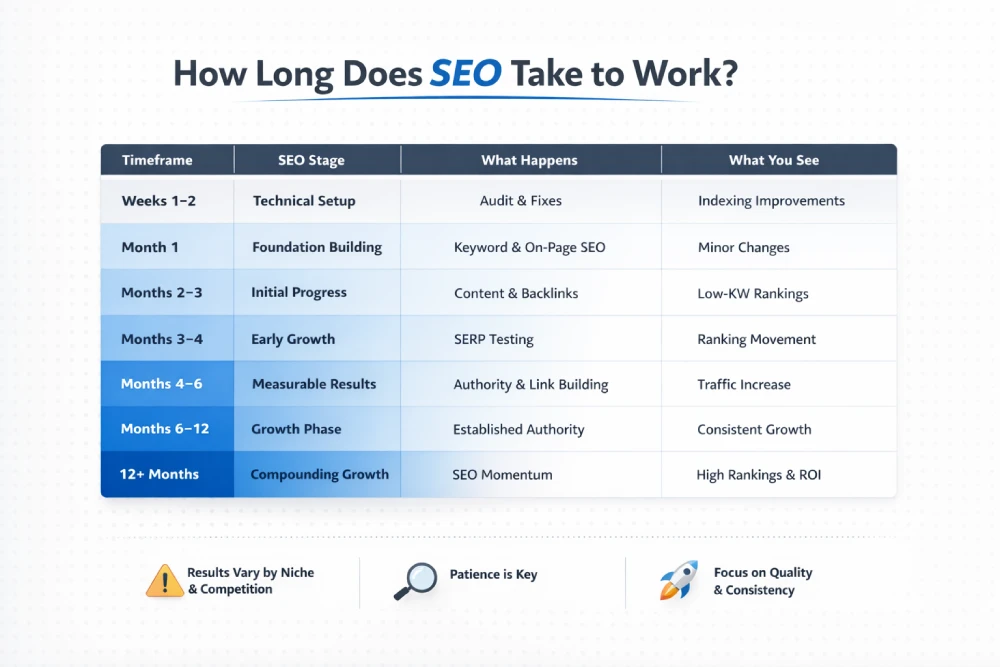
The reality is that SEO is a long-term strategy. In most cases, websites begin to see measurable SEO results within 3 to 6 months, while newer websites or competitive niches often take 6 to 12 months or more to achieve strong keyword rankings and consistent organic traffic. In highly competitive industries such as finance, insurance, healthcare, or legal services, the SEO timeline can extend even further due to higher competition and stricter ranking factors.
The exact timeframe depends on several key variables, including domain authority, content quality, keyword difficulty, backlink profile, technical SEO, and overall competition. These factors influence how quickly search engines like Google can crawl, index, and rank your pages.
A realistic understanding of the SEO timeline is essential for setting expectations and building a strategy that delivers sustainable growth. This guide breaks down a month-by-month SEO timeline for 2026, explains what impacts how fast SEO works, highlights early signs of progress, and shares proven ways to speed up SEO results without risking penalties.
Why Does SEO Take So Long to Show Results?

Before we look at timelines, it helps to understand why SEO works the way it does.
Unlike paid advertising, where you can flip on a campaign and get traffic within hours, SEO is built on trust. Search engines like Google do not award high rankings to websites overnight. They need time to discover your pages, crawl and index them, evaluate your content quality, assess your backlink profile, and compare your site against every competitor targeting the same keywords.
Think of it like building a professional reputation. When you first enter a new industry, no one knows who you are. Over time, as you show up consistently, produce quality work, and earn endorsements from others in your field, your credibility grows. Google works in a very similar way.
There are also several technical steps that happen before your rankings even begin to move. Google has to first find your page (discovery), add it to the search index (indexing), then decide where it should rank relative to everything else. Indexing alone can take anywhere from a few hours to several weeks depending on your site’s authority and crawl frequency.
On top of that, Google tests pages before committing to a ranking position. A newly published article might temporarily appear at position 20, then drop, then climb again as Google gathers data on how users interact with it. This is completely normal and part of the process.
As Google’s own Search Advocate John Mueller has confirmed, the timeline for ranking improvements depends on the scope of changes made, the overall quality of the site, and how Google interprets its usefulness for a given search query. There is no fixed deadline. But the good news is that the process is not random either.
The Realistic SEO Timeline: Month by Month
Here is what a realistic SEO campaign looks like from the moment you get started.
Month 1: Audit, Research, and Foundation
The first month is rarely about visible results. It is about building the infrastructure that everything else depends on.
During this phase, a proper SEO strategy begins with a thorough technical audit of your website. This means identifying crawl errors, fixing broken links, checking page speed (especially on mobile), reviewing your XML sitemap, and making sure Google can access and index your most important pages without obstacles.
Alongside the technical work, keyword research happens here. This means finding the terms your target audience actually searches for, understanding search intent behind those keywords, and mapping them to specific pages on your site.
If your website has never been optimized before, even basic fixes in month one can start producing early gains. Google’s John Mueller has noted that a site starting from virtually zero optimization and implementing best practices correctly can sometimes see a noticeable early improvement once those changes are crawled and processed.
Month 2 to 3: On-Page Optimization and Content Creation
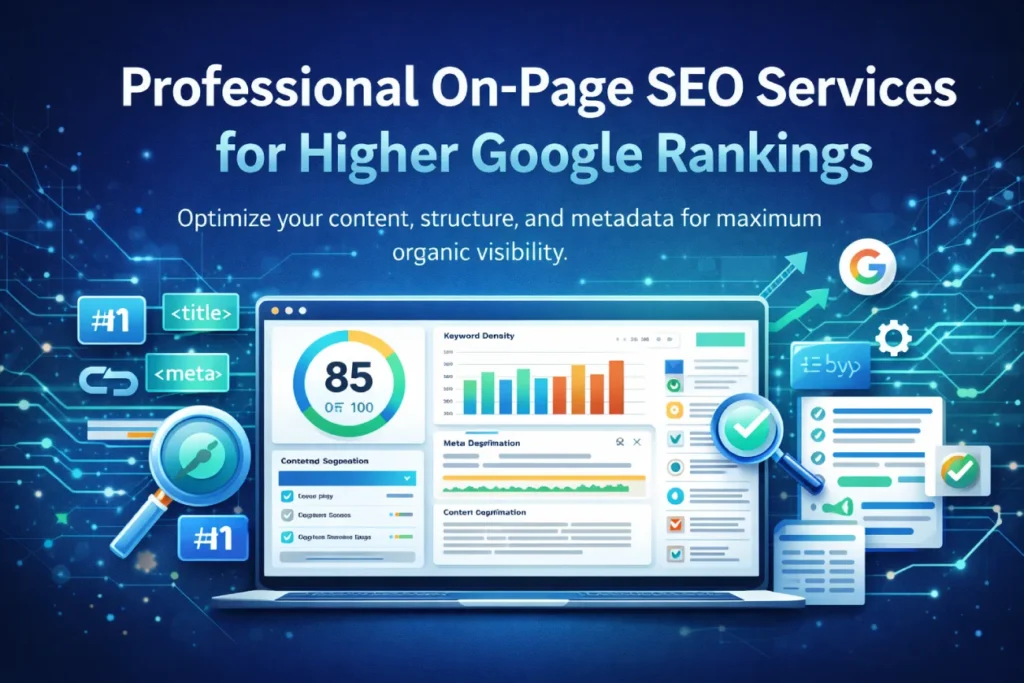
With the foundation in place, month two and three focus on on-page SEO and content.
This is when you start optimizing existing pages — updating title tags, meta descriptions, heading structures, internal linking, and content quality. It is also when new, targeted content starts to go live.
Early in this phase, you might see your pages begin to appear in search results for lower-competition, long-tail keywords. These are not high-volume terms, but they are real signals that Google has found and evaluated your content. Traffic from these early wins is modest, but it confirms things are moving in the right direction.
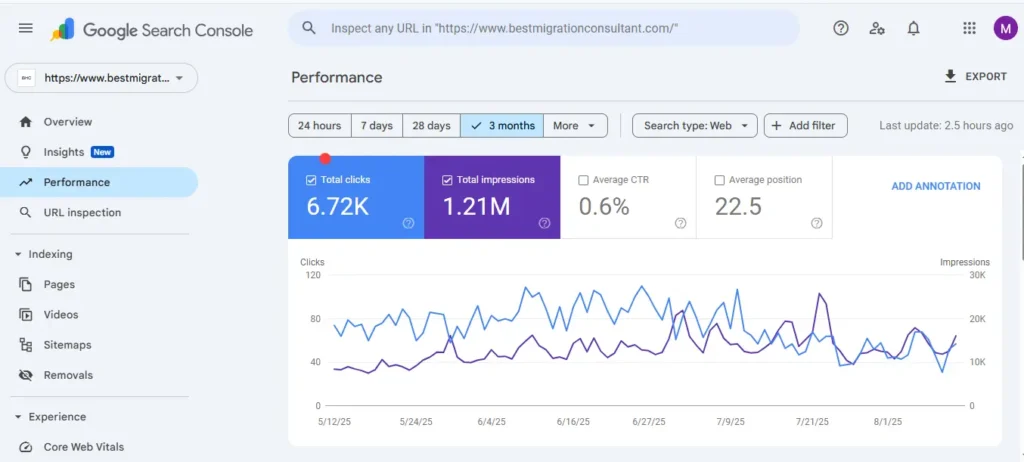
Organic impressions in Google Search Console will typically start climbing during this window, even if clicks have not caught up yet. That is a healthy leading indicator.
Month 4 to 6: Early Traction and Growing Visibility
This is the phase where most people either gain confidence in their strategy or start doubting it. Rankings for target keywords begin to move more noticeably. Pages that were sitting at positions 20 to 50 start climbing toward the first page for some queries.
Organic traffic begins a slow but consistent upward trend. For some sites, especially those in less competitive niches, the growth in this window can feel significant. For sites in crowded markets, progress is real but more incremental.
Link building starts to compound here as well. Backlinks acquired in earlier months begin to get indexed and pass authority to your pages, reinforcing the rankings that content and on-page optimization helped establish.
One thing to be aware of during this phase: it is common to see fluctuations. Pages might jump from position 15 to position 8, then settle at position 12. This is not failure. It is Google running tests and refining its understanding of where your page belongs.
Month 6 to 9: Measurable Results and Compounding Growth
By this point, most well-executed SEO campaigns are delivering results that are visible to stakeholders and clients. Organic traffic is on a consistent upward trend, a growing number of keywords are ranking on page one, and some pages may be generating conversions, leads, or sales directly from organic search.
This is also the stage where the compounding nature of SEO becomes tangible. Each piece of optimized content builds on the authority established by content published before it. Each new backlink lifts the pages it points to while also reinforcing the domain overall. Growth starts to feel like momentum.
Month 9 to 12 and Beyond: Authority, Dominance, and Long-Term ROI
For sites that have been consistent — publishing quality content, earning quality links, maintaining technical health — the final stretch of the first year often brings significant gains. First-page rankings become more stable. High-intent keywords start converting at scale. Brand visibility in search increases.
This is also when SEO starts to generate compounding ROI. A blog post that ranks well can drive traffic for years without additional investment. The content you published in month two can still be generating leads in year three, which is something paid advertising cannot replicate once the budget runs out.
7 Key Factors That Affect Your SEO Timeline
Understanding the timeline is one thing. Understanding what controls it is what allows you to actually influence it. Here are the variables that matter most.
1. Website Age and Domain History
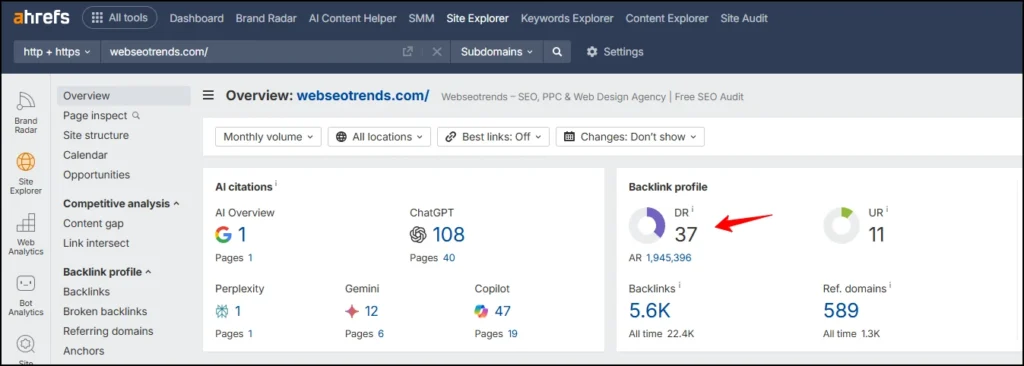
Established websites almost always gain SEO traction faster than brand-new domains. Older domains carry a history of crawling, indexing, and trust signals that search engines have already built models around. If Google has been regularly crawling your site for years, new content gets discovered and evaluated more quickly.
Brand-new domains, by contrast, often experience what the SEO community calls the Google Sandbox — an informal term for the period during which new websites may not rank well even with solid content and optimization. While Google has never officially confirmed the Sandbox as a feature, the pattern is widely observed: new sites tend to take 6 to 12 months before meaningful rankings appear, regardless of how aggressively they publish.
If you are starting fresh, this is not a reason to delay. It is a reason to start immediately, because the clock only begins ticking once you do.
2. Competition in Your Niche
The more saturated your industry, the longer the timeline. If you are trying to rank for “digital marketing agency” against thousands of established, well-funded competitors, you are in for a long road. If you are targeting something more specific — say, “SEO for boutique law firms in Manchester” — the path to visibility is dramatically shorter.
This is why long-tail keyword targeting is so strategically important in the early stages of an SEO campaign. Winning on lower-competition terms builds authority and traffic that you can later leverage to compete for bigger keywords.
3. Content Quality and Publishing Frequency
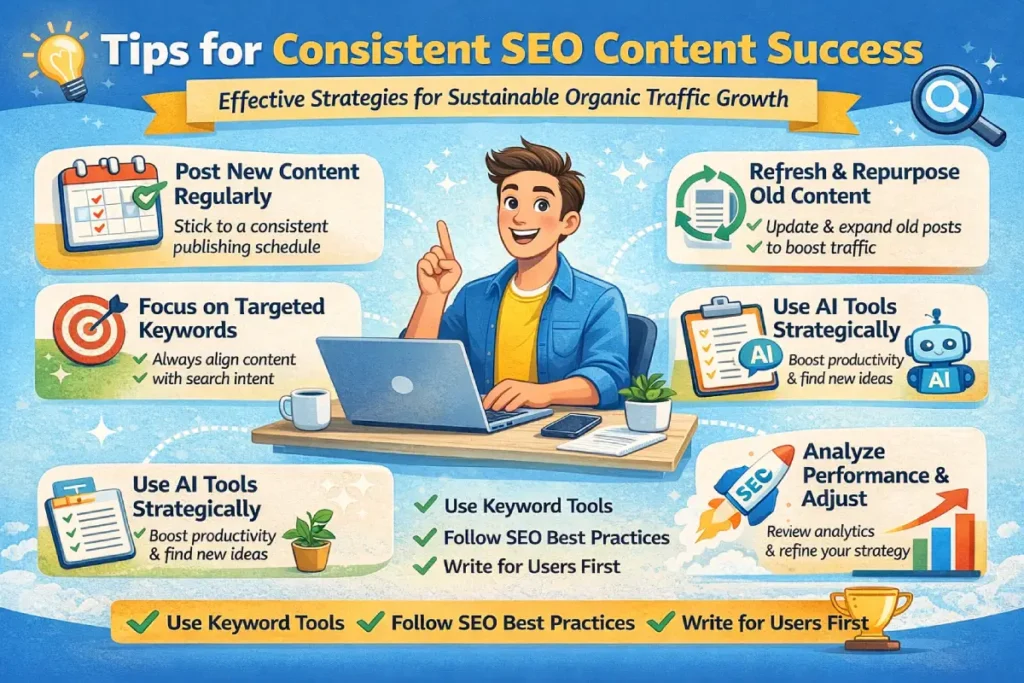
Content is still the primary mechanism through which your site earns rankings. But the quality bar has risen substantially. Generic, thin content rarely ranks anymore. Google’s systems are increasingly sophisticated at evaluating whether content genuinely answers the search query better than competing pages.
Publishing frequency also plays a role. Sites that publish consistently tend to be crawled more frequently, which means new content gets discovered and evaluated faster. A site that publishes four to eight well-researched articles per month will build topical authority significantly faster than one that posts sporadically.
Topical clustering — where you publish a long-form pillar page on a broad subject and support it with multiple related articles that all interlink — is one of the most effective content strategies for accelerating SEO timelines. It signals to Google that your site is a comprehensive resource on a given topic, not just a collection of loosely related pages.
4. Technical SEO Health
Even the best content cannot rank well if your website has technical barriers preventing Google from crawling and indexing it efficiently.
Common technical issues that slow down SEO progress include slow page load times (particularly on mobile), crawl errors and broken links, duplicate content, poor URL structure, missing or incorrect canonical tags, and pages being unintentionally blocked by robots.txt or noindex tags.
Fixing technical issues early in an SEO campaign can produce faster results than almost any other single action. When Google can efficiently crawl and index your site, all of the other signals — content, links, user experience — are interpreted more accurately. Core Web Vitals, which measure loading performance, visual stability, and interactivity, are a direct ranking signal that particularly affects technical SEO results.
5. Backlink Profile and Link Building
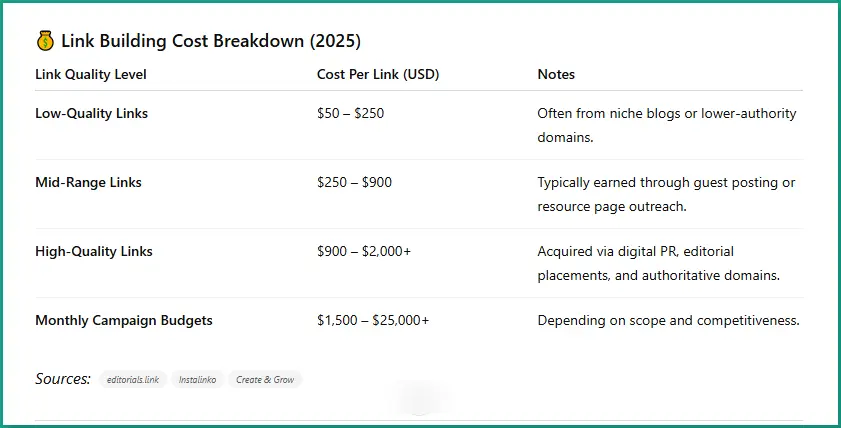
Backlinks remain one of the most powerful ranking signals in Google’s algorithm. A website with a strong profile of high-quality, relevant backlinks will consistently outrank sites with similar or even better content but weaker link equity.
The challenge is that building a quality backlink profile takes time. It involves creating content worth linking to, outreach to relevant publications and websites, digital PR, guest posting on authoritative sites, and building genuine relationships in your industry.
The effect of new backlinks on rankings is also not instant. A backlink may take weeks to get crawled and indexed, and its full impact on rankings might not be visible for another one to three months after that.
Link quality matters far more than link quantity. A single link from a highly authoritative, topically relevant domain can outperform dozens of links from low-quality directories. Spammy or irrelevant links can actually slow your progress or trigger algorithmic penalties, so white-hat link building is not just an ethical choice — it is a strategic one.
You can learn more about how we approach this in our guide to link building strategies and our deep dive on backlinks management.
6. YMYL Topics and Industry Type
If your website covers topics that Google classifies as “Your Money or Your Life” — meaning topics that could significantly impact a person’s health, financial wellbeing, or safety — the algorithm holds your content to a much higher standard.
Medical, legal, financial, and similar content is evaluated more rigorously against signals of Expertise, Authoritativeness, and Trustworthiness (E-E-A-T). This does not mean you cannot rank in these industries. It means it takes longer and requires demonstrated expertise, author credentials, and high-quality sourcing.
If your site operates in a YMYL niche, building E-E-A-T signals — author bios, credentials, references to credible sources, and earning links from authoritative industry publications — is not optional. It is the price of admission.
7. Resources, Budget, and Execution Speed
SEO results also depend on how quickly you can execute. Large companies that require multiple approval layers for every content piece or website change will naturally see slower results than lean teams that can publish and implement quickly.
Budget matters too, not because you can buy your way to the top, but because more resources mean more high-quality content, more link-building opportunities, better tools for tracking and analysis, and faster iteration based on data. If you are running SEO on a minimal budget, results are still achievable — they just take longer because the pace of execution is slower.
Early Signs That Your SEO Is Working
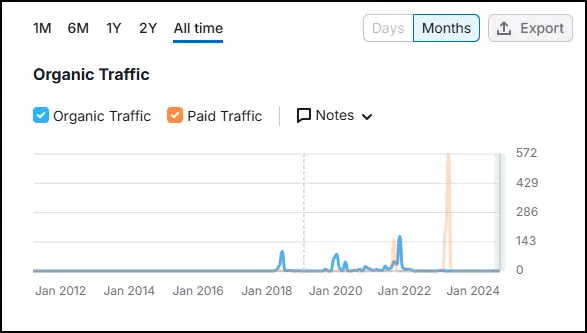
One of the most frustrating things about SEO is that the most meaningful metrics — traffic, rankings, conversions — take months to move. But there are leading indicators you can monitor from the first few weeks that confirm your strategy is working before the traffic arrives.
Increased crawl frequency. If Google Search Console shows Googlebot visiting your site more often, that is a positive sign. It means Google is taking your content seriously enough to check back regularly.
Growing search impressions. Your pages showing up in search results (even at positions 20 to 100) is a signal that Google has indexed your content and considers it relevant to search queries. Impressions rising in Search Console is a reliable early indicator.
Index coverage improvements. More of your pages being properly indexed means your technical foundation is solid and Google has no barriers to accessing your content.
Keyword position movement. Even gradual movement from position 60 to position 35 on target keywords is progress. It shows Google is reevaluating your page upward.
Early backlinks and brand mentions. If other sites are starting to reference your content or brand, that is a strong signal that your content strategy is gaining traction.
How to Speed Up Your SEO Results (The Right Way)
There are no shortcuts that last. Tactics like buying cheap backlinks, stuffing keywords, or using AI to mass-produce thin content might produce temporary gains, but they carry serious risks of algorithmic penalties that can set you back months or even permanently damage your domain.
That said, there are legitimate, highly effective ways to accelerate your SEO timeline.
Start with a comprehensive technical audit. Fixing crawlability issues, improving page speed, and resolving indexing errors gives every other SEO effort a faster path to impact. A professional SEO audit can uncover the specific blockers holding your site back.
Target long-tail keywords first. High-intent, lower-competition keywords give you the opportunity to rank faster, build topical authority, and generate early traffic that compounds over time. Our guide on affordable SEO services for small businesses covers this approach in depth.
Build topical authority through content clusters. Rather than publishing random one-off articles, organize your content around core topics. A pillar page covering a broad subject supported by a cluster of related, interlinked posts signals deep expertise to search engines and ranks faster than isolated content.
Use internal linking strategically. Internal links pass authority between pages and help Google understand the hierarchy and relationships within your site. Linking to new pages from high-authority sections of your site — your homepage, cornerstone content, or navigation menus — helps them get discovered and evaluated faster. Proper on-page SEO practices always include a structured internal linking plan.
Invest in quality link building from the start. Even modest, consistent link-building efforts compound over time. A few high-quality backlinks per month, sustained over a year, will produce significantly better results than a burst of low-quality links. Check out our resources on the best places to buy backlinks and PR link building for white-hat approaches that work.
Refresh and optimize existing content. Many SEO teams make the mistake of only creating new content and ignoring their existing pages. Updating older articles with fresh information, better keyword targeting, and improved structure can produce ranking improvements faster than publishing something brand new, because the page already has some history and indexing signals built up.
Use AI-powered SEO tools to work smarter. The right tools can dramatically accelerate keyword research, content planning, and performance analysis. We have tested and reviewed the best AI SEO tools available in 2026 to help you find the ones actually worth your investment.
Publish consistently and frequently. The more consistently you publish quality content, the more frequently Google crawls your site, the faster your new pages get indexed, and the more topical authority you build. A publishing cadence of four to eight well-researched pieces per month is a strong target for most sites.
New Website vs. Established Website: How the Timeline Differs
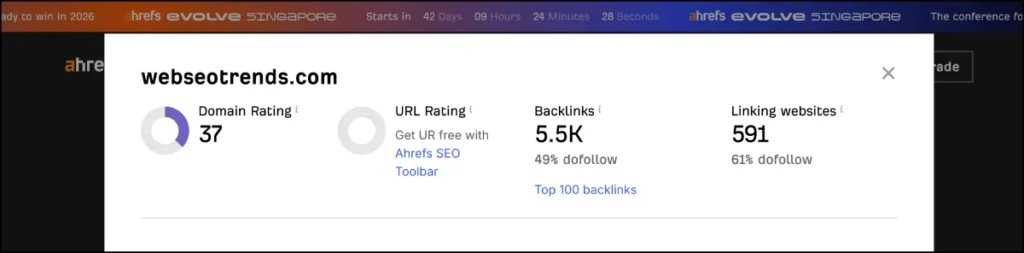
The starting point of your website is one of the single biggest factors in how long SEO takes.
For a brand-new domain with no content, no backlinks, and no history, you are essentially asking Google to trust a complete stranger. The first six months are largely about proving yourself — establishing that your site is legitimate, your content is valuable, and your brand is real. Meaningful traffic from SEO before the six-month mark is possible, particularly for very low-competition keywords, but it should not be expected as the baseline.
For an established website that has been live for two or more years, has existing content, and has earned even a modest backlink profile, SEO improvements often produce visible results within three to four months. The infrastructure of trust is already there. You are building on a foundation rather than laying one from scratch.
If you have an older domain with a history of poor SEO — thin content, technical errors, or a toxic backlink profile — the timeline can be unpredictable. Cleaning up a damaged site sometimes requires fixing issues before any growth work can begin, which adds time. But it also means there can be significant early gains from simply removing the obstacles that were holding back rankings.
SEO for Local Businesses: A Slightly Different Timeline
For businesses targeting local search — a restaurant in Delhi, a law firm in Mumbai, a plumber in Bangalore — the SEO timeline often moves faster than for national or global brands, because the competition is more contained.
Local SEO relies on a combination of Google Business Profile optimization, local citations (consistent name, address, and phone number across directories), locally focused content, and reviews. Many local businesses see their first meaningful results within two to four months of implementing a focused local SEO strategy, particularly for searches that include location terms or “near me” intent.
If your business depends on local customers, local SEO is one of the highest-ROI digital marketing investments available. You can explore affordable SEO packages built specifically for businesses at different growth stages.
When Should You Be Concerned That SEO Is Not Working?
Patience is essential in SEO, but patience without accountability is just waiting. Here is how to tell the difference between normal slow progress and an actual problem.
If you are seeing no improvement in crawl frequency, search impressions, or indexed pages within the first four to six weeks of implementing technical fixes, there may be a fundamental crawling or indexing issue that needs to be diagnosed.
If you are six months into a consistent SEO campaign — publishing quality content, building legitimate links, fixing technical issues — and you are seeing no movement in keyword rankings, no growth in impressions, and no increase in organic traffic, that is a signal to audit your strategy. It could be that your keywords are too competitive, your content quality is not strong enough to compete, your link velocity is too slow, or there are technical barriers you have not yet identified.
Nine months of consistent, quality SEO with zero meaningful results is unusual. At that point, a comprehensive SEO audit from an experienced team is warranted to identify what is blocking progress.
SEO vs. Paid Advertising: Understanding the Trade-offs
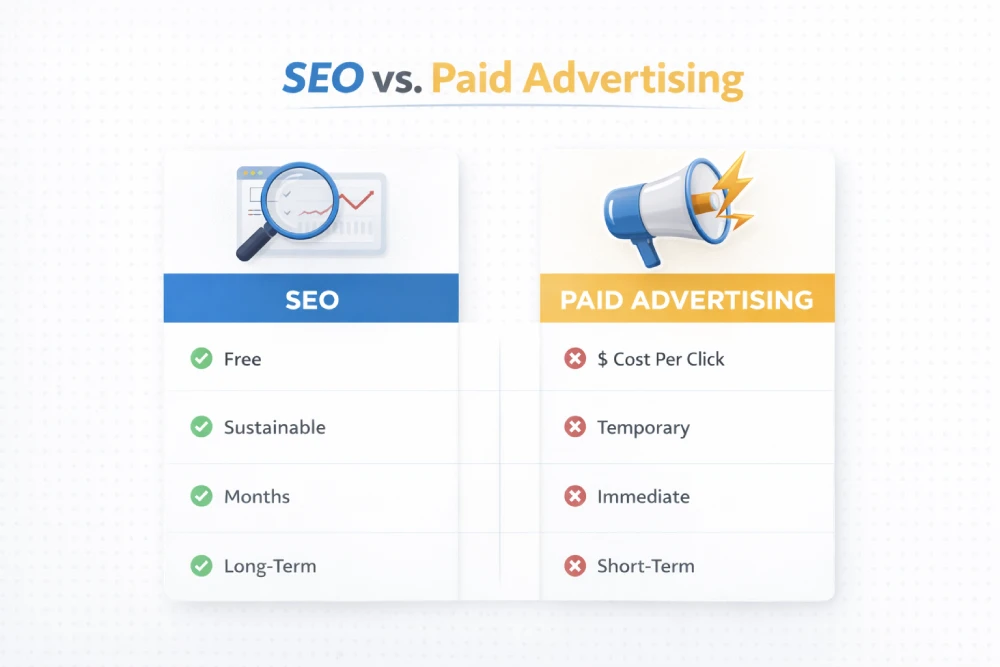
A question that frequently accompanies the “how long does SEO take” conversation is whether paid advertising is a better choice if you need results faster.
The honest answer is that they serve different purposes and are most powerful when used together.
Paid search can generate traffic within hours. If you need immediate visibility — for a product launch, a seasonal campaign, or while your SEO is still building — paid ads are a legitimate short-term tool. However, the moment you stop funding paid campaigns, the traffic stops. There is no compounding, no lasting asset being built.
SEO takes longer, but the results compound and persist. A well-ranked page can drive traffic for years. The cumulative value of organic traffic earned through SEO almost always exceeds the value of paid traffic when measured over a 12 to 24-month window, particularly for businesses with ongoing content strategies.
Many of the most successful digital marketing campaigns run paid advertising in the short term to generate immediate revenue while investing in SEO for long-term, sustainable growth. They are not competing strategies. They are complementary ones.
The Bottom Line: How Long Does SEO Take to Work?
Here is a clean summary of realistic expectations:
Weeks 1 to 4: Technical fixes, on-page optimization, and keyword research. Early indexing signals. No major traffic yet.
Months 2 to 3: Content going live, early keyword movements, growing search impressions. Possible traffic on low-competition terms.
Months 4 to 6: Measurable keyword ranking improvements, consistent upward trend in organic traffic, early conversion signals.
Months 6 to 9: Significant traffic growth, first-page rankings for target keywords, clear ROI for most websites.
Months 9 to 12 and beyond: Strong topical authority, stable rankings, compounding growth, and long-term ROI that continues to build.
The websites that succeed with SEO are the ones that understand this timeline from the start, execute consistently, track the right leading indicators, and do not abandon the strategy the moment results are slow to appear.
SEO is not magic. It is not instant. But for businesses willing to invest in it properly, it is one of the most powerful, cost-effective, and durable growth channels available.
If you are ready to start building your SEO foundation the right way, our team at Webseotrends offers a free SEO audit to help you understand exactly where you stand and what it will take to get where you want to go. And if you are curious about the tools and strategies we use to drive results, explore our SEO blog for in-depth guides on everything from keyword research to link building to technical optimization.
Published by Webseotrends — A results-driven SEO and digital marketing agency helping businesses achieve sustainable organic growth through technical excellence, content strategy, and white-hat link building.
Featured at: AAMAX
