

![Why Small Businesses Need a Website [2026]](https://webseotrends.com/wp-content/uploads/2026/05/why-small-businesses-need-a-website.webp "Why Small Businesses Need a Website")
Let me start with something uncomfortable. Last month, a local bakery owner in Austin called me almost in tears. She’d been running her shop for eleven years, had a loyal Instagram following of 14,000 people, and assumed that was “her online presence.” Then a new bakery opened three blocks away, launched a proper website, started ranking for “best birthday cakes Austin,” and within six months her revenue dropped 38%. She didn’t lose to a better product. She lost to a better-indexed competitor.
This is the brutal, unspoken reality of why small businesses need a website in 2026 — and why ignoring this single asset is the most expensive mistake an entrepreneur can quietly make. When a potential customer can’t find you on Google, ChatGPT, Perplexity, or Gemini, you don’t just lose a sale. You lose trust, you lose visibility, you lose credibility, and you bleed leads to competitors who showed up where you didn’t.
I’ve spent over a decade helping founders, freelancers, restaurants, dentists, lawyers, plumbers, eCommerce brands, and SaaS startups build their digital footprints. And if there’s one truth I’ve watched repeat itself across thousands of businesses, it’s this: a website is no longer optional infrastructure. It’s the foundation of every other marketing channel you’ll ever use.
Let’s break this down properly — not with recycled platitudes, but with real data, honest pricing, and the kind of advice I’d give a friend over coffee.
The 2026 Reality: Why Not Having a Website Is Actively Killing Your Business
Before we discuss benefits, let’s talk costs — the silent ones.
According to recent consumer research from BrightLocal and Statista, roughly 81% of buyers research a business online before making a purchase decision, and a staggering 75% of users admit they judge a company’s credibility based on its website design. When you don’t have a website, the customer’s brain doesn’t think “they must be a small operation.” It thinks “are they real? Are they legitimate? Are they still in business?” That hesitation is where you lose them — usually to the competitor who shows up two listings below you in search.
Here’s what’s changed dramatically in 2026 that most business owners haven’t caught up to yet:
- AI search engines like ChatGPT Search, Perplexity, Gemini, and Claude pull their answers from indexed web content. No website means you’re invisible to the fastest-growing layer of consumer discovery on the planet.
- Google’s Search Generative Experience (SGE) and AI Overviews now occupy the top of most commercial searches. They pull from structured, authoritative websites — not Facebook pages.
- Voice search adoption has crossed 58% in the US for local queries. Voice assistants don’t read your Instagram bio. They read your website’s schema markup.
- Apple Intelligence, Gemini on Android, and Copilot on Windows are increasingly answering shopping and service queries — all of which rely on web-indexable data.
So when people ask why is a website important for small business, the modern answer isn’t “to look professional.” It’s: to exist in the discovery layer that AI and search engines actually use.
- 18 Best AI Website Builders 2026 (Tested, Ranked & Compared)
What a Website Really Does for a Small Business (Beyond the Obvious)
Most articles will tell you a website “establishes credibility” and stop there. That’s lazy advice. Let me give you what a website actually does, in the order of business impact I’ve seen across hundreds of clients.
1. It Becomes the Trust Anchor for Every Other Marketing Channel
Run a Facebook ad? People click your profile, then look for a website. Drop a flyer? Customers Google your name. Get featured in a local newspaper? Readers search you. Every marketing dollar you spend elsewhere bounces off your website. Without that anchor, you’re funneling traffic to nothing — like building a sales funnel with no bottom.
This is the most underrated reason why a small business needs a website: it multiplies the ROI of everything else you do.
2. It Captures Demand That’s Already Searching for You
Right now, in your city, someone is typing “best [your service] near me” into Google or asking ChatGPT, “Where can I find a reliable [your service]?” If you don’t have a website backed by affordable SEO services for small business, you simply don’t exist in their decision-making process. The customer was ready to spend money. You weren’t ready to be found.
3. It Works 24/7 Without Asking for a Raise
This sounds cliché until you do the math. A website with even modest traffic — say 2,000 visitors a month at a 3% conversion rate — generates 60 qualified leads while you sleep. No employee, no ad campaign, no social post does that with the same compounding effect. The importance of a small business website lies in its compounding nature — content you publish today still earns leads three years from now.
4. It Lets You Own Your Audience (Instead of Renting It)
This one’s critical and almost nobody talks about it honestly. Your Instagram followers? Meta owns them. Your TikTok views? ByteDance owns them. Your Facebook page reach? Down 90% in the last decade. A website with an email list is the only digital asset you actually own. Algorithm changes can’t take it from you. Platforms can’t ban you off it. This is sovereignty in a rented digital economy.
5. It Powers Your Visibility in AI Search
In 2026, this is the silent revolution. When someone asks Perplexity, “Who’s the best wedding photographer in Brighton?” — Perplexity doesn’t scrape Instagram. It crawls indexed web pages with structured data, schema markup, clear topical authority, and trust signals. No website = no presence in AI answers. This alone is reason enough to invest.
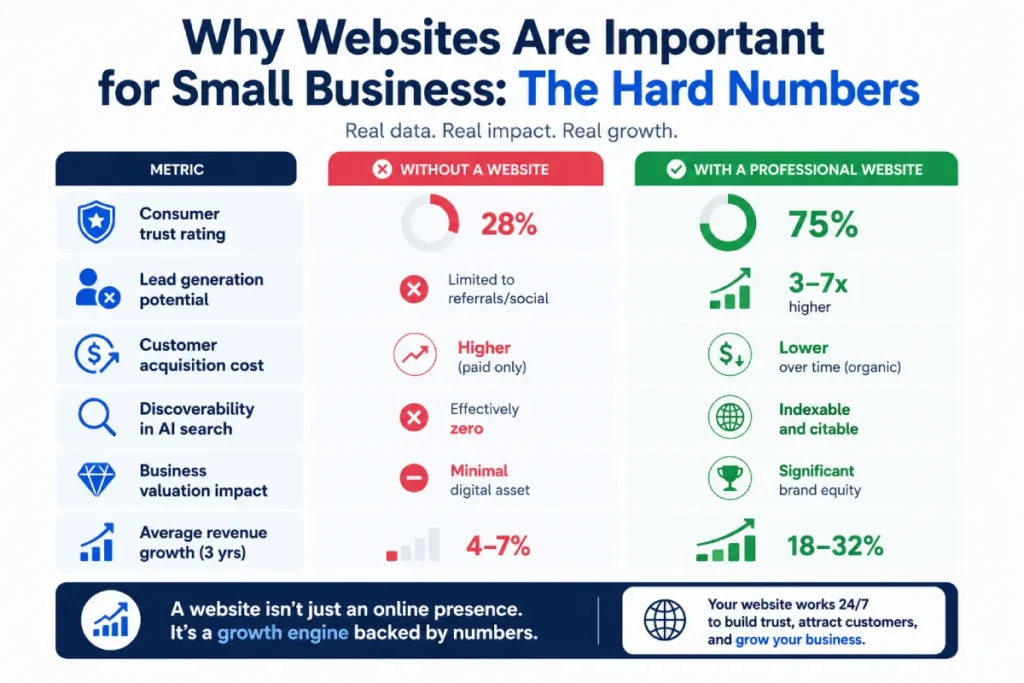
Why Websites Are Important for Small Business: The Hard Numbers
Let’s anchor this in data, because anecdotes aren’t enough.
Here’s what current industry research consistently shows across SMB benchmarking studies:
| Metric | Without a Website | With a Professional Website |
|---|---|---|
| Consumer trust rating | 28% | 75% |
| Lead generation potential | Limited to referrals/social | 3–7x higher |
| Customer acquisition cost | Higher (paid only) | Lower over time (organic) |
| Discoverability in AI search | Effectively zero | Indexable and citable |
| Business valuation impact | Minimal digital asset | Significant brand equity |
| Average revenue growth (3 yrs) | 4–7% | 18–32% |
When founders ask me why does my business need a website, I show them this table. Then I show them their three biggest local competitors’ Google rankings. Conversation usually ends with them asking, “Okay, where do I start?”
Website vs Social Media: Stop Treating Them as Equals
This is the most dangerous misconception I encounter. Business owners genuinely believe their Instagram or Facebook page is a “substitute” for a website. It isn’t. Here’s why, broken down honestly:
| Factor | Website | Social Media |
|---|---|---|
| You own the platform | Yes | No — you’re a tenant |
| Search engine indexing | Full | Limited/none |
| AI search citation | Yes | Rare |
| Algorithm dependency | None | Total |
| Conversion optimization | Full control | Heavily restricted |
| Custom branding | Unlimited | Templated |
| Data ownership | 100% yours | Platform’s |
| Audience portability | Total | None |
| Long-term SEO compounding | Yes | No |
| Trust signal value | High | Moderate |
Social media is a megaphone. A website is a building you own. You need both — but only one of them survives an algorithm change, a platform ban, or the next “we’re shutting down” announcement.
This is exactly why websites are important for small business in a way social pages will never replicate.
Website vs Marketplace Platforms (Etsy, Amazon, Fiverr, Upwork)
Marketplaces feel safe because they bring traffic.
But here’s the trade-off most founders don’t think through until it’s too late:
- They take 8–30% per transaction
- They own your customer relationship
- They can suspend your account with zero recourse
- They can compete with you using your own sales data (looking at you, Amazon Basics)
- Your “brand” is just a thumbnail on their site
- You can’t retarget or remarket to your buyers
A website doesn’t replace marketplaces. It liberates you from being dependent on them. Smart small businesses use marketplaces for discovery and a website for retention, brand-building, and direct sales.
Do Websites Help Small Business? Yes — Here’s the Mechanism
People often ask me bluntly: do websites help small business, or is it just expensive theater?
Here’s the mechanism, simply:
- Customer searches a problem
- Search engine (or AI engine) shows your page
- Customer reads, builds trust, sees proof
- Customer contacts you, books, or buys
- You retarget them, email them, build LTV
That’s it. The website is the conversion vehicle that catches demand other channels generate. Without it, you’re catching water with a sieve.
DIY Website Builders vs WordPress vs Custom Development
This is where most founders get paralyzed. Let me give you the honest comparison I’d give a client paying for a strategy session.
Website Builders (Wix, Squarespace, Shopify, Webflow, Carrd)
Best for: Solo entrepreneurs, side projects, MVPs, simple service businesses, founders with zero technical comfort.
Pros: Quick setup (days, not weeks). Hosting included. Templates handle design. Decent SEO basics out of the box. Minimal maintenance.
Cons: Limited customization. Migrating off is painful. SEO ceiling is real — advanced on-page SEO tools and techniques aren’t always usable on locked-down builders. Monthly costs add up. You don’t fully own your site files.
Real-world verdict: A solid 2/10 risk for businesses under $200K revenue. Above that, you outgrow it fast.
WordPress (Self-Hosted)
Best for: Content-heavy businesses, blogs, local services, eCommerce under 5,000 products, agencies, anyone who plans to scale SEO.
Pros: Total ownership. Massive plugin ecosystem. Best-in-class SEO control. Affordable. Endless customization. Future-proof.
Cons: Requires more setup. You’ll need basic WordPress maintenance knowledge or someone managing it, and pairing it with the best WordPress hosting is critical for performance. Plugin conflicts can happen.
Real-world verdict: Still the gold standard for SMBs serious about long-term SEO. Powers around 43% of the web for a reason.
You can also read:
How to Start a Blog in 2026 — 7 Steps to Make Money
Custom-Built Websites (React, Next.js, Headless)
Best for: Funded startups, SaaS companies, enterprise SMBs, brands needing unique UX, or businesses with complex business logic.
Pros: Total creative and technical control. Best performance possible. Highly differentiated user experience. Premium feel.
Cons: Expensive. Slow to update without a developer. Overkill for 90% of small businesses. Vendor lock-in if your developer disappears.
Real-world verdict: Don’t go custom unless you have a clear strategic reason and a budget that supports ongoing dev work.
Realistic Small Business Website Pricing in May 2026 (USD)
This is the section every founder skims to first, so let me be straight with you. Pricing varies wildly based on geography, complexity, freelancer vs agency, and timeline. Below are realistic 2026 market rates from working with vendors across markets.
Freelancer Pricing Comparison (USD)
| Service | USA | UK | India | Global Average |
|---|---|---|---|---|
| Basic 5-page website | $800 – $2,500 | $700 – $2,200 | $180 – $700 | $500 – $1,800 |
| WordPress business site | $1,200 – $4,000 | $1,000 – $3,500 | $300 – $1,200 | $800 – $2,800 |
| eCommerce (Shopify/Woo) | $2,000 – $6,000 | $1,800 – $5,000 | $500 – $2,000 | $1,400 – $4,200 |
| Custom landing page | $400 – $1,500 | $350 – $1,300 | $100 – $400 | $250 – $1,000 |
| SEO-optimized site | $1,500 – $5,000 | $1,300 – $4,200 | $400 – $1,500 | $1,000 – $3,500 |
Agency Pricing Comparison (USD)
| Service | USA | UK | India | Global Average |
|---|---|---|---|---|
| Brochure/business site | $3,500 – $12,000 | $3,000 – $10,000 | $800 – $3,500 | $2,500 – $8,500 |
| WordPress with custom design | $5,000 – $20,000 | $4,500 – $18,000 | $1,500 – $6,000 | $4,000 – $15,000 |
| eCommerce build-out | $8,000 – $35,000 | $7,000 – $30,000 | $2,500 – $12,000 | $6,000 – $25,000 |
| Custom React/Next.js site | $15,000 – $75,000+ | $13,000 – $65,000+ | $5,000 – $25,000 | $10,000 – $55,000+ |
| Full rebrand + website | $10,000 – $50,000 | $9,000 – $45,000 | $3,000 – $15,000 | $7,500 – $35,000 |
Hosting, Maintenance & Ongoing Costs (USD/year)
Hosting is where most founders quietly overpay. Before choosing a provider, scan the current shortlist of the 11 best cheap web hosting providers — and if you’re in India, the best web hosting in India breakdown saves you from the common bait-and-switch renewal pricing traps.
| Service | USA | UK | India | Global Average |
|---|---|---|---|---|
| Shared hosting | $60 – $250 | $55 – $230 | $40 – $180 | $50 – $220 |
| Managed WordPress hosting | $300 – $1,200 | $280 – $1,100 | $200 – $800 | $260 – $1,000 |
| Domain renewal | $12 – $25 | $10 – $22 | $8 – $20 | $10 – $22 |
| SSL certificate | Often free | Often free | Often free | $0 – $80 |
| Maintenance retainer | $600 – $3,600 | $550 – $3,200 | $200 – $1,500 | $480 – $2,800 |
| Monthly SEO retainer | $500 – $5,000 | $450 – $4,500 | $150 – $1,500 | $400 – $3,800 |
| Full website redesign (every 3–5 yrs) | $2,500 – $25,000 | $2,200 – $22,000 | $700 – $8,000 | $1,800 – $18,000 |
A useful reference point for the best small business web hosting services and what hidden costs to watch for is genuinely worth bookmarking before you sign anything.
Website Builder Subscription Costs (USD/month)
| Platform | Starter Plan | Business Plan | Premium/Pro |
|---|---|---|---|
| Wix | $16 – $22 | $27 – $36 | $45 – $159 |
| Squarespace | $16 – $25 | $23 – $36 | $52 – $99 |
| Shopify | $29 – $39 | $79 – $105 | $299 – $2,300 |
| Webflow | $14 – $23 | $29 – $49 | $79 – $235 |
| WordPress.com | $4 – $10 | $25 – $45 | $59 – $79 |
These are 2026 market figures. Expect roughly 5–10% annual price creep on most SaaS builders, and watch for transaction fees on eCommerce plans — they erode margin silently.
Cheap Websites vs Professional Websites: The True Cost Breakdown
Here’s a hard-earned lesson I share with every founder: the cheapest website is almost always the most expensive one.
A $200 Fiverr website looks fine until:
- It loads slow (you lose 32% of visitors at 3+ seconds)
- It isn’t mobile-responsive properly (75% of traffic is mobile)
- It has no schema markup (invisible to AI search)
- It has no proper on-page SEO foundation (zero rankings)
- Your developer ghosts you (no support)
- You need a redesign in 8 months anyway ($2,000+ later)
The actual cost of a “cheap” website is the cost of building it twice plus the revenue you lost during the period it didn’t work. Pay for quality once, or pay for shortcuts forever. If your budget is tight, it’s safer to learn how to choose the right SEO agency for small businesses than to chase the lowest bid on a website build.
Freelancer vs Agency: Which Should a Small Business Choose?
I get this question constantly. Honest framework:
Choose a freelancer when:
- Your budget is under $5,000
- Your needs are clearly scoped
- You want direct communication with the person doing the work
- You’re comfortable managing the project yourself
- You’re okay with longer timelines (freelancers juggle clients)
Choose an agency when:
- Your budget exceeds $8,000
- You need a multi-disciplinary team (design + dev + SEO + copy)
- You need accountability and contracts
- You want predictable timelines
- Your brand reputation depends on flawless execution
Choose a hybrid (specialist freelancer + agency oversight) when:
- You’re scaling from $500K to $5M revenue
- You need ongoing optimization, not just a one-time build
How a Website Directly Impacts Conversion Rate and Customer Trust
Let me share something most articles get backwards. Conversion isn’t a button color or a popup. It’s a trust accumulation curve. Every element on your site either adds trust or removes it.
A well-built small business website typically converts at 2–5% of traffic. A poorly-built one converts at 0.3–0.8%. The difference between those two numbers, applied to even 5,000 monthly visitors, is the difference between 25 leads and 250 leads. Every. Single. Month.
Here’s what compounds trust (and conversion) on a small business site:
- Real photos of your team, your space, your product (not stock images)
- Specific testimonials with names, faces, and locations (not “John D. says…”)
- Clear pricing or transparent ranges (vagueness kills conversions)
- Fast load times (under 2.5 seconds, ideally)
- Mobile-first design that actually works one-thumb
- Proof of expertise — case studies, certifications, awards, press
- Honest copywriting that sounds like a human, not a corporate robot
- Easy contact paths — phone, form, chat, all visible
- Schema markup for credibility signals to search engines
- HTTPS, privacy policy, and clear business details — non-negotiable in 2026
Want a deeper structural breakdown? My write-up on why backlinks still matter and how to build quality links explains how off-site authority compounds with on-site trust signals to lift conversion.
Why Small Business Needs a Website for Local SEO
If you run a service business — plumber, dentist, salon, restaurant, consultant, lawyer, contractor — local SEO is the single highest-ROI marketing channel available to you. And it doesn’t work without a website.
Here’s what a website unlocks for local visibility:
- Google Business Profile linkage (your GBP needs a website URL to perform well)
- Local schema markup (NAP — Name, Address, Phone — properly structured)
- City-specific landing pages (one of the most underused tactics)
- Local backlinks (chambers, BNI, local press all need somewhere to link to)
- Reviews integration (display third-party reviews on-site for trust)
- Local content (a “best parks near our shop” article ranks you for surrounding searches)
Without a website, your Google Business Profile is functioning at maybe 30% of its potential. With one — fully optimized and supported by a clean backlink audit of your local link profile — you become the dominant local result for high-intent searches.
How a Website Helps with Google Rankings and AI Search Discoverability
Let me explain something most SEO content glosses over.
In 2026, ranking isn’t just about Google’s blue links anymore. You’re optimizing for:
- Classic Google SERP (blue links + featured snippets)
- Google AI Overviews (the generative summary at the top)
- ChatGPT Search (citations from indexed web content)
- Perplexity AI (multi-source citation engine)
- Gemini / Bard (Google’s AI assistant pulling from web)
- Claude search integrations (citation-based answers)
- Bing Copilot (Microsoft’s AI search layer)
- Apple Intelligence (increasingly pulling from web sources)
Every one of these systems indexes websites. They cite URLs. They reference structured content. They cannot cite your Instagram caption. They cannot quote your TikTok. They need a webpage with proper hierarchy, schema, and topical authority.
This is the future of AI SEO and generative engine optimization — and a website is the absolute prerequisite. The brands winning AI search visibility right now are the ones using the best AI SEO tools and tracking citations with Copilot rank tracking tools. Skip the website foundation, and you’re invisible to the next decade of search.
A Realistic Small Business Website Launch Checklist
Use this as a launch-ready blueprint. I’ve tested every step with real small business clients:
Before You Build
- [ ] Define your single most important conversion goal (call, form, booking, purchase)
- [ ] Identify your top 3 competitor websites and what they do well
- [ ] Lock in your domain name (.com preferred, registered for 3+ years for trust signals)
- [ ] Choose your platform (builder vs WordPress vs custom)
- [ ] Plan your sitemap — typically 5–10 core pages for SMBs
During the Build
- [ ] Use a fast, modern theme (avoid bloated templates)
- [ ] Install SSL (HTTPS) from day one
- [ ] Set up Google Analytics 4 and Google Search Console
- [ ] Implement schema markup (LocalBusiness, Organization, Service)
- [ ] Optimize all images (WebP format, lazy loading)
- [ ] Mobile-test on at least 3 device sizes
- [ ] Test Core Web Vitals — aim for green across LCP, INP, CLS
- [ ] Write SEO titles and meta descriptions for every page
- [ ] Add structured FAQ schema where relevant
Content Foundations
- [ ] Homepage with clear value proposition above the fold
- [ ] About page with real photos and story
- [ ] Service/product pages with detailed copy
- [ ] Contact page with multiple paths
- [ ] Pricing or transparent ranges (or “starting at”)
- [ ] Testimonials and case studies
- [ ] Blog/insights section (critical — see how to start a blog the right way)
- [ ] Privacy policy, terms, cookie notice
Post-Launch
- [ ] Submit sitemap to Google Search Console
- [ ] Submit to Bing Webmaster Tools
- [ ] Link your Google Business Profile
- [ ] Build initial backlinks (chambers, directories, partners)
- [ ] Set up a 90-day publishing schedule
- [ ] Configure analytics goals and conversion tracking
- [ ] Schedule monthly maintenance reviews
Industry-Specific Examples: How a Website Transforms Different Small Businesses
Abstract advice is forgettable. Real scenarios stick. Here’s how a website concretely changes outcomes by industry:
Restaurants & Cafes: A simple website with menu, hours, location, and reservation integration typically lifts foot traffic 22–40% within six months. Without one, you’re losing to competitors who appear in “best brunch near me” AI Overviews.
Local Service Businesses (plumbing, electrical, HVAC): Properly built sites with city-targeted landing pages can generate 50–200 inbound leads per month. The lead value alone often exceeds $300–$2,000 per closed job. ROI is usually visible within 60–90 days.
Consultants & Coaches: A website with strong case studies, a clear methodology, and a booking link can be the single highest-converting asset in your business. Many consultants close $5,000–$50,000 engagements through a single landing page. If personal brand is part of your model, my guide on how to become a content creator walks through the exact stack I built around my own site.
eCommerce / Product Brands: Owning your direct-to-consumer site means margins of 60–80% instead of 30–40% on marketplaces. Plus, you build a customer email list — your most valuable long-term asset. Pair it with the right ecommerce SEO packages and the compounding effect on product-page rankings is significant.
SaaS & Digital Products: Your website is your product surface. There’s no negotiation here. A poor website = no signups, regardless of how good your software is.
B2B Services (agencies, freelancers): Premium websites command premium prices. I’ve watched freelancers double their rates after a proper website rebrand — same skills, just better perceived value.
Healthcare, Legal, Finance: Trust industries. A website with credentials, transparent processes, and educational content can outrank giant chains for hyper-local searches.
Common Objections I Hear (And Honest Answers)
Let me address the pushback I get most often:
“I don’t have technical skills.” — You don’t need them. Modern builders are visual. Or hire a freelancer for under $1,000. The skills barrier in 2026 is the lowest it’s ever been.
“It’s too expensive.” — Compared to what? One Yellow Pages ad in 2002 cost more than a yearly hosted website. A single closed lead from organic search often pays for the entire site.
“My customers find me through word of mouth.” — Good. Now imagine if word-of-mouth referrals could also Google you and find proof you’re real. Referrals close 3x faster when prospects can verify you online first.
“I don’t have time.” — A basic site can be live in a weekend. A freelancer can deliver one in 2–3 weeks. The opportunity cost of waiting is much higher than the time investment.
“My industry doesn’t need it.” — Every industry needs it. Even a one-person handyman business. Especially a one-person handyman business — that’s the differentiator from your competitors who only have a Facebook page.
Expert Insights: What I’d Tell My Past Self
If I could send three pieces of advice back to founders who are deciding whether to invest in a website:
First, your website is a long-term asset, not an expense. Treat it like real estate, not like a marketing campaign. The brands that win five years from now are publishing content and building authority today.
Second, don’t chase trends. Don’t get a flashy animated site that takes 8 seconds to load. Speed, clarity, and trust beat aesthetics every single time. The most effective small business websites I’ve worked on look almost boring — but they convert at 5%+.
Third, your website is never “finished.” It’s a living asset. Plan to publish, refresh, and optimize quarterly. The competitive moat isn’t in launching — it’s in compounding.
Frequently Asked Questions
Why do small businesses need a website in 2026?
Small businesses need a website to remain visible across Google, AI search engines like ChatGPT and Perplexity, and local search. Without one, you lose trust, leads, organic traffic, and discoverability — even loyal customers struggle to verify your legitimacy.
Is a website still necessary if I have social media?
Yes. Social media is rented audience; a website is owned audience. Social platforms don’t get indexed by search engines or AI engines the way websites do, and algorithm changes can wipe out your reach overnight.
How much should a small business website cost in 2026?
A solid small business website costs $800–$5,000 from a freelancer and $3,500–$20,000 from an agency. Website builders like Wix or Squarespace start at around $16–$45 per month. Avoid anything under $300 — it usually ends up costing more in the long run.
Why is a website important for small business credibility?
Around 75% of consumers judge a business’s legitimacy by its website. A professional site signals you’re real, established, and trustworthy — especially important when competing against businesses with no online presence or only social pages.
Do websites help small businesses get more customers?
Yes — significantly. Websites generate leads 24/7 through organic search, capture demand that’s already searching for your services, and serve as the conversion vehicle for every other marketing channel you use.
WordPress vs Wix vs Shopify — which is best for small business?
WordPress is best for content-heavy and SEO-focused businesses. Wix and Squarespace suit simple service businesses with no technical needs. Shopify is the gold standard for product-based eCommerce. Choose based on your business model, not platform popularity.
How long does it take to build a small business website?
A basic site takes 1–2 weeks. A standard professional WordPress site takes 3–6 weeks. Custom builds can take 8–16 weeks. Timelines depend heavily on content readiness — most delays come from clients not having copy and photos ready.
Will AI replace small business websites?
No — AI search engines actually depend on websites to generate their answers. Without an indexable website, your business is invisible to ChatGPT, Perplexity, Gemini, and Google’s AI Overviews. AI makes websites more important, not less.
Do I need ongoing SEO after my website launches?
Yes. SEO isn’t a one-time setup. Plan for $400–$2,000 per month on basic ongoing SEO, content publishing, and technical maintenance. Without it, rankings decay and competitors overtake you.
Can I build a small business website myself?
Absolutely. Platforms like Wix, Squarespace, Webflow, and WordPress (with a beginner-friendly theme) let non-technical founders launch a respectable site in a weekend. For higher-stakes businesses, hire a professional.
What’s the most important page on a small business website?
For most small businesses, it’s not the homepage — it’s the service or product page that ranks for your highest-intent keyword. That single page often generates the majority of qualified leads.
How do I get my website to show up on Google?
Use proper on-page SEO tools, publish consistent useful content, build relevant quality backlinks, optimize Core Web Vitals, submit your sitemap to Google Search Console, and ensure your Google Business Profile is fully optimized and linked to your site.
How often should I redesign my small business website?
Plan for a meaningful refresh every 3–5 years and continuous incremental improvements every quarter. Full redesigns are disruptive — incremental optimization compounds better.
Final Thoughts: The Cost of Waiting Is Higher Than the Cost of Building
If you’ve read this far, you already know the answer. The question was never really whether your small business needs a website — it was whether you’d act on it before your competitors widen the gap.
Every month you delay, three things compound against you: your competitors strengthen their search rankings, AI engines build their citation databases without you, and the digital cost of acquiring customers continues to rise. Meanwhile, the cost of building a website has never been lower, the tools have never been better, and the ROI has never been more measurable.
The importance of a website for small business isn’t really about looking professional — it’s about owning a foothold in the discovery layer where modern customers actually make decisions. Whether they’re typing into Google, asking ChatGPT, or letting Gemini recommend a local provider, your website is the gate that lets you appear in the conversation.
Start small if you need to. Build a five-page WordPress site this month. Get it live. Get it indexed. Add a blog. Publish consistently. Compound for two years. By the time your competitors realize what’s happening, you’ll already be the answer everyone’s search engine — and every AI engine — recommends.
That’s not a marketing pitch. That’s just how the next decade of small business growth works.
