

With over 600 million blogs online today, becoming skilled at SEO content writing is no longer optional. It’s the difference between getting lost in the noise and driving traffic that converts.
- What is SEO Content Writing?
- Difference Between SEO Content and Regular Content
- Why SEO Content Writing Matters in 2026
- Building Expertise, Authority, and Trust (E-E-A-T)
- AI and Search Engine Algorithms in 2026
- Meet User Intent: The Core of Modern SEO (Understanding Search Intent)
- Turning Traffic Into Leads and Customers
- Writing Content That Persuades and Converts
- Long-Term Organic Traffic
- Budget-Friendly Marketing Strategy
- Step-by-Step Process for Writing SEO Content
- Step 1: Research Keywords That Your Audience Actually Searches
- Step 2: Understand Search Intent Before You Write
- Step 3: Create a Content Brief and Outline
- Step 4: Write Content That Serves Both Readers and Search Engines
- Step 5: Optimize Technical SEO Elements
- Step 6: Optimize Images and Media for SEO
- Step 7: Build Internal Links and Topical Authority
- Step 8: Publish and Submit Your Content to Search Engines
- Promote Your SEO Blog Content and Build Authority Backlinks To Rank High
- SEO Content Optimization Checklist
- On-Page SEO Checklist for Blog Posts
- Technical SEO Basics Every Writer Should Know
- Post-Publishing SEO Checklist and Performance Tracking
- E-A-T (Expertise, Authority, Trust) in Content
- Common SEO Content Mistakes to Avoid
- Tips for Consistent SEO Content Success
- Conclusion
- Frequently Asked Questions About SEO Content Writing
- Q1. What makes SEO content writing different from regular content writing?
- Q2. How long should an SEO-optimized blog post be to rank well?
- Q3. What is E-E-A-T and why does it matter for SEO content?
- Q4. How can I identify the right keywords for my SEO content?
- Q5. How long does it take for SEO content to start ranking in search results?
SEO content writing that ranks on Google and converts visitors into customers requires strategy, not just good grammar. SEO optimized content balances search engine requirements with reader value.
SEO content writing helped me grow my company’s organic traffic from 25k to 250k visitors per month. I earned a promotion from that success and learned what works in search rankings.
Here’s the challenge: over 600 million blogs exist online today. You need more than good writing to stand out. You need search engine optimization content writing skills that balance reader value with technical optimization.
Today, I’ll show you how to write SEO content that ranks on Google and converts visitors into customers. We’ll cover keyword research, search intent, on-page optimization, and proven strategies to build authority and improve results.
What is SEO Content Writing?
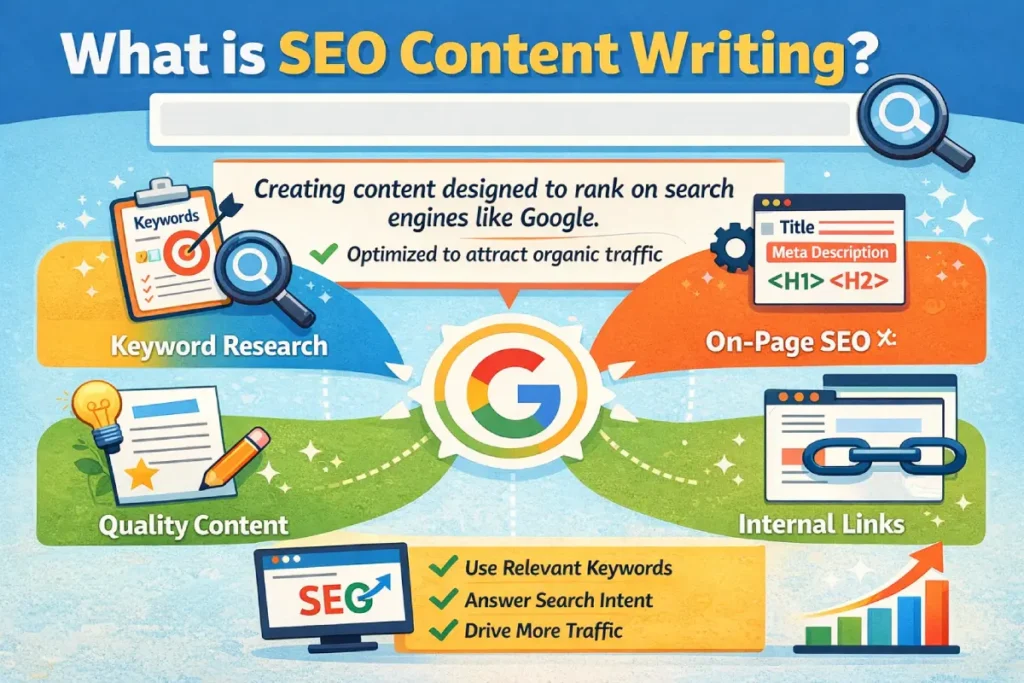
SEO content writing is the practice of creating website content that’s optimized to appear prominently in search engines like Google while delivering genuine value to readers. It’s online material centered around topics your target audience actively searches for, built with search engine ranking factors in mind.
The difference seemed simple when I first learned content writing for seo. Yet after years of testing and refining strategies, I found that writing seo content requires balancing two critical elements: satisfying search algorithms and serving human readers.
Search engine optimization content writing targets specific keywords and phrases relevant to your business or industry. The content wants to attract organic traffic by matching user search intent with valuable information. One brand created seo optimized content that drove remarkable results: organic traffic grew roughly 600 times over two years, and product sales revenue increased by 2,964%.
This type of performance demonstrates why seo content writing has become essential for online businesses. The approach goes beyond inserting keywords into text. It involves researching your audience, identifying high-value search terms, and optimizing various elements to improve visibility in search results.
Blog post seo serves as a main vehicle for this strategy. Companies publish articles targeting different keywords related to their business, building topical authority while attracting potential customers. Writing for seo optimization extends to product descriptions in e-commerce, helping interested shoppers find exactly what they need.
The strategy delivers more than just traffic. Seo blog writing helps with lead generation by connecting you with people who search for solutions. Visitors arriving through search results show higher purchase intent, even if your product is different from their initial query.
Difference Between SEO Content and Regular Content
Regular content is written for human readers, with zero keyword research involved. Authors create blog posts based on their ideas, theories, or passions. Google discovering some keywords becomes a bonus rather than an intentional outcome.
This approach requires bravery. Regular content faces a high likelihood that no one will ever read it without a promotion strategy. The content might be creative and engaging, but it lacks the strategic foundation needed for search discovery.
Seo blog post writing is designed to use search engines for content discovery. You’re creating material for both algorithms and humans at once. The main goal is ranking so your content can be found through organic search.
Several technical characteristics distinguish how to write seo content:
- Keywords: Strategic incorporation of search terms at 2-7% density, woven so readers don’t notice them
- Condensed format: Concise paragraphs and sentences that get to the point, often using bullets and numbered lists
- Link building: Internal links connecting related pages, helping search engines understand your content’s focus
Seo for blog posts follows a more structured, informed approach compared to regular content marketing. Regular content prioritizes creativity and flexibility, while blog posts seo optimization uses specific formulas involving header tags, meta descriptions, and formatting techniques designed for search visibility.
The audience focus is different. Regular content meets the needs and interests of readers first, ranking if search crawlers recognize its value. Seo content writing services flip this priority, optimizing for search engines while ensuring the material still serves human readers.
Quality remains paramount in both approaches. High-quality content ranks as one of Google’s most important signals for website evaluation. Valuable content that strikes a chord with your audience may rank without targeting a specific keyword because search algorithms recognize its relevance and benefit to users.
As Mani Pathak, I’ve seen companies struggle by producing thin content that ranks but provides little value. Search engines penalize such sites, and they suffer from high bounce rates and low conversions. The winning formula combines technical optimization with genuine value creation.
Seo content writing agency professionals understand this balance. Whether you handle seo content writing service needs internally or outsource them, the goal stays consistent: create content that search engines can discover and users will appreciate.
Why SEO Content Writing Matters in 2026
Search behavior has changed in a dramatic way. People no longer search only to click links; they search to get answers, confirm decisions, and compare options instantly. This change defines SEO content writing in 2026, where success depends on understanding how people find information and how search engines assess credibility.
Building Expertise, Authority, and Trust (E-E-A-T)
Google’s E-E-A-T framework gained an extra “E” for Experience in December 2022. The update recognizes that firsthand experience adds value to content. Product reviews prove more trustworthy when the reviewer has used the product themselves. To cite an instance, a review based on actual use carries more weight than speculation.
Trust stands as the element that matters most. Google states this point without ambiguity: “Trust is the most important member of the E-E-A-T family because untrustworthy pages have low E-E-A-T no matter how Experienced, Expert, or Authoritative they may seem”. This principle now applies to all competitive searches, not just Your Money or Your Life topics.
Writing seo content in 2026 requires demonstrating expertise through credentials and showcasing authority via reputable backlinks. You build trust through accurate, transparent information. Sites with poor E-E-A-T signals struggle to gain visibility, especially when the industry is competitive.
AI and Search Engine Algorithms in 2026
The search landscape is being reimagined at a structural level. We’re moving into the era of AI as an executive assistant. The agentic web means AI won’t just recommend products but will find your size, apply coupons, and execute checkout.
ChatGPT serves 810 million daily users. Google AI Overviews hit 1.5 billion monthly users. The debate about whether AI search matters is over. Personalization stops being a feature and becomes the operating system in 2026. Two people asking the same question receive different answers, different sources, and different explanation levels based on how the system has learned to serve them.
Seo blog writing now demands that you optimize for machine readability as much as human readability. AI systems assess trust signals at scale. They review content structure, backlinks, schema, topical consistency, and brand reputation. Authority isn’t claimed; it’s inferred.
Meet User Intent: The Core of Modern SEO (Understanding Search Intent)
User intent is the “why” behind the search, what the person wants to accomplish through it. Search engines like Google focus on ranking results that arrange with user needs. Content that isn’t relevant for a query won’t appear in the search results.
Intent falls into four categories: informational (seeking specific information), navigational (finding a specific website), commercial (comparing before purchasing), and transactional (ready to buy). Understanding this remains central to crafting seo optimized content that strikes a chord with visitors and increases rankings.
Research shows that figuring out what your audience needs when they use specific keywords helps you remain relevant and compete in search results. Nothing satisfies users more than finding a resource that gives them what they need without looking elsewhere.
Turning Traffic Into Leads and Customers
Traffic without conversion benefits visibility but falls short of business goals. Research shows 70 to 80% of search engine users ignore paid ads and go straight for organic results.
A simple formula determines lead value: conversion rate multiplied by average sale price. With a 3% conversion rate and a $50 average sale, each visitor holds a $1.50 value. Understanding this lets you determine traffic requirements to achieve business goals.
Blog post seo strategies must arrange content with keyword intent at every sales funnel stage. Someone lands on your site from an optimized listing and doesn’t find what they expected, they bounce. Matching user intent may now be the single factor that matters most for SEO, especially with AI-powered search.
Writing Content That Persuades and Converts
Persuasive writing convinces readers that your way of thinking is best. It relies on three modes: ethos (credibility), logos (logic and evidence), and pathos (emotion). These concepts from Aristotle remain alive and help business writers in the 21st century.
Content writing for seo must present hard facts readers need to make decisions. Strong evidence and logical thinking form the first key to persuasive, effective writing. You must also make readers believe in you by adopting an appropriate tone. Come across as confident yet not condescending.
Effective writing makes authors achieve desired goals and produce specific outcomes. This means understanding how to create documents that meet reader needs and help them access information when they need it.
Long-Term Organic Traffic
Organic traffic continues as the foundation of sustainable online success. Paid advertising generates visibility right away, but organic traffic builds long-term value by attracting users who search for solutions.
Organic visitors arrive with clear expectations. This makes them more engaged than those encountering a brand through interruption-based marketing. This intent-driven behavior leads to higher session durations, lower bounce rates, and stronger engagement signals.
A well-optimized page can attract visitors for months or years without additional cost. Each piece of organic content contributes to a growing digital asset. Content gains authority and trust, and it often ranks for multiple related queries. This increases reach without proportional cost increases.
Budget-Friendly Marketing Strategy
SEO remains one of the strategies that work best for marketing. It delivers long-term traffic without the constant expense of paid ads. PPC stops working once the budget runs out, but search engine optimization content writing builds an enduring online presence.
Nearly half of all marketers report that organic SEO provides the highest return on investment compared to other digital marketing strategies. The first organic search result on Google boasts a 39.8% clickthrough rate, far higher than the 2.1% CTR of the first paid ad position.
Organic search generates 300% more traffic than social media. Organic search accounts for over 40% of total revenue in industries like B2B, technology, retail, and hospitality. Once a website ranks high in search results, visitors keep coming. This boosts reach without draining budgets.
Step-by-Step Process for Writing SEO Content
Creating content that ranks requires a systematic approach. After testing dozens of strategies, I’ve refined this eight-step process that delivers results consistently for SEO content writing projects.
Step 1: Research Keywords That Your Audience Actually Searches
Put yourself in your customers’ shoes first. What words might they use to find solutions to their problems? Plug these into a keyword research tool like Google Keyword Planner or Ahrefs’ Keywords Explorer and generate thousands more relevant keyword ideas.
You’ll get back related keywords and questions for every seed keyword you enter. The tools show how hard they’ll be to rank and give a rough sense of monthly search volume.
Google Search Console shows what keywords your website already ranks for. This helps brainstorm new, similar keyword ideas or improve pages to get better rankings. Analyze your competitors by searching Google for your seed keywords and see who ranks on the front page.
Target “low-hanging fruit” and focus on relevant words with fewer monthly searches. Companies with lower domain authority face less competition when targeting lower-volume search terms. This increases chances of reaching page one of Google search.
Step 2: Understand Search Intent Before You Write
User intent is the reason behind a search query. Understanding whether a search is informational, navigational, transactional, or commercial helps you create seo optimized content that meets users’ needs.
Studying actual search results is the most reliable way to understand intent. The intent is usually informational if the page features guides and how-to articles. Reviews and comparisons suggest commercial investigation. Product pages signal transactional intent.
Users with informational intent want to learn something. They often start queries with “how to,” “what is,” or “why”. Navigational intent occurs when someone wants to visit a specific website. Commercial investigation sits between learning and buying, where users research options and compare products.
Step 3: Create a Content Brief and Outline
A content brief is a short document that serves as a guide or blueprint to create content. The specifics vary depending on the content type, but it should answer top-level questions about content, format, and communication.
Include target keyword, secondary keywords, search intent, expected word count, target audience, brand voice, internal links, external links, competitor links, headings, and technical details. An SEO content brief helps writers create content that satisfies search intent and gets better rankings. It outlines the thinking behind the content.
Writers need the core subject and angle to hook readers before they start. A simple guideline for desired word count will give the writer coverage of the topic. Look at competitor content already ranking for your keywords to determine this.
Step 4: Write Content That Serves Both Readers and Search Engines
Prioritize creating valuable, helpful content first when writing seo content. Google’s Helpful Content Update highlighted their prioritization of helpful content when ranking pages in SERPs.
Research and identify keywords you’re trying to rank for, then use them throughout your piece. Find ways to incorporate keywords organically in headers and throughout the copy. Try to use a keyword in the first 100 words.
Structure your content with H1 and H2 headers to break up sections. H1 headers should be big ideas. H2 headers are smaller points within those ideas. Pictures and videos make content more interesting and break up text, which keeps readers engaged.
Step 5: Optimize Technical SEO Elements
Title tags are the clickable headlines that appear in search engine results pages and show up in browser tabs. Keep them to 50-60 characters and ensure they display fully on both desktop and mobile devices.
Meta descriptions should stay within 140-160 characters. Focus on intent-based, conversational phrases rather than rigid keyword optimization. Ask yourself what the searcher is trying to accomplish.
Step 6: Optimize Images and Media for SEO
Image SEO starts with the file name. Use your focus keyphrase in the image file name instead of generic names like DSC4536.jpg. Choose JPEG for larger photos, PNG to preserve background transparency, or WebP for high-quality results with smaller file sizes.
Alt text is added to an image so descriptive text appears if the image can’t be displayed. Alt text helps search engines understand image content and contributes to better rankings in image search results.
Step 7: Build Internal Links and Topical Authority
Internal linking is one of those underrated SEO strategies that does the heavy lifting for your website quietly. Internal links are hyperlinks that connect one page of your website to another page on the same domain.
Search engines follow internal links to map relationships between pages when they crawl your site. This helps them recognize topic clusters, content depth, and hierarchy. A solid internal linking strategy will give every important page its share of authority.
Step 8: Publish and Submit Your Content to Search Engines
Submitting your site to Google is probably the easiest step-by-step process. Find your XML sitemap by looking up yoursite.com/sitemap.xml, then add it to Google Search Console under the sitemaps section. You technically also submit it to Google News when you submit your site to Google.
Promote Your SEO Blog Content and Build Authority Backlinks To Rank High
SEO optimized content is just the beginning when you publish. What happens after you hit publish is where the real ranking power comes from. Backlinks still matter a lot, but we’re no longer just optimizing for Google PageRank. We’re optimizing for brand building, topic associations, and co-citations in trusted content.
Context beats the link tag in 2026. AI search engines like ChatGPT and Google AI Mode pull answers from the web, and while they often cite sources, they’re not picking those sources based on classic link metrics. The real goal isn’t just earning links. It’s becoming part of the conversation.
A co-citation happens when your brand or product gets mentioned in the same piece of content as authoritative sources in your space, even without a direct link. These references help large language models associate your brand with key topics and entities. That builds contextual authority, the kind that surfaces in AI-generated answers. The best brands in 2026 earn backlinks AND co-citations. They train the internet to associate their name with the right topics.
You don’t need a PR agency to earn high-impact links. You just need to be helpful to the right people at the right time. I’m talking about white hat links from news outlets, niche blogs, journalist outreach and curated listicles. Three free tools worth bookmarking right now include Featured.com (freemium), Help a Reporter Out (free), and MentionMatch (free). These platforms work like matchmaking services for content. Reporters and content marketers post questions. You reply with useful, credible answers. If they use your quote, you often get a mention or link.
The new playbook focuses on earning mentions in relevant, trustworthy content, especially in places that influence AI responses and brand perception. Guest posting for visibility has evolved beyond traditional link building. Instead of looking for ‘guest post accepting’ sites, look for brands, creators, or publishers in your niche who already rank or write about your topic. They should have a real audience in your space and might benefit from highlighting your product as part of their story. Your pitch should solve a problem their audience has. Include a reason your brand fits into that solution and offer value rather than just promotion.
Companies change names, move websites, or stop offering services, but the sites linking to them often forget to update those links. This gives you a chance to help site owners fix old information. When you do, you can suggest they mention your brand too. Broken link building remains effective because you’re solving a problem for the site owner rather than just asking for a favor.
Some content types are built to rank, while others are built to be referenced. People love citing fresh numbers and LLMs love structured facts. Combine both and you have a link magnet. A well-run affiliate program doesn’t just drive sales. It incentivizes creators to build content about you through listicles, tutorials, product reviews, comparison posts, YouTube videos, Reddit replies, TikToks, and even ‘tools we use’ mentions in newsletters and blogs.
There’s a good chance people are already talking about you online without linking back if you’ve built a brand they recognize. Finding and converting these unlinked mentions into backlinks strengthens your authority profile without creating new content.
SEO Content Optimization Checklist
Optimization doesn’t end when you publish. I’ve developed a systematic checklist that catches issues before they hurt rankings after years of refining SEO content writing processes.
On-Page SEO Checklist for Blog Posts
Choose one keyword per page that balances relevance, search volume, and difficulty. Research the search intent behind your keyword. This ensures your seo optimized content provides the information searchers want.
Your URL should implement the chosen keyword within 70 characters and use hyphens to separate words for improved readability. The title tag needs your keyword close to the front and should stay within 50-60 characters to avoid truncation.
Meta descriptions should stay under 160 characters while using action-oriented language that encourages clicks. Use your keyword once within this space.
Header tags carry more weight for search engines. Include your keyword in the H1 or H2 and vary the messaging so it feels natural rather than forced. Break down concepts into H2s and H3s for better readability.
Use your keyword within the first 100 words to signal relevance, but avoid keyword stuffing. Write alt text that describes the image and incorporates the keyword when you add images.
Technical SEO Basics Every Writer Should Know
Technical SEO determines whether search engines can access and understand your content. Search engines must find and index a page through crawling before it can rank.
Check your robots.txt file to avoid blocking important pages. Submit your XML sitemap through Google Search Console to help search engines discover content.
Site architecture should follow a pyramid structure where users can reach any page within three to four clicks from the homepage. Internal links distribute ranking power throughout your site and help establish topical relevance.
Post-Publishing SEO Checklist and Performance Tracking
Track total clicks in Google Search Console to see how much traffic Google sends you. Monitor Core Web Vitals as Google now ranks sites in part based on user experience signals.
Organic traffic remains the best indicator of how well your pages rank for relevant keywords. The average result on Google’s first page contains around 1,890 words.
Check your click-through rate. It shows how effective your titles and descriptions are in attracting searchers. Monitor bounce rate and scroll depth to gage whether visitors find your content valuable.
E-A-T (Expertise, Authority, Trust) in Content
E-E-A-T stands for Experience, Expertise, Authoritativeness, and Trustworthiness. Google’s Quality Raters use this framework to assess content quality, especially when you have topics impacting well-being.
Demonstrate experience through firsthand product use, actual visits to places, or communicating what you experienced. Showcase author credentials and reference authoritative sources to build expertise.
Display genuine customer testimonials, use HTTPS encryption, and provide transparent contact information to establish trust. As Mani Pathak, I’ve seen companies improve rankings 20-50% after resolving technical SEO issues and strengthening E-E-A-T signals.
Common SEO Content Mistakes to Avoid
Most SEO content writing failures stem from avoidable errors that drain rankings. Hundreds of underperforming sites show certain patterns that emerge again and again.
Keyword stuffing remains common. Search engines register too many keywords as spam and this hurts your website’s ranking. Keyword stuffing affects content quality and causes high bounce rates with low session duration. Best practice maintains 1-2% keyword density. The opposite mistake proves just as problematic: skipping keyword research altogether. This matters because 93% of people begin their search for products or services on Google.
Poor linking strategy cripples many sites. Millions of blog posts publish daily. Many sites avoid external linking to prevent driving people away. Linking to credible sources backs up statements and helps your content. Neglecting internal links misses opportunities to increase session duration.
Title tags and meta descriptions that are missing or poorly crafted hurt click-through rates. Title tags should stay under 66 characters with keywords placed first. Meta descriptions should target around 155 characters and remain unique for each page.
Short articles under 2,000 words struggle in modern search algorithms. Neil Patel states that articles under this threshold should become obsolete for high-quality, SEO optimized content. Content that targets 2,500 words performs even better, provided it stays informative without keyword stuffing.
SEO blog writing treated as a one-time task fails over the long term. Consumer behavior changes and search engine algorithms update constantly. Regular evaluation and adjustment prove necessary for sustained success.
Focusing only on rankings rather than conversions misses the point. High rankings might stroke your ego. But if they don’t generate leads or sales, your strategy fails where it counts most. As Mani Pathak, I’ve observed companies waste resources chasing vanity metrics while ignoring actual business outcomes.
Tips for Consistent SEO Content Success
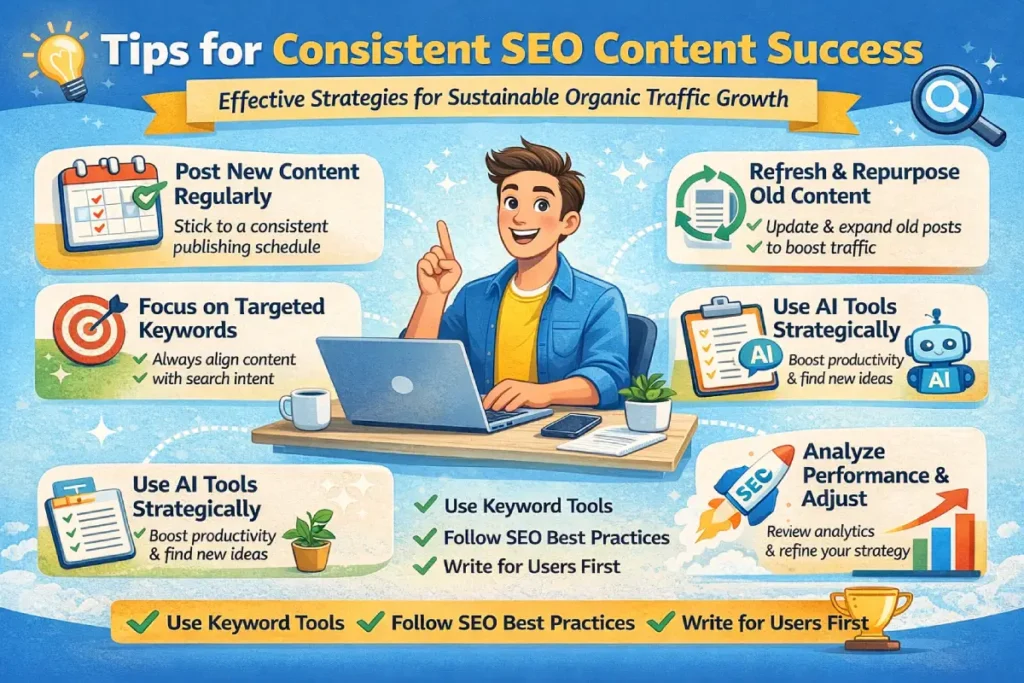
Consistency separates SEO content writing programs that thrive from those that stagnate. A content calendar proves essential for maintaining steady output and outlines what content to publish, when to publish it, and where it will appear. This planning tool helps distribute resources well and ensures a continuous stream of seo optimized content.
Strategic goal setting drives every decision. Define clear, measurable objectives before you create content. Are you generating leads? Building brand awareness? Educating customers? Your blog post seo efforts lack focus and become difficult to assess without direction.
Quality control systems maintain high performance standards. Review content regularly to identify underperforming pieces that need refreshes. These audits keep messaging and branding consistent across your site. SEO tools like Google Analytics, SEMrush, or Ahrefs provide data to refine your content writing for seo strategies.
Team training remains very important for consistency. Continuous education keeps everyone current with SEO trends and best practices. As Mani Pathak, I’ve watched well-informed teams build successful programs while untrained teams struggle despite good intentions.
Treat published posts as living documents rather than finished products. SEO maturity takes roughly 100 days, so your seo blog writing requires ongoing refinement. Gather stakeholder feedback from readers, customers, and internal teams, then implement improvements. This cycle of publication, measurement, and adjustment creates search engine optimization content writing that delivers sustained results.
Conclusion
You now have everything you need to become skilled at SEO content writing that delivers real rankings and conversions. The strategies I’ve shared helped me grow organic traffic tenfold, and they’ll work for you too.
Begin with solid keyword research and match search intent. Optimize every technical element. Focus on creating valuable content writing for seo that serves your readers first.
Writing seo content isn’t a one-time task. Consistency wins every time. Publish regularly, track performance and refine your approach. Results take time, but your rankings will climb with quality and strategic optimization.
Frequently Asked Questions About SEO Content Writing
Q1. What makes SEO content writing different from regular content writing?
SEO content writing strategically targets specific keywords and search terms to help content rank in search engines, while regular content is written purely for human readers without keyword research. SEO content uses structured formatting with optimized headers, meta descriptions, and internal links, whereas regular content prioritizes creativity and flexibility without following specific technical formulas.
Q2. How long should an SEO-optimized blog post be to rank well?
High-quality SEO blog posts should typically be at least 2,000 words, with 2,500 words being even more effective for ranking purposes. Research shows that the average first-page result on Google contains around 1,890 words. However, length alone doesn’t guarantee success—the content must remain informative and valuable without keyword stuffing.
Q3. What is E-E-A-T and why does it matter for SEO content?
E-E-A-T stands for Experience, Expertise, Authoritativeness, and Trustworthiness—a framework Google uses to evaluate content quality. Trust is the most critical element, as untrustworthy content will rank poorly regardless of other factors. Demonstrating firsthand experience, showcasing credentials, citing authoritative sources, and providing transparent contact information all help establish strong E-E-A-T signals.
Q4. How can I identify the right keywords for my SEO content?
Start by thinking about what terms your target audience would use to find solutions to their problems, then use keyword research tools like Google Keyword Planner or Ahrefs to generate related keyword ideas. Focus on “low-hanging fruit”—relevant keywords with lower search volumes and less competition—especially if your website has lower domain authority. Also check Google Search Console to see what keywords your site already ranks for.
Q5. How long does it take for SEO content to start ranking in search results?
SEO content typically takes around 100 days to reach maturity and achieve stable rankings. Results don’t happen overnight—it requires consistent publishing, performance tracking, and ongoing refinement. Once content gains authority and trust, it can continue attracting visitors for months or years without additional cost, making it a long-term investment rather than a quick win.