

I made an expensive mistake in my third year doing SEO.
A client wanted to buy a high-traffic blog for link building purposes.
The seller’s listing showed a Domain Authority of 58 — impressive on paper. I approved the acquisition. Three weeks later, when we pulled the site into Ahrefs, the Domain Rating was 19.
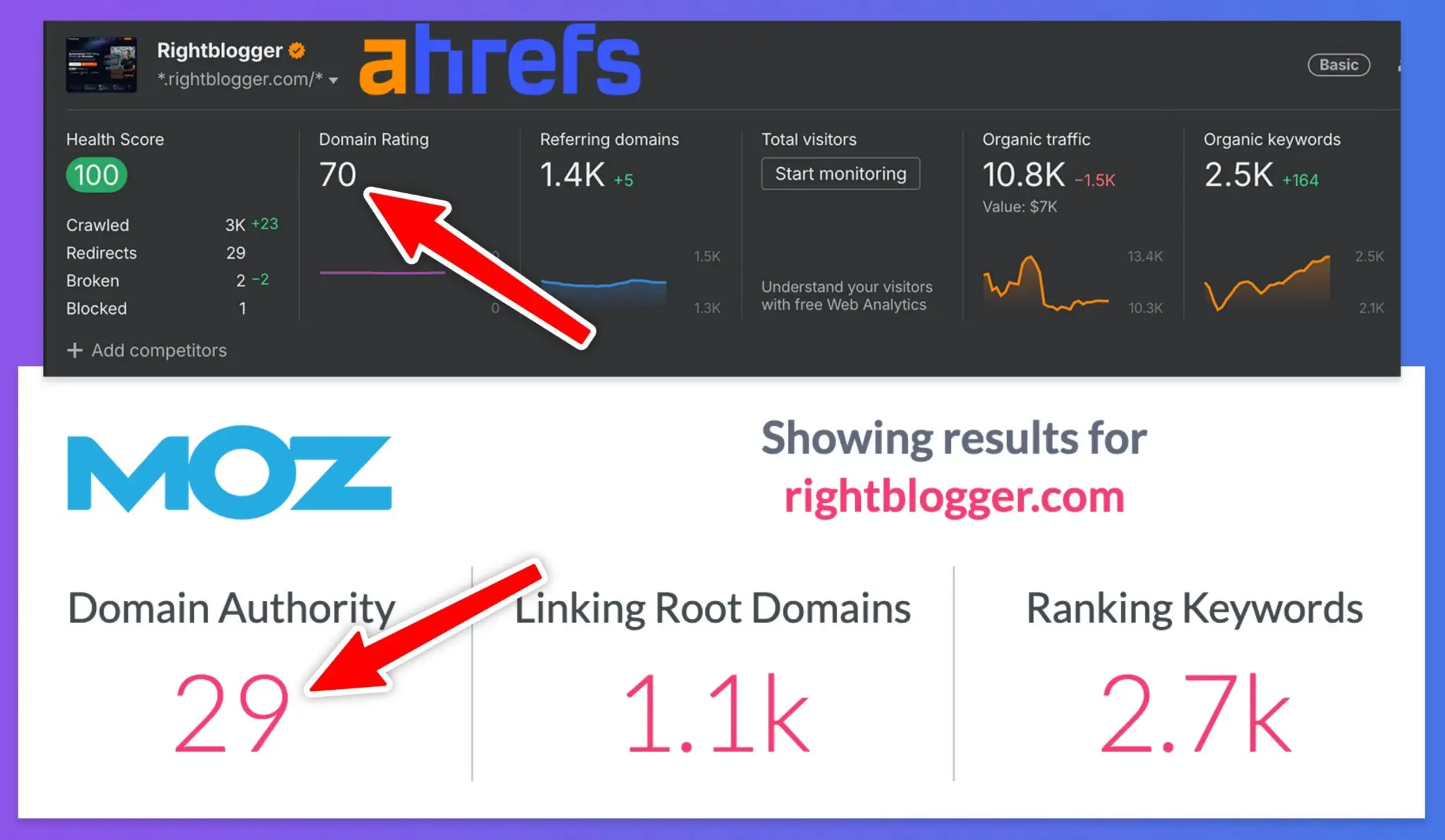
Same site. Two completely different numbers. Neither was wrong. Both were measuring something real — just not the same thing.
That confusion cost the client more money than it should have. Since then, understanding the real difference between Ahrefs Domain Rating (DR) and Moz Domain Authority (DA), (Ahrefs DR vs Moz DA) has been something I explain to every blogger, client, and SEO I work with.
This is that explanation — done properly, covering every question I see asked repeatedly including: how often Ahrefs DR updates, whether DR and DA are the same thing, what URL Rating is versus Domain Rating, why your DR dropped without a ranking change, and which metric is actually more accurate for domain rankings.
What Ahrefs Domain Rating and Moz Domain Authority Actually Are
Before comparing them, it is worth being precise about what each metric is actually trying to do. They share a 0–100 scale and a surface-level goal — measuring website authority — but the philosophies underneath them are fundamentally different.
What is Ahrefs Domain Rating (DR)?
Ahrefs Domain Rating (DR) is a single-purpose metric. It measures the strength of a website’s backlink profile relative to every other site in the Ahrefs database. Nothing else. No content quality signals. No traffic data. No on-page factors. Just the link graph.
The calculation works on a domain-level version of Google’s original PageRank algorithm:
- Number of unique referring domains linking to the target site
- Domain Rating of those linking sites — links from high-DR domains pass more authority
- Link dilution — the more unique domains a site links out to, the less authority each of its outgoing links passes
- Nofollow links contribute zero to DR
Think of Ahrefs DR as a pure backlink score. It deliberately excludes traffic, content quality, spam signals, and domain age. That narrowness is a feature — it makes DR a clean, unambiguous signal of link equity with no noise from other factors.
What is Moz Domain Authority (DA)?
Moz Domain Authority (DA) tries to answer a more ambitious question: how likely is this domain to rank well in Google’s search results? To answer it, DA incorporates far more than just backlinks.
Moz built DA 2.0 on a machine learning model — a neural network — trained on search engine results pages (SERPs) to identify patterns in what causes websites to rank. The inputs include:
- Quality and quantity of backlinks and referring domains
- Overall site signals from ranking pattern analysis
- Link relevance and topical signals
- Historical authority momentum
DA tries to model overall ranking potential rather than just link strength. That breadth makes it a genuinely different kind of signal from DR — useful for different decisions.
Is Ahrefs DR the Same as Moz DA?
No. Ahrefs DR is not the same as Moz DA. They use entirely different methodologies, different link databases, and different update schedules. A DR of 50 and a DA of 50 do not mean the same thing — they cannot be compared directly.
The confusion is understandable because both use a 0–100 scale and both are described as “domain authority” metrics in common usage. But they measure different properties of a website and will almost always produce different numbers for the same site.
The Core Differences — Side by Side
| Factor | Ahrefs Domain Rating (DR) | Moz Domain Authority (DA) |
|---|---|---|
| What it measures | Backlink profile strength | Overall SEO ranking potential |
| Data inputs | Backlinks only | Backlinks + site signals + ranking patterns |
| Update frequency | Every ~12 hours | Approximately once per month |
| Scale | 0–100 (logarithmic) | 0–100 (logarithmic) |
| Volatility | High — reacts fast to link changes | Low — stable over time |
| Manipulation resistance | Lower — can be moved with link building | Higher — needs overall site improvement |
| Best used for | Link building progress, vetting guest post targets | Long-term SEO health, client reporting |
| Database | 1.5+ trillion links | ~44 trillion links (larger, slower updates) |
| Pricing | From $99/month (Ahrefs Lite) | From $99/month (Moz Pro) |
| Free access | Ahrefs Webmaster Tools (own sites only) | MozBar browser extension |
How Often Does Ahrefs DR Update?
This is one of the most searched questions about Ahrefs Domain Rating — and the answer matters practically for anyone tracking link building progress.
Ahrefs updates Domain Rating approximately every 12 hours.
This means if you land a significant backlink from a high-DR publication today, your DR could move by tomorrow. Conversely, if you lose several strong links or a major referring domain removes links to your site, you may see a DR drop within a day.
This is why DR feels like a live scoreboard for active link builders. It reacts fast.
Moz Domain Authority updates approximately once per month.
Changes in your backlink profile may not reflect in DA for several weeks. This makes DA far more stable — and far less useful for tracking short-term link building activity.
A quick mental model that helps:
- Ahrefs DR = heartbeat monitor — shows you what is happening right now
- Moz DA = monthly health check — shows you the trend over time
If you see your DR move significantly and DA stays flat, that is expected and normal. DA will catch up in its next monthly update. The reverse — DA moving while DR stays flat — is also possible if Moz’s model has picked up content or site signals that have not yet translated into measurable backlink changes in Ahrefs’ index.
Ahrefs DR vs URL Rating (UR) — What Is the Difference?
This is one of the most underexplored topics in the DR vs DA conversation. Many people focus on domain-level metrics and completely overlook page-level metrics — which are often more relevant for specific link building decisions.
Ahrefs has two separate authority metrics:
Domain Rating (DR) — measures the overall strength of an entire website’s backlink profile. It is a domain-level metric. Every page on the same domain shares the same DR.
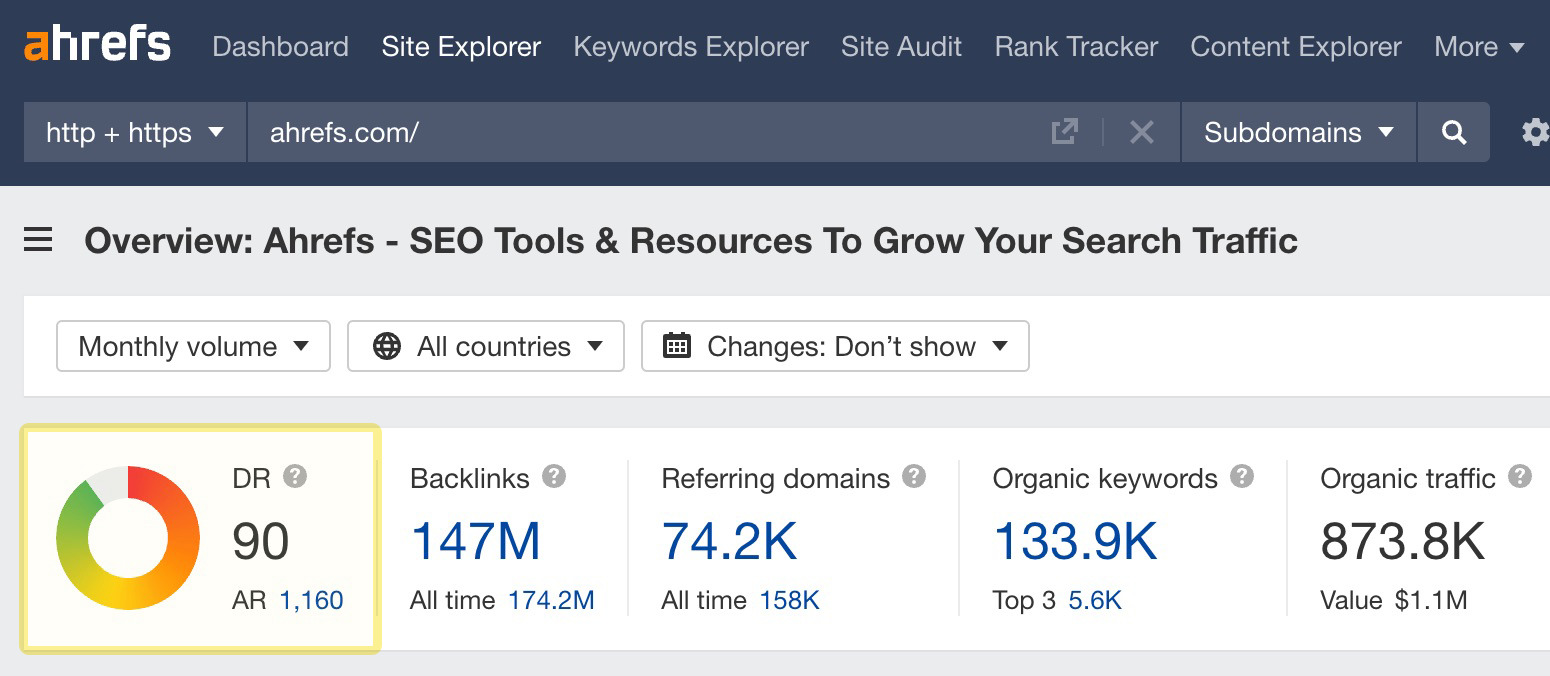
URL Rating (UR) — measures the backlink strength of a specific individual page. It is a page-level metric. A site with DR 60 might have pages with UR ranging from 0 (rarely linked pages) to 50+ (heavily linked cornerstone content).
Why UR matters more than DR for link building decisions:
When you are evaluating whether a specific guest post or link placement is worth pursuing, the page that will actually contain your link matters more than the overall domain. A link from a UR 40 page on a DR 30 domain often passes more page-level authority than a link from a UR 5 page on a DR 70 domain.
Moz’s equivalent to UR is Page Authority (PA).
PA measures the ranking strength of a specific page using Moz’s own link data. PA and UR are not interchangeable — they use different data sources and different formulas — but both serve the same purpose: evaluating the specific page rather than the overall domain.
Does Page Authority (PA) change when Ahrefs DR or Moz DA changes?
No. PA is a Moz-only, page-level metric calculated entirely from Moz’s own link data. Changes to Ahrefs DR have zero effect on Moz PA because they are completely independent systems. Similarly, a DA change from Moz will not alter what Ahrefs reports for DR or UR. They are separate tools with separate databases — changes in one tool’s metrics have no influence on another tool’s metrics.
Practical guide to choosing between DR, UR, DA, and PA:
| Decision | Use This Metric |
|---|---|
| Evaluating an outreach target’s overall domain credibility | Ahrefs DR or Moz DA |
| Evaluating the specific PAGE that will contain your link | Ahrefs URL Rating (UR) |
| Comparing page-level authority in Moz’s ecosystem | Moz Page Authority (PA) |
| Tracking long-term domain authority growth for reports | Moz DA |
| Monitoring live link building campaign progress | Ahrefs DR |
| Quick browser check while prospecting outreach targets | Moz MozBar (shows DA + PA free) |
Why Your DR Dropped — and What to Do About It
One of the most alarming experiences in SEO is waking up to find your Ahrefs Domain Rating has dropped significantly overnight. Because DR updates every 12 hours, it is the metric most likely to show sudden movement — and the most likely to cause unnecessary panic.
Here is a systematic approach to diagnosing a DR drop:
Step 1: Check Ahrefs Lost Links report.
Go to Site Explorer → your domain → Backlinks → Lost. Filter by the date range when the drop occurred. You are looking for whether high-DR referring domains have removed links to your site.
Step 2: Check if the linking site’s DR dropped.
Sometimes your own DR drops not because you lost links, but because a major site that links to you lost DR. If a DR 75 site linking to you dropped to DR 40, the authority they pass to you decreases even though the link still exists.
Step 3: Verify your traffic and rankings.
A DR drop that is not accompanied by a traffic or ranking decline is usually not worth acting on. DR is a third-party metric, not a Google signal. Google did not change its assessment of your site just because Ahrefs’ model shifted.
Step 4: Check for natural link decay.
Over time, sites remove pages, change domains, or let hosting lapse. Links to your site from dead pages stop passing authority. If your DR drops gradually over several months without lost links in the report, natural link decay is the likely cause.
Step 5: Check for algorithm changes in Ahrefs’ index.
Ahrefs occasionally updates how it calculates DR — adjusting how link dilution is modelled or how nofollow links are treated. These updates can cause broad DR movements across many sites simultaneously. Check SEO communities for reports of industry-wide DR fluctuations on the date of your drop.
When should you take action after a DR drop?
- You lost links from multiple high-DR referring domains → reach out to recover them or replace them
- Your organic traffic dropped alongside DR → investigate whether Google’s assessment also changed
- DR dropped and rankings for backlink-sensitive keywords declined → accelerate new link acquisition
When should you NOT panic after a DR drop?
- Traffic and rankings are stable → the drop is likely a model change, not a real authority loss
- DR dropped 2–5 points without lost links → normal volatility from Ahrefs’ frequent index updates
- DR dropped but DA stayed flat → confirms the change is Ahrefs-specific, not a real-world authority signal
What Is a Good Ahrefs Domain Rating?
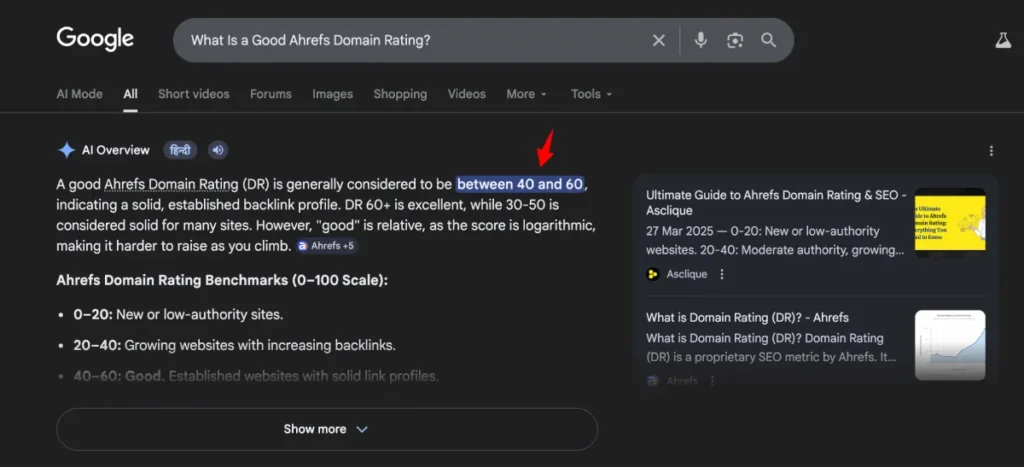
Because DR uses a logarithmic scale, “good” depends heavily on your niche and competitive context. Here is a realistic benchmark based on 7 years of working across niches:
| DR Range | What It Typically Means | Realistic For |
|---|---|---|
| DR 0–20 | New site with few or no backlinks | Freshly launched domains in first 6–12 months |
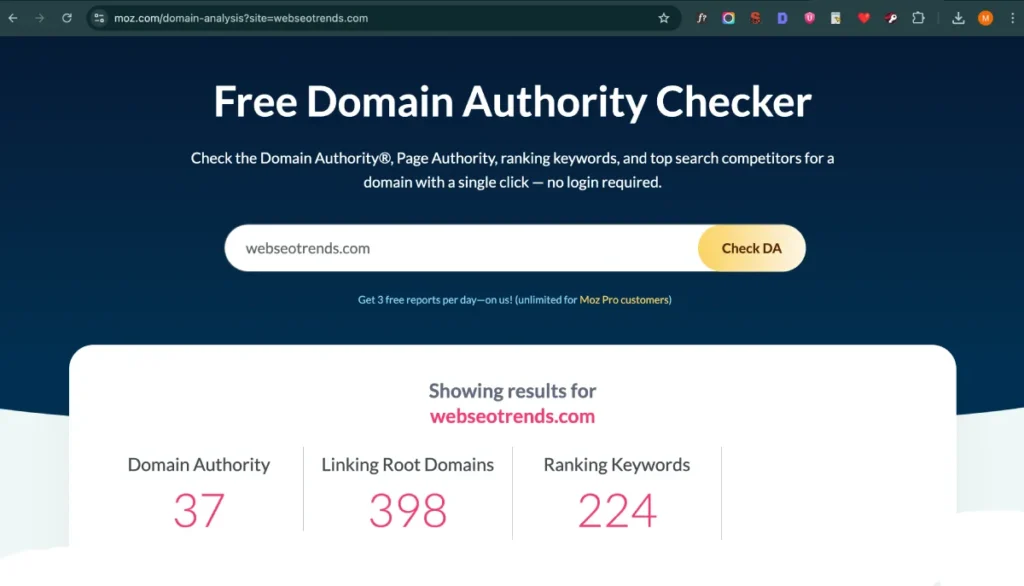
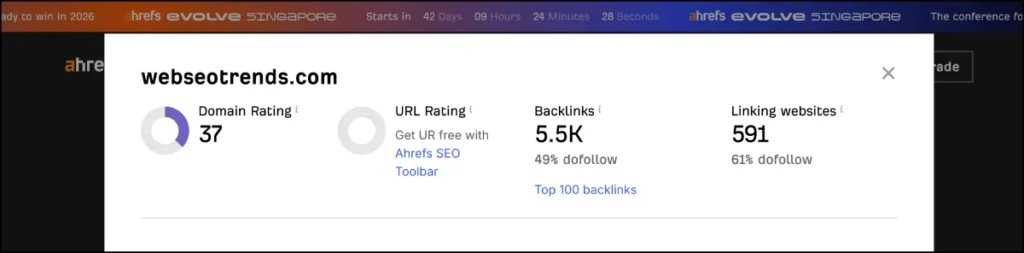
| DR 20–40 (We have a DR of 37) | Growing site with a real backlink profile beginning | Bloggers, small business sites after 1–2 years of active link building |
| DR 40–60 | Solid competitive authority | Established niche sites, active content publishers with consistent outreach |
| DR 60–75 | Strong authority | Well-known industry publications, successful affiliate sites |
| DR 75+ | Highly authoritative | Major media sites, high-traffic SaaS platforms, established ecommerce brands |
The most important nuance: DR is relative to your niche. In competitive SEO or finance niches, you may need DR 60+ to compete for primary keywords. In narrow local or specialist niches, DR 25–35 can be enough to dominate because your competitors are also in that range.
Do not compare your DR to sites in completely different niches. Compare it to the sites actually ranking for the keywords you want to target. If the top 10 results average DR 35, you do not need DR 70 to compete — you need better content and marginally more authority than those specific competitors.
Ahrefs DR vs DA — Is Moz Domain Authority Always Lower Than Ahrefs Domain Rating?
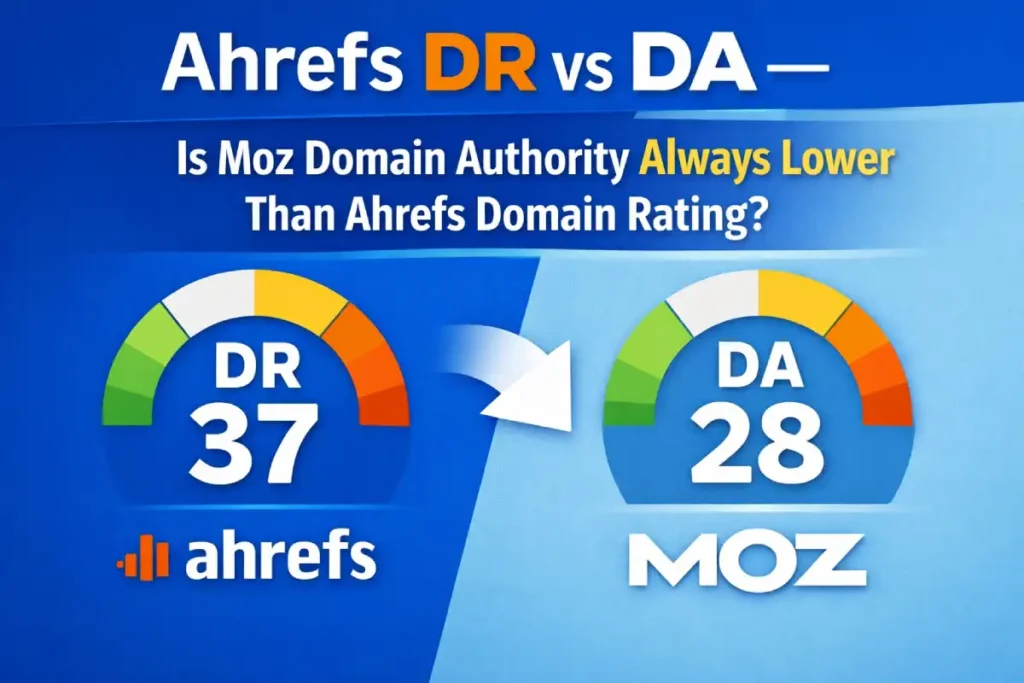
No — and this is one of the most commonly misunderstood aspects of these metrics. There is no systematic relationship between the two scores. It is common to find:
- Sites with DA 65 and DR 28 (DA much higher than DR)
- Sites with DR 72 and DA 35 (DR much higher than DA)
- Sites where both scores are approximately equal
- Sites where both scores move in the same direction over time
Why do these discrepancies happen?
Different link databases.
Ahrefs and Moz discover different links through their independent crawlers. Moz’s larger overall link index (~44 trillion links) may contain links that Ahrefs has not indexed, artificially inflating DA relative to DR for some sites.
Different formula weights.
Moz’s machine learning model incorporates signals beyond backlinks. A site that ranks well but has a relatively modest backlink profile might score higher in DA (which accounts for ranking patterns) than in DR (which only cares about links).
Different update timing.
Because Moz updates monthly and Ahrefs updates every 12 hours, the two scores are capturing different moments in time. A site that recently built significant links will show a higher DR than DA until Moz’s model catches up.
The practical rule: If a site consistently shows much higher DA than DR, it likely benefits from strong content and ranking signals beyond its link profile. If DR is consistently much higher than DA, the site may have an aggressive link building history that Ahrefs detects but Moz’s model discounts.
Is Moz or Ahrefs More Accurate for Domain Rankings?
This is perhaps the single most common question about these two tools — and the honest answer is: neither is more accurate, because they measure different things.
Accuracy implies a single correct answer to compare against. But there is no official “real” domain authority number published by Google. DR and DA are both models built by private companies using their own data to estimate a website’s authority. Asking which is more accurate is like asking whether Fahrenheit or Celsius is more accurate — the answer depends on what you are measuring and why.
That said, for specific use cases, one metric is more useful than the other:
Ahrefs DR is more reliable for:
- Evaluating the pure link equity strength of a domain
- Tracking live link building campaign progress
- Assessing outreach targets based on fresh backlink data
- Detecting link acquisition or loss in near real-time
Moz DA is more reliable for:
- Long-term competitive benchmarking
- Client-facing authority reporting (DA is more universally recognised)
- Holistic site health assessment that factors in content and ranking signals
- Comparing sites where overall ranking potential matters more than raw link count
Which has better correlation with actual Google rankings?
Studies comparing both metrics against real SERP positions have found that both DA and DR correlate meaningfully with rankings — and that page-level metrics (Moz PA and Ahrefs UR) often correlate even more strongly than domain-level metrics, which aligns with Google’s own documentation that its systems work primarily at the page level.
A 2023 joint academic study from Universitat Pompeu Fabra (Spain) and Universidad de Chile found that Moz DA, Ahrefs DR, and Semrush Authority Score are all strongly correlated with each other — which makes sense, since they are all attempting to measure related underlying properties. None is definitively superior.
DR vs DA vs Majestic Trust Flow — The Full Authority Metric Landscape
Once you are comfortable with DR and DA, it is worth understanding where they sit within the broader landscape of domain authority metrics you will encounter in SEO work.
| Metric | Tool | What It Measures | Update Speed |
|---|---|---|---|
| Domain Rating (DR) | Ahrefs | Backlink profile strength | Every ~12 hours |
| Domain Authority (DA) | Moz | Overall ranking potential | Monthly |
| Authority Score (AS) | Semrush | Backlinks + traffic + spam signals | Frequently |
| Trust Flow (TF) | Majestic | Quality/trustworthiness of backlinks | Periodic |
| Citation Flow (CF) | Majestic | Quantity of backlinks (without quality filter) | Periodic |
| URL Rating (UR) | Ahrefs | Page-level backlink strength | Every ~12 hours |
| Page Authority (PA) | Moz | Page-level ranking potential | Monthly |
Semrush Authority Score (AS) sits between DR and DA in philosophy. Like DA, it incorporates more than just backlinks — factoring in organic search traffic and spam signals. Like DR, it updates more frequently than DA. If Semrush is your primary SEO tool, Authority Score is your native equivalent. Read our full Semrush review to see how AS integrates with Semrush’s full feature set.
Majestic Trust Flow (TF) is a metric worth knowing for link prospecting. While DR measures link quantity weighted by quality, TF specifically measures how close a site’s links are to a set of hand-curated “seed” trusted sites. A site with high TF and lower CF is generally a high-quality link target. A site with high CF and low TF has many links but from lower-quality sources.
For a full comparison of Ahrefs against all its major alternatives including Semrush, Moz, and Majestic, see our 12 best Ahrefs alternatives guide.
When to Use DR vs DA — Complete Decision Guide
Use Ahrefs DR when you are:
Evaluating a guest post opportunity.
DR gives you a fast, current read on the site’s backlink strength. A site with DR 50+ from legitimate referring domains is generally worth pursuing. Because DR updates every 12 hours, you are seeing data that reflects the site’s current link profile — not a snapshot from last month.
Tracking your own link building progress.
Land a strong link from a DR 70+ site today and you may see your DR move by tomorrow. This immediate feedback loop makes DR the right tool for active link building campaigns where you need to know if new links are taking effect.
Vetting a site before acquiring it or forming a partnership.
Combine DR with organic traffic data. A site with DR 60 and 50,000 monthly organic visitors in your niche is a strong acquisition candidate. A site with DR 60 and 200 monthly visitors is a red flag regardless of the score.
Monitoring competitor link acquisition activity.
Because DR reacts quickly, tracking a competitor’s DR over time reveals when they are actively building links, at what velocity, and whether they are gaining or losing authority.
Use Moz DA when you are:
Producing client reports.
DA has been the industry’s most recognised authority metric since Moz popularised it over 15 years ago. Most clients and marketing stakeholders understand “Domain Authority” as shorthand for website credibility. DA is more appropriate for non-technical audiences.
Making long-term SEO health assessments.
Because DA is stable and slow to update, a year-on-year comparison of DA is more meaningful than a year-on-year comparison of DR (which can fluctuate month to month). For demonstrating sustained SEO improvement, DA is the more credible indicator.
Doing competitive benchmarking in a niche.
For comparing a group of similar sites on overall SEO health over time, DA’s stability makes it a more useful benchmark than the more volatile DR.
Use both together when:
Buying or selling a content site.
A site with high DR but low DA may have an aggressive link building history that DA’s broader model discounts. A site with high DA but low DR may have older, slower-built authority. Comparing both gives you a fuller picture.
Choosing outreach targets for link building.
Check DR to assess link equity strength, then verify organic traffic independently. DA provides a secondary signal on broader authority. A strong target shows healthy scores on both, has real organic traffic, and is topically relevant to your site.
Our Semrush vs Ahrefs comparison covers how to use both tools together for competitive analysis and link prospecting workflows.
The Logarithmic Scale — Why Getting to DR 80 Is Exponentially Harder Than DR 40
Both metrics use a logarithmic scale, which has a practical consequence most people underestimate: every point becomes significantly harder to earn as you climb.
The gap between DR 20 and DR 21 requires far less link building effort than the gap between DR 70 and DR 71 — even though both represent a single-point increase.
According to Moz’s own data, only three websites in the world have a DA of 100, and only 80 websites have a DA of 95 or above. The distribution follows near-perfect exponential decay — hundreds of millions of websites sit below DA 10, while the top of the scale belongs to Google, YouTube, Facebook, and Wikipedia.
Ahrefs DR shows an identical power-law distribution.
Realistic timeframes based on consistent link building:
| DR Movement | Realistic Timeline |
|---|---|
| DR 0 → DR 20 | 3–6 months with active outreach |
| DR 20 → DR 40 | 6–18 months |
| DR 40 → DR 60 | 12–36 months |
| DR 60 → DR 70 | 2–5 years |
| DR 70 → DR 80 | 5+ years, even with significant resources |
This is why chasing a specific number is often less useful than focusing on the underlying activities. Build content worth linking to, earn genuine backlinks from relevant authoritative sites, and the metrics follow naturally over time.
Common Mistakes with DR and DA — And How to Avoid Them
Mistake 1: Treating DA 50 as Equal to DR 50
A DA of 50 and a DR of 50 are not interchangeable. They use different data sources, different algorithms, and different update cycles. Always note which tool a score comes from before making any comparison or decision based on it.
Mistake 2: Evaluating a Site by Score Alone
A high DR or DA with no organic traffic is a serious red flag — usually indicating link manipulation or a site that has lost all its rankings. Before acting on any authority metric, verify:
- Organic traffic via Ahrefs Site Explorer or Semrush
- Number and quality of ranking keywords
- Content relevance to your own site’s topic
- Moz Spam Score (free via MozBar)
A DR 65 site with 400 monthly visitors warrants scepticism. A DR 35 site with 60,000 monthly visitors in your niche is likely a stronger outreach target than the inflated DR 65.
Mistake 3: Confusing DR with Ahrefs Domain Authority
Ahrefs does not have a metric called “Domain Authority” — that terminology belongs to Moz. Ahrefs’ equivalent is “Domain Rating.” If you see the phrase “Ahrefs Domain Authority” in articles or discussions, the author is referring to Ahrefs Domain Rating (DR). The two tools use different names for conceptually similar (but methodologically different) metrics.
Mistake 4: Ignoring URL Rating When Evaluating Link Opportunities
DR tells you about the domain. UR tells you about the specific page. For link building, the page-level metric is often more directly relevant. A link from a UR 45 page on a DR 35 domain can be more valuable than a link from a UR 8 page on a DR 70 domain. Always check both when evaluating specific link placement opportunities. See our Ahrefs alternatives guide for tools that show UR and PA without requiring a full Ahrefs subscription.
Mistake 5: Panicking When DR Drops Without Traffic Loss
Because DR updates every 12 hours, it fluctuates more than any other authority metric. A 3–7 point DR drop without a corresponding traffic or ranking decline is usually noise — a natural link decay, a Ahrefs index update, or a temporary data fluctuation. Verify through the Lost Links report before taking action. If traffic and rankings are stable, your actual authority with Google has not changed.
Mistake 6: Using DR or DA as a Primary Goal
I have seen small business owners spend months obsessing over moving their DA from 22 to 30, while a competitor at DA 18 outranked them for every target keyword. Domain authority metrics are indicators, not goals. Your goal is to rank for keywords that drive traffic that converts into revenue. DR and DA help you understand your current position — they are not the destination.
How to Improve Both DR and DA Without Buying Links
The safest and most durable path to improving both metrics is the oldest advice in SEO: earn genuine backlinks from relevant, authoritative sites by creating content worth linking to.
Strategies that move DR:
Guest posting on relevant authoritative sites. One link from a DR 60 site does more for your DR than ten links from DR 15 sites. Quality of referring domain matters far more than volume. Target sites that are topically relevant and actually receive organic traffic.
Creating linkable assets. Original research, comprehensive comparison guides, free tools, calculators, and data studies attract natural backlinks at scale. Our own Semrush vs Ahrefs comparison and Ubersuggest vs Ahrefs breakdown earn links from bloggers who reference the analysis in their own content.
Broken link building. Identify broken links on relevant sites pointing to dead content, then propose your own content as a replacement. This earns genuine editorial links efficiently by solving a real problem for the linking site.
Digital PR. Publishing genuinely newsworthy data or studies that journalists want to cite produces the highest-authority backlinks available — often from DR 70+ news and media publications.
Strategies that move DA:
Because DA incorporates broader signals than backlinks, improving it requires a more holistic approach:
Publish higher-quality content consistently. DA’s machine learning model learns from sites that rank well — and sites that rank well publish thorough, well-structured, accurate content that matches search intent. For AI-powered content optimisation tools that help with this, see our guide to best AI SEO tools.
Fix technical SEO issues. Core Web Vitals, mobile usability, crawlability, canonical tags, and structured data all contribute to a site’s ability to rank — which feeds into the ranking patterns DA’s model recognises.
Build strong internal linking. A clear internal linking structure distributes authority across your site and helps Google understand your topical depth — both of which influence the ranking patterns that DA’s model learns from.
Remove or disavow genuinely toxic backlinks. Spammy, irrelevant links drag down DA faster than DR because DA’s model penalises sites whose link profiles show manipulation signals. Moz’s Spam Score (available via MozBar for free) helps identify these.
For affordable tools that help you build links and track authority without paying $99+/month for Ahrefs or Moz, our guide to affordable SEO tools under $50 covers tested alternatives that deliver solid authority tracking at significantly lower cost.
Ahrefs vs Moz — Which Tool Should You Choose?
| Choose Ahrefs if you need | Choose Moz if you need |
|---|---|
| Most current backlink data (12-hour updates) | Recognised DA metric for client reports |
| Largest keyword database (28.7B vs Moz’s 1.25B keywords) | Free MozBar browser extension for quick prospecting |
| Content Explorer for finding link opportunity topics | Daily rank tracking at lower price (Moz Starter plan) |
| Deep competitor backlink gap analysis | Cleaner interface for teams newer to SEO tools |
| UR data for page-level link evaluation | Whiteboard Friday and beginner-friendly educational content |
| DR for real-time link building campaign tracking | MozBar for free on-the-fly DA + PA checking while browsing |
Both tools start at $99/month. If budget is the primary constraint, our guide to affordable SEO tools under $50 covers tested alternatives including Mangools ($19.90/month) and Ubersuggest ($29/month) that deliver strong keyword research and basic authority metrics.
For a full comparison of 12 Ahrefs alternatives with honest assessments of where each falls short and where each genuinely matches Ahrefs, see our Ahrefs alternatives guide.
Frequently Asked Questions — Ahrefs DR vs Moz DA
What is the difference between Ahrefs DR and Moz DA?
Ahrefs Domain Rating (DR) measures backlink profile strength only — it ignores content quality, traffic, and on-page signals. It updates every 12 hours and reacts quickly to link changes. Moz Domain Authority (DA) predicts overall ranking potential using a machine learning model that incorporates backlinks, site signals, and ranking pattern data. It updates monthly and is more stable. Use DR to track link building and evaluate link opportunities. Use DA for long-term SEO health assessment and client reporting.
How often does Ahrefs Domain Rating update?
Ahrefs updates Domain Rating approximately every 12 hours. This means significant backlink changes — gaining or losing links from high-DR sites — can show up in your DR within a day. Moz Domain Authority updates approximately once per month. If your DR drops but your DA stays flat, this is expected — DA will catch up in its next monthly refresh.
Is Ahrefs DR the same as Domain Authority?
No. Ahrefs does not have a metric called “Domain Authority” — that is Moz’s terminology. Ahrefs’ equivalent metric is called Domain Rating (DR). When people say “Ahrefs Domain Authority” they are referring to Ahrefs Domain Rating. The two metrics use different formulas, different data sources, and produce different scores for the same site.
What is the difference between DR and UR in Ahrefs?
Domain Rating (DR) is a domain-level metric — it measures the backlink strength of the entire website. URL Rating (UR) is a page-level metric — it measures the backlink strength of one specific page. Every page on a domain shares the same DR, but individual pages have their own UR based on how many links point directly to that URL. For link building decisions, UR of the specific page is often more relevant than the overall DR of the domain.
Did PA change when Ahrefs DA/DR changed?
No. Moz Page Authority (PA) is completely independent of Ahrefs Domain Rating (DR). PA is calculated by Moz from Moz’s own link index. Changes to Ahrefs DR have no effect on Moz PA because the two systems are entirely separate. Similarly, changes in Ahrefs’ index that affect DR will not cause any movement in Moz’s metrics (PA or DA), and vice versa. They are independent tools with independent databases.
Can I compare a DA score to a DR score directly?
No. A DA of 50 and a DR of 50 do not mean the same thing. They use different data sources, different algorithms, and different update cycles. It is common for the same site to show DA 65 and DR 28, or DA 30 and DR 55. Neither score is wrong — they are measuring different properties. Never use one as a substitute or proxy for the other.
Is Moz Domain Authority always lower than Ahrefs Domain Rating?
No — there is no systematic relationship between the two numbers. Either can be higher for any given site. The discrepancy depends on the site’s backlink profile, content strength, ranking history, and which tool’s crawler has indexed more of its links. Sites that have built links aggressively often show higher DR than DA. Sites that rank well through content quality may show higher DA than DR.
Is Moz or Ahrefs more accurate for domain rankings?
Neither is objectively more accurate because they measure different things using different methodologies. For evaluating raw backlink strength, Ahrefs DR is more transparent and more current. For predicting holistic ranking potential, Moz DA incorporates more signals. Studies show both metrics correlate meaningfully with actual SERP positions, and page-level metrics (Ahrefs UR and Moz PA) often correlate even more strongly than domain-level metrics.
What is a good Ahrefs Domain Rating?
For most bloggers and small business sites, DR 30–50 represents a healthy, growing backlink profile. DR 50–70 puts you in competitive territory for most commercial niches. DR 70+ is strong and typically associated with established high-authority publications. Because DR uses a logarithmic scale, each point becomes progressively harder to earn as you climb. Compare your DR to the sites actually ranking for your target keywords rather than to a fixed “good” number.
Why did my DR suddenly drop?
Common causes include: losing backlinks from high-DR referring domains, a major site that linked to you losing its own DR, natural link decay from dead pages, or an update to Ahrefs’ index calculation. Check your Lost Links report in Ahrefs first. If traffic and rankings remain stable after the DR drop, Google’s assessment of your site has not changed — the drop is likely a model fluctuation rather than a real authority loss.
Does Google use DR or DA as a ranking factor?
No. Google has stated explicitly that it does not use any third-party authority metric — including Ahrefs DR, Moz DA, or Semrush Authority Score — as a direct ranking signal. These metrics correlate with rankings because they measure properties (backlink quality, site authority) that do influence Google’s own systems. But the relationship is indirect: the underlying real-world authority causes both the rankings and the metric scores, rather than the metric causing the rankings.
How can I check DR and DA for free?
Moz DA is available free via the MozBar browser extension or the free Moz Domain Analysis tool — no account required. Ahrefs DR is available free via Ahrefs Webmaster Tools for sites you own and verify. For competitor sites, Ahrefs requires a paid plan from $99/month. Budget-friendly alternatives that include authority metrics are covered in our affordable SEO tools guide.
Final Verdict — DR or DA: Which Metric Should You Use?
After 7 years working with both metrics across hundreds of client websites, my position is clear:
Use Ahrefs DR for backlink decisions. It is more transparent, more current, and more focused. For evaluating link opportunities, tracking link building progress, and monitoring competitor link activity, DR gives you the most actionable, up-to-date signal.
Use Moz DA for long-term reporting and holistic comparisons. It is more stable, more universally recognised, and incorporates broader signals. For client reports and long-term competitive benchmarking, DA is the more credible reference point.
Use UR and PA when evaluating specific pages. For individual link placement decisions, the page-level metrics (Ahrefs URL Rating and Moz Page Authority) are often more relevant than domain-level scores.
Use neither as your primary goal. Build content worth linking to. Earn backlinks from relevant, authoritative sites. Fix technical issues that prevent Google from understanding your site. The metrics follow automatically. Chasing numbers without the underlying work is the most expensive mistake in SEO.
Related guides from Webseotrends:
- Semrush Review — Is It Worth It for SEO?
- Semrush vs Ahrefs — Full Head-to-Head Comparison
- Ubersuggest vs Ahrefs — Which Is Better for Small Businesses?
- 12 Best Ahrefs Alternatives (Free and Paid, Tested)
- Best Affordable SEO Tools Under $50/Month
- 15 Best AI SEO Tools — Tested
- 10 Best AI-Powered SEO Agents in 2026
- SEO Packages for Small Businesses
