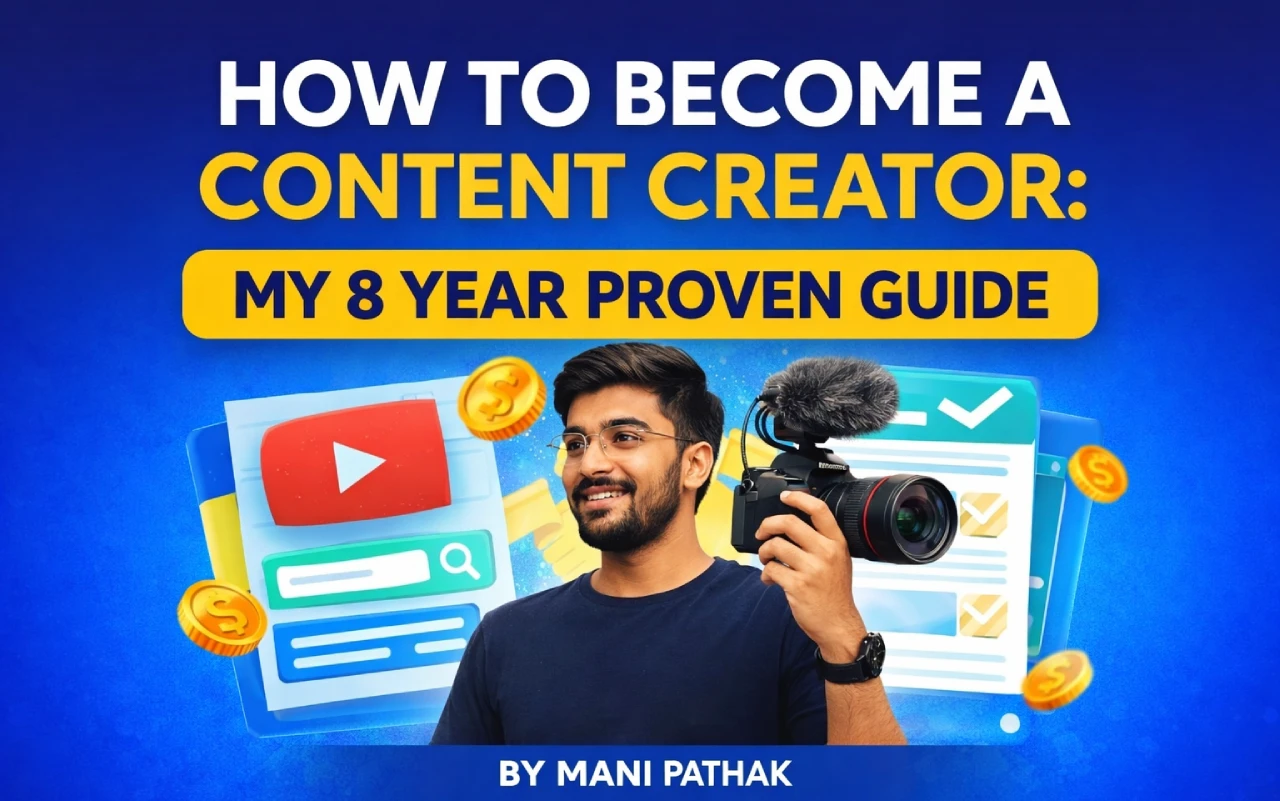
I remember sitting at my desk in 2017, engineering degree on the wall, a decent job title, and a nagging feeling that none of it was “it.” I had started writing online, posting SEO breakdowns and digital marketing observations. Nobody read it at first. Truly nobody. But eight years later, I run Webseotrends, I have helped over 500 businesses grow their organic presence, I host a podcast, and content creation is the engine behind everything I do professionally.
So when people ask me how to become a content creator, I do not give them a generic 10-step listicle. I give them the truth. The slow parts, the confusing parts, the parts that actually compound into something real. That is what this guide is.
Whether you want to know how to become a content creator with no experience, or you are already creating and wondering how to be a successful content creator long term, this guide covers everything from someone who has lived every stage of it.
What a Content Creator Really Is (And Is Not)
Let us start with the basics, because there is a lot of noise around this topic.
What a content creator is: a person who researches, plans, produces, and publishes original content for a specific audience across one or more digital platforms. That content can take the form of written articles, videos, podcasts, photographs, infographics, short clips, or social media posts. The goal is always to deliver value, whether that means entertaining, educating, inspiring, or solving a real problem for the audience.
What a content creator is not: a person who reposts other people’s work, buys followers, posts randomly without strategy, or treats every platform as a megaphone for self-promotion.
I have consulted with hundreds of aspiring creators over the years, and the single biggest misconception I run into is that content creation is about volume. Post more. Post everywhere. Stay consistent no matter what. The truth is far more nuanced. The best creators I know are deliberate. They understand their audience deeply, they choose their platforms strategically, and they create with intention.
The term “what a content creator” means today also extends well beyond individual influencers. Brands hire content creators as full-time employees. Agencies have entire content teams. Freelance creators run six-figure businesses from their laptops. The spectrum is enormous and the opportunity is real.
The global creator economy was estimated to reach over $528.36 billion dollars by 2030 and is projected to nearly double of 2026. There are over 200 million people worldwide who identify as content creators. This is not a trend. It is an industry.
What Does a Content Creator Do? A Real Day-in-the-Life
A question I get asked often: what does a content creator do on a daily basis? People imagine it is all cameras and ring lights. Let me show you what it actually looks like, at least in my world and the world of creators I work closely with.
The Core Responsibilities
Research and Ideation
Before a single word is written or a single frame is recorded, a content creator needs to understand what their audience is searching for, talking about, and struggling with. This means keyword research, reading forums, checking competitor content, and staying on top of industry trends. I spend at least two hours per week on topic ideation and search intent analysis alone.
Content Planning and Calendaring
Successful creators operate on a schedule. They know what goes out, when it goes out, and on which platform. A content calendar is not optional; it is the backbone of a sustainable creation process.
Content Production
Writing articles, filming videos, recording podcast episodes, designing graphics, scripting reels. The format varies but the process is the same: create something genuinely useful and well-crafted.
Editing and Quality Control
Raw content almost never goes out as-is. It gets edited, refined, fact-checked, and aligned with your brand voice. I do multiple passes on everything I publish on Webseotrends before it goes live.
SEO and Distribution
Creating something great means nothing if no one sees it. A serious creator understands on-page SEO, platform algorithms, email newsletters, social sharing, and sometimes paid promotion to amplify their work. If you want a deeper look at how SEO ties into content strategy, my guide on SEO content writing services breaks this down in detail.
Community Engagement and Analytics
Creators respond to comments, answer emails, read DMs, and track what is and is not performing. Analytics inform future content decisions. This feedback loop is what separates growing creators from stagnant ones.
Monetization Management Brand deals, affiliate links, ad revenue, digital products, consulting. Managing these revenue streams is its own part-time job as you scale.
Types of Content Creators in 2026
Understanding the landscape helps you figure out where you fit.
Here are the main categories:
- Video Creators: YouTube, TikTok, Instagram Reels, and LinkedIn Video are their primary homes. These creators invest in cameras, lighting, editing software, and storytelling skills.
- Written Content Creators (Blog Content Creators): This is where I started and where I still spend much of my energy. A blog content creator uses long-form writing to rank on search engines, build authority, and drive consistent traffic over time. More on this in its own section below.
- Podcast Creators: Audio-first creators who build loyal audiences through interview-based or solo-episode shows. I launched my own podcast covering SEO and digital marketing and it has become one of my best relationship-building and brand-building tools.
- Social Media Creators: Instagram photographers, LinkedIn thought leaders, X (Twitter) commentators, Pinterest curators. These creators thrive on short-form, highly shareable content.
- Graphic and Visual Creators: Designers, illustrators, and photographers who tell stories primarily through imagery.
- Newsletter Creators: A fast-growing category in 2026. These creators build direct relationships with subscribers through curated, original email content on platforms like Beehiiv and Substack.
Most successful creators do not live in just one category. They start with one medium, master it, and then repurpose intelligently across others.
Content Creator Salary: What You Can Actually Earn
Before diving into the how-to, let us be honest about the money because vague promises do more harm than good.
As an employed in-house content creator, salaries in the United States typically range from around $45,000 on the entry end to $85,000 or more for experienced creators at established companies. Senior content strategists and creative directors command six figures in technology, finance, and media sectors. Cities like San Francisco and Seattle offer the highest compensation, often $10,000 to $30,000 above the national median for comparable roles. In India and other markets, in-house content roles typically pay between 3 to 12 lakhs per annum depending on experience, niche, and company size.
As a freelance or independent content creator, income varies enormously based on your niche, audience size, and the revenue streams you have built. Here is a realistic breakdown of what different monetization channels generate:
YouTube ad revenue, accessed through the YouTube Partner Program which requires 1,000 subscribers and 4,000 watch hours to qualify, typically pays between $1.50 and $4 per 1,000 views for general content. Finance, business, and legal niches earn up to $10 to $15 per 1,000 views depending on audience geography and advertiser competition.
Sponsored content and brand partnerships are where serious independent income comes from. A creator with 10,000 to 50,000 highly engaged followers in the right niche can charge $500 to $3,000 per sponsored post or video integration. Creators at 100,000 followers and above routinely charge $5,000 to $25,000 or more per dedicated campaign.
Affiliate marketing commissions range from 3 to 5 percent on physical products to 20 to 50 percent on digital products and software subscriptions. This is often where blog content creators who rank organically for buying-intent keywords generate their most consistent passive income.
Digital products such as courses, templates, presets, and ebooks at scale can generate $10,000 to $100,000 per launch for creators with engaged audiences and established credibility.
The honest timeline is this: most creators earn little to nothing in year one, modest income in year two, and begin approaching meaningful full-time income somewhere between years two and four, assuming consistent strategic effort. The gap between expectations and reality is the number one reason creators quit before they reach their own turning point.
How to Become a Content Creator: Step-by-Step Roadmap
This is the framework I wish someone had handed me in 2017. After eight years of building, testing, and refining, here is the clearest path I know.
Step 1: Define Your Niche with Precision
The most common mistake beginners make is choosing a niche that is either too broad or too vague.
“Health” is not a niche. “Nutrition for women over 40 managing thyroid conditions” is a niche.
The more specific you are at the start, the faster you build a loyal audience.
To find your niche, ask yourself three questions: What do I know well enough to teach or share consistently? What audience is actively searching for this topic? Where does my knowledge meet a genuine market need?
Your niche does not have to be your lifelong passion. It has to be something you can speak about with authority and something people actually want to consume.
Step 2: Study Your Audience Before Creating Anything
Spend two full weeks before you publish a single piece of content. Read forums. Check Reddit threads. Look at the comments sections of popular creators in your space. Use tools like Google Trends, AnswerThePublic, and basic keyword research to understand what your future audience is genuinely asking.
When I launched Webseotrends, I spent weeks understanding what small business owners and freelancers were confused about when it came to SEO. That research shaped my entire content strategy and it is still paying dividends today.
Step 3: Choose Your Primary Content Format
Before you pick a platform, pick a format that suits your natural strengths. If you are a natural writer, start with articles and build from there. If you are comfortable on camera and have strong energy in person, video might be your fastest path. If you love one-on-one conversation, a podcast format might feel immediately natural.
Try not to start on three platforms simultaneously. Pick one, go deep, and get genuinely good at it before expanding.
Step 4: Set Up Your Content Home Base
Every serious creator needs a home base they own and fully control. For me, that is Webseotrends.com. For you, it might be a personal blog or a website you build around your niche. Social platforms can disappear, change their algorithms, or restrict your account. Your own website is yours forever.
If you are thinking about starting a blog as your home base, my in-depth guide on how to start a blog in 2026 walks through the exact steps, hosting recommendations, and the monetization timeline I have personally tested and verified.
Step 5: Create Your First 10 Pieces of Content Before Worrying About Anything Else
Do not get lost in branding, logo colors, or what your header font should be. Your first job is to publish. Commit to producing 10 solid pieces of content before you evaluate performance at all. This breaks the perfectionism loop and gets you real data to work with.
Step 6: Learn Basic SEO and Platform Algorithms
Content that cannot be found is content that was never made. Even if your primary format is video or audio, understanding how search works gives you a significant competitive edge. Learn the basics of keyword research, on-page optimization, and how the algorithms of your chosen platforms decide what to surface to users.
Step 7: Build a Consistent Publishing Schedule and Protect It
Consistency beats brilliance in the early stages. Publishing two high-quality pieces per week is dramatically better than publishing ten pieces once and then disappearing for a month. Set a realistic schedule and treat it like a client obligation.
Step 8: Build a Distribution Plan for Every Piece of Content
Creating is only half the work. Every piece of content needs a distribution strategy. Share it on social media. Send it to your email list. Repurpose it into shorter formats for other platforms. Reach out to communities where your audience already hangs out. My guide on link sculpting and content distribution covers how to make your content travel further with less effort.
Step 9: Engage With Your Audience Actively in Year One
Reply to every comment in your first year. Read every email response. The relationships you build with early audience members become the foundation of your community and eventually your brand. This direct engagement also gives you the best possible insight into what your audience actually needs from you next.
Step 10: Measure What Matters and Adjust Every 90 Days
After 60 to 90 days of consistent publishing, look at your data seriously. What content got the most engagement? What topics drove the most traffic or views? Double down on what is working and cut what is not. Data is your compass when intuition is still developing.
How to Become a Content Creator with No Experience {#how-to-become-a-content-creator-with-no-experience}
This is the question I hear most often and it is the one I care most about answering with real honesty.
The truth about how to become a content creator with no experience is this: everyone started with zero experience. Every creator you admire had a first post, a first video, a first episode that was rough and uncertain. The difference between those who built something and those who did not is not talent. It is time spent creating under real conditions.
Here is how I recommend approaching it if you are starting from absolute zero:
Start Learning in Public
You do not need to be an expert to start creating. You need to be honest, curious, and committed to growing. Document your learning process. Share what you are figuring out as you figure it out. Audiences connect powerfully with real journeys, not just polished expertise.
Use Free Tools First and Upgrade Only When You Are Committed
A smartphone camera, a free editing app like CapCut, a free blogging platform, and a willingness to write are all you need to begin. Invest in equipment only after you have validated that you enjoy the process and are genuinely sticking with it. Many successful creators ran their entire operation on a phone for the first year or two.
Consume Content Critically as a Student
Watch, read, and listen to creators in your niche not just for entertainment but as an active student. Notice their structure. Understand how they hook attention in the first 10 seconds. Study their headlines, their formatting, their transitions, their call to action. This is free, high-quality education that most beginners skip entirely.
Take One Focused Course or Read One Book on Your Chosen Format
A targeted investment in learning your specific craft will compress your learning curve meaningfully. For writing, study copywriting and narrative structure. For video, understand the basics of framing, lighting, and editing. For podcasting, learn audio fundamentals and interview technique.
Commit to 90 Days Before Judging Results
No content creator sees meaningful results in the first month. The first three months are about learning, publishing consistently, and building the habit. Do not measure your success against creators who have been at it for three or five years.
Skills Every Content Creator Needs to Build
Over eight years, I have identified the skills that consistently separate creators who thrive from those who plateau.
Here is what actually matters at each stage:
- Storytelling: Every piece of content, regardless of format or topic, is a story. The ability to take information and shape it into a narrative that holds attention is the single most valuable skill a creator can develop.
- Research: Creating content that is genuinely accurate, current, and helpful requires real research skills. Not just a quick Google search but deep reading, cross-referencing sources, and developing real subject-matter expertise over time.
- Writing: Even if you are primarily a video creator, writing is foundational. Your scripts, your captions, your email subject lines, and your social media posts all benefit from strong, clear writing.
- Basic SEO: Understanding how search engines decide what content to surface is non-negotiable for any creator who wants organic, long-term traffic. Learning keyword research, on-page optimization, and content structure will pay dividends for years after you apply it.
- Video Editing: Even basic editing skills make a dramatic difference in the watchability and perceived quality of video content. Tools like CapCut, DaVinci Resolve, and Adobe Premiere are widely accessible at every budget level.
- Graphic Design: Creating thumbnails, cover images, social media graphics, and visual assets is part of the job regardless of your primary format. Canva has made this genuinely accessible even for people with zero design background.
- Analytics and Data Reading: The ability to look at traffic data, engagement metrics, and conversion rates and draw actionable conclusions is what separates strategic creators from hopeful ones.
- Email Marketing: Building and maintaining an email list is one of the most important things any creator can do. It is the one distribution channel that no algorithm can take from you.
- Personal Branding: Understanding how to present yourself consistently across platforms, what your voice sounds like, and what values you stand for is a skill that compounds dramatically over time.
Best Tools for Content Creators in 2026
A content creator is only as efficient as their toolkit.
Here are the tools I use or recommend across the key areas of the creation workflow:
- Writing and Blog Content Creation
WordPress remains the best platform for serious blog content creators who want full control, SEO flexibility, and long-term scalability. For writing itself, Hemingway Editor helps simplify prose, and Grammarly handles grammar and clarity checks. For research and keyword planning, Ahrefs and SEMrush are the industry standard, while Google Keyword Planner and Ubersuggest are strong free options for beginners.
- Video Production and Editing
CapCut is the most accessible free video editing app for short-form content and performs remarkably well for TikTok, Reels, and YouTube Shorts. DaVinci Resolve is the best free option for long-form video. Adobe Premiere Pro remains the professional standard. For screen recording and tutorials, Loom is excellent. For thumbnails, Canva handles this well for most creators.
- Graphic Design and Visual Assets
Canva handles the vast majority of graphic needs including YouTube thumbnails, blog featured images, social media posts, and infographics. Adobe Illustrator and Photoshop are the professional tier for creators who need full design control.
- Audio and Podcasting
Audacity is a strong free audio editing tool. Adobe Audition is the professional option. Riverside.fm is excellent for recording remote podcast interviews in high quality. Buzzsprout and Anchor are the most accessible podcast hosting and distribution platforms.
- Analytics and SEO
Google Analytics 4 and Google Search Console are non-negotiable free tools every creator needs from day one. Ahrefs provides the most comprehensive SEO data including backlink tracking, keyword research, and content gap analysis. I use it daily for Webseotrends and for client work. My backlink audit guide explains how to use these tools to understand your current authority standing.
- Email Marketing
ConvertKit (now rebranded as Kit) is purpose-built for creators and remains the best option for managing list segmentation, automations, and landing pages in one place. Beehiiv is an excellent choice for newsletter-first creators who want strong discovery features built in.
- Content Scheduling and Workflow Management
Buffer and Later handle multi-platform scheduling efficiently. Notion is the best tool I have found for maintaining a content calendar, storing ideas, and managing editorial workflows in one place.
AI Tools for Content Creators: What Actually Helps
In 2026, knowing which AI tools help and which ones harm your output is an essential part of learning how to become a successful content creator.
Here is the framework I use:
AI is a tool for compression, not a replacement for your voice or your thinking.
- Research and Ideation: Perplexity AI is excellent for quick research synthesis on topics you are exploring. NotebookLM from Google allows you to upload multiple sources and have a conversation with your research before writing anything. These tools save hours that used to go into reading and summarizing.
- Content Outlining and Structuring: Claude and ChatGPT are genuinely useful for generating outline options, brainstorming angles on a topic, or identifying questions a piece of content should answer. I use them as a thinking partner during planning, not as a writer.
- Video Production: CapCut’s AI features now include automatic captions, background removal, and video enhancement. HeyGen allows creators to generate faceless video presentations from scripts, which is particularly useful for tutorial and educational content.
- SEO and Keyword Research Assistance: Surfer SEO and Frase integrate AI with keyword data to help blog content creators optimize their articles for search intent during the drafting process.
- Editing and Refinement: Grammarly’s AI layer now goes well beyond grammar to suggest clarity and tone improvements. Adobe Premiere Pro’s AI features include automatic audio leveling and scene detection that save significant editing time.
The line I draw is this: AI can help you research faster, outline smarter, and edit more efficiently. It cannot give you your perspective, your stories, your lived experience, or your genuine voice. Those are the things that build audiences that trust you. Use AI to do more of what only you can do, not to replace what only you can do.
According to industry research, around 21 percent of content creators already use AI tools for editing assistance, and that number is growing rapidly. Creators who learn to integrate AI intelligently will have a meaningful production advantage over those who resist it entirely and those who rely on it blindly.
Best Platforms for Content Creators in 2026
Choosing the right platform is a strategic decision, not a personal preference. Here is a practical breakdown of where to invest your energy based on your goals and content format:
Your Own Website or Blog
This is the foundation. Non-negotiable for any creator who wants sustainable, long-term growth. You own the audience, the content, and the data. SEO-driven content on your own site continues to drive traffic for years without additional promotion. Social platforms change; your website does not.
YouTube
The second largest search engine in the world. To monetize through the YouTube Partner Program, you need 1,000 subscribers and 4,000 watch hours in the last 12 months. Long-form video content here has remarkable longevity. A well-optimized video from two years ago can still drive significant views today. If your content format lends itself to video and you can commit to consistent production quality, YouTube rewards that commitment like no other platform.
TikTok and Instagram Reels
Short-form, high-discovery platforms. Excellent for building awareness and reaching new audiences quickly. The tradeoff is that individual content pieces have a short lifespan and algorithm dependency is high. Use these platforms strategically to drive traffic to channels you own.
Underutilized by most creators. For B2B, professional, and expertise-driven content, LinkedIn currently offers organic reach that Facebook and Instagram stopped delivering years ago. Thought leadership posts, case studies, and professional insights perform extremely well here in 2026.
Podcasting Platforms (Spotify, Apple Podcasts, Amazon Music)
Podcasting builds deep, loyal listener relationships. The average podcast listener is more engaged and more likely to act on recommendations than audiences on most other platforms. Episode length gives you time to develop nuanced ideas that short-form content simply cannot accommodate.
Often overlooked, Pinterest functions as a visual search engine and sends significant long-term referral traffic to blogs and websites. For niches like food, travel, home design, fashion, personal finance, and parenting, Pinterest can be a major evergreen traffic driver.
Email Newsletters (Beehiiv, Substack, Kit)
Your email list is your most valuable asset as a creator and should be built alongside every other channel from day one. A list of 5,000 engaged email subscribers who chose to hear from you is worth more than 50,000 social followers subject to an algorithm you do not control.
How to Build Your Personal Brand as a Creator
Your personal brand is what people think of when they hear your name before you even say anything. As a content creator, it is not optional. It is the entire product.
Define Your Point of View
The most powerful personal brands are built on a clear, consistent perspective. What do you believe about your niche that most people get wrong? What approach do you take that is different from the mainstream? Your point of view is what makes someone choose your content over thousands of other options on the same topic.
Create a Consistent Visual and Voice Identity
Your profile images, color palette, thumbnail style, and tone of voice should be recognizable across every platform you are on. This does not mean rigid sameness. It means a coherent aesthetic that signals this is you. When someone sees your thumbnail in a YouTube search result or your post in a feed, they should know it is yours before they even read your name.
Be Specific About Who You Serve
The clearest personal brands are also the most specific. I am not just a digital marketing professional. I am specifically the person who helps small businesses and entrepreneurs understand SEO without the jargon and without the agency overhead. That specificity is what makes the right people feel like I am speaking directly to them.
Show Your Actual Personality
Audiences in 2026 have an exceptionally well-calibrated detector for inauthenticity. The safest brand strategy you can have is to be genuinely yourself in your content. Your quirks, your communication style, your sense of humor. These are differentiators that no AI and no competitor can replicate.
Build Relationships With Other Creators in Your Space
Collaborations, guest appearances, and genuine friendships within your niche are both personally rewarding and practically effective. When you are associated with respected creators, some of their credibility extends to you. When you collaborate, you gain access to each other’s audiences. This is one of the highest-leverage growth activities available to any creator at any stage.
How to Be a Successful Content Creator: The Long Game
Learning how to be a successful content creator
is really a question about sustainability, not just initial growth. I have seen many creators explode in the first year and disappear by year two. I have also seen slow, deliberate creators build something that lasts a decade. Here is what the latter group consistently does differently:
They Treat Themselves Like a Business
A successful content creator has clear goals, tracks their key metrics, reinvests a portion of their revenue, and plans months ahead. They do not just create. They build systems that allow them to create consistently even when motivation is low and life gets complicated.
They Build an Email List from Day One
When a platform changes its algorithm, when a video gets wrongly flagged, when a social account gets restricted, the creators who survive are the ones with a direct line to their audience through email. Start your list from your very first piece of content.
They Say No to Opportunities That Do Not Fit
Especially early on, every brand deal or collaboration request feels exciting. Successful creators develop clear criteria for what they will and will not align with. Audience trust is their most valuable asset and they protect it accordingly.
They Invest Continuously in Their Own Education
The digital landscape evolves fast. Creators who stay at the top commit to continuous learning. New formats, new platforms, new tools, new SEO best practices emerge constantly. Staying still in this industry means falling behind.
They Build Systems, Not Just Content
A content calendar, a repurposing workflow, a standard operating procedure for editing and publishing, an outsourcing plan for tasks that do not require their unique input. These systems are what allow creators to scale beyond what a single person can physically produce.
They Prioritize Depth Over Breadth
Covering every trending topic in a shallow way is a race to the bottom. The creators who build lasting authority go deeper than anyone else in their niche. They become the definitive resource in their space, not just another voice covering the same ground as everyone else.
Content Creator Tips from 8 Years of Real Experience
Here are the most practical content creator tips I can offer, the ones that have made the biggest real-world difference for me and the creators I have mentored over the years:
Repurpose Everything Strategically
One long-form blog post or video can become five social media posts, three short video clips, one email newsletter, and one podcast episode. Build a repurposing workflow into your content production process from the very beginning. I have written about autoblogging and content automation strategies that can help you scale your output without burning out mentally.
Write Better Headlines Than You Think You Need To Eight out of ten people will read your headline and nothing else. The headline is not a label for your content; it is the sales pitch for your content. Spend 20 to 30 percent of your writing time crafting and testing headline options before you commit to one.
Create for Humans First, Algorithms Second I say this as an SEO professional: algorithms are specifically designed to reward content that genuinely serves users. The best long-term SEO strategy is to be deeply useful. Stop trying to find workarounds and start trying to be the best possible answer to your reader’s real question.
Batch Your Content Production to Protect Your Creative Energy Creating one piece of content per session is inefficient and exhausting. When you are in a writing or filming mindset, create three to five pieces in one session. Batch production protects your creative energy and ensures you always have content in reserve even during off days or low-motivation periods.
Use Analytics as a Learning Tool, Not a Report Card Looking at your numbers every day and feeling bad about them is not data analysis. Real analytics work means looking at trends over 30 to 90 day periods, identifying patterns in what your audience engages with, and using that information to inform your next batch of content decisions.
Build Relationships Before You Need Them The time to reach out to collaborators, potential brand partners, and fellow creators is not when you need something from them. Build genuine relationships early by engaging with their content, sharing their work when it is relevant, and offering value before you ever ask for anything.
Invest in Your Technical SEO Foundation Content without discoverability is invisible. From optimizing your site structure to building quality backlinks, the technical work underneath your content determines how far it can travel. My guide on backlink auditing is a good place to understand your current authority standing and identify the most impactful improvement areas.
Blog Content Creator: Why I Still Believe in Long-Form Writing
Despite the dominance of short-form video, being a blog content creator in 2026 remains one of the most powerful strategic choices you can make. Here is why I am still betting on it after eight years:
Search is still text-dominant. When someone types a question into Google, they are almost always looking for a detailed, written answer. A well-written, thoroughly researched article that directly addresses that question will outperform a two-minute video for that specific search intent, because the person searching is in reading and learning mode, not passive viewing mode.
Blog content compounds in value over time. A video post on TikTok has a lifespan of hours to days. A well-optimized blog post can generate consistent traffic for years with no additional promotion. Some of my older articles on Webseotrends still bring in thousands of visitors per month without any recent updates.
Blog content builds authority in ways that short-form content fundamentally cannot. When a reader spends 15 minutes reading an article that genuinely changes how they think about something, the trust that builds is qualitatively different from someone who watched a 45-second reel.
If you want to start your journey as a blog content creator, the first step is getting your own website set up correctly on a solid hosting foundation. I have put together a full step-by-step guide on how to start a blog in 2026 that covers everything from choosing your hosting to publishing your first posts to your first monetization moves.
How to Make Money as a Content Creator?
Let me be direct about the money because vague answers frustrate me and they should frustrate you too.
Here is the realistic timeline and breakdown:
- Month 1 to 3: Your focus is building, not earning. Invest this time in creating quality content, understanding your audience, and setting up your systems properly. Expect zero income and plan your finances accordingly.
- Month 4 to 6: Your first monetization opportunities appear. Affiliate marketing is the most accessible starting point because it requires no minimum follower count, only an audience that trusts your recommendations. Find products or services that you genuinely use and would recommend regardless of any commission.
- Month 7 to 12: Ad revenue begins to become meaningful if you have built consistent traffic. Apply for Google AdSense for your blog or the YouTube Partner Program for your channel once you meet the thresholds of 1,000 subscribers and 4,000 watch hours. Continue growing your affiliate income and building your email list aggressively.
- Year 2: Explore brand partnerships. Brands pay creators with engaged, niche audiences significantly more than follower count alone would suggest. A micro-creator with 5,000 highly engaged readers in the right niche can command better brand deal rates than an account with 100,000 general, disengaged followers.
- Year 3 and Beyond: Digital products, online courses, consulting, membership communities. These are the high-margin revenue streams that transform content creation from a side income into a real, scalable business. This is where I am with Webseotrends and it is the most sustainable and rewarding stage of the journey.
The six primary revenue streams for content creators in 2026, ranked roughly by accessibility to beginners:
- Affiliate marketing commissions (start immediately, no threshold required)
- Display advertising revenue (Google AdSense, Mediavine, AdThrive)
- Sponsored content and brand partnerships
- Digital products such as ebooks, templates, courses, and presets
- Consulting or coaching services built on your creator credibility
- Membership communities or subscription newsletters
You do not need all six from day one. But you should understand where you are building toward from the very beginning, because the content you create now shapes which of these channels will be accessible to you later.
Burnout: The Content Creator Problem Nobody Talks About
No guide on how to become a successful content creator is complete without an honest conversation about burnout, because it is the reason most promising creators stop before they reach their own tipping point.
Content creation requires continuous creative output, public visibility, audience management, business development, and constant learning simultaneously. That is an enormous cognitive and emotional load that most people significantly underestimate when they start.
Here is what I have learned about avoiding and recovering from burnout over eight years:
Protect your creation time fiercely.
The most important hours in your week are the ones where you are actually creating. Guard them from meetings, admin tasks, and reactive work. I block my best morning hours for creation and handle everything else afterward.
Batch production is burnout prevention.
Creating one piece of content per day keeps you in a permanent state of urgency and scarcity thinking. Creating in batches, three to five pieces in a single focused session, gives you breathing room and perspective that actually makes the work better.
Build a content buffer before you launch anything publicly.
Before you start publishing, have six to eight pieces of content ready to go. This gives you a runway so that a bad week, an illness, or a major life event does not break your publishing schedule and destroy the audience trust you have been building.
Outsource the tasks that drain you without adding to your unique value.
Once you have validated income from your content, identify the tasks that take a lot of time but do not require your unique skill or voice. Graphic design, video editing, transcription, social media scheduling, and basic research are often the first things creators outsource effectively.
Give yourself one completely off day per week with no content consumption or creation.
Not a half-day. A full day away from the work. The best ideas almost always come from the space between creation sessions, not from grinding through without breaks.
Know the difference between a rough patch and a genuine misalignment.
Every creator goes through periods where motivation is low, results feel invisible, and the whole project feels pointless. This is normal and it passes. A genuine misalignment is when the topic or format was never right for you in the first place. Learning to tell the difference is an important skill that only comes from honest self-reflection.
Mistakes I Made So You Do Not Have To
Eight years leaves a long trail of hard lessons. Here are the ones I want you to learn from my experience rather than your own:
I Tried to Be on Every Platform Simultaneously
In year two, I was writing blog posts, posting on Twitter, making YouTube videos, posting on Instagram, and running a LinkedIn page at the same time. The result was mediocre performance everywhere and complete exhaustion. I eventually stripped back to my blog and one social platform and my results improved dramatically within three months.
I Ignored Email From the Start
I published content for almost a full year before I set up an email list. That was a year of building an audience I could not directly contact when I needed to. Start your list from your very first piece of content. Even 100 email subscribers who chose to hear from you are worth more than 10,000 social media followers you cannot reach when the algorithm shifts.
I Chased Trending Topics Instead of Building Pillar Content
Trending content can spike your traffic short-term but does not build lasting authority or organic search traffic. I should have focused earlier on pillar content, comprehensive definitive guides on the core topics in my niche. The traffic from well-built pillar content is the traffic that compounds year after year.
I Underpriced My Services and Knowledge
When my blog started driving consulting inquiries, I underpriced my time out of imposter syndrome. I learned that pricing signals authority and that confident pricing actually converts better than desperate discounting. Charge what your knowledge and experience are genuinely worth.
I Did Not Outsource Soon Enough
Content creation is one part of the business. Accounting, admin, graphic design, and technical maintenance are others. I held on to everything too long. Delegating the tasks outside my zone of genuine expertise earlier would have accelerated my growth significantly.
I Did Not Build Relationships With Other Creators Early Enough For the first two years I operated almost entirely in isolation, focused only on producing content. The collaborations, introductions, and cross-promotions I missed during that period represent real growth I never captured. Start building genuine relationships from day one.
Frequently Asked Questions
How long does it take to become a content creator?
You technically become a content creator the moment you publish your first piece of content. Becoming a creator who generates a full-time income typically takes one to three years of consistent, strategic effort. Most creators see their first meaningful income between months six and twelve.
Can I become a content creator with no money?
Absolutely. A smartphone camera, free editing apps like CapCut, a free blogging platform, and your existing knowledge are all you need to start. Invest in better tools only after you have validated your commitment and found your format.
What does a content creator do every day?
A content creator typically spends their day on some combination of research and ideation, writing or filming, editing and refinement, distributing content across platforms, engaging with their audience, and analyzing performance data. The exact split depends on their format, primary platform, and stage of business development.
What niche is best for content creators in 2026?
The best niche is the intersection of your genuine expertise, your audience’s real needs, and a market with enough search volume or platform interest to support sustainable growth. High-opportunity niches in 2026 include personal finance, AI tools and productivity, health and longevity, sustainable living, B2B and SaaS education, and digital marketing. However, the creator who goes genuinely deepest in any niche will outperform the one who chose the most popular niche without real commitment or authentic knowledge.
Is being a content creator a real career?
Absolutely. Content creation is a legitimate career path supporting millions of professionals globally, from individual creators earning income through their own channels to in-house content strategists at major brands. The creator economy is estimated at over 250 billion dollars and growing rapidly.
How do I become a successful content creator without being on camera?
Many of the most successful creators never appear on camera. Written blog content, podcast audio, animated explainer videos, faceless YouTube channels with screen recordings and voiceover, and graphic-heavy social media accounts are all proven formats that do not require showing your face. Find the medium that matches your comfort level and your natural communication strengths.
What is the difference between a content creator and an influencer?
A content creator produces original content as their primary output and builds their career around that content’s quality and usefulness. An influencer leverages their personal brand and social reach primarily to promote products and ideas. There is significant overlap but the distinction matters. The most resilient careers are built on genuine content quality and audience trust, not just follower counts or perceived status.
How important is SEO for content creators?
If you are a blog content creator or anyone whose content lives on the open web, SEO is foundational. It determines whether your content gets discovered organically over the long term. Even video creators benefit meaningfully from YouTube SEO knowledge. I have spent eight years helping businesses and creators understand and implement SEO and I can tell you directly: content without SEO is a significant missed opportunity. If you want professional help building your content SEO strategy, my team at Webseotrends is ready to help.
What tools do content creators need to get started?
To begin, you need very little: a smartphone or basic computer, a free editing tool such as CapCut for video or Canva for graphics, a free blogging platform or social account, and Google Analytics set up from day one. As you grow, investing in tools like Ahrefs for SEO research, ConvertKit for email marketing, and a proper WordPress hosting setup will multiply your effectiveness significantly.
How many hours per week does content creation take?
In the beginning, plan for 10 to 20 hours per week to produce two to three quality pieces of content consistently. As you build systems, templates, and a more efficient workflow, you can maintain or increase your output with fewer hours. Many full-time creators operate on 30 to 40 hours per week once they have a proper production workflow and have outsourced tasks outside their core contribution.
Final Thoughts
How to become a content creator is ultimately a question about commitment as much as it is about strategy. The roadmap exists. The tools are accessible to anyone. The platforms are open to anyone with a device and an internet connection. What is genuinely rare is the willingness to show up consistently, get better deliberately, and keep going through the months when results feel invisible.
I started with a blog nobody read and a perspective I was not sure anyone cared about. Eight years later, content creation is the backbone of my business, my career, and a meaningful part of how I think and who I am professionally.
If I had to distill everything in this guide to three pieces of advice, they would be:
Pick one niche and one platform and go genuinely deep before expanding. Build your email list from your very first day of publishing. Create for your audience first and for algorithms second.
The rest, including how to become a successful content creator financially, how to grow your audience with intention, how to monetize your platform sustainably, will follow from those three principles consistently applied over time.
If you need help with the SEO side of your content creation journey, from keyword strategy to technical optimization to backlink building, explore what Webseotrends offers or reach out directly. I build content and SEO strategies for creators and digital businesses at every stage, the same way I built my own: with data, patience, and genuine respect for the audience.
Related Reading from Webseotrends:
- How to Start a Blog in 2026: A Step-by-Step Guide
- SEO Content Writing Services That Drive Real Traffic
- Backlink Audit: How to Find and Fix Your Link Profile
- Autoblogging: Automate Your Content Creation Efficiently
- Link Sculpting: Control Your PageRank Flow for Maximum SEO Impact
- The Mani Pathak Digital Marketing Podcast