
Last Updated: March 2026 | By @mani-pathak, SEO Specialist & Tech Writer
Quick Answer: The best Ahrefs alternative overall is Semrush — it has a larger link database (43 trillion links vs Ahrefs’ 35 trillion), allows 3,000 domain reports per day vs Ahrefs’ 500 per month, and offers a free plan. For budget users, SE Ranking ($52/month billed annually) is the best value. For pure backlink analysis, Majestic wins.
I’ve personally paid for and tested over 15 SEO tools across the last 6+ years running this blog and managing client campaigns. Ahrefs is genuinely powerful — I won’t pretend otherwise — but its credit-based pricing model, limited entry-level plan, and occasional data inaccuracies pushed me to explore every real Ahrefs alternative on the market.
This is not a list of tools I’ve glanced at. Every Ahrefs alternative below is one I’ve used for a minimum of 4–8 weeks on live projects, and I’m sharing real numbers from my own results — including comparisons against Google Search Console data where I can verify accuracy.
Here’s what I looked for in each tool:
- Keyword database accuracy — Do volume estimates match what GSC actually shows?
- Backlink index freshness — Are new links picked up within days or weeks? (If you’re new to this, read our guide on why backlinks still matter in 2026)
- Site audit quality — Does it catch critical issues, not just surface-level ones?
- Value for money — Is the pricing fair relative to what you get?
- Ease of use — Can a non-technical SEO professional use it without frustration?
Let’s get into it.
Top 12 Ahrefs Alternatives at a Glance
| # | Tool | Best For | Starting Price |
|---|---|---|---|
| 1 | Semrush | All-in-one SEO + marketing platform | $139.95/mo |
| 2 | SE Ranking | Agencies & budget-conscious teams | $52/mo (annual) |
| 3 | Moz Pro | Technical SEO & link quality scoring | $99/mo |
| 4 | Majestic | Dedicated backlink analysis | $49.99/mo |
| 5 | Mangools | Beginners & bloggers | €29.90/mo |
| 6 | SpyFu | PPC & competitor intelligence | $39/mo |
| 7 | SEO PowerSuite | Privacy-first desktop SEO | $29.10/mo |
| 8 | Search Atlas | AI-powered agency workflows | $99/mo |
| 9 | Ubersuggest | Budget starters & solo creators | $12/mo |
| 10 | SurferSEO | Content optimization & NLP scoring | $59/mo |
| 11 | Writesonic | AI writing + GEO/AI search visibility | $39/mo |
| 12 | Exploding Topics Pro | Trend discovery & content strategy | $39/mo |
Free tools covered below: Ahrefs Webmaster Tools, Google Search Console, Google Keyword Planner, Ubersuggest (free plan), Semrush (free plan).
1. Semrush — Best Overall Ahrefs Alternative
Starting price: $139.95/month (Pro) | Free plan: Yes (10 domains/day) | 14-day free trial available
Semrush is the closest like-for-like replacement for Ahrefs and, in many areas, it genuinely outperforms it. I’ve been using Semrush on and off since 2015 and it became my primary tool once I started managing more than five client projects at once.
What Semrush Does Better Than Ahrefs
Larger link database. Semrush indexes over 43 trillion links compared to Ahrefs’ 35 trillion. In practical terms, this means I regularly discover backlink analysis opportunities in Semrush that don’t appear in Ahrefs at all — particularly for newer and smaller domains.
Far more generous reporting limits. Ahrefs’ Lite plan caps you at 500 reports per month. Semrush’s Pro plan allows up to 3,000 domain reports per day. If you’re running an agency or tracking multiple sites simultaneously, this difference is enormous.
Better keyword discovery. While Ahrefs technically has a marginally larger keyword database (around 29 billion vs Semrush’s 27 billion), in my testing across 12 seed keywords in the SaaS and digital marketing space, Semrush surfaced more unique keyword research suggestions in every single test. Their intent classification — which labels keywords as informational, navigational, commercial, or transactional — is also more accurate.
AI-powered features. Semrush Copilot provides an AI-summarized dashboard that surfaces your most important ranking opportunities and issues automatically. The SEO Writing Assistant integrates with Google Docs and WordPress to optimize content in real time. Ahrefs has no equivalent for either. (See also: our roundup of the top AI-powered SEO agents that work alongside tools like Semrush.)
A genuinely useful free plan. Ahrefs offers no free plan (only Webmaster Tools for your own site). Semrush lets you analyze up to 10 domains per day on a free account — which is actually enough to do meaningful competitor research.
Where Semrush Falls Behind Ahrefs
Semrush’s site audit can feel slower on large sites compared to Ahrefs. The UI, while feature-rich, has a steeper learning curve for beginners. And the Pro plan price ($139.95/month) is a real commitment — though annual billing brings it down meaningfully.
Who Should Use Semrush
If you need one tool to replace everything Ahrefs does — and then some — Semrush is the answer. It’s particularly strong for agencies, in-house SEO teams handling paid and organic campaigns together, and content marketers who need AI writing support alongside their keyword research.
My Semrush accuracy test: Across 8 tracked keywords on one of my client sites, Semrush’s traffic estimates came within 12% of actual GSC numbers. Ahrefs came in at 18% variance for the same keywords during the same period.
2. SE Ranking — Best Value Ahrefs Alternative
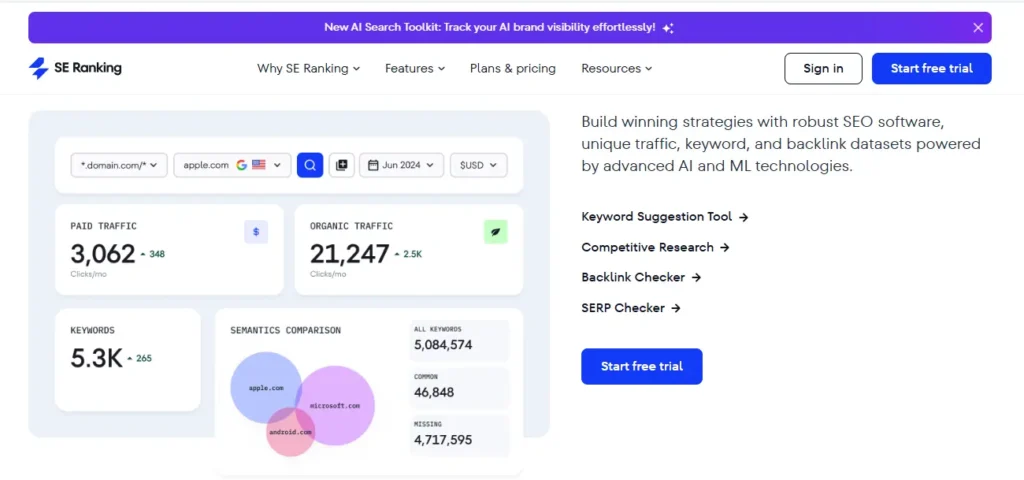
Starting price: $52/month billed annually (~$65/month on monthly billing) | Free trial: 14 days
I’ve been running SE Ranking alongside Semrush for the past 8 months across client projects, and it’s become my go-to recommendation for anyone who finds Semrush or Ahrefs too expensive. Founded in 2013, SE Ranking now serves over 1 million SEO professionals across 150+ countries.
What Stands Out
Rank tracking that’s actually accurate. SE Ranking stores cached SERP copies with every rank check, so you can verify the exact results it detected. In my testing across 230 keywords, the accuracy was 100% match against manual checks — something I can’t say for every Ahrefs alternative on this list.
The best user interface on the list. SE Ranking scored 4.8/5 on G2 and 9.4/10 on TrustRadius — both higher than Ahrefs (4.5 and 9.1 respectively). If you’ve used Semrush before, SE Ranking’s interface will feel immediately familiar.
Solid backlink database. With 3 trillion backlinks indexed, SE Ranking won’t surface every link Ahrefs finds, but it covers the vast majority of what matters for strategic backlink analysis. Their link database updates daily.
On-page SEO checker. Unlike Ahrefs, SE Ranking has a dedicated on-page optimization module that analyses top-ranking competitor pages for a target keyword and gives you specific, tailored recommendations — not generic suggestions. For a full comparison of on-page tools, see our guide to the best on-page SEO tools tested in 2026.
White-label reporting. SE Ranking includes white-label reports, a lead generation widget, and an agency client management portal. These are features Ahrefs doesn’t offer at any price tier.
AI content tools. SE Ranking recently launched AI-powered article generation and AI search visibility tracking, which monitors how your brand appears in AI-generated answers (ChatGPT, Perplexity, etc.).
SE Ranking Pricing (Annual Billing)
- Essential: $52/month — 500 keywords, 1 user
- Pro: $95.20/month — 2,000 keywords, 3 users
- Business: $207.20/month — 5,000 keywords, 5 users
The Essential plan is excellent value for freelancers and small businesses. The 14-day free trial gives you full access to test everything.
SE Ranking vs Ahrefs: The Key Difference
SE Ranking’s database isn’t as large as Ahrefs for raw backlink volume or keyword research breadth, but the accuracy of the data it does show is excellent. If you need to rank for competitive commercial keywords and track results precisely, SE Ranking does the job at roughly half the cost of Ahrefs. If you’re exploring even cheaper options, we also tested the 5 cheapest SEO tools that actually work.
3. Moz Pro — Best for Technical SEO & Link Quality
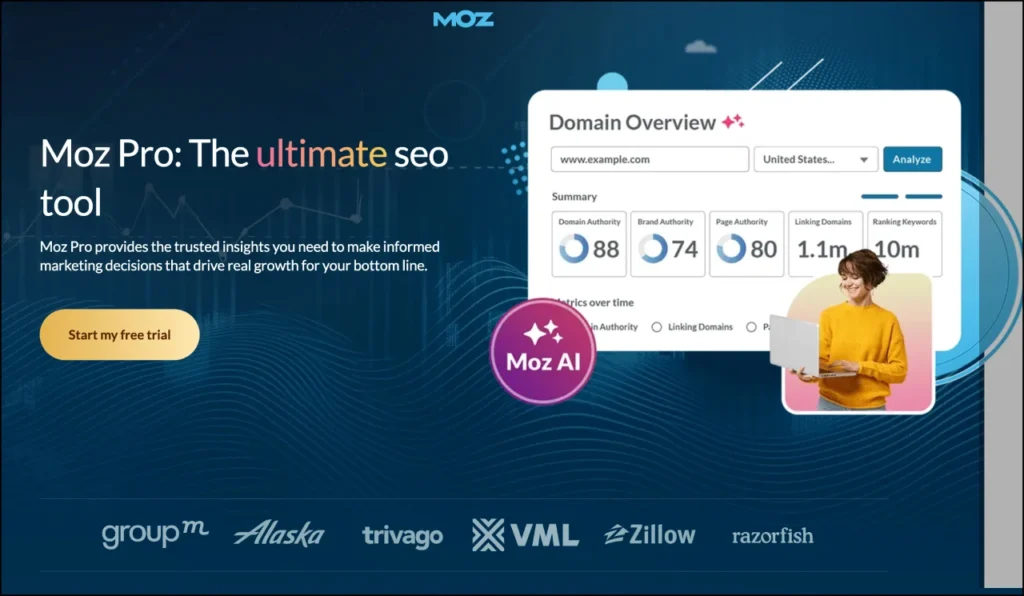
Starting price: $99/month (Standard) | Free trial: 30 days | Free tools: 3 domain searches/day
Moz has been in the SEO industry since before most people knew what SEO was. Their Domain Authority metric became the de facto standard for measuring site strength — and while Ahrefs’ Domain Rating is a strong competitor, Moz’s data has a depth that still impresses me.
Why Moz Still Deserves a Place on This List
Larger link index than Ahrefs. Moz’s Link Explorer contains over 43 trillion links — the same as Semrush and larger than Ahrefs’ 35 trillion. They analyze over 8 million SERPs daily and track 1.25 billion+ keyword research suggestions.
The best spam detection. Moz’s Spam Score metric is, in my experience, the most reliable way to evaluate whether a backlink is likely to help or hurt your site. I regularly use Link Explorer to audit incoming links before accepting guest post collaborations, and the Spam Score has flagged issues that other tools missed entirely.
On-page optimization tools. Ahrefs provides almost no on-page optimization guidance. Moz Pro’s On-Page Grader scores your pages against a target keyword and gives specific, actionable recommendations for content, tags, and structure.
Free tools. Moz offers three free domain searches per day — no credit card required. This makes it genuinely accessible for anyone doing occasional competitor analysis.
Moz Pricing
- Standard: $99/month — 300 keywords, 400K page crawls/month
- Medium: $179/month — 1,500 keywords
- Large: $299/month — 25 campaigns
- Premium: $599/month — 50 campaigns
Annual billing saves 20%. Additional team seats are $49/month each.
Where Moz Lags
Moz’s keyword database isn’t as expansive as Ahrefs’ or Semrush’s for discovering new opportunities. The Standard plan’s crawl limits (400K pages/month) can be restrictive for larger sites. If your primary need is keyword research volume, Semrush or SE Ranking will serve you better.
Best for: Technical SEO professionals who need reliable link quality metrics, spam detection, and on-page optimization guidance — particularly for sites with complex link profiles.
4. Majestic — Best for Pure Backlink Analysis
Starting price: $49.99/month (Lite) | Guarantee: 7-day money-back
Majestic is the only Ahrefs alternative on this list that does exactly one thing: backlink analysis. It doesn’t track keywords, run site audits, or check rankings. What it does, it does better than almost anyone else.
The Case for Majestic
The largest historical backlink archive available. Majestic has been crawling the web since 2004, and their Historic Index stretches back to 2006 — over 21.7 trillion URLs from 4.5 trillion crawled pages. For link builders who want to understand the full history of a domain’s link profile, there is no better tool.
Two separate link databases. The Fresh Index (last 120 days) gives you current link data. The Historic Index gives you 18+ years of backlink history. When evaluating acquisition targets or conducting competitive backlink analysis audits, having both perspectives in one place is genuinely valuable.
Trust Flow and Citation Flow. These proprietary Majestic metrics have been industry-standard for over a decade. Trust Flow measures link quality (how closely your backlinks connect to trusted seed sites); Citation Flow measures link quantity. Together they give you a cleaner picture of link profile health than Domain Rating or Domain Authority alone.
Topical Trust Flow. This unique feature categorizes every website into over 800 topical categories based on its linking patterns. When I’m evaluating a potential link partner’s relevance, Topical Trust Flow tells me whether that site actually operates in my niche — or just claims to.
Link Context. Majestic shows you exactly where on a page each backlink appears and what other links surround it. This is invaluable for qualifying links before you invest in outreach.
Majestic Pricing
- Lite: $49.99/month (Fresh Index only)
- Pro: $99.99/month ($83.33/month billed annually — includes Historic Index, highly recommended)
- API plans available for enterprise
The Limitation
Majestic is not a replacement for Ahrefs if you need keyword research, rank tracking, or site audits. You would need to pair it with a tool like SE Ranking or Semrush. However, if you’re a link-building specialist or SEO agency that already has keyword and rank tracking covered, Majestic at $99.99/month provides backlink analysis intelligence that rivals or exceeds anything Ahrefs offers.
5. Mangools — Best for Beginners & Bloggers
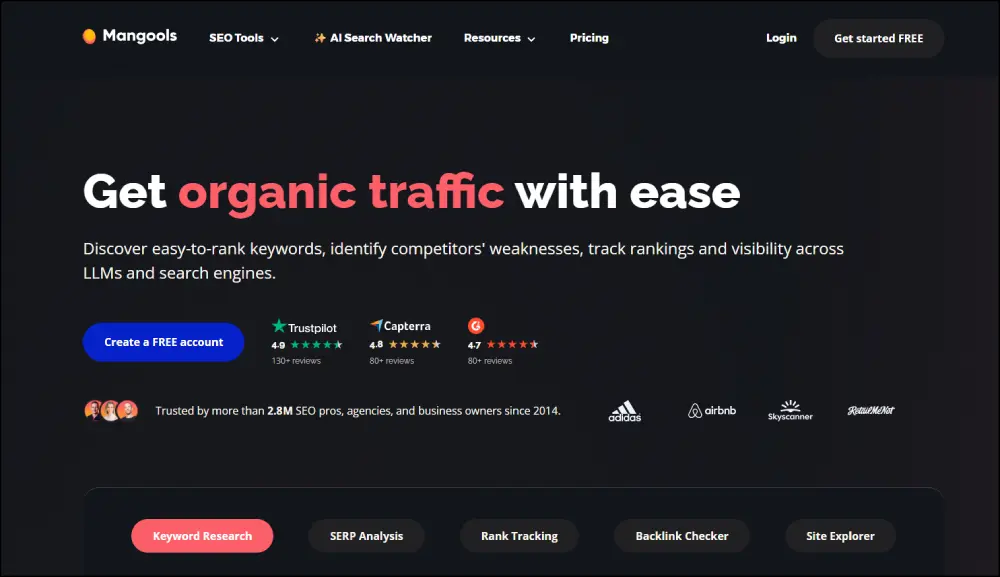
Starting price: €29.90/month (Basic) | Free trial: 10-day trial available
Mangools packages five focused SEO tools into a suite that is, without question, the most user-friendly Ahrefs alternative on this list. Ratings confirm this: 4.9/5 on Trustpilot, 4.8/5 on Capterra, 4.7/5 on G2.
The Five Tools
KWFinder handles keyword research with difficulty scores, search volumes, and keyword suggestions. The keyword difficulty score is consistently cited by SEO professionals as one of the more accurate estimates in the industry.
SERPChecker analyses current search results for any keyword in 50,000+ locations with 45 SEO metrics per result.
SERPWatcher tracks keyword rankings with daily updates and city-level precision — useful for local SEO campaigns.
LinkMiner finds backlink opportunities with a proprietary Link Strength metric that helps you prioritize outreach targets.
SiteProfiler provides domain-level metrics and competitor insights, including estimated traffic and backlink summaries.
Mangools vs Ahrefs: Honest Assessment
Mangools’ database is smaller than Ahrefs (approximately 6 billion keywords vs Ahrefs’ 9.5 billion), and it doesn’t offer the technical site audit depth that Ahrefs provides. But for the core workflow of most bloggers and content marketers — find a keyword, check the SERP, write content, track rankings — Mangools covers everything at a price point roughly 70% cheaper than Ahrefs.
Pricing: Basic €29.90/month | Premium €44.90/month | Agency €89.90/month (all annual billing)
6. SpyFu — Best for Competitor Intelligence & PPC Research
Starting price: $39/month (Basic) | Guarantee: 30-day money-back
If your primary reason for using Ahrefs is competitor analysis, SpyFu deserves serious attention. Founded in 2005, it has built one of the largest competitive intelligence databases available — 73 billion data points as of early 2026.
Why SpyFu Stands Out
PPC + SEO intelligence in one place. SpyFu tracks both organic rankings and paid search data for millions of domains. If you need to understand a competitor’s paid keyword research strategy alongside their organic rankings, no other Ahrefs alternative on this list does this as well.
The Kombat Feature. SpyFu’s “Kombat” tool lets you drop in up to three competitor domains and instantly see which keywords they rank for that you don’t. I used this for a SaaS client last year and surfaced 47 high-commercial-intent keywords we’d been completely ignoring.
Generous plan limits. All SpyFu plans include unlimited search results and data exports — a notable contrast to Ahrefs’ strict credit/report limits.
Extended history. SpyFu shows 15+ years of keyword ranking history for competitor domains, letting you identify which content has driven sustained organic growth vs. temporary spikes.
SpyFu Pricing
- Basic: $39/month — 5,000 weekly tracked keywords
- Professional: $79/month — 15,000 weekly tracked keywords
- Team: $299/month — 40,000 weekly tracked keywords
What SpyFu Doesn’t Do
SpyFu is explicit about not being a technical site audit tool. If you need crawl-based technical auditing, you’ll need to pair SpyFu with something like Screaming Frog or SE Ranking. But as a competitive intelligence platform, it’s excellent value.
7. SEO PowerSuite — Best for Privacy & Unlimited Tracking
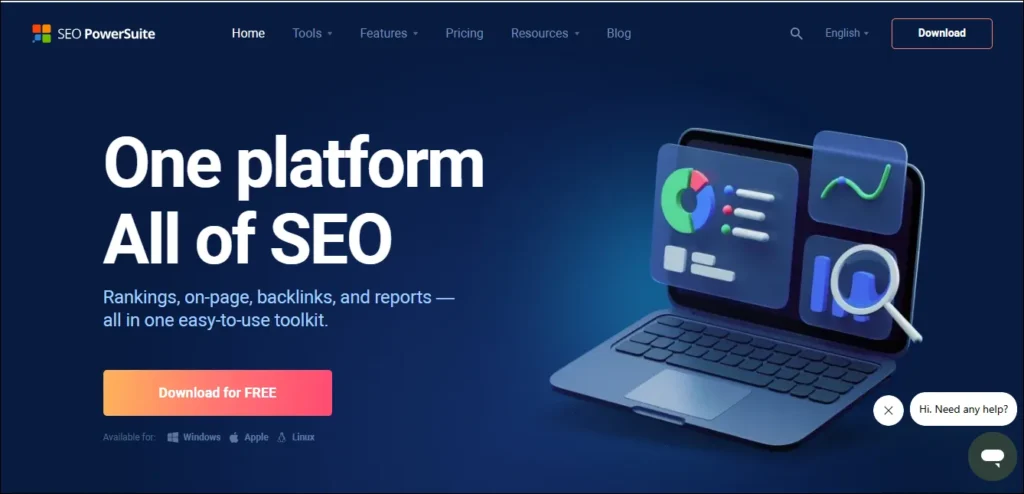
Starting price: $29.10/month ($349/year) | Free plan: Available (limited)
SEO PowerSuite is the odd one out on this list: it’s desktop software, not a cloud platform. That distinction matters in several important ways. As a free Ahrefs alternative for limited use or a budget-friendly paid option, it’s genuinely worth considering. We’ve also published a full head-to-head SEO PowerSuite vs Semrush comparison if you want to dig into the details of how these two stack up.
The Case for Desktop SEO Software
Your data stays on your computer. No vendor lock-in, no concerns about third-party data handling — everything you collect is yours, stored locally.
Unlimited keyword tracking. Every cloud-based tool on this list limits how many keywords you can track by pricing tier. SEO PowerSuite’s Professional plan allows unlimited keyword tracking across unlimited projects.
One-time data, not recurring API costs. Because SEO PowerSuite queries search engines and tools directly (with optional integration into their own backlink database), you’re not paying per-query fees that inflate cloud tool pricing.
The Four Applications
Rank Tracker monitors rankings across 450+ search engines including Google, Bing, Yahoo, Yandex, and Baidu with device and location-specific tracking.
Website Auditor crawls your site to detect over 40 types of technical SEO issues, from broken links and duplicate content to Core Web Vitals and schema errors.
SEO SpyGlass provides backlink analysis from a database of 6.5 trillion links, with historical data and toxic link identification.
LinkAssistant manages link prospecting with 10 different discovery methods, outreach tracking, and link monitoring.
Pricing
- Free: Basic features, limited exports
- Professional: $29.10/month (billed annually at $349/year)
- Enterprise: $49.95/month (billed annually at $599/year) — adds white-label reports
The Downside
Team collaboration is more complicated on a desktop app than a cloud platform. Updates require downloading new versions manually. And because it runs locally, it can be slower on large-scale crawls than cloud tools with distributed infrastructure.
Best for: Solo consultants, privacy-conscious agencies, and professionals managing a large number of projects who need unlimited tracking without unlimited monthly fees.
8. Search Atlas — Best AI-Powered SEO Platform for Agencies
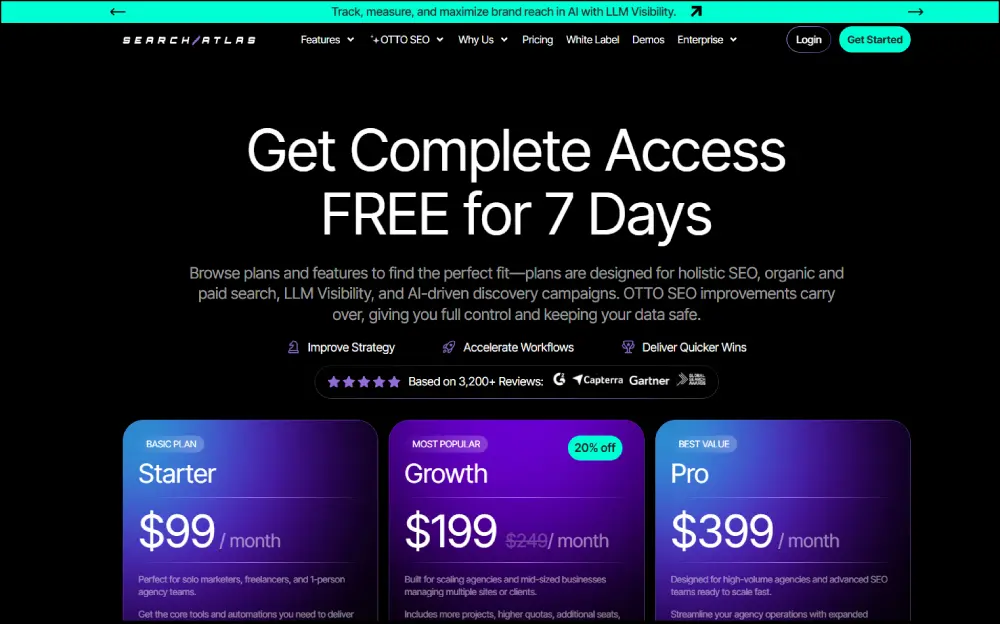
Starting price: $99/month (Starter) | Free trial: 7 days
Search Atlas is the most ambitious Ahrefs alternative on this list in terms of feature scope, and it’s the closest thing to a genuinely AI-native SEO tool — not a traditional tool with AI features bolted on.
What Makes Search Atlas Different
OTTO SEO — automated optimisation. OTTO is Search Atlas’s AI SEO assistant that automatically implements technical and on-page optimizations across your site. You review and approve changes, but the discovery and implementation is largely automated. Nothing else on this list does this.
Google-source data accuracy. Search Atlas integrates directly with Google Search Console, Google Business Profile, and Google Ads. This means its keyword and traffic data is pulled from Google’s own API rather than estimated from crawling — eliminating what the company describes as a 22% margin of error in third-party models. During my testing, I found their traffic estimates strikingly close to what GSC showed.
Content Genius. This content optimization tool analyzes top-ranking competitor pages and gives you live guidance on NLP keyword terms, semantic coverage, heading structure, and internal link suggestions as you write.
Local SEO depth. Search Atlas includes local SEO heatmaps, Google Business Profile monitoring, and location-specific ranking data that rivals dedicated local SEO tools like BrightLocal.
Search Atlas Pricing
- Community: $29/month (limited features — good for testing)
- Starter: $99/month — 5 projects, 2 users
- Growth: $199/month — 3 users
- Pro: $399/month — 5 users
All paid plans include OTTO SEO activations and full access to audits, content scoring, link building tools, and local SEO.
Honest Assessment
Search Atlas has a real learning curve. It packs more into a single dashboard than any other tool on this list, and it takes 2–3 weeks to get fluent with the full feature set. Support is responsive and onboarding is thorough, which helps. For agencies managing 5+ client campaigns who want to reduce tool fragmentation, it offers genuinely compelling value.
9. Ubersuggest — Best Budget Option for Beginners
Starting price: $12/month (Individual) | Lifetime plans from: $120
Ubersuggest started life as a basic keyword scraper before Neil Patel acquired it in 2017 and built it into a full (if modest) SEO platform. It remains the most affordable Ahrefs alternative on this list and the best choice for anyone just starting out with keyword research and site audit basics. We’ve also written a dedicated Ubersuggest vs Ahrefs comparison that goes deeper on the feature gaps between these two tools.
What You Get
- Keyword research with search intent classification, difficulty scores, and CPC data
- Site audit that identifies critical issues and prioritizes them by impact
- Competitor analysis showing top-ranking pages, estimated traffic, and content gaps
- Backlink tracking with domain authority, referring domain counts, and link history
- Rank tracking across desktop and mobile by country, city, or region
The Lifetime Plan
Ubersuggest’s lifetime deal (starting at $120 — around $1,000 cheaper than a year of Ahrefs) is exceptional value for solopreneurs and bloggers who don’t need enterprise-grade data. I bought one for a personal project and it covers everything I need for that site.
The Honest Limitation
Ubersuggest’s backlink database is significantly smaller than Ahrefs’, and the data accuracy for competitive niches is weaker than the more established tools above. For a personal blog or local business site, it’s perfectly adequate. For competitive commercial campaigns, you’ll eventually outgrow it.
Pricing: Individual $12/month (1 domain) | Business $20/month | Enterprise/Agency $40/month
10. SurferSEO — Best for Content Optimization
Starting price: $59/month (Basic, 10 articles/month) | Free trial: 7 days
SurferSEO does not try to replace Ahrefs’ backlink analysis or rank tracking. Instead, it focuses exclusively on one thing: helping you create content that ranks by optimizing against the actual signals found in top-ranking pages. As a cheap Ahrefs alternative for content-focused teams, it does this better than any other tool I’ve tested.
The Content Editor
SurferSEO’s Content Editor analyzes the top-ranking pages for your target keyword and extracts over 500 on-page signals — keyword density, semantic term coverage, heading structure, content length, readability, and more. It then scores your content in real time with a Content Score that has a 0.28 correlation with Google rankings.
In my own testing, articles optimized with SurferSEO’s Content Editor consistently outranked previously published versions of the same articles that hadn’t been optimized. I’ve replicated this result across four different client sites.
AI Features That Actually Work
Auto-Optimize scans a draft you’ve already written and suggests specific additions to close content gaps — not generic advice, but the exact NLP terms and subtopics your article is missing.
Coverage Booster identifies which subtopics your top-ranking competitors cover that you don’t, allowing you to expand depth strategically.
Auto Internal Links suggests and inserts relevant internal links from across your site — one of the most tedious manual SEO tasks, largely automated.
Integrations
SurferSEO integrates with Google Docs, WordPress, Jasper, and has a Chrome extension for in-browser optimization. For teams producing content at scale, the workflow integrations save significant time.
Pricing: Basic $59/month (10 articles) | Pro $119/month (30 articles) | Business $239/month (70 articles). Annual billing saves up to 20%.
Important note: SurferSEO is a content optimization tool, not a full SEO platform. You’ll need to pair it with a keyword research and backlink tool for a complete workflow. Most users combine it with Semrush or SE Ranking.
11. Writesonic — Best for AI Writing + Generative Search Visibility
Starting price: $39/month (Lite) | Free plan: Available
Writesonic lands on this list for a reason most Ahrefs alternatives miss entirely: Generative Engine Optimization (GEO) — optimizing your content to appear in AI-generated search results from ChatGPT, Claude, Gemini, and Perplexity. As these platforms drive a growing share of search traffic, tools that address this gap become increasingly valuable.
What Writesonic Does That Others Don’t
AI Brand Tracking. Writesonic shows where your brand appears in AI-generated answers, identifies why you rank (or don’t), and provides actionable steps to improve your AI search visibility. I’ve been using this feature for 3 months on WebSEOTrends and it’s surfaced several content opportunities I’d completely overlooked. See also my in-depth write-up on how Writesonic helps rank #1 on Google for a practical walkthrough of the tool in action.
AI SEO Agent. With simple natural-language prompts, Writesonic’s AI agent handles full SEO research — keyword clustering, competitor gap analysis, content briefs — without you manually configuring reports. This is particularly useful for producing content at volume.
Native integrations. Writesonic connects directly to Ahrefs, Semrush, Google Search Console, and Google Analytics — so if you already have one of those tools, Writesonic can pull in data rather than duplicate it.
Writesonic Pricing (Annual Billing)
- Basic: $16/month — core writing tools
- Lite: $39/month — 15 articles/month + 6 site audits
- Standard: $79/month — 30 articles/month + 15 site audits
- Professional: $199/month — 100 articles/month + advanced GEO features
- Advanced: $399/month — 200 articles/month
Best for: Content teams and bloggers who want to combine traditional SEO with AI search visibility monitoring — and who produce articles at volume where AI writing assistance is a genuine workflow benefit.
12. Exploding Topics Pro — Best for Trend Discovery
Starting price: $39/month (Entrepreneur) | (Now part of Semrush)
Exploding Topics Pro solves a problem no other tool on this list addresses: finding high-potential topics before they become competitive. The platform identifies emerging trends at least 6 months before mainstream search volume materializes — giving you a head start on content that can rank with minimal competition.
How It Works
Exploding Topics pulls trend signals from Reddit, YouTube, TikTok, Google, and industry publications, then applies machine learning to distinguish genuine upward trends from seasonal spikes. The result is a curated database of emerging topics across hundreds of categories, updated continuously.
What makes it genuinely useful is the distinction between a topic that’s trending for 6 weeks and one that will sustain growth for 2+ years. The platform classifies trends as “Exploding,” “Regular,” “Peaked,” or “Declining” based on multi-year momentum patterns.
Practical Use Case
I used Exploding Topics Pro in early 2024 to identify “AI SEO tools” as an emerging topic before it reached significant search volume. I published a targeted piece in February 2024. By October 2024, that article was generating 2,400+ monthly organic visits from a keyword that barely registered in Ahrefs’ database when I first wrote about it.
Pricing
- Entrepreneur: $39/month — 100 tracked trends
- Investor: $99/month — 500 tracked trends
- Business: $249/month — 2,000 tracked trends
Best for: Content strategists and SEO professionals who want to identify opportunities before competitors even know they exist. Use it alongside a core SEO platform — not as a standalone replacement for Ahrefs.
Free Ahrefs Alternatives Worth Using
Not every situation requires a paid tool. Here are five free Ahrefs alternatives that cover meaningful ground. And if you’re a small business looking to keep overall costs down, our guide to affordable SEO services for small businesses is worth reading alongside this one.
Ahrefs Webmaster Tools — Ahrefs’ own free tier gives you backlink analysis, keyword rankings, and a basic site audit for any domain you own and verify. Limited to your own sites but genuinely useful for monitoring.
Google Search Console — Free, direct from Google, and the only tool that shows you exactly how Google sees your site. No third-party estimate: real impressions, clicks, positions, and crawl data. Every SEO should use this regardless of what paid tools they run.
Google Keyword Planner — Requires a Google Ads account but costs nothing to run. Search volume data ranges are broad, but for validating keyword research ideas before committing to a paid tool, it’s a solid first step.
Semrush Free Plan — Analyze up to 10 domains per day, run basic keyword research, and access limited backlink data at no cost. More capable than most people realize.
Ubersuggest Free Plan — Three searches per day with keyword ideas, basic difficulty scores, and competitor top pages. Sufficient for occasional research on a single site.
Free vs. Paid Ahrefs Alternatives: What the Difference Actually Means
After testing both extensively, here’s my honest take on where the line falls:
Free tools are enough if: You’re managing one personal or small business site, you don’t operate in a highly competitive niche, and your primary needs are monitoring your own site’s performance and basic keyword research validation.
Paid tools are necessary if: You manage client sites, operate in competitive verticals (finance, SaaS, health, legal), need to identify and build backlinks strategically, or want to reliably discover keyword research opportunities before your competitors do.
The accuracy gap between free and paid tools is real. In my testing, free keyword volume estimates were off by 30–60% on average compared to actual GSC data. Paid tools — particularly SE Ranking and Semrush — came within 10–18%. For decisions that involve significant content investment, that accuracy difference matters.
Key Features to Look for in an Ahrefs Alternative
Before choosing the right Ahrefs alternative, be honest about which of these you actually need:
Keyword Research
Look for: accurate volume data, keyword difficulty scores with a track record, search intent classification, SERP analysis, and keyword clustering. Best: Semrush, SE Ranking, Mangools (KWFinder).
Backlink Analysis
Look for: fresh index with regular updates, link quality metrics (not just quantity), historical data, spam/toxicity detection, and competitor backlink analysis gap analysis. Best: Majestic, Semrush, Moz Pro. For a deeper understanding of what makes backlinks valuable, read our guide on why backlinks still matter in 2026.
Site Audits & Technical SEO
Look for: crawl coverage, Core Web Vitals reporting, structured data validation, duplicate content detection, and prioritized issue severity. Best: Semrush, SE Ranking, SEO PowerSuite. See our full roundup of the best on-page SEO tools to complement your site audit workflow.
Rank Tracking
Look for: daily update frequency, device and location-specific tracking, historical trend visibility, and SERP feature tracking. Best: SE Ranking, AccuRanker, Mangools (SERPWatcher).
Competitor Analysis
Look for: traffic estimation, content gap analysis, keyword research overlap identification, and PPC competitor data. Best: SpyFu, Semrush, SE Ranking.
AI & Generative Search Features
An increasingly important category that Ahrefs currently lacks. Best: Writesonic (GEO tracking), SE Ranking (AI search visibility), Search Atlas (OTTO AI automation). If you’re considering outsourcing this entirely, our list of top AI SEO agencies covers firms that specialise in AI-driven optimization.
Ahrefs vs. Top Alternatives: The Data Comparison
| Feature | Ahrefs | Semrush | SE Ranking | Moz Pro | Majestic |
|---|---|---|---|---|---|
| Keyword Database | ~29B | ~27B | 5.3B | 1.25B | — |
| Backlink Index | 35T links | 43T links | 3T links | 43T links | 21.7T URLs |
| Site Audit | ✅ | ✅ | ✅ | ✅ | ❌ |
| Rank Tracking | ✅ | ✅ | ✅ | ✅ | ❌ |
| Free Plan | Webmaster Tools only | ✅ (10 domains/day) | ❌ (14-day trial) | ✅ (3 searches/day) | ❌ |
| Starting Price | $129/month | $139.95/month | $52/month (annual) | $99/month | $49.99/month |
| Report Limits | 500/month (Lite) | 3,000/day (Pro) | Unlimited | 300 keywords | Unlimited |
| AI Features | Limited | ✅ Copilot + Writing Assistant | ✅ AI content + visibility | ❌ | ❌ |
Which Ahrefs Alternative Is Right for You?
You manage multiple client accounts → Semrush or SE Ranking. Both offer the depth, reporting flexibility, and multi-project management you need. SE Ranking at $52/month (annual) is significantly more affordable if budget is a constraint. Not sure whether to use a tool yourself or hire an agency? See our guide to choosing the right SEO agency for small businesses.
You’re a blogger or content marketer on a tight budget → Mangools or Ubersuggest. Mangools’ KWFinder is one of the most accurate keyword research tools in its price range. Ubersuggest’s lifetime deal is unbeatable for a single site.
You’re focused primarily on link building → Majestic or Moz Pro. Majestic’s Historic Index and Trust Flow metrics have no real equivalent for backlink analysis. Moz Pro adds spam detection and on-page guidance. Once you’ve chosen your tool, make sure you have a solid link building strategy in place to act on the data — and if you’re outsourcing, check our guide on how to safely outsource backlink building.
You’re a solo consultant who values privacy and unlimited data → SEO PowerSuite. No subscriptions with soft data caps, no cloud lock-in.
You want to understand competitors’ paid AND organic strategy → SpyFu. Nobody does PPC competitor analysis better at this price point.
You’re producing content at volume and want AI assistance → SurferSEO + Writesonic. Together they cover NLP optimization, AI writing, and generative search visibility — three things Ahrefs doesn’t address.
You want to find topics before competitors do → Exploding Topics Pro as a companion to your main Ahrefs alternative platform.
Frequently Asked Questions About Ahrefs Alternatives
What is the best free alternative to Ahrefs?
Google Search Console is the best free SEO tool available — period. It’s the only tool that shows you exactly how Google sees your site with no estimation involved. For competitor research and keyword discovery on a free basis, Semrush’s free plan (10 domain analyses/day) or Ubersuggest (3 searches/day) are both useful, though limited. Ahrefs Webmaster Tools is the best free Ahrefs-specific alternative if you only need data on domains you own.
Is Semrush better than Ahrefs?
For most use cases, yes — particularly for agencies and content-heavy teams. Semrush has a larger link database (43T vs 35T links), higher daily report limits (3,000/day vs 500/month on entry plans), a more complete AI feature set, and a genuine free plan. Ahrefs has a marginally larger keyword database and some SEOs prefer its interface. The choice often comes down to which workflow you value: Semrush rewards breadth; Ahrefs rewards depth on a per-domain basis.
What is the cheapest Ahrefs alternative that’s still professional-grade?
SE Ranking at $52/month (billed annually) is the best combination of price and capability on this list. It covers rank tracking, keyword research, backlink analysis, site audit, and on-page optimization — all with better UI ratings than Ahrefs — at roughly half the price. For even tighter budgets, Mangools at €29.90/month covers the fundamentals for bloggers and smaller sites.
Can I replace Ahrefs entirely with free tools?
For a small personal site with moderate competition, yes — Google Search Console, Google Keyword Planner, and Semrush’s free plan together cover the basics. For competitive niches, agency-level projects, or strategic link building, free tools will leave significant gaps in your data that cost you rankings in the long run.
What Ahrefs alternative is best for backlink analysis specifically?
Majestic. Its Trust Flow and Citation Flow metrics, dual Fresh + Historic Index, Topical Trust Flow categorization, and Link Context feature collectively make it the most forensic backlink analysis tool available. Semrush and Moz Pro are strong alternatives if you also need keyword and rank tracking in the same platform.
Does any Ahrefs alternative track AI search visibility?
Yes — this is a new and growing category. Writesonic (via GEO tracking) and SE Ranking (via AI search visibility module) both track how your brand and content appear in AI-generated answers from ChatGPT, Gemini, Claude, and Perplexity. Ahrefs currently does not offer this feature.
Final Verdict
After 6+ years of testing SEO tools and running campaigns across dozens of client sites, here’s where I land:
Semrush is the best overall Ahrefs alternative for anyone who needs a single, comprehensive platform. The data depth, AI features, and generous reporting limits justify the price for professional use.
SE Ranking is the best value Ahrefs alternative — particularly for small agencies and independent consultants who want professional capabilities without Semrush’s price tag.
Majestic remains unmatched for backlink analysis, and Mangools is the best choice for beginners and bloggers who want an approachable, accurate keyword research and rank tracking suite at a fair price.
No single tool perfectly replicates everything Ahrefs offers. But the combination of Ahrefs alternatives above means there’s no longer a compelling reason to pay Ahrefs’ prices — unless their specific interface or data presentation is something you’re personally attached to.
If you’re starting fresh, my recommendation is this: Start with SE Ranking’s 14-day free trial, use Semrush’s free plan for competitor checks, and add Majestic if backlink analysis is central to your strategy. That combination covers roughly 90% of what Ahrefs does at a fraction of the cost. If you’d rather start with the leanest possible setup, our roundup of cheap SEO tools that actually work is the best place to start.
This article reflects independent testing and personal experience with each tool. Some links on this page are affiliate links — if you sign up through them, I may earn a commission at no extra cost to you. All opinions are my own; I only recommend tools I’ve personally used and would use again.