
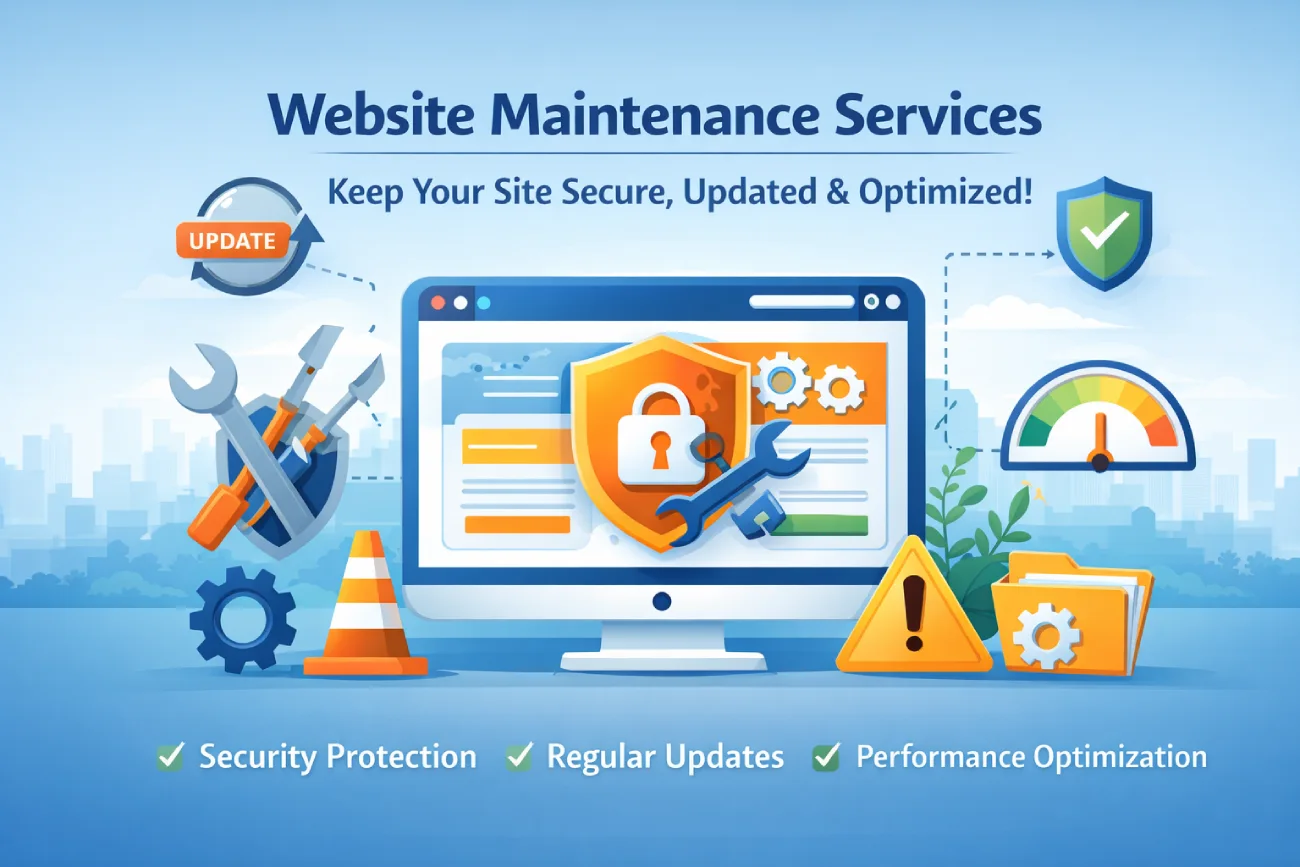
Our Website Maintenance Services Packages
Affordable monthly plans for businesses, startups, and enterprises. Keep your website secure, optimized, and running smoothly.
Starter
$199/month
- ✔ Monthly Website Backup
- ✔ Core Updates (WordPress, Themes, Plugins)
- ✔ Security Monitoring
- ✔ Uptime Monitoring (24/7)
- ✔ Basic Speed Optimization
- ✔ 1 Hour of Support
Professional
$299/month
- ✔ Weekly Backups & Restore
- ✔ Advanced Security Firewall & Malware Removal
- ✔ Database Optimization
- ✔ Performance & SEO Optimization
- ✔ Uptime & Downtime Reports
- ✔ 4 Hours of Support
- ✔ Broken Link Fixing
- ✔ Monthly Website Audit Report
Premium
$499/month
- ✔ Daily Cloud Backups
- ✔ Enterprise-level Security & SSL Management
- ✔ Priority Speed Optimization (Core Web Vitals)
- ✔ Unlimited Malware Cleanup
- ✔ Staging Environment Setup
- ✔ 10 Hours of Dedicated Support
- ✔ Custom Feature & Plugin Updates
- ✔ Advanced Analytics & SEO Tracking
- ✔ Quarterly Strategy Call
Website Maintenance Services by Webseotrends
Small businesses are the target of 46% of all cyber breaches. This scary fact explains why your business can’t survive without website maintenance services anymore.
The risks go beyond just security problems. Your site visitors won’t come back 88% of the time if they have a bad experience. Poor website performance makes e-commerce companies lose about 35% of their sales. The good news is that website maintenance services don’t have to break the bank. Small businesses can find simple plans that cost between $50 and $300 per month. On top of that, WordPress maintenance services start at just $69 monthly.
This detailed guide explains the best website maintenance companies and what you get for your money. You’ll find the right maintenance plan that fits your business needs. From simple security updates to full e-commerce support, there are options that keep your website safe without emptying your wallet.
7 Best Website Maintenance Companies in United States
The right website maintenance service provider can make or break your business’s online success. These seven companies are the best website maintenance providers in the United States, based on their industry expertise, client satisfaction, and service offerings.
1. Webseotrends
Webseotrends – Website Maintenance Services
Webseotrends delivers reliable website maintenance services designed to keep your site secure, fast, and fully optimized. Our team specializes in website support, site management, and performance monitoring, ensuring your business website is always running smoothly.
From WordPress maintenance, CMS updates, bug fixes, and regular backups to site security, uptime monitoring, and technical support, Webseotrends handles it all with precision. A well-maintained site not only improves user experience but also protects your search engine rankings and overall online presence.
Whether you run an eCommerce store, business website, or personal blog, Webseotrends offers tailored website care plans that include speed optimization, software updates, malware protection, and SEO-safe upgrades. With transparent pricing and expert support, we make sure your site stays reliable, secure, and growth-ready.
2. WebFX
WebFX is a 29-year old trusted website maintenance services company that serves businesses worldwide. Their maintenance packages have text additions or deletions, photo modifications, page updates, navigation changes, file management, video insertions, link adjustments, and color/background image replacements. The company’s strategies have generated 24 million leads and $10 billion in revenue for their clients. Clients can choose from flexible monthly, hourly, or after-hours options, with prices between $35 to $500 per month.
3. Sagapixel
Sagapixel specializes in healthcare digital marketing and offers complete website maintenance solutions for medical practices. The company builds websites on WordPress where clients get full ownership and control of their online presence. They also provide hosting services so businesses can concentrate on operations instead of technical updates. Their website design services start at $260 for pre-built templates and $420 for custom solutions.
4. Coalition Technologies
Coalition Technologies stands out in Shopify maintenance and provides significant support for e-commerce businesses. They offer three tiered maintenance packages:
- Basic ($630/month): Has 5 monthly update hours, full site backup, and speed testing
- Enhanced ($1,080/month): Has 12 monthly hours, app performance testing, and faster turnaround
- Premium ($1,530/month): Has 17 monthly hours and priority support
The company uses 24/7 monitoring tools to spot site downtime quickly, while their quality assurance prevents problems before customers notice them.
5. Startdesigns
Startdesigns provides budget-friendly website maintenance packages that cost between $35 and $500+ monthly. Their services include domain and hosting management ($5-$50), website maintenance support ($30-$200+), CMS updates ($10-$100), performance optimization ($10-$60), and security monitoring ($5-$40). Their team has over a decade of experience with more than 200 business clients and specializes in WordPress, Shopify, and responsive design.
6. Rock Salt Marketing Cooperative
Rock Salt Marketing Cooperative is a Utah-based agency that specializes in SEO-friendly web design and maintenance. The company creates websites that generate leads right after launch. Their clients report improved keyword rankings, increased website traffic, and better quality web leads. They combine technical expertise with creative design to keep sites functional and competitive.
7. Webyking
Webyking is a leading website maintenance company with unique experience in WordPress website maintenance. Their services cover regular plugin updates, software maintenance, performance optimization, backup and restore functions, and 24/7 website monitoring. The company also provides white-label website maintenance services that let agencies outsource client maintenance while keeping brand consistency. They focus on security and performance through daily security audits and proactive threat response systems.
What Website Maintenance Services Actually Cover
A successful website needs a resilient maintenance plan to stay secure, updated, and fast. Learning about website maintenance services will help you pick the right plan that fits your business needs.
Security patching and malware scans
Today’s website maintenance services use advanced security measures to protect your online presence. They actively monitor security and take immediate action when they detect vulnerabilities. Professional services run regular security audits and malware scans to spot potential threats early.
Effective malware detection systems use multiple advanced methods:
- Heuristic analysis to identify malicious code patterns
- Behavioral analysis to detect abnormal activities
- Reputation analysis to flag risky domains
- Anti-virus analysis using traditional signatures
Statistics show that 49% of hacked websites ran outdated software when they got infected. Regular security patches are vital. Website maintenance services maintain firewalls, test for vulnerabilities, and set up intrusion detection systems to keep your site safe.
CMS updates and plugin management
Software updates are crucial for website maintenance. Your content management system (CMS), plugins, themes, and other software components need regular updates to stay secure and functional.
Professional maintenance services handle these updates automatically. Your site gets new features and stays current. This matters especially for WordPress sites, which run 40% of the web. Skipping updates might seem harmless but creates a “ticking time bomb” for your site’s security.
Outdated plugins can make your site crash and stop working, which frustrates users. Regular updates also keep your SSL certificate current to protect user data during transmission.
Daily or weekly site backups
Backups protect you from data loss. Maintenance services automatically back up your site’s content, database, and media files daily or weekly. If technical issues or security breaches occur, you can restore your site quickly with minimal downtime.
Backup frequency depends on your site’s activity level:
- Static sites: Daily backups for minor updates, weekly full backups
- High-activity websites: Hourly backups to capture up-to-the-minute changes
- E-commerce sites: Real-time backups to prevent order data loss
Professional services follow the “3-2-1 rule” – three copies of your data stored on two different media devices with one copy stored off-site. This strategy protects against major failures through data redundancy.
Performance monitoring and uptime checks
Website maintenance services optimize your site’s speed and responsiveness. Regular performance checks ensure your site loads fast and works smoothly on all devices. Slow page speed hurts SEO and revenue.
Uptime monitoring tells you right away if your site goes down. You get alerts from multiple countries every 30 seconds when issues occur. This monitoring checks response time and availability worldwide.
Maintenance teams use tools like Google PageSpeed Insights and GTmetrix to track and improve your site’s performance. They also watch server metrics and alert you when RAM, CPU, and disk usage exceed custom limits.
Why Ongoing Website Maintenance Is Critical for Businesses
Your website’s success takes a hit when you neglect it. A strong online presence needs regular attention to work well and stay secure.
Impact on SEO and Google rankings
Search engines reward websites that stay well-maintained and optimized. Your search rankings go up when GoogleBot finds updated software, working links, and no duplicate pages. Your website might stop showing up in search results if there are too many 404 pages or broken links.
Google’s PageRank algorithm looks at “site health” – your website’s security, stability, and technical integrity. Broken links, 404 errors, slow loading speeds, and security issues hurt your site’s health and search rankings.
Websites with regular maintenance see organic traffic grow 50% faster than neglected ones. This happens because search engines like websites that stay secure, work well on mobile devices, and get fresh content often.
User experience and conversion rates
Loading speed makes a big difference in conversion rates. Here’s what the data shows:
- Pages loading in 2.4 seconds had a 1.9% conversion rate
- At 3.3 seconds, conversion rate dropped to 1.5%
- At 4.2 seconds, conversion rate fell below 1%
- At 5.7+ seconds, conversion rate plummeted to 0.6%
These numbers directly affect revenue. Walmart’s conversions went up 2% for each second they shaved off loading time. COOK boosted conversions by 7% just by making pages load 0.85 seconds faster.
Regular maintenance helps you make your website better for users. You can fix navigation, make forms work better, improve search features, and create layouts that users love.
Risk of data loss or hacking
Your website becomes an easy target for cyber attacks without proper maintenance. Old software, plugins, or themes leave doors wide open for hackers. You risk losing data and damaging your reputation.
Small and medium businesses are targets in 43% of data breaches. Your company size doesn’t matter – website security matters for everyone. About 49% of hacked websites ran outdated software when they got infected. This shows why keeping everything updated matters so much.
Data breaches cost $4.24 million on average. Search engines might even remove your site from their results.
Migrate Website to New Hosting Without SEO Loss
Moving your website can hurt your SEO if you don’t plan carefully. Search rankings can drop fast, taking your traffic with them. Websites can disappear from search results completely without proper preparation.
Wise.com’s story shows both sides. When they changed from Transferwise.com, their traffic dropped from 32 million to 13 million monthly visits. But good planning helped them bounce back to 205 million organic visits – 5 times more than before.
Success depends on a solid 301 redirect plan. These redirects tell search engines that pages moved to new URLs, helping them find and index the new pages. Watch your site closely for 30-90 days after moving to protect your SEO.
Breakdown of Website Maintenance Services Cost by Task
You’ll make better budget decisions for your online presence when you know the exact costs of website maintenance. Let’s get into what professional website maintenance services usually cost.
Hosting and domain renewal: $10–$100/month
Your website starts with hosting and domain services. A domain name costs between $10 and $50 yearly. Renewal prices are often higher than the original rates and usually run $10 to $20 per year. The price changes based on the extension (.com, .org, etc.).
Your hosting costs depend on the service type:
- Shared hosting: $3 to $15 per month (ideal for small sites)
- VPS hosting: $20 to $50 per month (better for medium-traffic sites)
- Dedicated hosting: $70 to $200 per month (for large businesses or high-traffic websites)
- Cloud hosting: $15 to $100 per month (scales with demand)
You’ll get better value with longer subscriptions, but your total hosting costs depend on your provider and plan.
CMS updates and backups: $20–$200/month
Regular CMS updates and backups are vital for your website’s health, and costs can vary by a lot. Self-hosted CMS platforms like WordPress, Joomla, or Drupal need complete update services that cost between $20 and $200 monthly.
Backup solutions are another key cost, ranging from $5 to $30 monthly. Your backup frequency affects the price – static sites might work with weekly backups, while e-commerce sites just need immediate backup solutions to avoid losing order data.
Many site owners don’t plan for these costs at first, but good CMS maintenance prevents issues that could get pricey to fix later.
Security scans and SSL: $0–$85/month
Website security protects your business reputation and customer data. SSL certificates encrypt sensitive information on your site. They range from free options through Let’s Encrypt to premium solutions costing $200+ yearly.
SSL certification costs vary by level:
- Domain Validation (DV): Simple verification ($0-60/year)
- Organization Validation (OV): Verifies company exists (higher cost)
- Extended Validation (EV): Highest level of verification ($50-$200+/year)
Security scanning services run $5 to $50 monthly, based on tools and storage needs. Most hosting providers include simple security features, but complete protection often needs extra investment.
Ongoing development and tech support: $200–$5,000/month
Tech support costs vary the most in website maintenance. Simple support packages start at $200 monthly, while complete enterprise-level support can reach $5,000 monthly.
Your tech support costs change based on:
- Response time guarantees
- Support availability (business hours vs. 24/7)
- Expertise level (general vs. specialized platform knowledge)
- Service scope (reactive troubleshooting vs. proactive optimization)
Development retainers help businesses with complex websites ensure continuous improvements and quick fixes. This might be the highest maintenance cost, but good technical support prevents expensive downtime and lost revenue.
Affordable Website Maintenance Plans by Business Type
Website maintenance needs vary based on business type and budget. The right maintenance plan will give a site optimal performance without extra costs.
Simple plans for small businesses and blogs
Small businesses and personal websites with simpler needs can opt for simple maintenance plans that cost between $50 and $300 per month. These starter packages include:
- Routine software updates
- Regular weekly or monthly backups
- Simple security monitoring
- Performance improvements
- Limited content updates
Simple plans suit businesses that rarely update their information. They protect against common vulnerabilities without costly extras. Many providers have “Tier 1” plans from $100-249 monthly that come with security monitoring, weekly backups, and 1-3 hours of support time.
Standard plans for service-based businesses
Sites with moderate traffic and medium-sized businesses do well with standard maintenance plans that range from $200 to $600 monthly. These packages include everything in simple plans plus extra features such as:
Content updates, security patches, monthly performance audits, and simple SEO support are the foundations of these packages. Professional-level plans ($250-749 monthly) add user experience testing, performance optimization tips, and 3-5 support hours. These plans work best for service-based businesses because they balance cost with detailed protection.
Ecommerce maintenance plans with product updates
Online stores need special maintenance attention, especially with transaction security and product management. E-commerce maintenance costs between $300 and $2,000 monthly due to its complexity. These specialized packages focus on:
Product updates, order management, advanced SEO, payment gateway maintenance, and inventory management. Shopify stores often need specialized maintenance packages starting at $499 monthly with dedicated e-commerce experts handling security and functionality. Top-tier plans ($750-2,000 monthly) offer optimization fixes and live analytics reporting.
Custom enterprise-level support plans
Complex websites of large businesses need enterprise-level maintenance starting at $5,000+ monthly. These detailed plans deliver maximum protection and performance through:
24/7 monitoring, advanced security protocols, custom development solutions, and targeted performance optimization. Enterprise plans typically include priority support, custom hosting options, automated resource scaling, professional advisory sessions, and security audits. These plans adapt to specific business needs and unite billing for multiple websites, unlike standard packages.
Pricing Models: Hourly, Flat Rate, and Retainer Options
Website maintenance services come with flexible pricing that suits different business needs. You can pick a payment model that fits your budget and requirements.
Hourly rates: $50–$200/hour
Businesses with occasional maintenance needs benefit most from hourly pricing. Regular support costs between $50 to $150 per hour. Technical experts charge higher rates from $250 to $400 per hour. Emergency support rates usually range from $200 to $350 per hour.
This pricing works best for:
- Projects with changing workloads
- Specific tasks needing occasional attention
- Companies trying out new service providers
Companies that prefer task-based work find hourly arrangements particularly useful. Most providers bill in 30-minute blocks with a minimum service time of 1-1.5 hours.
Flat monthly fees: $300–$2,000/month
Fixed monthly costs make budgeting easier. These packages combine several services like hosting, updates, security monitoring, and standard support hours. Small businesses usually spend between $500 and $1,000 monthly for complete maintenance.
The biggest advantage comes from lower hourly rates—usually $50-$100 per hour compared to standard pricing. Monthly fees give you budget certainty and regular site maintenance.
Retainer-based support: $1,000–$10,000/month
Retainer agreements let you pre-pay for dedicated support hours or services. These agreements typically last 3-12 months and give businesses priority access while building stronger relationships.
Retainers work well because they offer:
- Steady, predictable income for service providers
- Reserved time blocks for clients
- Better client relationships through ongoing work
- Simplified billing processes
Enterprise-level retainers start at $4,500 monthly and include over 60 service points. Professional-level options around $9,000 monthly suit growing marketing teams. This model works best for businesses that need ongoing strategic support instead of occasional fixes.
Website maintenance providers now prefer retainer models. These arrangements create stable revenue and let teams focus on client needs rather than constantly looking for new projects.
How to Choose a Website Maintenance Company
Choosing the right website maintenance company requires careful assessment of several significant factors. Your choice will directly affect your site’s performance, security, and overall success.
Check for platform expertise (e.g., WordPress, Shopify)
Your maintenance provider must have specific expertise with your website’s platform. Different content management systems require specialized knowledge and skills. Note that your site might run on WordPress, Shopify, or a custom CMS, so working with technicians who know your specific platform will ensure efficient maintenance. Technicians with certifications and experience in relevant technologies can quickly identify and resolve issues, which saves time and prevents complications. Platform-specific expertise helps handle updates without breaking site functionality. You should ask potential companies about their experience with sites that match yours in size, industry, and complexity.
Evaluate response time and support availability
Support responsiveness becomes vital when your site faces problems. You should ask prospective providers about their average response times and support channels (phone, email, live chat). Companies offering 24/7 support are ideal, especially if your business operates in multiple time zones. Emergency protocols need equal attention – ask how potential providers handle urgent issues and website downtime. A reliable maintenance company should outline their response times for different severity levels and their method to prioritize urgent issues.
Look for bundled services like SEO and backups
Detailed maintenance packages often provide better value than individual services. The best providers offer more than simple maintenance:
- Daily or weekly backup services
- Security monitoring
- SEO optimization
- Content updates
Combining hosting with maintenance creates smooth coordination between services. Regular daily backups protect against data loss or hacking incidents. Services that include security guarantees show confidence in their protective measures.
Review client testimonials and case studies
Client feedback reveals service delivery quality. Testimonials help you learn about how the provider works and their reliability level. Case studies provide detailed overviews of the company’s approach and outcomes, unlike brief testimonials. In fact, case studies show real-life results achieved for similar businesses. You should look for feedback from companies that match yours in size or industry to get relevant insights. Testimonials mentioning specific benefits, such as improved site performance or security, matter more than generic praise.
Conclusion
Website maintenance is a vital investment, not just another expense for your business. This piece shows how regular upkeep affects your security, user experience, SEO rankings, and ends up impacting your bottom line. Professional maintenance services protect your website from the 46% of cyber attacks that target small businesses and help create better user experience that keeps customers coming back.
You need to think over your specific business needs when picking the right maintenance provider. Simple plans ($50-$300 monthly) might work well for small blogs, while e-commerce sites usually need detailed packages ($300-$2,000 monthly) to handle their unique security and inventory management needs. Your budget and maintenance requirements will help you decide whether hourly rates, flat monthly fees, or retainer-based support fits your situation best.
Note that websites lose visitors, conversions, and revenue quietly when ignored. Slow loading times can cut conversion rates sharply, and outdated software creates security gaps that might get pricey to fix after a breach. Well-maintained websites, on the other hand, rank higher on Google, get more organic traffic, and convert better by a lot.
Take time to review a maintenance company’s platform expertise, response times, service bundles, and client feedback before making your choice. Companies that know your CMS well (WordPress, Shopify, or custom-built) offer quicker service and avoid costly mistakes during updates.
Regular website maintenance works like insurance for your digital storefront. It protects your investment while boosting its performance and profitability. Your website shows your business to the world 24/7, so keeping it running at its best through professional maintenance services isn’t just smart – it’s essential for lasting online success.
FAQs
Q1. What services are typically included in website maintenance packages?
Website maintenance packages usually include security patching, malware scans, CMS updates, plugin management, regular backups, performance monitoring, and uptime checks. Some providers also offer content updates and basic SEO support.
Q2. How much does website maintenance cost for small businesses?
For small businesses and blogs, basic website maintenance plans typically range from $50 to $300 per month. These plans cover essential services like routine software updates, regular backups, basic security monitoring, and minimal content updates.
Q3. Why is ongoing website maintenance important for SEO?
Ongoing website maintenance is crucial for SEO because search engines prioritize websites that are regularly updated, secure, and perform well. Maintained websites often experience faster growth in organic traffic, improved crawlability, and higher search rankings.
Q4. How often should website backups be performed?
The frequency of website backups depends on how often your site changes. Static sites may only need weekly backups, while high-activity websites might require daily or even hourly backups. E-commerce sites often need real-time backup solutions to prevent order data loss.
Q5. What should I look for when choosing a website maintenance company?
When selecting a website maintenance company, consider their expertise with your specific platform (e.g., WordPress, Shopify), response times and support availability, bundled services like SEO and backups, and client testimonials or case studies. It’s also important to ensure their services align with your budget and specific business needs.