

AI-powered SEO tools are changing the way websites rank in search results. SEO professionals worldwide believe these tools will boost website traffic in the next five years – 49.1% to be exact. My journey with these intelligent tools began when ChatGPT launched in 2022, and the results exceeded expectations. Users who optimized their content with AI tools like Surfer experienced remarkable growth, with average organic traffic increasing by 205% in 2024.
These AI SEO tools prove their worth beyond being mere technological additions. They process and analyze data at a scale that human teams simply cannot match. The tools’ accuracy is remarkable – they align with Google’s top 10 domains 91% of the time. My years of manual SERP reviews and outline creation have given way to a completely new workflow thanks to these innovations.
The efficiency gains are substantial. Marketers using AI for creative ideas save an hour each day, which adds up to 37 working days annually. This explains why 98% of organizations plan to use more AI. This piece will explore my hands-on experience with the most effective AI SEO tools that excel at keyword research and content optimization. Small blog owners and enterprise client managers alike will find these tools essential to keep up with trends in 2025’s AI-driven search world.
Why Use AI SEO Agents in 2025?
AI SEO Agents have become vital tools for businesses that want to gain competitive advantage in a complex search world by 2025. These tools offer unique benefits that traditional methods can’t match.
Real-time data analysis and automation
Companies should adopt AI SEO tools in 2025 because they process data instantly. These systems watch search performance non-stop and provide quick insights automatically. AI analytics dashboards alert teams about SERP changes, traffic drops, and user behavior patterns right away. Teams can make quick optimization decisions. These tools use machine learning to deliver accurate rankings data continuously.
AI SEO agents have cut down manual work significantly. Studies show AI now handles 44% of SEO tasks. Site audits, schema markup, meta tag updates, and technical SEO run automatically. Teams can now focus on strategy and creativity. Automated reports give clear insights that help teams communicate better with stakeholders.
Predictive SEO and trend forecasting
Predictive SEO marks a big change in search optimization. AI-powered tools figure out what audiences want before they know it themselves. This approach uses past data to spot future trends and predict search patterns months ahead.
AI figures out user intent well. It groups searches into informational, transactional, or navigational categories. These tools analyze past traffic spikes to predict future increases. Marketers can prepare content ahead of time. Predictive SEO tools help businesses learn about their target audience’s needs and priorities.
Scalability for growing websites
AI SEO agents excel at handling growing websites without needing more resources. Scalable SEO needs pattern recognition and repeatable optimization processes. AI tools make this easier by automating time-consuming tasks.
These systems can analyze whole websites and spot patterns humans might miss. Good scalable SEO balances growth and optimization. Users get better experience while quality stays high.
How to Evaluate an AI SEO Agent
Choosing the right AI SEO Agent needs a thorough review of multiple aspects. My main focus stays on integration capabilities, transparency features, and detailed SEO support.
Tool integration with GSC, Ahrefs, Semrush
Advanced AI SEO agents stand apart from simple ones through their integration with industry-standard tools. The best agents combine smoothly with Google Search Console, Ahrefs, and Semrush. This lets you analyze all website data from one central location. Your chosen agent should support integration with:
- Position tracking through GSC and analytics platforms
- Backlink data from multiple sources
- Competitive research tools
- Content optimization systems
You need proper permissions before connecting these tools. Google Analytics requires Viewer access while Google Search Console needs Owner/Full user status. The integration provides up-to-the-minute keyword research with precise metrics from your preferred data source.
Transparency in AI decision-making
AI SEO agents’ transparency means understanding how the system works and makes recommendations. This visibility must flow through every aspect of AI development and deployment. Systems without proper transparency might perpetuate harmful biases or make unclear decisions.
Essential transparency elements include explainability (describing algorithm decisions in clear terms), interpretability (understanding input-output relationships), and data governance (insight into training data quality).
Support for technical and content SEO
The best AI SEO agent excels in both technical and content optimization. A good agent should detect these technical SEO issues automatically:
- Broken links and crawl errors
- Page speed issues and Core Web Vitals metrics
- Mobile responsiveness problems
- Duplicate content
Content SEO requires agents offering semantic keyword suggestions, SERP-based keyword clustering, and AI-generated content briefs. Quality tools rank issues by their effect on search rankings and analyze severity based on the affected pages’ importance.
A detailed evaluation should look at both current functionality and how well the tool adapts to your specific SEO needs and goals.
Top 10 AI-Powered SEO Agents: Comparison Table
Choosing the right AI SEO agent can be tricky with so many tools claiming to boost rankings. To make it easier, we’ve compared the top 10 AI-powered SEO agents side by side. This table highlights each tool’s best use case, key features, and starting price so you can quickly find the perfect match for your SEO strategy.
| AI SEO Agent | Best For | Key Features | Pricing (Starting) |
|---|---|---|---|
| Chatsonic | Real-time SEO research | Live search data, AI content generation, SERP insights | $12.67/mo |
| Surfer SEO | Content optimization | Content editor, SERP analyzer, SEO audits | $59/mo |
| RankIQ | Blog post SEO | Keyword library, AI content briefs, content grading | $49/mo |
| SearchAtlas | All-in-one SEO management | Keyword research, link building, SEO audits | $79/mo |
| MarketMuse AI | Content planning & optimization | Topic modeling, AI content briefs, SEO scoring | $149/mo |
| Frase AI | Content briefs & optimization | SERP analysis, AI content writing, FAQ generation | $14.99/mo |
| Clearscope AI | Keyword-driven content optimization | Content grading, keyword suggestions | $170/mo |
| Outranking AI | AI-driven SEO writing | Content briefs, optimization, automation tools | $69/mo |
| Alli AI | Automated on-site SEO fixes | Site optimization, bulk changes, SEO audits | $249/mo |
| NeuralText AI | Keyword clustering & copywriting | Keyword research, content briefs, AI copywriting | $19/mo |
1. Chatsonic (By Writesonic) – Best for Real-Time SEO Research
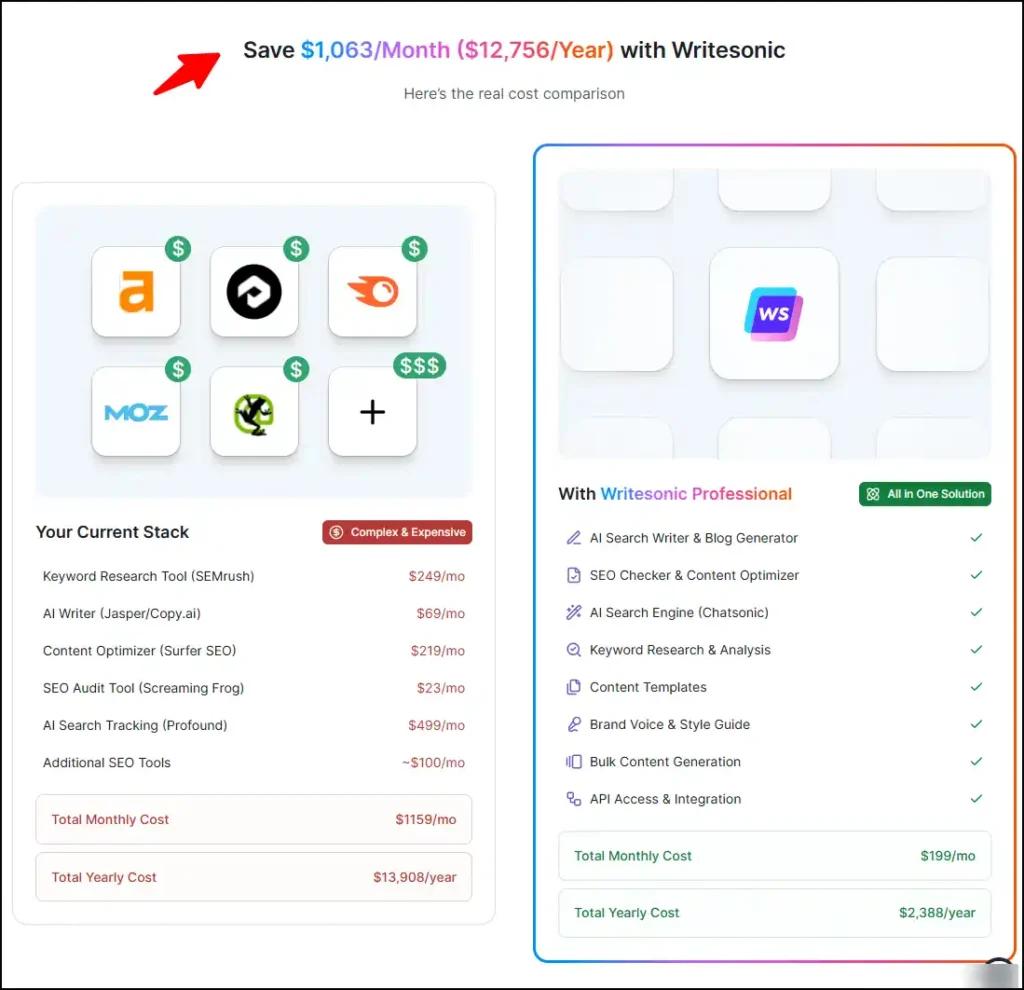
Chatsonic leads the pack of AI-powered SEO agents. This Writesonic’s smart marketing assistant combines multiple AI models with up-to-the-minute data analysis.
What is Chatsonic?
Chatsonic serves as an AI marketing agent that brings together several powerful AI models in one chat interface. These include GPT-4o, Claude 3.5, Gemini 1.5, and Flux 1.1. The system stands out from typical AI chatbots by connecting to current internet data. This ensures your SEO research stays relevant and accurate. The tool proves most useful to marketers, content strategists, and growth teams who manage content across platforms.
How Chatsonic Supports Real-Time SEO Research
The platform turns lengthy SEO processes into quick operations. Chatsonic delivers fresh insights by accessing current web data instead of old information. The system pulls up-to-the-minute data from Google SERP and Ahrefs to analyze competitor SEO strategies.
This reveals their top-ranking keywords and backlink sources.
Connected tools: Ahrefs, GSC, Writesonic
Chatsonic’s strength comes from its reliable tool integrations:
- Ahrefs to get complete keyword data
- Google Search Console to measure performance
- WordPress to publish directly
- Keywords Everywhere to gain extra keyword insights
- Answer the People to generate question-based content ideas
SERP analysis and keyword clustering
Chatsonic’s SERP analysis spots winning patterns in top-performing sites and finds content gaps others might miss. The system makes keyword clustering quick and effective. It uses AI-driven natural language processing to find keyword relationships faster than SERP-based tools.
Pricing & Plans
Chatsonic comes with four pricing tiers:
- Free Plan ($0/month): Basic access with 5 daily AI generations
- Individual Plan ($16/month annually or $20/month monthly): Full AI model access with 100 credits monthly
- Standard Plan ($79/month annually or $99/month monthly): 1000-6500 credits monthly
- Enterprise Plan: Custom pricing with enterprise-grade features
My honest review
My extensive testing of Chatsonic shows its exceptional value for SEO research. The tool’s current data capabilities and integrations set it apart. It processes thousands of keywords quickly to provide useful insights faster than traditional methods. The free version has limited features, and outputs sometimes need fact-checking.
2. Surfer SEO – Best for Content Optimization
Surfer SEO is one of the most innovative AI SEO tools that makes on-page SEO straightforward and effective.
What is Surfer SEO?
Surfer SEO helps content creators make SEO-friendly content by analyzing pages that rank well. This tool looks at over 500 web signals to give live, competition-based guidelines that match Google’s requirements. The platform goes beyond simple optimization and uses NLP solutions, machine learning, and advanced AI technology to decode successful content strategies.
Key Features of Surfer SEO
The platform’s best features include:
- Content Editor with live responsive metrics
- Auto-Optimize for smart content improvements
- Topical Map for keyword research and clustering
- AI-powered article generation
- Plagiarism Checker for content uniqueness
How Surfer SEO Improves Content Performance
Content creators who used Surfer saw their organic traffic grow by 205% in 2024. These impressive numbers come from Surfer’s skill at finding content gaps and adding context around entities and topics that Google and AI assistants like ChatGPT value.
Content Editor and Auto-Optimize features
Content Editor is Surfer SEO’s core feature that guides you on word count, headings, paragraphs, images, and keyword usage. The live Content Score tracks your optimization progress by analyzing 500+ ranking factors.
Auto-Optimize improves your article’s Content Score with one click by adding relevant NLP terms while keeping your original message intact. The tool can add new sections to fill content gaps and still maintains a natural tone.
Semantic keyword suggestions
Surfer finds relevant secondary keywords for your topics exceptionally well. The tool analyzes top-performing content and suggests weighted keywords based on their importance.
Pricing & Plans
Here’s what each plan costs:
- Essential Plan: $89/month – 15 content editor articles monthly
- Advanced Plan: $179/month – 45 content editor articles monthly
- Max Plan: $299/month – 90 content editor articles monthly
- Enterprise: Custom pricing with dedicated support
My Honest Review
Surfer SEO excels at building strong foundations for top-funnel informational content. The platform streamlines content creation but works best as a complement to human creativity. Its integration features and informed approach are a great way to get insights for serious content creators, even though it costs more than similar tools.
3. Alli AI – Best for Technical SEO Automation
Alli AI excels as a technical SEO powerhouse that automates countless SEO tasks for any website. The tool naturally works with all content management systems and lets users make thousands to millions of code and content changes instantly.
Bulk on-page optimization
The platform automates on-page SEO tasks that usually take up valuable time. Alli AI handles meta tag updates, heading optimizations, and image alt text fixes across entire websites without requiring coding knowledge. Unlike manual approaches, teams can create site-wide optimization rules and deploy them with a single click. Users can bypass CMS limitations to make changes that typically need developer intervention. This process has reduced months of work into just minutes.
Schema generation and internal linking
Structured data plays a significant role in search visibility during website optimization. The AI-powered schema markup generator analyzes content and identifies the most relevant schema types automatically. Search engines understand page content better, which often leads to improved listings with reviews, product details, or event information that get more clicks.
The internal linking automation feature makes site navigation smoother by suggesting relevant connections between pages. These AI-driven link recommendations help users find related content while building a stronger site architecture. Smart identification of optimal linking opportunities improves user experience and makes the site easier for search engines to crawl.
4. Jasper – Best for AI-Driven Content Creation
Jasper revolutionizes content creation with AI capabilities built for SEO-driven marketing teams. The platform started as a writing assistant but has evolved into a detailed content partner that helps businesses grow their online presence through optimized content.
Campaign dashboard and tone consistency
The Campaign dashboard in Jasper is a game-changer for content marketers who handle multiple projects. Teams can coordinate marketing initiatives and keep their brand voice consistent in this unified workspace. Users can teach Jasper their communication style by adding existing content through URLs or text.
The system analyzes these patterns and applies them to new content. Jasper’s Knowledge Base lets you store essential brand information, product details, and industry facts that you can reference while creating content.
SEO blog post generation
Jasper shines at creating SEO-optimized blog content through its smart workflow system. You start by entering your topic and target audience, then create or generate an outline. This approach keeps content focused on search goals and user needs. The chat interface helps generate schema markup and FAQ sections for technical SEO.
The platform works with Surfer SEO to check content “rankability” and suggests improvements based on competitor data. Content creators can make material that works for both readers and search engines by optimizing keywords and content structure.
5. Semrush AI Toolkit – Best All-in-One SEO Platform
Semrush’s AI Toolkit stands out as a complete solution that blends artificial intelligence with its 15-year old SEO platform. This suite helps marketers guide their way through traditional SEO and AI-driven search environments with specialized tools.
AI Copilot and Article Writer
Semrush Copilot works as your personal SEO assistant. It analyzes data from multiple Semrush tools and delivers useful recommendations. The system gets into your Site Audit, Backlink Analytics, Organic Research, and Position Tracking to spot critical issues and opportunities.
The moment you log into Semrush, Copilot shows prioritized suggestions based on technical issues, keyword opportunities, and competitor movements. This analytical approach turns hours of manual analysis into seconds.
The AI Article Writer works alongside Copilot to create SEO-friendly content based on up-to-the-minute Semrush data. You only need to input the topic and location to get optimized drafts that match search intent. The system’s brand voice settings ensure consistency in all content.
AI Overview tracking and keyword suggestions
With AI search features on the rise, Semrush provides specialized tools to track AI Overviews—AI-generated content blocks in search results. Position Tracking lets users see their visibility within these features and shows which keywords trigger AI Overviews with their content. The tool highlights when your domain appears as a source in AI-generated answers.
The platform studies AI conversations on ChatGPT and Google’s AI Mode to uncover trending topics and questions for keyword research. These insights help create content that answers what users ask AI systems.
6. WriterZen – Best for Brief Creation and Clustering
WriterZen makes keyword research and content planning simple with its innovative clustering technology. This specialized tool improves the whole SEO workflow from finding topics to creating content with advanced AI algorithms.
SERP-based keyword clustering
The platform’s keyword clustering capability is its standout feature. Content strategists can quickly build related article topics to create detailed content plans. The system analyzes SERP data, Google keyword planner, and Google suggested databases to group relevant keywords into meaningful clusters.
This approach saves hours that teams would spend sorting through spreadsheets manually.
The tool gives a clear picture of each topic and its keywords. Users get valuable metrics like search volume and qualitative data about keyword intent and buying journey position. Teams can also import up to 20,000 keywords from their existing lists and create organized clusters instantly.
AI-generated content briefs
WriterZen’s strength goes beyond organizing keywords. The platform creates detailed content briefs with AI based on audience traits, content format, author’s view, and writing tone.
Content creators can see SERP pages and read AI summaries of competitor blogs to compare top-ranking pages quickly. Writers can build outlines that follow proven practices and include profitable keywords they found through competitor analysis. These briefs give practical guidance that makes the writing process smooth in WriterZen’s Content Creator module.
7. SE Ranking – Best for AI-Powered Rank Tracking
SE Ranking leads the way with AI-powered rank tracking in their advanced visibility monitoring system. Their platform tracks both traditional SEO metrics and AI-generated content performance. This gives users an explanation that standard tools cannot match.
AI content editor and keyword intent analysis
The Content Editor from SE Ranking has changed SEO writing with evidence-based guidelines from competitor analysis. The tool learns from top-ranking pages to set recommended parameters for word count, headings, and keyword usage. Their built-in SEO content checker scores your writing immediately. This helps content creators hit optimization targets without losing quality.
The platform’s keyword intent analysis shines in today’s AI-dominated digital world. It spots the true search intent behind queries that trigger AI Overviews. Content creators can better match their material with user needs. Marketers learn not just which keywords to target, but why users look for specific terms.
AI Overviews visibility tracking
SE Ranking started tracking AI search results early, with monitoring beginning in January 2024. Their AI Visibility Tracker watches brand mentions throughout AI answers. Marketers can see their brand’s appearance in AI-generated content.
The dashboard shows key metrics like AI overview presence percentage for tracked keywords, brand mentions, and position analysis. Historical tracking reveals changes in AI overview visibility. Users can analyze content and source changes through cached SERP copies.
8. Koala AI – Best for Budget-Friendly SEO Content
You don’t need a big budget to get great SEO results.
Koala AI proves that powerful AI SEO tools can be available without expensive pricing. More than 18,000 paying users trust this smart platform to optimize their content completely.
Custom tone and outline control
The Outline Editor in Koala AI gives you amazing control over your content structure right from the start. Most AI writing tools have rigid outlines, but KoalaWriter creates complete H2 and H3 headings automatically by analyzing search intent and top-ranking content structures.
The platform really shines with its customizable voice settings that match your brand’s identity – you can choose professional, friendly, formal, relaxed, or humorous tones. The Custom tone option takes it further and lets you specify exact personality traits and language style priorities.
Multilingual content generation
Koala AI’s standout feature is its ability to keep your brand’s voice consistent while creating content in more than 100 languages. Your organization can adjust the tone for different regional markets and still keep its brand identity intact. Users can keep their chosen voice characteristics the same whatever the content type, topic complexity, or target audience.
Koala AI makes powerful SEO tools available to users who don’t have technical backgrounds. This helps smaller teams compete with bigger companies by making use of AI-powered optimization.
9. RankIQ – Write Blog Posts that Rank on Google’s 1st Page
RankIQ stands out in the AI SEO digital world as a tool built just for bloggers who want to rank faster. The tool’s focused approach sets it apart from other SEO platforms.
What is RankIQ?
Brandon Gaille created RankIQ as an intuitive SEO tool that puts bloggers first with its low-competition keyword libraries and content optimization. The platform has carefully selected keyword libraries in more than 80 niches that help content creators spot opportunities their competitors miss.
Key Features of RankIQ
RankIQ’s standout features include:
- Curated low-competition keyword libraries
- Content optimization reports with useful recommendations
- Competition analysis tailored to bloggers
- Ready-to-use content briefs
How RankIQ Helps You Rank Faster
The platform helps you rank quickly through its unique approach to keyword selection. RankIQ targets achievable keywords with high traffic potential and eliminates time wasted on impossible-to-rank terms. The content optimization system studies top-ranking posts to pinpoint the exact elements that drive success.
Pricing & Plans
RankIQ keeps it simple with a single $49/month subscription that unlocks all features, including unlimited optimization reports and full keyword library access.
My Honest Review
RankIQ shines brightest for solo bloggers or small teams focused on specific niches. All the same, bigger organizations might find its targeted approach too narrow compared to enterprise-level AI SEO tools. The streamlined workflow makes it perfect for creators who value content quality over complex technical details.
10. Searchatlas.com – AI SEO Automation Platform for Agencies and Brands
SearchAtlas is a detailed AI-powered platform that helps scale SEO operations for multiple client websites. This tool connects enterprise-level analytics with practical implementation.
What is SearchAtlas?
SearchAtlas works as an all-in-one SEO workspace that combines content optimization, site auditing, and rank tracking in a single dashboard. The platform helps agencies manage multiple clients and supports in-house teams with large websites.
Automate your SEO in 1 click
SearchAtlas shines with its “Autopilot” feature that runs multiple optimization tasks at once. The platform lets you schedule regular audits, update meta tags, and create technical reports automatically.
Key Features of SearchAtlas
The platform includes:
- Advanced content optimization with NLP analysis
- Multi-site management capabilities
- White-label reporting for agencies
- Custom API access for integration flexibility
How SearchAtlas Improves SEO Performance
SearchAtlas builds website authority through automated link building suggestions and content gap analysis. The platform’s predictive ranking technology helps you spot opportunities before competitors find them.
Pricing & Plans
The platform starts at $29/month for individual users and scales up to custom enterprise plans for larger agencies. Each subscription tier unlocks different features.
My Honest review
SearchAtlas proves particularly effective for agencies that handle multiple clients. The sort of thing I love about it is how it balances automation with customization, though smaller businesses might find some features more than they need.
What Are AI-Powered SEO Agents?
AI-Powered SEO Agents are autonomous systems that have access to external tools, data, and functions. They handle multiple search engine optimization tasks with minimal human input. These specialized assistants work nonstop to optimize websites for search engines, unlike chatbots that just answer questions.
These smart systems know their SEO goals and make use of information to achieve them. More than that, they can run complete SEO processes on their own – from keyword research to content optimization and technical audits.
The technology behind AI SEO agents blends several advanced components:
- Natural Language Processing (NLP) to understand search intent beyond simple keywords
- Machine Learning algorithms that keep improving recommendations based on data trends
- Live data integration with analytics tools and search console
- Automation engines that power behind-the-scenes workflows
These agents are nowhere near traditional SEO tools. Standard tools give you data that needs human interpretation, while AI SEO agents turn that data into useful decisions. To name just one example, when your rankings drop suddenly, an AI agent creates a ready-to-implement action plan custom-made for your situation.
AI SEO agents excel at:
- Automating keyword research and clustering
- Analyzing content and suggesting improvements
- Conducting technical SEO audits to identify usability issues
- Finding link-building opportunities
- Turning search data into analytical insights
The numbers tell an interesting story. We found that 75% of marketers use AI to cut down time spent on repetitive tasks like keyword research and meta-tag optimization. The adoption rate keeps climbing as 86% of SEO professionals have added AI to their strategy, and 65% report better results.
These agents pack quite a punch but aren’t fully autonomous yet – they still need human guidance to deliver the best results. The transformation toward agentic systems shows AI working as a smart assistant alongside SEO professionals rather than taking their place.
How do they differ from traditional SEO tools
Traditional SEO tools and AI-Powered SEO Agents have a basic difference in their approach to search optimization. Traditional SEO focuses on ranking web pages through keyword optimization, technical website improvements, and link-based authority building. AI SEO changes toward understanding natural language. It answers user questions and builds trust signals that AI systems recognize.
The biggest difference shows up in automation capabilities. Traditional SEO needs time-consuming manual processes with human input, while AI-powered agents automate these tasks with machine learning algorithms. This automation helps businesses improve their SEO efforts faster. Companies that use AI automation have doubled their content output and kept their quality standards.
There’s another reason why these approaches differ – adaptability. Traditional methods react to algorithm changes after they happen, which can lead to ranking drops. AI SEO adapts through live analysis of ranking changes and search trends to refine strategies right away. Then, businesses using evidence-based insights bounce back from ranking drops faster and stay ahead of competition.
Data processing makes a vital difference too. Traditional SEO depends on manual data collection and interpretation, which takes more resources and time. AI agents process large datasets quickly. They reduce human error and help make better decisions.
About 49.2% of businesses using AI saw better rankings after Google algorithm updates.
User intent understanding varies between these approaches. Traditional SEO makes search intent too simple by treating all users the same, whatever their position in the buying experience. AI SEO tools use natural language processing to understand context, search patterns, and what users expect. This leads to more precise results.
Traditional SEO doesn’t deal very well with growing websites. AI SEO handles large-scale campaigns with ease by automating content creation and performance tracking. Marketing teams can focus on strategic planning instead of repetitive optimization tasks because of this efficiency.
How AI SEO Agents Instantly Boost Your SEO?
AI SEO agents quickly show their worth through clear productivity gains. Marketers who use AI for creative ideas save an hour each day – that’s 37 working days per year [581]. Teams can now focus on strategic planning instead of routine optimization tasks.
AI has changed how we make SEO decisions by processing data differently. Tasks that used to take hours – like keyword research, metadata creation, and content structuring – now take minutes. Companies that use AI SEO tools properly see returns in several ways:
- Boosted productivity as AI handles repetitive tasks
- Time savings for the whole team
- Better overall performance from smarter data analysis
Search Atlas’s AI assistant, OTTO SEO, shows these benefits. It works on content creation, technical fixes, internal linking, and on-page changes all at once. The tool excels at spotting technical problems that human reviewers might miss.
AI SEO tools make data collection and analysis simple. Take Google Analytics (GA4) AI features – users can now ask about specific KPIs in plain language instead of clicking through reports. This mix of automation, data analysis, and predictive features creates an SEO system that improves constantly, not just when problems arise.
This AI SEO Agent Automatically Optimizes Your Site and Fixes Critical Issues
Picture having an SEO professional who works on your website day and night. Otto AI does exactly that – it works as a self-running agent that never sleeps or misses important issues. It handles tasks that would normally need whole teams. The system scans sites live, fixes technical problems, and rolls out big optimizations.
Otto stands out because it can make thousands of changes on your site with a single click. The system finds and fixes:
- Broken links and duplicate tags without needing developers
- Technical SEO problems through constant site checks
- Content structure issues with its built-in AI writers
- Weak internal linking by adding relevant connections
Companies know the value of AI – 98% are using more of it because these tools turn weeks of SEO work into minutes [601]. Standard tools just find problems, but these self-running agents fix issues right away. They tackle the most important problems first based on how much they affect rankings.
Other platforms like Alli AI can also make thousands of code and content changes in minutes, whatever CMS you use. Tools like ContentKing keep an eye on technical SEO non-stop and warn you about errors before they hurt your rankings.
These AI agents do more than spot problems – they show you how to fix them or do it themselves. This way, you focus on what really counts.
My experience testing AI SEO technologies has shown me their remarkable rise over the last several years. The biggest problem many face is finding the right AI-powered SEO agent that works best for their needs.
Picking the right tool means looking at several key factors. Budget limits matter a lot – tools like Semrush AI Toolkit give you complete features but cost more than focused options like WriterZen or RankIQ.
Here are the key factors to think over before deciding:
- Integration capabilities with your existing workflow and tools
- Learning curve and implementation timeline
- Specific optimization focus (technical SEO, content creation, or complete)
- Team size and collaboration requirements
- Scalability as your business grows
Companies that see dramatic ranking improvements often use multiple AI SEO tools together. They might use Surfer SEO to optimize content while using Alli AI to fix technical issues. This combined approach usually works better than sticking to just one solution.
Note that even the most sophisticated AI tools need human guidance. These tools are a great way to get more from your expertise rather than replace strategic thinking. The best results come from striking the right balance between AI’s efficiency and human creativity.
Conclusion
AI-powered SEO agents have changed the way we handle search optimization in 2025. My experience with testing tools in websites and niches of all types shows these smart systems deliver amazing results when we set them up right. A good AI SEO agent analyzes huge amounts of data in minutes, spots opportunities humans might miss, and handles optimizations that used to need whole teams.
The perfect tool you end up choosing depends on what you need. Teams that focus on content creation might benefit more from Surfer SEO or Jasper, while those who don’t deal very well with technical issues should look into Alli AI or SearchAtlas. Marketing teams on a budget can still get great results with cheaper options like Koala AI or RankIQ without losing key features.
The best SEO strategies now blend multiple AI agents to build detailed optimization systems. My clients who mix content tools with technical SEO platforms always perform better than competitors who stick to just one solution. This strategy helps teams tackle all ranking factors at once instead of one by one.
All the same, human oversight is vital even with advanced AI help. These tools are great at processing data, spotting patterns, and implementation—but strategic decisions still need human judgment. The best results come when we treat AI agents as partners instead of replacements. They handle repetitive work while you focus on creative strategy.
Without doubt, AI SEO agents are the future of search optimization. They process information at scale, adapt to algorithm changes instantly, and run thousands of optimizations at once. This gives users a big edge in today’s competitive search environment. Whether you run a small blog or enterprise website, these smart tools will help you remain competitive in 2025’s AI-driven digital world.
My Key Takeaways
AI-powered SEO agents are revolutionizing search optimization by automating complex tasks and delivering measurable results that traditional methods simply cannot match.
• AI SEO agents save 37 working days annually by automating keyword research, content optimization, and technical audits that previously required manual effort
• Content optimized with AI tools shows 205% average organic traffic growth, proving these systems deliver tangible ranking improvements beyond basic automation
• Multi-tool strategies outperform single solutions – combining content-focused platforms like Surfer SEO with technical tools like Alli AI maximizes optimization coverage
• Real-time adaptation gives competitive advantage as AI agents instantly respond to algorithm changes and SERP shifts, while traditional SEO reacts after damage occurs
• Human oversight remains essential – treat AI agents as intelligent partners that handle data processing while you focus on strategic decision-making and creative direction
The most successful SEO strategies in 2025 leverage AI automation for efficiency while maintaining human creativity for strategic thinking, creating a powerful combination that scales optimization efforts without sacrificing quality.
Frequently Asked Questions(FAQs) on AI SEO Agents
Q1. How do AI-powered SEO agents differ from traditional SEO tools?
AI-powered SEO agents offer real-time data analysis, automation of complex tasks, and predictive capabilities. Unlike traditional tools that provide data for manual interpretation, AI agents can process large datasets quickly, adapt to algorithm changes in real-time, and implement optimizations automatically.
Q2. What are the key benefits of using AI SEO agents in 2025?
The main benefits include real-time data analysis and automation, predictive SEO and trend forecasting, and scalability for growing websites. These agents can save significant time, provide more accurate insights, and handle increasing workloads without proportional resource increases.
Q3. How do I choose the right AI SEO agent for my needs?
Consider factors such as integration capabilities with existing tools, the learning curve, specific optimization focus (technical SEO, content creation, or comprehensive), team size, collaboration requirements, and scalability. It’s often beneficial to combine multiple AI SEO agents for optimal results.
Q4. Can AI SEO agents completely replace human SEO professionals?
While AI SEO agents are powerful tools, they cannot fully replace human expertise. These agents excel at data processing, pattern recognition, and implementation, but strategic decision-making and creative thinking still require human judgment. The best approach is to use AI agents as partners to handle repetitive tasks while focusing on creative strategy.
Q5. What kind of results can I expect from using AI SEO agents?
When properly implemented, AI SEO agents can lead to significant improvements in search rankings and organic traffic. For example, content optimized with AI tools has shown an average organic traffic growth of 205%. However, results may vary depending on factors such as your specific niche, competition, and how effectively you use the tools.
